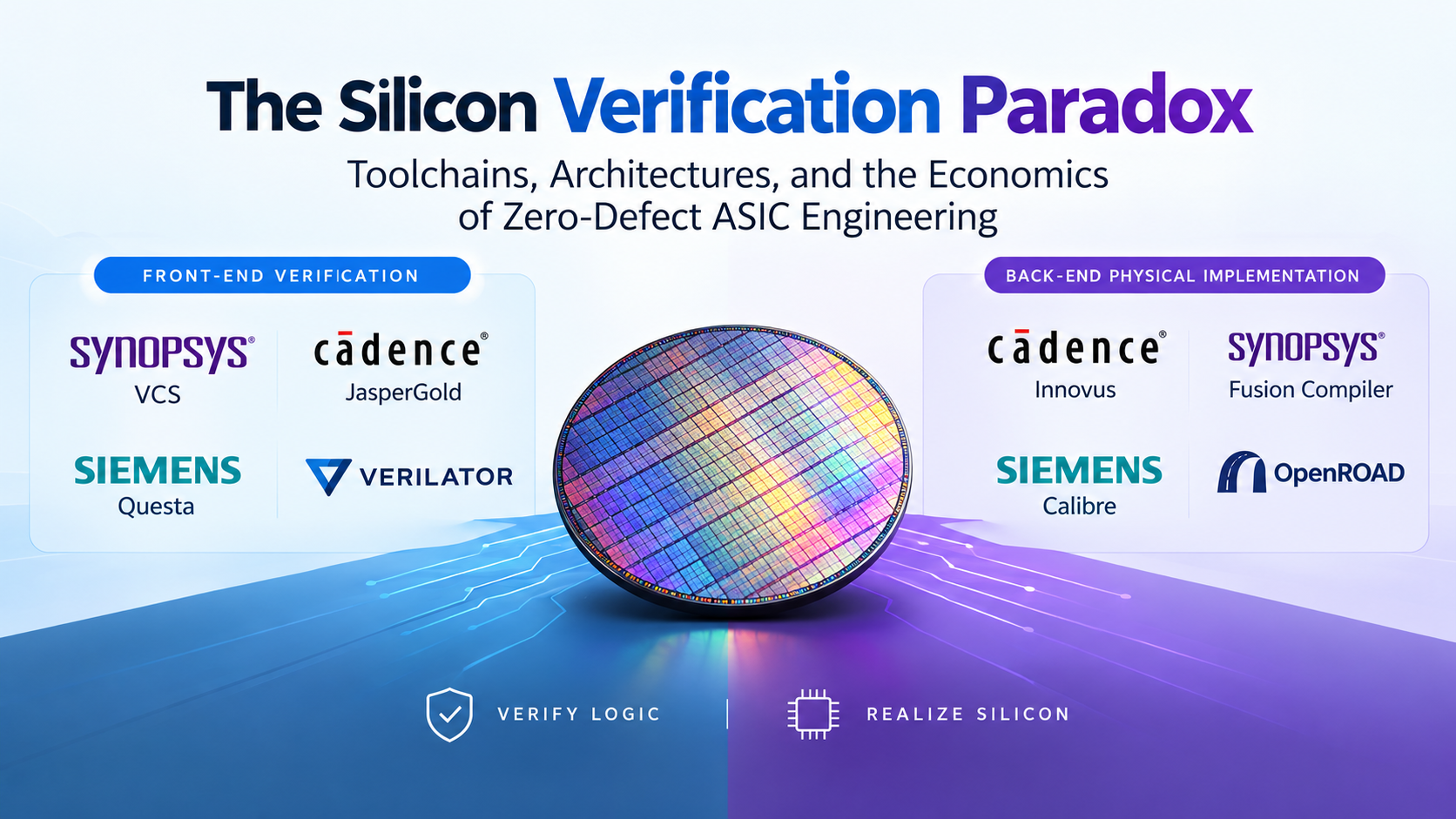
Integrated circuit development is governed by an unforgiving economic law: silicon cannot be patched in production. In modern enterprise software, an edge-case concurrency flaw or memory leak is resolved through an over-the-air hotfix or a rolling deployment. In semiconductor manufacturing, an unhandled race condition or an unmodeled parasitic coupling effect produces an unrecoverable failure. Correcting that defect requires a complete physical mask re-spin, months of delayed market entry, and capital losses reaching into the tens of millions of dollars.
As leading-edge digital designs scale beyond tens of billions of transistors, realizing an application-specific integrated circuit (ASIC) or system-on-chip (SoC) has shifted from a geometric drafting problem to a massive computational verification challenge. Front-end verification cycles now routinely consume up to seventy percent of total project engineering hours and dominate compute cluster allocation.
Evaluating and procuring integrated circuit design and verification software requires engineering organizations to balance functional correctness, physical convergence, and licensing economics across an enterprise software market controlled by a small group of incumbents.
The Structural Divide: Front-End Verification Versus Back-End Physical Implementation
Realizing a complex semiconductor design demands two fundamentally different software regimes that must continually exchange state, timing, and topological metadata.
Front-End Verification: Proving Architectural Intent
Front-end engineering starts with functional specifications expressed in hardware description languages (HDLs) such as SystemVerilog and VHDL, or high-level algorithmic generators like Chisel. The core objective is proving that the described state machine behaves as intended before translating it into physical geometry.
- Dynamic Simulation: Logic simulators compile RTL along with testbenches constructed using the Universal Verification Methodology (UVM). Dynamic simulation relies on constrained-random stimulus generation to sweep complex state spaces, paired with functional and code coverage metrics to quantify progress.
- Formal Verification: Rather than relying on random stimulus, formal verification tools use mathematical property checkers and boolean satisfiability (SAT) solvers to prove whether an assertion holds true across all possible legal operational states. Formal verification is mathematically exhaustive, making it the premier approach for proving control logic, arbitration schemes, and security-critical subsystems.
- Hardware Emulation and Prototyping: As designs scale, software-based logic simulation becomes a throughput bottleneck. Simulating a full boot sequence of an operating system on an unverified processor core inside a software simulator can take weeks. Emulation platforms map RTL directly onto proprietary processor arrays or vast FPGA topologies, accelerating cycle speeds by several orders of magnitude to validate bare-metal firmware before tape-out.
Back-End Physical Design: Closing the Gap with Sub-Micron Physics
Once functional logic is frozen, back-end implementation toolchains transform abstract register transfers into foundry-ready physical masks.
- Logic Synthesis: The synthesis engine maps boolean equations to discrete standard cells (logic gates, flip-flops) pulled from a foundry-specific library, optimizing concurrently for Power, Performance, and Area (PPA).
- Floorplanning, Placement, and Routing (P&R): Engines place millions of macro blocks and standard cells, balance multi-level clock distribution trees, and route complex multi-layer metal interconnects without creating electromigration hotspots or physical routing congestion.
- Static Timing Analysis (STA): Rather than evaluating logic vectors, STA mathematically analyzes path delays across all operating corners (process, voltage, and temperature variations) to verify that data signals reliably settle before clock edges arrive.
- Physical Signoff (DRC/LVS): Design Rule Checking (DRC) ensures the drawn shapes satisfy the lithographic constraints of the target foundry node. Layout Versus Schematic (LVS) mathematically proves that the geometric polygons laid down on silicon correctly match the electrical schematic of the netlist.
Primary IC Design and Verification Toolchains Compared
The global enterprise IC design market is concentrated within three primary vendors, with specialized open-source initiatives serving academic research and mature planar fabrication nodes.
| Vendor / Platform Suite | Primary Technical Domains | Execution Architecture | Core Operational Strength | Primary Operational Bottleneck |
| Synopsys Verification Continuum & Fusion Design Platform (VCS, PrimeTime, Fusion Compiler, ZeBu) | Digital IC synthesis, static timing analysis, dynamic logic simulation, hardware emulation | Multi-threaded compute grid (Linux x86_64); hybrid cloud execution | De facto standard for static timing signoff (PrimeTime); unified data model linking synthesis and routing | Substantial licensing overhead; steep administrative learning curve requiring dedicated CAD teams |
| Cadence Implementation & Verification Suites (Xcelium, Innovus, Virtuoso, JasperGold, Palladium) | Custom analog/mixed-signal, advanced digital P&R, formal verification, enterprise emulation | Distributed multi-core clusters; custom hardware acceleration appliances | Undisputed industry standard for analog/RF layout (Virtuoso); high formal verification throughput (JasperGold) | Complex, multi-tiered token licensing schemes; interface fragmentation across acquired product suites |
| Siemens EDA (Calibre, Questa, Veloce) | Foundry physical signoff verification, mixed-language logic simulation, hardware emulation | Distributed hierarchical compute engines; specialized hardware | The universal, undisputed foundry reference benchmark for physical signoff (Calibre) | Fragmented synthesis footprint; heavy reliance on custom scripting interfaces |
| Open-Source Stacks (OpenROAD, Yosys, Verilator, Cocotb, Magic) | Academic silicon prototyping, mature planar ASIC nodes, open-hardware initiatives | Modular command-line executables (Linux/macOS containerized) | Zero licensing friction; native compatibility with standard software CI/CD pipelines; full script auditability | Unsupported on advanced nodes (sub-16nm FinFET/GAA); complete lack of commercial legal indemnification |
Technical Toolchain Analysis
Synopsys: The Digital Implementation and Timing Closure Standard
Synopsys holds an established position across digital synthesis and static timing closure. For teams producing high-throughput data center infrastructure, graphics processors, or digital signal processors, Synopsys offers a cohesive path toward manufacturing signoff.
The anchor of the Synopsys ecosystem is PrimeTime. Global contract foundries certify their advanced process design kits (PDKs) directly against PrimeTime’s timing and noise models. Achieving timing closure within PrimeTime represents the universal signal to corporate leadership and investors that a digital design is physically viable for manufacturing.
On the digital implementation side, Fusion Compiler addresses the traditional handoff friction between synthesis and physical routing. By sharing an underlying data model, synthesis and routing engines continually exchange physical parasitic estimates, reducing the iterative churn historically required to close setup and hold violations.
For front-end verification, VCS provides a high-throughput dynamic logic simulation engine, combining native code compilation with advanced constraint-solving algorithms to accelerate coverage closure on large-scale SystemVerilog testbenches.
However, operating a Synopsys-centric environment demands significant operational infrastructure. The toolset requires deep, highly specialized Tcl scripting workflows, and license governance is notoriously rigid, requiring active CAD management to prevent developer lockouts during high-utilization project phases.
Cadence: Analog Mastery and Formal Verification Performance
Where Synopsys maintains strong digital timing dominance, Cadence maintains equivalent authority across analog, radio frequency (RF), and mixed-signal silicon realization, while competing directly in digital place-and-route.
Virtuoso remains the undisputed worldwide benchmark for transistor-level custom layout. Analog and power electronics cannot be effectively synthesized using abstract HDLs; they require direct, manual manipulation of geometric boundaries to preserve circuit symmetry, manage thermal dissipation, and isolate sensitive signals from digital noise. Virtuoso’s deep integration with the Spectre simulation engine provides the interactive parametric sweeps and Monte Carlo statistical analyses required to ensure high-yield analog manufacturing.
On the verification side, Cadence’s JasperGold is widely regarded as the premier enterprise platform for formal verification. JasperGold deploys an array of specialized mathematical proof engines, orchestrating their execution to prove properties or pinpoint edge-case assertion failures in complex protocols, multi-core interconnects, and security subsystems.
For back-end digital realization, Innovus provides a high-capacity place-and-route engine engineered for dense physical floorplans, utilizing multi-threaded slack optimization to achieve power, performance, and area closure on leading-edge process technologies.
The platform’s operational challenge lies in its commercial complexity. Cadence relies on sophisticated licensing models where multi-threaded execution, specialized formal apps, and simulator acceleration require independent functional tokens that must be actively balanced across engineering teams.
Siemens EDA: The Universal Foundry Physical Signoff Benchmark
Siemens EDA occupies a critical position in the global semiconductor ecosystem via a single, indispensable product: Calibre.
While both Synopsys and Cadence have developed competing physical verification platforms, Calibre remains the industry’s primary signoff standard for:
- Design Rule Checking (DRC): Verifying that billions of microscopic layout polygons comply with hundreds of geometric and lithographic rules defined by the fabrication facility.
- Layout Versus Schematic (LVS): Proving mathematically that the physical masks correlate with the intended electrical circuit diagram.
Leading foundries publish their official, authoritative process decks formatted for Calibre rule syntax. As a result, engineering groups employing full Synopsys or Cadence flows for physical routing almost universally perform their ultimate signoff runs through Calibre to eliminate disputes with the foundry prior to mask tooling.
In parallel, Siemens maintains a strong presence in system validation through its Questa simulation platform, noted for mixed-signal support, and its Veloce hardware emulation ecosystem.
Open-Source Toolchains: The Rise of Headless, Scriptable Automation
Driven by academic research, the open-source RISC-V architecture, and public initiatives like the DARPA OpenROAD project, an independent, open-source EDA ecosystem has emerged.
This toolchain trades the graphical user interfaces of enterprise suites for headless, command-line execution:
- Yosys executes logic synthesis, translating Verilog into optimized gate-level representations.
- OpenROAD automates the entire back-end implementation pipeline, executing floorplanning, placement, clock tree synthesis, and global routing without manual intervention.
- Verilator compiles synthesizable Verilog code into highly optimized C++ binaries, delivering cycle-accurate simulation speeds that often outpace commercial interpreted simulators for specific logic profiles.
- Cocotb enables front-end engineers to construct sophisticated asynchronous verification testbenches using Python rather than the rigid syntax of SystemVerilog UVM.
The defining advantage of open-source toolchains is programmatic integration. They can be bundled into modern, containerized continuous integration and deployment (CI/CD) pipelines. Every code commit to an RTL repository can automatically trigger synthesis, routing, and timing evaluation on standard cloud compute instances without licensing barriers.
The fundamental limitation is manufacturing support. Open-source toolchains are functionally constrained to mature planar lithography nodes (typically 130nm down to 28nm). Advanced foundries protect the manufacturing physics of FinFET and gate-all-around (GAA) nodes under strict non-disclosure agreements, preventing the release of open-source rule decks. Furthermore, open-source platforms offer no commercial indemnification: if an undetected toolchain defect ruins a multi-million-dollar wafer run, the financial liability falls entirely on the design house.
Operational Realities: Total Cost of Ownership
Procuring an enterprise IC design and verification environment introduces cost structures fundamentally distinct from standard enterprise software. The base software license is typically only a fraction of the total operational expenditure required to reach production tape-out.
- Specialized High-Performance Compute Infrastructure (40% of Total Investment): Back-end place-and-route, 3D field extraction, and full-chip physical verification require high-performance server clusters. Individual compute nodes must be equipped with terabytes of error-correcting (ECC) memory to keep flat chip databases resident in RAM, backed by high-throughput enterprise NVMe storage to sustain millions of file read/write operations during signoff.
- Software Licensing and Floating Tokens (30% of Total Investment): Commercial enterprise agreements are structured around multi-year Term-Based Licenses (TBLs). However, accessing multi-threaded acceleration, running distributed DRC signoff runs across hundreds of CPU cores, or deploying formal verification apps requires purchasing supplemental compute tokens that scale costs rapidly.
- Dedicated CAD Engineering and Workflow Maintenance (20% of Total Investment): Enterprise tools do not operate off-the-shelf. Organizations must hire specialized CAD engineers whose primary role is building, updating, and maintaining internal Tcl and Python scripts that connect disparate verification, synthesis, and physical layout tools into a functional pipeline.
- Third-Party Silicon IP, PDK Access, and Audits (10% of Total Investment): Beyond EDA tooling, teams must license standard cell libraries, memory compilers, and complex functional IP blocks (such as PCIe controllers and DDR physical interfaces) certified specifically for their target foundry process.
Practical Selection Guidelines
Navigating the procurement of IC design and verification software requires matching design characteristics, fabrication processes, and team structure to the appropriate toolchain architecture:
- For High-Performance Digital Silicon on Leading Nodes (Sub-16nm FinFET/GAA): If you are building high-throughput CPUs, data center AI accelerators, or complex mobile SoCs, a commercial flow based on Synopsys Fusion Compiler/PrimeTime or Cadence Innovus, with final physical DRC/LVS signoff executed on Siemens Calibre, remains mandatory. Attempting to bypass these validated foundry toolchains on advanced nodes introduces unacceptable tape-out risk.
- For Analog, Power Management, and RF Front-Ends: If your engineering focus centers on mixed-signal interfaces, high-frequency transceivers, or power conversion semiconductors, Cadence Virtuoso paired with Spectre provides the necessary parametric simulation depth and manual layout controls.
- For Complex Control Logic Requiring Zero Functional Margin: If your architecture features deep cache-coherency fabrics, multi-agent arbiters, or mission-critical automotive safety blocks, investing in Cadence JasperGold for formal mathematical verification will expose systemic design flaws faster and more thoroughly than running trillions of dynamic simulation cycles.
- For Open Hardware, Academic Research, and Mature-Node IoT: If your target is an experimental processor, an educational tape-out, or a cost-constrained micro-controller produced on mature planar nodes, the OpenROAD / Yosys / Verilator stack provides complete organizational autonomy, eliminates recurring seat licensing fees, and integrates directly with modern automated testing pipelines.
Structuring a Realistic Software Evaluation
When evaluating IC design and verification platforms, avoid demonstrations based on pre-packaged vendor benchmarks. Demonstrations using ideal designs obscure the points where EDA software actually breaks down: computational scaling limits, complex corner cases, and script fragility.
Instead, build an evaluation around your team’s most congested, timing-critical intellectual property block—such as an out-of-order execution pipeline or an irregular mixed-signal boundary interface. Run that block through the candidate synthesis, place-and-route, and timing engines under worst-case manufacturing corners.
The platform that converges on timing and routing closure with the fewest manual geometry interventions, the lowest memory overhead, and the most predictable script maintenance is the toolchain that will protect your tape-out milestone and preserve your engineering capital.
