Introduction
Software delivery is no longer only about writing code and sending it to production. Today, teams are expected to release faster, recover faster, monitor everything, and keep cloud operations stable without slowing business growth.
That is where AWS DevOps Engineer – Professional becomes relevant. It helps engineers, software developers, cloud teams, and managers understand the full flow of modern delivery on AWS, from automation and deployment to observability and operational control.
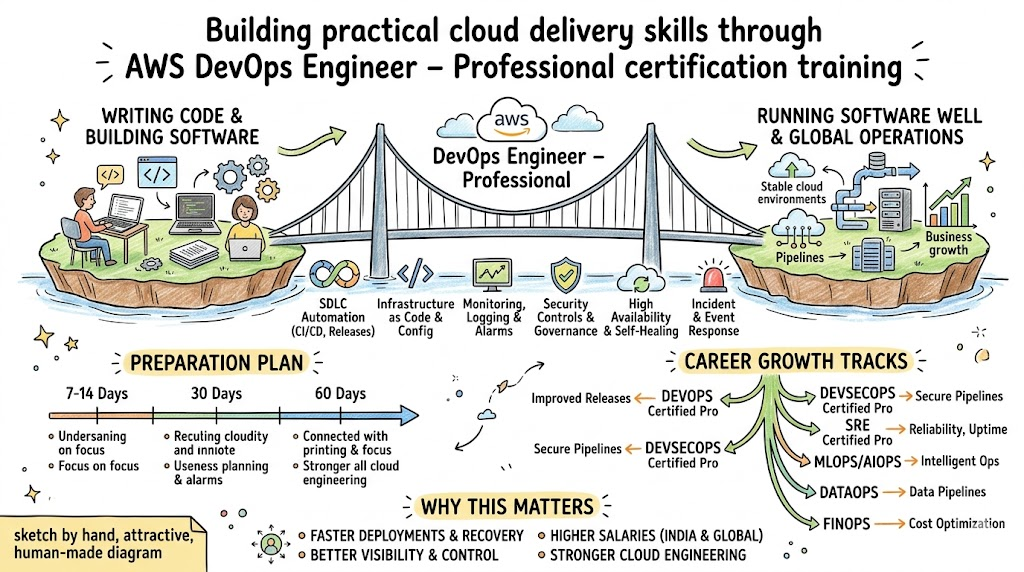
For working professionals in India and global markets, this certification is useful because it sits at the meeting point of software engineering, cloud operations, automation, and platform reliability. It is not a beginner-only certificate and not a pure operations credential either; it is a bridge between building software and running it well.
What it is AWS Certified DevOps Engineer – Professional
The AWS Certified DevOps Engineer – Professional is a premier, professional-level credential that validates an individual’s advanced technical expertise in provisioning, operating, and managing complex, distributed application systems on the AWS platform. Designed for seasoned engineers and architects, it focuses on the intersection of development and operations, testing your ability to implement automated continuous delivery (CI/CD) pipelines, build self-healing infrastructures, and enforce rigorous security and compliance guardrails at scale. Earning this certification demonstrates that you possess the “systems-thinking” required to optimize the entire software development lifecycle—from code commit to production monitoring—ensuring that cloud environments remain highly available, resilient, and cost-efficient in high-pressure enterprise settings.
Why it Matters in Today’s Software, Cloud, and Automation Ecosystem
AWS has framed this certification around tasks that are central to modern delivery teams, including continuous delivery, security controls, governance processes, compliance validation, monitoring, and event-driven operations.
That makes it valuable for organizations that want not only faster deployments, but also better control, better visibility, and better recovery when things fail.
The market signal is also strong. AWS notes that the certification ranked among top-paying certifications in industry salary reporting, and UK market data shows AWS DevOps roles with a recent median salary of £77,500, with London and remote roles reaching £100,000 median in the same dataset.
In India, the value is easy to understand. Current DevOps growth roadmaps keep emphasizing AWS, CI/CD, automation, cloud operations, and platform thinking as high-priority skills for software and cloud careers.
That is why this certification is useful for SaaS companies, product teams, consulting firms, global capability centers, and internal platform groups that want engineers who can connect code delivery with production reliability.
Why DevOpsSchool Is a Practical Choice
DevOpsSchool presents itself as a training provider with 500+ company customers, 25,000+ trained engineers, and a reported 98% satisfaction rate.
Its AWS DevOps Engineer – Professional offering is described as a 30-hour instructor-led live online course with 100+ lab assignments, scenario-based projects, interview preparation support, and 250+ interview questions.
That course design matters because this certification is practical by nature. People usually learn DevOps faster when they build pipelines, study deployment patterns, read alerts, and practice recovery scenarios instead of only reading slides.
For managers, the training value is also clear. A structured program helps teams build shared vocabulary around release quality, automation maturity, operational readiness, and governance, which is important when multiple engineers support the same cloud environment.
Certification Overview
AWS DevOps Engineer – Professional Explained
What it is
AWS DevOps Engineer – Professional is a professional-level certification and training path focused on provisioning, operating, and managing distributed application systems on AWS. DevOpsSchool highlights its coverage of SDLC automation, infrastructure and configuration management, monitoring and logging, governance, incident and event response, and highly available architectures.
Who should take it
- DevOps engineers who already support AWS environments and want stronger professional depth.
- Software engineers moving toward platform engineering, release engineering, or automation-heavy roles.
- Cloud engineers who want more than resource provisioning and need delivery and operations knowledge.
- SRE and platform teams that want better deployment, observability, and recovery patterns.
- Engineering managers who need a clearer understanding of modern release systems and cloud operating models.
Skills you’ll gain
- Build CI/CD pipelines using AWS-native delivery services.
- Automate infrastructure provisioning and environment setup.
- Apply security controls, governance rules, and compliance validation in release workflows.
- Use monitoring, logging, metrics, alarms, and event-driven operations.
- Improve high availability, self-healing, and disaster recovery readiness.
- Handle incidents with better operational judgment and automation.
Real-world projects you should be able to do after it
- Build a multi-stage deployment pipeline for an AWS-hosted application.
- Implement blue/green or canary release strategies for safer production changes.
- Create dashboards, alerts, and centralized logs for application and infrastructure visibility.
- Automate policy checks for tagging, approvals, and release governance.
- Design a highly available application setup with rollback and recovery planning.
- Use event-driven logic to respond to recurring operational failures.
Preparation plan
- 7–14 days
This short plan works only for professionals who already use AWS pipelines, IAM, deployment troubleshooting, monitoring, and operational workflows regularly. In that case, the focus should be revision, domain mapping, and scenario practice.
- 30 days
This is the best path for many working professionals. Divide your study into automation and release workflows, observability and governance, then incident response, resilience, and mock scenarios.
- 60 days
This is the smarter option for beginners and role changers. A longer runway gives you time to build one small pipeline, one monitoring setup, and one recovery design so the concepts become real instead of theoretical.
Common mistakes
- Studying AWS services one by one without learning the full release lifecycle.
- Focusing only on deployment while ignoring monitoring and incident response.
- Skipping governance, policy, and compliance topics.
- Reading too much and practicing too little.
- Treating the certification like a memory exam instead of a decision-based one.
Best next certification after this
- Same-track option: DevOps Certified Professional, because Gurukul Galaxy’s related DevOps certification guidance points toward deeper automation, pipeline maturity, and delivery discipline as the natural next move.
- Cross-track option: SRE Certified Professional or DevSecOps Certified Professional, because Gurukul Galaxy’s related content reflects reliability and secure delivery as strong specialization tracks after core DevOps capability.
- Leadership option: Master in DevOps Engineering, because Gurukul Galaxy presents it as a broader advanced path for senior practitioners moving toward architecture and leadership.
Choose Your Path
DevOps
Choose this if you want to improve release speed, automation, infrastructure as code, and deployment confidence. This is the most direct path after AWS DevOps Engineer – Professional for delivery-focused engineers.
DevSecOps
This path is for people who want to add policy controls, secure pipelines, and compliance-aware delivery into cloud engineering work. It suits teams where speed and control must grow together.
SRE
Pick this when uptime, service health, alert quality, and incident response matter more than only shipping speed. It is a strong choice for production-heavy environments and platform operations.
AIOps/MLOps
Choose this direction when your work starts to include observability intelligence, anomaly detection, automated responses, or machine learning delivery pipelines. It is useful for teams growing into smarter operations.
DataOps
This path is ideal when your role touches analytics systems, ETL platforms, data quality, and governed pipeline movement. It suits engineers who want operational discipline in data delivery environments.
FinOps
Pick this when cost visibility, cloud usage optimization, and engineering accountability become important parts of your work. It is especially relevant for platform leads, architects, and managers.
Role → Recommended Certifications
Top Training Institutions
- DevOpsSchool
DevOpsSchool is a strong option for professionals who want a guided and practice-first route into AWS DevOps. Its public course page highlights a 30-hour live online format, 100+ lab assignments, scenario-based projects, interview support, and 250+ interview questions, which makes it useful for engineers who need structure and hands-on repetition. - Cotocus
Cotocus can be a reasonable choice for learners who want technical training with a practical cloud focus. The right way to evaluate it is to check whether it offers real AWS exercises, guided practice, and enough mentoring to help learners connect delivery automation with day-to-day engineering work. - Scmgalaxy
Scmgalaxy may appeal to learners who want wider exposure across DevOps, cloud automation, and software delivery practices. Its usefulness depends on whether the course content explains not just tool usage, but also the real logic behind release systems, operational checks, and troubleshooting patterns. - BestDevOps
BestDevOps may fit professionals looking for certification-linked DevOps learning with broad topic coverage. The key thing to assess is whether the course goes beyond buzzwords and actually teaches how to design pipelines, handle operational issues, and apply automation in cloud environments. - devsecopsschool.com
devsecopsschool.com is a natural next stop for people who want to add stronger security practices to software delivery. It becomes especially relevant after core DevOps learning because many teams eventually need policy enforcement, secrets handling, vulnerability awareness, and compliance-aware release workflows. - aiopsschool.com
aiopsschool.com is suitable for professionals who want to move from traditional operations into AI-assisted monitoring and automation. It is most useful for teams that already understand alerting and observability basics and now want more intelligent signal handling and automated responses. - dataopsschool.com
dataopsschool.com is relevant for engineers working around analytics platforms, ETL pipelines, and data delivery systems. It is a useful cross-track option for DevOps professionals who now support both applications and data platforms. - finopsschool.com
finopsschool.com is worth exploring when cloud cost becomes part of engineering responsibility. This matters for architects, platform teams, and managers who need to connect technical design, scale choices, and automation patterns with budget efficiency. - sreschool.com
sreschool.com is a good next move for learners who want deeper understanding of reliability, incident response, operational excellence, and production health. It pairs well with AWS DevOps learning because it shifts focus from delivery speed alone toward service quality and system resilience.
General FAQs
1) Is AWS DevOps Engineer – Professional hard?
Yes, it is a professional-level certification and not designed as a first step for complete beginners. DevOpsSchool lists AWS experience, coding familiarity, automation exposure, operating system administration, and modern DevOps understanding among the expected prerequisites.
2) How much time should I keep for preparation?
Most experienced professionals can target 30 days, while beginners and role changers are usually better off with 60 days. The right timeline depends on how often you work with AWS delivery, IAM, monitoring, and troubleshooting already.
3) What should I know before starting?
A good base includes Linux, Git, IAM, AWS basics, CI/CD concepts, scripting, and simple monitoring. If these topics are still new, build that foundation first before going deep into the certification.
4) Is coding required?
Yes, at least to a practical level. DevOpsSchool lists familiarity with one high-level programming language as part of the prerequisites.
5) Do I need real AWS work experience?
The DevOpsSchool page lists two or more years of experience provisioning, operating, and managing AWS environments as part of the expected background.
If you do not have that yet, use the certification as a roadmap for structured learning rather than rushing into the exam.
6) Is this only for DevOps engineers?
No. It is also useful for software engineers, cloud engineers, SREs, platform engineers, and managers involved in release and operations work.
7) Is this valuable in India?
Yes. India-focused DevOps career roadmaps continue to emphasize AWS, automation, CI/CD, and monitoring as core skills for modern cloud and platform roles.
8) Does it improve career growth globally?
Yes. AWS highlights strong salary value for the certification, and UK market data shows AWS DevOps roles remain strongly paid.
9) What is the best study method?
The most effective approach is to build one small project, automate its deployment, add logs and alarms, and study services in the context of the delivery flow rather than in isolation.
10) What is the biggest beginner mistake?
Many beginners memorize services without understanding the chain from source code to build to deployment to monitoring. Once you understand the whole flow, the topic becomes much easier.
11) What should I do after this certification?
Choose based on interest. Stay in DevOps for deeper automation, move into DevSecOps for secure delivery, shift into SRE for reliability, or expand into DataOps, FinOps, AIOps, or leadership.
12) Can managers benefit from this certification?
Yes. It helps managers understand automation maturity, release quality, operational readiness, and where cloud delivery risks usually appear.
AWS DevOps Engineer – Professional FAQs
1) What does the certification validate?
AWS says it validates the ability to automate testing and deployment of AWS infrastructure and applications.
2) What are the main domains?
DevOpsSchool highlights SDLC automation, infrastructure and configuration management, monitoring and logging, policies and standards automation, incident and event response, and high availability.
3) Does it include CI/CD?
Yes. Continuous delivery systems and methodologies are central parts of the program.
4) Does it include monitoring and logging?
Yes. Monitoring, metrics, logging, and event management are included.
5) Does it include security and compliance?
Yes. The course includes automating security controls, governance processes, and compliance validation.
6) Are labs included?
Yes. DevOpsSchool says the training includes 100+ lab assignments and scenario-based projects.
7) Is interview support available?
Yes. The course page says interview preparation support and 250+ interview questions are included.
8) Is there support for missed sessions?
Yes. The page says recordings, notes, LMS materials, and batch re-attendance support are available.
Conclusion
AWS DevOps Engineer – Professional is one of the most useful certifications for engineers and managers who want to understand how software delivery, automation, observability, and resilient operations come together on AWS. It is most powerful when treated as a practical career roadmap, not just an exam target.
For working professionals in India and global markets, this certification can open a clear path into DevOps, SRE, DevSecOps, AIOps/MLOps, DataOps, FinOps, and leadership-oriented roles. DevOpsSchool adds value through live instruction, labs, project work, and interview-oriented preparation built around real AWS delivery work

I gained clarity on automation, CI/CD, and cloud delivery practices, and I will apply these capabilities to strengthen enterprise DevOps workflows and operational scalability.
Mastering Advanced Cloud Automation Strategies Enhances My Technical Competence While Building Practical Infrastructure Skills For Successful Personal Growth And Future Professional Engineering Career Development Successfully
A practical read that shows how AWS DevOps training can help build real-world cloud delivery skills. The examples and insights are easy to relate to and understand.