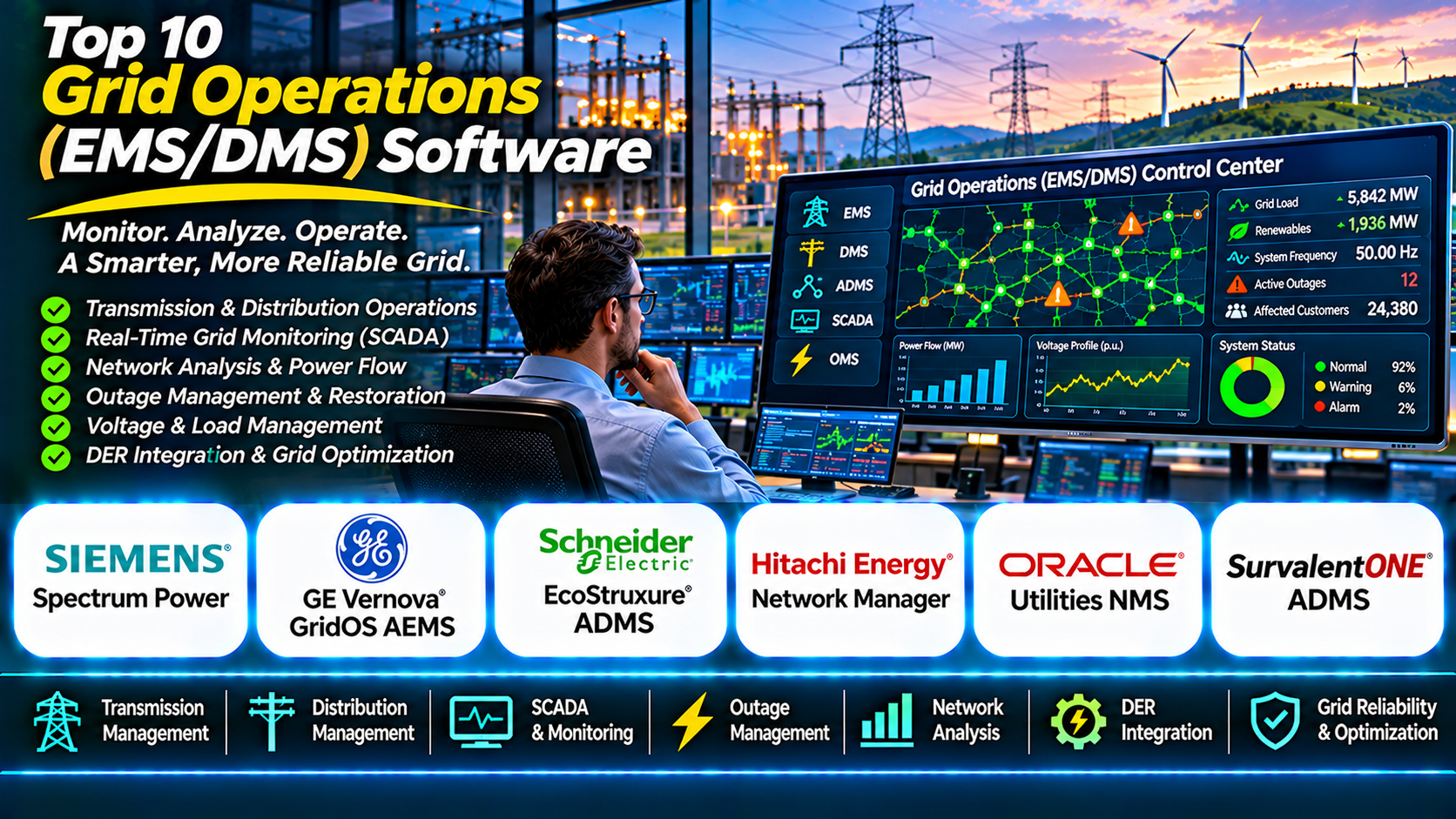
Introduction
Electricity grids require continuous monitoring, coordination, and operational management to deliver reliable power to residential, commercial, and industrial customers. Increasing electricity demand, renewable energy integration, and distributed energy resources make grid management more complex.
Traditional grid management approaches often depend on disconnected monitoring applications, manual operational procedures, and limited visibility into network conditions. These limitations can delay fault identification, complicate restoration activities, and reduce operational efficiency.
Grid Operations Software helps electricity utilities monitor transmission and distribution networks, analyze electrical conditions, manage operational events, and coordinate authorized control activities. Energy Management Systems (EMS) and Distribution Management Systems (DMS) represent two important categories of this technology.
Modern grid operations platforms increasingly combine supervisory control, network modeling, outage management, power flow analysis, distributed energy resource coordination, and operational analytics. Advanced Distribution Management Systems (ADMS) integrate several of these capabilities into coordinated environments.
Selecting appropriate grid operations software requires consideration of network size, existing infrastructure, communication protocols, operational responsibilities, cybersecurity requirements, and integration complexity. Transmission system operators and municipal distribution utilities may require significantly different capabilities.
This guide examines ten grid operations software solutions, explaining their features, benefits, advantages, limitations, practical applications, and suitability for different electricity utility environments.
What Is Grid Operations (EMS/DMS) Software?
Grid Operations Software is a category of specialized applications that helps electricity utilities monitor, analyze, coordinate, and manage electrical transmission and distribution networks.
Energy Management Systems primarily support transmission-level operations, including network monitoring, state estimation, contingency analysis, and generation coordination where applicable. Distribution Management Systems focus on distribution networks, feeder conditions, voltage management, switching workflows, and service reliability.
Advanced Distribution Management Systems combine distribution network analysis with supervisory control, outage management, and other operational applications. The exact combination of capabilities varies according to the platform and selected modules.
These systems receive information from compatible field devices, substations, communication networks, supervisory control systems, geographic information systems, and enterprise applications. Authorized grid operators use this information to maintain situational awareness and support safe, reliable operational decisions.
Understanding Grid Operations Software Categories
| System | Full Name | Primary Function |
|---|---|---|
| EMS | Energy Management System | Transmission network monitoring and analysis |
| DMS | Distribution Management System | Distribution network management |
| ADMS | Advanced Distribution Management System | Integrated distribution operations |
| SCADA | Supervisory Control and Data Acquisition | Operational monitoring and authorized control |
| OMS | Outage Management System | Outage identification and restoration coordination |
| DERMS | Distributed Energy Resource Management System | Distributed energy resource coordination |
| GIS | Geographic Information System | Geographic and asset information management |
| MDMS | Meter Data Management System | Utility measurement information processing |
Common Applications of Grid Operations Software
- Transmission Network Monitoring: Maintain visibility into transmission network conditions, equipment status, and relevant electrical measurements.
- Distribution Network Management: Analyze distribution feeder conditions, network connectivity, and operational constraints.
- Outage Management: Coordinate outage information, affected customer estimates, restoration activities, and operational reporting.
- Power Flow Analysis: Evaluate electrical power flows, voltage conditions, and equipment loading using appropriate network models.
- Renewable Energy Integration: Assess operational implications of variable renewable generation and distributed energy resources.
- Voltage Management: Support voltage monitoring and authorized optimization activities within approved operating limits.
- Operational Planning: Evaluate representative network conditions and potential contingencies before authorized operational decisions.
- Grid Reliability Management: Analyze service interruptions, operational performance, and network reliability indicators.
Top 10 Grid Operations (EMS/DMS) Software
The following comparison includes dedicated EMS platforms, ADMS solutions, distribution management systems, and complementary grid control environments.
The numbering organizes the comparison rather than representing independently tested rankings. Available capabilities depend on product configuration, deployment architecture, and selected modules.
1. Siemens Spectrum Power
Short Description
Siemens Spectrum Power is a family of grid control software solutions designed to support electricity transmission and distribution operations. It provides capabilities for operational monitoring, network analysis, and coordinated grid management.
The platform is particularly relevant to large electricity utilities and transmission system operators requiring centralized visibility into complex electrical networks. Its applications can help operators assess network conditions and evaluate potential operational constraints.
Spectrum Power solutions can connect with compatible supervisory control infrastructure, network models, and enterprise utility applications. This integration helps establish a consistent operational information environment.
Organizations should evaluate the specific Spectrum Power configuration required for their transmission, distribution, or market-related responsibilities rather than assuming every capability is included in one deployment.
Key Features
- Supervisory Monitoring: Presents supported electrical measurements, equipment status, and operational notifications.
- Energy Management Applications: Supports applicable transmission network monitoring and analytical workflows.
- State Estimation: Uses available measurements and network models to estimate electrical operating conditions.
- Power Flow Analysis: Evaluates modeled power flows, voltage conditions, and equipment loading.
- Contingency Analysis: Helps operators assess potential consequences of selected equipment unavailability.
- Distribution Management: Supports applicable distribution network analysis through relevant product configurations.
- Alarm and Event Management: Organizes operational notifications for authorized personnel.
- Enterprise Integration: Connects with compatible utility information and operational systems.
- Control Center Visualization: Provides interfaces for monitoring network conditions and operational information.
Benefits
- Improves centralized grid visibility.
- Supports transmission network reliability management.
- Facilitates structured operational analysis.
- Reduces fragmented control center information.
- Supports complex network modeling.
- Improves accessibility of operational measurements.
- Helps utilities modernize grid control environments.
Pros
- Established electricity grid technology ecosystem.
- Comprehensive enterprise grid management capabilities.
- Relevant transmission and distribution applications.
- Supports sophisticated network analysis.
- Suitable for large electricity networks.
- Configurable control center functionality.
Cons
- Implementation can require substantial investment.
- Specialized engineering expertise may be necessary.
- Commercial licensing requires individual evaluation.
- Integration with legacy infrastructure can be complex.
- Smaller utilities may not need its complete capabilities.
Use Cases
- Transmission Control Centers: Monitor electrical network conditions and relevant operational indicators.
- Network Security Analysis: Evaluate modeled network conditions and selected contingencies.
- Distribution Operations: Support applicable distribution network management workflows.
- Grid Modernization: Replace fragmented or outdated control center applications.
- Renewable Integration Planning: Assess changing generation patterns within network models.
- Utility Operational Reporting: Maintain relevant grid performance and event information.
Best For
- Transmission system operators.
- Large electricity utilities.
- Regional grid operators.
- National electricity network organizations.
- Utility control center teams.
- Enterprise grid modernization projects.
2. GE Vernova GridOS Advanced Energy Management System
Short Description
GE Vernova GridOS Advanced Energy Management System provides transmission-level grid management capabilities within the broader GridOS software portfolio.
The platform helps electricity system operators maintain operational awareness, analyze electrical network conditions, and coordinate applicable energy management activities.
Its analytical capabilities are particularly relevant to interconnected electricity networks experiencing changes in generation composition, demand patterns, and operational complexity.
Utilities should evaluate the relationship between the proposed AEMS deployment and complementary GridOS applications, including distribution management, data integration, and grid orchestration capabilities.
Key Features
- Transmission Network Monitoring: Presents relevant transmission measurements and equipment information.
- State Estimation: Supports estimation of electrical network conditions using available information.
- Network Analysis: Evaluates modeled electrical operating conditions.
- Contingency Assessment: Supports evaluation of selected network contingencies.
- Generation Management Applications: Provides applicable generation coordination functionality.
- Operational Visualization: Presents relevant grid conditions through control center interfaces.
- Alarm Administration: Organizes supported operational notifications and events.
- Grid Information Integration: Connects with compatible operational information sources.
- Operational Planning Support: Helps operators evaluate representative network scenarios.
Benefits
- Improves transmission system situational awareness.
- Supports coordinated electricity network operations.
- Facilitates analytical assessment of network conditions.
- Supports changing generation environments.
- Improves operational information accessibility.
- Helps modernize enterprise control centers.
- Supports reliability-focused decision-making.
Pros
- Established enterprise electricity technology provider.
- Dedicated transmission energy management capabilities.
- Relevant network analysis applications.
- Suitable for interconnected electricity systems.
- Compatible GridOS software ecosystem.
- Supports complex operational environments.
Cons
- Enterprise implementation may be demanding.
- Commercial pricing requires consultation.
- Specialized operational expertise is necessary.
- Existing system migration requires careful planning.
- Complementary capabilities may require additional modules.
Use Cases
- Transmission Grid Operations: Maintain visibility into electrical network conditions.
- Contingency Evaluation: Assess selected potential equipment unavailability scenarios.
- Generation Coordination: Support applicable generation management activities.
- Renewable Energy Integration: Evaluate modeled operational impacts of changing generation.
- Control Center Modernization: Introduce coordinated grid management applications.
- Regional Electricity Operations: Support operational analysis across interconnected networks.
Best For
- Transmission system operators.
- Independent system operators.
- Regional electricity organizations.
- Large integrated utilities.
- Grid control center administrators.
- Enterprise electricity modernization teams.
3. Schneider Electric EcoStruxure ADMS
Short Description
Schneider Electric EcoStruxure ADMS is an advanced distribution management solution designed to support electricity distribution network operations.
The platform combines relevant supervisory control, distribution network analysis, outage management, and operational optimization capabilities within an integrated environment.
EcoStruxure ADMS is particularly relevant to utilities seeking to improve distribution network visibility, service reliability, and coordination between control center personnel and field operations.
Organizations should evaluate network model requirements, compatible field infrastructure, outage management functionality, and integration with existing utility applications before implementation.
Key Features
- Integrated Distribution Management: Coordinates relevant distribution network operational applications.
- SCADA Functionality: Supports monitoring and authorized control through compatible infrastructure.
- Distribution Network Modeling: Represents electrical network connectivity and equipment relationships.
- Outage Management: Supports outage identification, assessment, and restoration coordination.
- Power Flow Analysis: Evaluates modeled distribution network electrical conditions.
- Volt/VAR Management: Supports applicable voltage and reactive power optimization workflows.
- Fault Location and Restoration Support: Provides relevant analytical and configured automation capabilities.
- Operational Visualization: Presents distribution network conditions and operational events.
- Utility System Integration: Connects with compatible geographic, customer, and enterprise applications.
Benefits
- Improves distribution network visibility.
- Supports coordinated outage management.
- Facilitates network reliability improvement initiatives.
- Reduces fragmented operational information.
- Supports distribution voltage management.
- Improves coordination between utility teams.
- Helps modernize distribution control centers.
Pros
- Comprehensive ADMS orientation.
- Integrated distribution and outage management capabilities.
- Established utility technology ecosystem.
- Relevant distribution optimization applications.
- Suitable for complex distribution networks.
- Supports coordinated operational workflows.
Cons
- Implementation requires detailed network models.
- Commercial pricing varies by configuration.
- Integration projects can be resource-intensive.
- Specialized employee training may be necessary.
- Automation capabilities require rigorous operational validation.
Use Cases
- Distribution Control Center Operations: Monitor feeder conditions and operational information.
- Outage Restoration Coordination: Organize affected network information and authorized restoration workflows.
- Voltage Management: Assess voltage conditions and approved optimization opportunities.
- Distribution Network Analysis: Evaluate modeled feeder loading and electrical conditions.
- Smart Grid Modernization: Integrate distribution monitoring and analytical applications.
- Renewable Distribution Integration: Assess distributed generation impacts within applicable network models.
Best For
- Electricity distribution utilities.
- Municipal electricity providers.
- Distribution system operators.
- Smart grid modernization teams.
- Utility outage management departments.
- Distribution control center administrators.
4. Hitachi Energy Network Manager
Short Description
Hitachi Energy Network Manager is a family of grid management solutions supporting electricity transmission and distribution operations.
Its applications address operational monitoring, network analysis, energy management, and distribution management requirements. The platform can help utilities establish centralized visibility into complex electrical networks.
Network Manager is particularly relevant to organizations operating extensive grid infrastructure and requiring coordinated control center applications.
Utilities should evaluate the specific EMS, ADMS, SCADA, and related applications included in their proposed deployment. Integration requirements and supported functionality depend on the selected architecture.
Key Features
- Grid Supervisory Monitoring: Presents supported electrical measurements and equipment conditions.
- Transmission Energy Management: Supports applicable transmission operational workflows.
- Distribution Management: Provides relevant distribution network management applications.
- State Estimation: Estimates network conditions using available measurements and models.
- Power Flow Analysis: Evaluates modeled electrical network behavior.
- Contingency Analysis: Supports assessment of selected network contingencies.
- Outage Management: Coordinates applicable distribution interruption information.
- Operational Event Management: Organizes relevant alarms and system events.
- Enterprise Integration: Connects with compatible utility operational and information systems.
Benefits
- Improves grid operational awareness.
- Supports transmission and distribution management.
- Facilitates network reliability analysis.
- Reduces disconnected operational information.
- Supports control center modernization.
- Improves coordination across utility applications.
- Helps organizations manage complex grid environments.
Pros
- Established electricity infrastructure specialization.
- Relevant EMS and ADMS applications.
- Supports extensive utility networks.
- Comprehensive network analysis orientation.
- Configurable enterprise architecture.
- Suitable for integrated utility operations.
Cons
- Implementation can be technically demanding.
- Commercial licensing requires evaluation.
- Network model maintenance requires dedicated resources.
- Integration with older systems may be complex.
- Available capabilities depend on selected applications.
Use Cases
- Transmission Network Management: Monitor relevant transmission system conditions.
- Distribution Grid Operations: Analyze supported distribution network information.
- Grid Contingency Assessment: Evaluate modeled operational constraints.
- Outage Coordination: Support applicable interruption and restoration workflows.
- Integrated Control Centers: Coordinate transmission and distribution applications where appropriate.
- Utility Infrastructure Modernization: Introduce updated operational management capabilities.
Best For
- Large electricity utilities.
- Transmission network operators.
- Distribution system operators.
- Integrated utility enterprises.
- Grid modernization departments.
- Enterprise control center teams.
5. AspenTech OSI monarch
Short Description
AspenTech OSI monarch is a real-time operational technology platform associated with supervisory control and energy management applications for electricity utilities.
The platform provides an environment for acquiring, processing, visualizing, and managing operational information from compatible utility infrastructure.
Its broader application ecosystem can support transmission energy management, distribution management, generation management, and other electricity operational requirements.
Organizations should distinguish the core monarch platform from additional applications and modules required for their specific EMS or DMS deployment.
Key Features
- Real-Time Data Acquisition: Receives operational information from compatible field infrastructure.
- SCADA Applications: Supports supervisory monitoring and authorized control workflows.
- Energy Management Integration: Connects with applicable transmission energy management applications.
- Distribution Management Integration: Supports relevant distribution operational capabilities.
- Operational Data Processing: Organizes supported real-time electrical information.
- Alarm and Event Management: Presents relevant operational notifications.
- Control Center Interfaces: Provides visualization of network and equipment conditions.
- Historical Information Management: Supports applicable operational history and reporting.
- Communication Integration: Connects with compatible utility communication infrastructure.
Benefits
- Improves access to real-time operational information.
- Supports centralized control center workflows.
- Facilitates utility infrastructure integration.
- Reduces fragmented monitoring applications.
- Supports configurable grid management environments.
- Improves operational event visibility.
- Helps utilities modernize supervisory control systems.
Pros
- Established utility operational technology platform.
- Relevant SCADA and EMS integration capabilities.
- Supports configurable application environments.
- Suitable for complex operational information requirements.
- Supports centralized monitoring.
- Relevant transmission and distribution applications.
Cons
- Specific functionality depends on selected modules.
- Commercial pricing requires evaluation.
- Implementation requires operational technology expertise.
- Legacy integration can increase project complexity.
- Grid analytical capabilities require appropriate network models.
Use Cases
- Utility SCADA Modernization: Establish updated supervisory monitoring environments.
- Transmission Control Centers: Connect real-time information with applicable EMS applications.
- Distribution Operations: Support relevant distribution monitoring and management.
- Operational Event Administration: Organize alarms and equipment notifications.
- Generation Management: Support applicable generation monitoring workflows.
- Enterprise Operational Integration: Connect compatible utility operational information sources.
Best For
- Electricity transmission utilities.
- Distribution control centers.
- Integrated energy providers.
- Utility SCADA administrators.
- Operational technology engineering teams.
- Organizations requiring configurable control environments.
6. Oracle Utilities Network Management System
Short Description
Oracle Utilities Network Management System provides electricity distribution network management and outage management capabilities within the Oracle Utilities software portfolio.
The platform helps organizations maintain network connectivity information, assess operational events, coordinate outage activities, and support distribution network analysis.
It is particularly relevant to electricity distribution providers seeking to connect network operations with customer information, field service, and other compatible utility applications.
Organizations should evaluate the specific NMS applications, network model integration requirements, operational interfaces, and complementary SCADA functionality required for their environment.
Key Features
- Distribution Network Management: Maintains relevant electrical network relationships and operational information.
- Outage Management: Supports interruption assessment and restoration coordination.
- Network Connectivity Modeling: Represents relationships between supported distribution assets.
- Customer Impact Assessment: Helps estimate affected customers using available network and service information.
- Distribution Analysis: Provides applicable network analytical capabilities.
- Operational Workflow Management: Organizes supported utility operational activities.
- Field Service Integration: Connects with compatible field workforce applications.
- Customer Information Integration: Uses relevant customer and service account relationships.
- Operational Reporting: Presents applicable outage and network performance information.
Benefits
- Improves outage management coordination.
- Supports distribution network visibility.
- Connects customer and operational information.
- Facilitates structured restoration administration.
- Reduces fragmented utility workflows.
- Improves accessibility of outage information.
- Supports enterprise utility integration.
Pros
- Established utility software ecosystem.
- Relevant outage management functionality.
- Supports distribution network administration.
- Compatible Oracle Utilities applications.
- Useful customer impact assessment capabilities.
- Suitable for enterprise distribution operations.
Cons
- Implementation requires accurate network information.
- Commercial licensing requires evaluation.
- Integration with external SCADA systems may be necessary.
- Specialized technical expertise may be required.
- Advanced optimization functionality depends on configuration.
Use Cases
- Distribution Outage Management: Coordinate interruption information and restoration activities.
- Customer Impact Analysis: Estimate affected service accounts using network relationships.
- Distribution Network Monitoring: Maintain relevant network operational information.
- Field Workforce Coordination: Connect outage activities with compatible field service applications.
- Utility Customer Communication: Provide relevant outage information to customer service workflows.
- Network Management Modernization: Replace fragmented distribution and outage applications.
Best For
- Electricity distribution companies.
- Oracle Utilities customers.
- Municipal electricity providers.
- Utility outage management teams.
- Distribution network administrators.
- Customer service integration departments.
7. ETAP Advanced Distribution Management System
Short Description
ETAP Advanced Distribution Management System combines relevant electrical network modeling, real-time monitoring, and distribution management applications.
ETAP is widely associated with electrical engineering analysis and power system modeling. Its operational software capabilities extend these modeling foundations into applicable grid management environments.
The platform is particularly relevant to organizations seeking a close relationship between engineering network models and operational analysis. These organizations may include utilities, industrial power networks, and campus electricity systems.
Users should distinguish ETAP’s offline engineering analysis products from real-time ADMS and supervisory control capabilities. The appropriate configuration depends on the organization’s operational responsibilities.
Key Features
- Electrical Network Modeling: Represents supported electrical equipment and network relationships.
- Real-Time Monitoring: Receives relevant measurements through compatible infrastructure.
- Distribution Power Flow: Evaluates modeled distribution network electrical conditions.
- Voltage Analysis: Assesses voltage profiles and applicable operating constraints.
- Distribution Management Applications: Supports relevant distribution operational workflows.
- Network Scenario Analysis: Evaluates representative changes in network conditions.
- Operational Visualization: Presents electrical network and measurement information.
- Outage Management Integration: Supports applicable interruption management capabilities.
- Engineering and Operational Integration: Connects relevant electrical models with operational applications.
Benefits
- Connects engineering models with operational analysis.
- Improves visibility into electrical network conditions.
- Supports distribution network planning.
- Facilitates voltage and loading assessment.
- Improves consistency of electrical network information.
- Supports industrial and utility power management.
- Helps organizations evaluate operational scenarios.
Pros
- Strong electrical engineering modeling foundation.
- Relevant real-time distribution management capabilities.
- Supports detailed electrical network analysis.
- Suitable for utility and industrial environments.
- Configurable power system applications.
- Useful engineering-to-operations integration.
Cons
- Specialized electrical engineering expertise is necessary.
- Real-time functionality may require additional components.
- Commercial licensing varies by configuration.
- Accurate network models require ongoing maintenance.
- Large utility deployment requirements should be tested.
Use Cases
- Distribution Network Analysis: Evaluate feeder loading and voltage conditions.
- Industrial Power Management: Monitor supported industrial electrical networks.
- Campus Grid Operations: Manage relevant electricity distribution information.
- Network Modernization Planning: Evaluate representative infrastructure changes.
- Renewable Integration Analysis: Assess modeled distributed generation impacts.
- Operational Engineering Coordination: Connect electrical studies with applicable operational workflows.
Best For
- Electricity distribution utilities.
- Industrial power system operators.
- Electrical engineering departments.
- Campus utility administrators.
- Microgrid engineering teams.
- Organizations requiring detailed electrical network modeling.
8. SurvalentONE ADMS
Short Description
SurvalentONE ADMS is an advanced distribution management platform designed to support electricity utility control center operations.
The solution combines relevant SCADA, distribution management, and outage management capabilities. It helps utilities monitor network conditions and coordinate operational information within a centralized environment.
SurvalentONE is particularly relevant to municipal utilities, electric cooperatives, and distribution companies seeking integrated operational management applications.
Organizations should evaluate network model requirements, communication compatibility, selected optimization modules, and the resources required for implementation.
Key Features
- Integrated SCADA: Supports supervisory monitoring and authorized control activities.
- Distribution Management: Provides relevant distribution network operational capabilities.
- Outage Management: Organizes interruption information and restoration coordination.
- Network Visualization: Presents supported distribution network relationships.
- Distribution Analysis: Evaluates applicable electrical network conditions.
- Alarm Management: Organizes operational notifications for authorized personnel.
- Historical Data Management: Maintains relevant operational information.
- Utility Integration: Connects with compatible geographic and customer information applications.
- Distribution Automation Support: Provides applicable configured operational automation capabilities.
Benefits
- Improves centralized distribution network visibility.
- Supports coordinated outage management.
- Reduces disconnected control center applications.
- Facilitates operational information integration.
- Supports municipal and cooperative utility operations.
- Improves accessibility of historical operational information.
- Helps utilities modernize distribution management.
Pros
- Dedicated electricity distribution specialization.
- Integrated SCADA, DMS, and OMS orientation.
- Relevant municipal and cooperative utility applications.
- Supports configurable operational workflows.
- Suitable for centralized control centers.
- Provides distribution network visualization.
Cons
- Functionality varies by selected modules.
- Commercial pricing requires evaluation.
- Integration with existing infrastructure requires testing.
- Accurate network models are essential.
- Advanced automation requires appropriate engineering validation.
Use Cases
- Municipal Electricity Operations: Monitor relevant distribution network conditions.
- Electric Cooperative Management: Coordinate supported grid operational information.
- Outage Administration: Organize interruption and restoration activities.
- Distribution Automation Projects: Support applicable authorized automation workflows.
- Control Center Modernization: Consolidate supervisory and distribution applications.
- Operational Reporting: Review relevant network performance and event information.
Best For
- Municipal electricity utilities.
- Electric cooperatives.
- Regional distribution companies.
- Utility SCADA administrators.
- Distribution control center teams.
- Organizations seeking integrated ADMS capabilities.
9. PSIcontrol
Short Description
PSIcontrol is a grid control software solution from PSI Software designed to support energy network monitoring and operational management.
The platform addresses relevant supervisory control, network analysis, and operational information requirements for electricity infrastructure.
PSIcontrol is particularly relevant to utilities managing complex electricity networks and requiring configurable control center environments.
Organizations should evaluate regional requirements, available transmission and distribution applications, supported communication interfaces, and complementary PSI software components.
Key Features
- Network Supervisory Monitoring: Presents supported electrical measurements and equipment status.
- Grid Control Applications: Supports applicable authorized network operational workflows.
- Network Modeling: Maintains relevant electrical network relationships.
- Power System Analysis: Evaluates modeled electrical operating conditions.
- Operational Event Management: Organizes alarms and relevant network events.
- Control Center Visualization: Presents operational information through configurable interfaces.
- Communication Integration: Connects with compatible utility field infrastructure.
- Operational Information Processing: Organizes supported real-time and historical information.
- Enterprise Application Integration: Exchanges relevant information with compatible utility systems.
Benefits
- Improves centralized network awareness.
- Supports configurable control center operations.
- Facilitates electrical network analysis.
- Reduces fragmented operational information.
- Improves accessibility of network events.
- Supports utility infrastructure modernization.
- Helps coordinate complex energy network workflows.
Pros
- Established energy network software specialization.
- Relevant grid control and monitoring capabilities.
- Supports configurable operational environments.
- Suitable for complex network management.
- Provides relevant analytical functionality.
- Supports utility information integration.
Cons
- Regional availability and support require evaluation.
- Commercial licensing requires consultation.
- Implementation may require specialized expertise.
- Integration with legacy infrastructure can be complex.
- Specific EMS and DMS functionality should be demonstrated.
Use Cases
- Electricity Network Control: Monitor relevant grid operating conditions.
- Utility Control Center Operations: Coordinate supported operational information.
- Electrical Network Analysis: Evaluate representative network scenarios.
- Operational Event Administration: Organize alarms and equipment notifications.
- Grid Modernization: Replace outdated operational management applications.
- Energy Network Integration: Connect compatible utility operational systems.
Best For
- Electricity network operators.
- Transmission and distribution utilities.
- Regional energy providers.
- Utility operational technology departments.
- Grid control center administrators.
- Organizations requiring configurable network management.
10. Open Systems International–Independent Alternative: SEL POWERMAX
Short Description
SEL POWERMAX is a power management and control solution from Schweitzer Engineering Laboratories designed to support reliable electrical power system operations.
Its applications are particularly relevant to industrial facilities, microgrids, utility substations, and other environments requiring coordinated monitoring and control.
POWERMAX can combine electrical measurements, automation controllers, protection infrastructure, and applicable power management applications. It provides a specialized alternative for localized or industrial power management requirements.
Unlike a comprehensive transmission EMS or utility-wide ADMS, POWERMAX should be evaluated according to its specific power management responsibilities. Organizations requiring extensive outage management, customer impact analysis, or enterprise distribution modeling may need complementary platforms.
Key Features
- Power System Monitoring: Presents relevant electrical measurements and equipment conditions.
- Power Management Applications: Supports applicable electrical power management workflows.
- Microgrid Control: Provides relevant microgrid management capabilities.
- Generation Coordination: Supports applicable local generation management.
- Load Management: Provides configured load management functionality.
- Automation Integration: Connects with compatible automation controllers and protection infrastructure.
- Operational Visualization: Displays relevant electrical system information.
- Event Information Management: Organizes supported operational events.
- Electrical Infrastructure Integration: Connects with compatible industrial and utility equipment.
Benefits
- Supports localized electrical system reliability.
- Improves visibility into industrial power networks.
- Facilitates microgrid management.
- Connects power management and automation infrastructure.
- Supports coordinated electrical operational workflows.
- Improves access to equipment information.
- Helps organizations manage complex local power systems.
Pros
- Established electrical protection and automation expertise.
- Relevant industrial power management capabilities.
- Suitable for microgrid environments.
- Supports compatible electrical automation infrastructure.
- Provides specialized power management functionality.
- Useful for localized grid management requirements.
Cons
- Not a direct replacement for every enterprise EMS or ADMS.
- Utility-wide outage management may require complementary applications.
- Implementation requires specialized electrical engineering expertise.
- Commercial costs depend on project requirements.
- Compatibility with existing infrastructure requires assessment.
Use Cases
- Industrial Power Management: Monitor and manage supported facility electrical networks.
- Microgrid Operations: Coordinate applicable local generation and consumption.
- Campus Electricity Management: Support localized electrical infrastructure operations.
- Utility Substation Integration: Connect relevant automation and monitoring infrastructure.
- Local Generation Management: Coordinate supported generation resources.
- Electrical Reliability Projects: Improve localized power management capabilities.
Best For
- Industrial electricity consumers.
- Microgrid operators.
- Campus utility departments.
- Electrical automation engineers.
- Utility substation engineering teams.
- Organizations requiring specialized power management.
Comparison Table: Top 10 Grid Operations Software
| Software | Primary Category | Best For | Standout Capability | Pricing Model |
|---|---|---|---|---|
| Siemens Spectrum Power | EMS/DMS | Large electricity networks | Enterprise grid control and analysis | Enterprise quotation |
| GE Vernova GridOS AEMS | EMS | Transmission operators | Transmission network management | Commercial licensing |
| Schneider Electric EcoStruxure ADMS | ADMS | Distribution utilities | Integrated distribution optimization | Enterprise quotation |
| Hitachi Energy Network Manager | EMS/ADMS | Integrated utilities | Transmission and distribution management | Commercial licensing |
| AspenTech OSI monarch | SCADA and grid applications | Enterprise control centers | Real-time operational information processing | Commercial arrangements |
| Oracle Utilities NMS | DMS/OMS | Distribution utilities | Outage and customer impact management | Commercial licensing |
| ETAP ADMS | ADMS and electrical analysis | Utilities and industrial networks | Engineering model integration | Module-based licensing |
| SurvalentONE ADMS | ADMS | Municipal utilities and cooperatives | Integrated distribution control | Commercial arrangements |
| PSIcontrol | Grid control software | Electricity network operators | Configurable control center applications | Enterprise quotation |
| SEL POWERMAX | Specialized power management | Industrial networks and microgrids | Electrical automation integration | Project-based quotation |
Pricing, deployment models, supported protocols, individual capabilities, and product availability should be confirmed with the respective providers.
SEL POWERMAX is a specialized adjacent solution rather than a direct equivalent to a utility-wide enterprise ADMS or transmission EMS.
Which Grid Operations Software Is Right for You?
For Large Transmission System Operators
Siemens Spectrum Power, GE Vernova GridOS AEMS, and Hitachi Energy Network Manager are worth evaluating when organizations manage extensive transmission networks.
Prioritize state estimation, contingency analysis, operational visibility, network model accuracy, system resilience, and integration with existing infrastructure.
For Electricity Distribution Companies
Schneider Electric EcoStruxure ADMS, SurvalentONE ADMS, and Hitachi Energy Network Manager provide relevant distribution management capabilities.
Evaluate feeder modeling, outage management, voltage analysis, field infrastructure integration, and operational workflow requirements.
For Municipal Utilities and Electric Cooperatives
SurvalentONE ADMS is particularly relevant to municipal electricity providers and electric cooperatives seeking integrated distribution management.
The organization should evaluate implementation resources, network size, operational staffing, and long-term support arrangements.
For Outage Management Departments
Oracle Utilities Network Management System and Schneider Electric EcoStruxure ADMS provide relevant outage management capabilities.
Evaluate network connectivity accuracy, customer impact estimation, field service integration, and outage communication workflows.
For Industrial Power Networks
ETAP ADMS and SEL POWERMAX are worth considering for industrial facilities managing complex electrical infrastructure.
The choice depends on whether the organization prioritizes detailed electrical network analysis, localized power management, or broader distribution operations.
For Microgrid Operators
SEL POWERMAX provides relevant specialized power management capabilities for microgrid environments.
ETAP’s applicable modeling and operational applications can also support microgrid engineering and management requirements.
For SCADA Modernization Projects
AspenTech OSI monarch, PSIcontrol, and SurvalentONE provide relevant supervisory monitoring and operational management environments.
Evaluate existing communication infrastructure, device compatibility, operational interfaces, resilience requirements, and migration procedures.
For Integrated Utility Enterprises
Siemens Spectrum Power and Hitachi Energy Network Manager provide relevant technology portfolios for organizations managing both transmission and distribution responsibilities.
Organizations should determine whether integrated applications or separately managed operational environments provide the most appropriate architecture.
Best Grid Operations Software by User Type
| User Type | Platform to Evaluate | Primary Reason |
|---|---|---|
| Transmission control center manager | Siemens Spectrum Power | Enterprise transmission management |
| Regional grid system operator | GE Vernova GridOS AEMS | Transmission network analysis |
| Distribution operations manager | Schneider Electric EcoStruxure ADMS | Integrated distribution management |
| Integrated utility technology director | Hitachi Energy Network Manager | EMS and ADMS portfolio |
| Utility SCADA administrator | AspenTech OSI monarch | Real-time operational integration |
| Outage management director | Oracle Utilities NMS | Outage and customer impact workflows |
| Electrical engineering manager | ETAP ADMS | Engineering and operational modeling |
| Electric cooperative administrator | SurvalentONE ADMS | Integrated distribution operations |
| Grid control system architect | PSIcontrol | Configurable operational architecture |
| Industrial microgrid manager | SEL POWERMAX | Specialized power management |
How to Choose the Best Grid Operations Software
1. Define Operational Responsibilities
Begin by identifying whether the organization manages transmission networks, distribution networks, industrial electrical infrastructure, or localized microgrids.
Transmission operators may require state estimation, contingency analysis, generation coordination, and wide-area network visibility.
Distribution utilities may prioritize feeder analysis, outage management, voltage monitoring, and distributed energy resource integration.
Industrial organizations may require localized power management rather than a complete utility-wide ADMS.
Clearly defining these responsibilities prevents unnecessary investment in unsuitable software.
2. Evaluate Network Modeling Capabilities
Grid operations applications depend heavily on accurate electrical network models.
These models may represent substations, transformers, feeders, transmission lines, electrical equipment, connectivity relationships, and relevant operating characteristics.
Evaluate how the platform imports, validates, updates, and maintains network models.
Organizations should establish documented responsibilities for approving model changes and reconciling differences between engineering records and operational infrastructure.
3. Assess SCADA and Field Infrastructure Compatibility
Grid operations software frequently receives information from existing supervisory control systems, remote terminal units, intelligent electronic devices, and substation automation infrastructure.
Evaluate supported communication standards, information exchange methods, and integration architectures.
Standards such as IEC 61850, IEC 60870-5-104, DNP3, and the Common Information Model may be relevant, depending on the organization’s infrastructure.
Support should be demonstrated using representative systems rather than assumed from general product descriptions.
4. Review Network Analytical Applications
Different grid operations platforms provide different analytical capabilities.
Relevant applications may include:
- State estimation.
- Transmission power flow.
- Distribution power flow.
- Contingency analysis.
- Voltage analysis.
- Equipment loading assessment.
- Network topology processing.
- Distributed generation impact analysis.
Organizations should test analytical applications using validated network models and representative operating scenarios.
Analytical recommendations should remain subject to approved operational procedures and qualified engineering review.
5. Examine Outage Management Requirements
Distribution utilities should evaluate how the platform handles outage information, network connectivity, customer impact estimates, restoration coordination, and operational reporting.
Integration with customer information systems, smart metering infrastructure, and field workforce applications can improve the information available during service interruptions.
However, the accuracy of outage predictions depends on reliable source information and network relationships.
Organizations should test how the system manages incomplete or conflicting information.
6. Assess Distributed Energy Resource Integration
Increasing deployment of rooftop solar systems, battery storage, electric vehicles, and other distributed energy resources changes distribution network behavior.
Evaluate whether the platform can represent relevant distributed resources, analyze changing power flows, and support applicable operational coordination.
Some utilities may require a dedicated DERMS application alongside their ADMS.
Organizations should confirm whether the proposed architecture supports anticipated distributed resource growth.
7. Review Operational Technology Cybersecurity
Grid operations software supports critical electricity infrastructure and requires rigorous security governance.
Evaluate access management, authentication, audit records, network segmentation support, software maintenance procedures, vendor security practices, and incident response arrangements.
Utilities should assess applicable regulatory obligations, which may include regional critical infrastructure requirements or relevant industrial cybersecurity standards.
Cybersecurity responsibilities must be clearly defined across utility employees, implementation partners, and software providers.
8. Evaluate System Resilience and Availability
Electricity control centers require dependable operational applications.
Evaluate redundancy, backup arrangements, disaster recovery, recovery objectives, maintenance procedures, and operational continuity during communication interruptions.
Organizations should establish approved fallback procedures for situations where software applications or information sources become unavailable.
Resilience testing should take place within authorized environments under qualified supervision.
9. Assess Operator Experience and Training
A technically sophisticated platform can still create operational difficulties if its interfaces are confusing or employees receive inadequate training.
Evaluate network visualization, alarm presentation, information accessibility, workflow consistency, and support for different operator responsibilities.
Representative users should participate in product evaluations.
Training should cover normal operational workflows, abnormal information conditions, approved fallback procedures, and escalation responsibilities.
10. Calculate Total Cost of Ownership
Grid operations software costs extend beyond licensing.
Potential expenses include:
- Implementation and engineering services.
- Network model preparation.
- Operational technology integration.
- Computing and communication infrastructure.
- Cybersecurity assessments.
- Historical information migration.
- Operator training.
- Software maintenance.
- Technical support.
- Disaster recovery infrastructure.
- Future expansion and modernization.
Organizations should evaluate long-term costs against measurable operational objectives rather than selecting software solely according to initial licensing expenses.
Practical Example: Implementing an ADMS for a Regional Electricity Distribution Utility
Consider a regional electricity distribution company serving 250,000 customer accounts across urban and rural areas.
The utility operates multiple substations and distribution feeders. Its existing operational environment includes separate supervisory monitoring, geographic information, outage administration, and customer information applications.
Management wants to establish an integrated distribution management environment that improves network visibility, outage coordination, and operational planning.
The following figures are hypothetical and demonstrate evaluation methods rather than guaranteed software performance.
Step 1: Establish Implementation Objectives
The utility defines several objectives:
- Improve centralized distribution network visibility.
- Establish consistent electrical network models.
- Integrate relevant supervisory monitoring information.
- Improve outage identification and customer impact assessment.
- Support distribution network analysis.
- Improve coordination between control center and field personnel.
- Strengthen operational information governance.
- Establish measurable reliability indicators.
These objectives guide platform selection and project planning.
Step 2: Document Existing Infrastructure
The utility creates an inventory of existing substations, distribution feeders, electrical equipment, communication infrastructure, supervisory monitoring applications, and relevant enterprise systems.
The implementation team identifies information owners and evaluates existing network records.
Discrepancies between geographic information, engineering models, and operational records are documented for authorized review.
Accurate network information provides an essential foundation for distribution management.
Step 3: Evaluate Candidate Platforms
The utility evaluates Schneider Electric EcoStruxure ADMS, Hitachi Energy Network Manager, SurvalentONE ADMS, and Oracle Utilities Network Management System.
Each candidate is assessed using representative network models and approved operational scenarios.
The evaluation examines network visualization, distribution analysis, outage management, integration capabilities, operator experience, security, and long-term support.
The utility selects its preferred architecture according to documented operational requirements rather than relying solely on vendor demonstrations.
Step 4: Establish Baseline Network Visibility
Suppose the utility has 2,000 operational measurement points included in its modernization program.
Before implementation, 1,600 measurement points provide information through the centralized operational environment.
Baseline visibility:
1,600 ÷ 2,000 × 100 = 80%.
After approved infrastructure integration, 1,900 measurement points provide centralized information.
Updated visibility:
1,900 ÷ 2,000 × 100 = 95%.
The illustrative improvement is 15 percentage points.
The utility should also monitor measurement accuracy, availability, and timeliness rather than treating connectivity alone as proof of reliable information.
Step 5: Evaluate Feeder Loading
Suppose a distribution feeder has an illustrative applicable capacity of 10 MVA.
Its measured apparent power is 7.5 MVA.
Feeder loading:
7.5 ÷ 10 × 100 = 75%.
The utility uses validated network information to monitor loading conditions.
Actual equipment limits depend on engineering ratings, environmental conditions, network configuration, and approved operational requirements.
The calculation supports situational awareness but does not independently authorize operational changes.
Step 6: Assess Outage Customer Impact
Suppose a distribution interruption affects an estimated 2,400 customer accounts.
The utility serves 250,000 accounts.
Estimated affected customer percentage:
2,400 ÷ 250,000 × 100 = 0.96%.
The ADMS or integrated OMS uses available network relationships and relevant customer information to support impact assessment.
Personnel validate the estimate as additional information becomes available.
Accurate customer impact information supports customer communication, resource coordination, and operational reporting.
Step 7: Calculate SAIDI
The System Average Interruption Duration Index, or SAIDI, measures average interruption duration per customer served during a defined reporting period.
Suppose the utility records 12,000,000 customer interruption minutes during a reporting year.
Total customers served: 250,000.
SAIDI:
12,000,000 ÷ 250,000 = 48 minutes per customer.
The illustrative annual SAIDI is 48 minutes.
Actual reporting should follow applicable regulatory definitions, customer population methodologies, and event inclusion requirements.
Step 8: Calculate SAIFI
The System Average Interruption Frequency Index, or SAIFI, measures average interruption frequency per customer served.
Suppose the utility records 300,000 qualifying customer interruptions during the same reporting year.
SAIFI:
300,000 ÷ 250,000 = 1.2 interruptions per customer.
This indicator helps the organization examine service interruption frequency.
SAIFI should be interpreted alongside interruption duration, network characteristics, and applicable reporting definitions.
Step 9: Calculate CAIDI
The Customer Average Interruption Duration Index, or CAIDI, represents average interruption duration per qualifying customer interruption.
Using the preceding illustrative figures:
CAIDI = SAIDI ÷ SAIFI.
48 ÷ 1.2 = 40 minutes per interruption.
The illustrative CAIDI is 40 minutes.
The organization should ensure that the underlying SAIDI and SAIFI calculations use consistent event definitions and reporting periods.
Step 10: Evaluate Reliability Improvements
Suppose annual SAIDI decreases from 48 minutes to 36 minutes following a broader utility modernization program.
Absolute reduction:
48 − 36 = 12 minutes per customer.
Percentage reduction:
12 ÷ 48 × 100 = 25%.
The illustrative reliability improvement is 25%.
Management should investigate contributing factors, including infrastructure investments, weather conditions, maintenance activities, operational improvements, and software adoption.
The entire improvement should not automatically be attributed to ADMS implementation.
Step 11: Measure Administrative Efficiency
Suppose utility employees previously spent 320 hours monthly consolidating operational information, preparing reports, and reconciling outage records.
After introducing integrated workflows, these activities require 200 hours monthly.
Monthly time saved:
320 − 200 = 120 hours.
Percentage reduction:
120 ÷ 320 × 100 = 37.5%.
Illustrative annual time savings:
120 × 12 = 1,440 staff hours.
Actual efficiency improvements depend on integration quality, employee adoption, information accuracy, and workflow design.
Step 12: Establish Continuous Operational Governance
The utility introduces regular reviews of network model accuracy, measurement quality, outage information, operational reporting, cybersecurity, and employee training.
Qualified personnel investigate significant discrepancies and approve relevant system changes according to documented procedures.
Management evaluates reliability indicators and identifies opportunities for infrastructure investment and process improvement.
The ADMS becomes an ongoing component of electricity distribution operations rather than simply a control center modernization project.
Common Mistakes to Avoid When Implementing Grid Operations Software
1. Confusing EMS, DMS, and ADMS Requirements
Organizations sometimes select software based on broad grid management terminology without defining their actual operational responsibilities.
Identify whether transmission analysis, distribution management, outage coordination, or localized power management represents the primary requirement.
2. Using Inaccurate Electrical Network Models
Incorrect connectivity relationships and equipment information can undermine network analysis and outage assessment.
Establish documented model validation and maintenance procedures before relying on analytical applications.
3. Underestimating Legacy System Integration
Existing supervisory systems, communication infrastructure, geographic information applications, and customer databases may require extensive integration work.
Evaluate representative interfaces early in the project.
4. Neglecting Operational Cybersecurity
Grid operations platforms require appropriate protection because they support critical electricity infrastructure.
Establish security responsibilities, access controls, maintenance governance, and incident response procedures throughout the software lifecycle.
5. Automating Operational Activities Without Adequate Validation
Automated recommendations and control capabilities require rigorous engineering validation and authorized operational governance.
Software functionality should not replace approved procedures, qualified personnel, or required safety controls.
6. Ignoring Operator Training
Control center employees need practical experience with network visualization, alarms, analytical applications, and abnormal information conditions.
Provide role-specific training and appropriate supervised practice before operational deployment.
7. Failing to Define Reliability Indicators
Utilities may introduce new operational applications without establishing measurable performance objectives.
Define appropriate baseline indicators and consistent reporting methodologies before implementation.
8. Overlooking Disaster Recovery
Grid operations applications must remain dependable during infrastructure failures and other disruptions.
Evaluate resilience arrangements and maintain approved operational continuity procedures.
9. Assuming Every Module Is Included
Enterprise grid software portfolios frequently contain separately licensed applications.
Confirm exactly which EMS, DMS, OMS, SCADA, and DERMS capabilities are included in the proposed commercial arrangement.
10. Treating Software as a Complete Reliability Solution
Grid reliability depends on infrastructure condition, maintenance, communication systems, engineering practices, operational procedures, and workforce expertise.
Software supports these activities but cannot independently resolve every electricity network reliability problem.
Frequently Asked Questions (FAQs)
1. What is grid operations software?
Grid operations software helps electricity utilities monitor, analyze, coordinate, and manage electrical networks using relevant operational information and specialized analytical applications.
2. What is an Energy Management System?
An Energy Management System, or EMS, supports transmission network monitoring, electrical network analysis, and applicable generation management activities.
3. What is a Distribution Management System?
A Distribution Management System, or DMS, supports electricity distribution network monitoring, modeling, analysis, and operational management.
4. What is an Advanced Distribution Management System?
An ADMS integrates multiple distribution operational capabilities, potentially including SCADA, DMS, outage management, and network optimization applications.
5. What is Siemens Spectrum Power?
Siemens Spectrum Power is a family of electricity grid control solutions supporting relevant transmission and distribution management applications.
6. What is GE Vernova GridOS AEMS?
GE Vernova GridOS Advanced Energy Management System provides transmission-level operational monitoring, network analysis, and applicable energy management capabilities.
7. What is Schneider Electric EcoStruxure ADMS?
EcoStruxure ADMS is an advanced distribution management solution supporting relevant supervisory control, distribution analysis, outage management, and optimization applications.
8. What is Hitachi Energy Network Manager?
Hitachi Energy Network Manager is a grid management software family supporting applicable electricity transmission and distribution operational requirements.
9. What is AspenTech OSI monarch?
AspenTech OSI monarch is a real-time operational technology platform supporting supervisory monitoring and integration with applicable grid management applications.
10. What is Oracle Utilities Network Management System?
Oracle Utilities NMS provides relevant distribution network management, outage coordination, customer impact assessment, and utility operational integration capabilities.
11. What is ETAP ADMS?
ETAP ADMS combines applicable electrical network modeling, real-time monitoring, distribution analysis, and operational management capabilities.
12. What is SurvalentONE ADMS?
SurvalentONE ADMS is a distribution management platform combining relevant SCADA, DMS, and outage management applications.
13. What is PSIcontrol?
PSIcontrol is grid control software supporting relevant electricity network monitoring, analysis, and operational management requirements.
14. What is SEL POWERMAX?
SEL POWERMAX is a specialized power management solution supporting applicable industrial electrical networks, microgrids, and localized power management applications.
15. What is the difference between SCADA and EMS?
SCADA primarily supports supervisory monitoring and authorized control. An EMS adds transmission network analytical and applicable energy management capabilities.
16. What is the difference between DMS and ADMS?
A DMS focuses on distribution network management. An ADMS integrates additional operational capabilities, potentially including SCADA, outage management, and optimization applications.
17. What is an Outage Management System?
An Outage Management System helps utilities identify, assess, organize, and coordinate electricity service interruption information and restoration activities.
18. What is state estimation?
State estimation uses available electrical measurements and network models to estimate network operating conditions.
19. What is power flow analysis?
Power flow analysis evaluates modeled electrical power flows, voltage conditions, and equipment loading within an electrical network.
20. What is contingency analysis?
Contingency analysis evaluates modeled network conditions associated with selected potential equipment unavailability scenarios.
21. What is Volt/VAR optimization?
Volt/VAR optimization involves evaluating and coordinating voltage and reactive power conditions according to approved electrical operating requirements.
22. What is DERMS?
A Distributed Energy Resource Management System supports monitoring and applicable coordination of distributed energy resources, such as solar generation and battery storage.
23. Can ADMS support renewable energy integration?
Many ADMS platforms provide network modeling and analytical capabilities that support evaluation of distributed renewable generation impacts. Dedicated DERMS applications may also be required.
24. What is SAIDI?
SAIDI stands for System Average Interruption Duration Index. It measures average qualifying interruption duration per customer served during a defined reporting period.
25. What is SAIFI?
SAIFI stands for System Average Interruption Frequency Index. It measures average qualifying interruption frequency per customer served.
26. What is CAIDI?
CAIDI stands for Customer Average Interruption Duration Index. It represents average duration per qualifying customer interruption.
27. Can grid operations software integrate with GIS?
Many grid operations platforms support integration with compatible geographic information systems. Accurate asset relationships and network connectivity are essential.
28. Can grid operations software operate in the cloud?
Some products support cloud, hosted, hybrid, or locally deployed architectures. Suitability depends on operational responsibilities, resilience requirements, security obligations, and applicable regulations.
29. How much does grid operations software cost?
Costs vary according to network size, selected applications, infrastructure requirements, integrations, implementation services, licensing arrangements, and ongoing support.
30. What makes a grid operations software implementation successful?
Successful implementation requires accurate electrical network models, reliable operational information, validated integrations, appropriate cybersecurity, qualified personnel, documented operational procedures, and continuous governance.
Final Thoughts
Grid Operations Software provides an essential foundation for modern electricity transmission and distribution management. These platforms help utilities establish operational visibility, analyze electrical network conditions, coordinate outage information, and support reliable electricity services.
Siemens Spectrum Power, GE Vernova GridOS AEMS, and Hitachi Energy Network Manager provide relevant enterprise grid management capabilities. Schneider Electric EcoStruxure ADMS, SurvalentONE ADMS, and Oracle Utilities Network Management System address important distribution and outage management requirements.
AspenTech OSI monarch and PSIcontrol provide relevant operational technology and grid control environments. ETAP ADMS connects electrical engineering models with applicable operational management capabilities, while SEL POWERMAX addresses specialized industrial and microgrid power management requirements.
The most appropriate grid operations software depends on network characteristics, operational responsibilities, existing infrastructure, integration requirements, cybersecurity obligations, and implementation resources.
Successful grid management requires more than advanced dashboards and automated analytical applications. Accurate network information, dependable infrastructure, qualified operators, validated engineering practices, and accountable operational governance remain essential to maintaining reliable electricity services.
