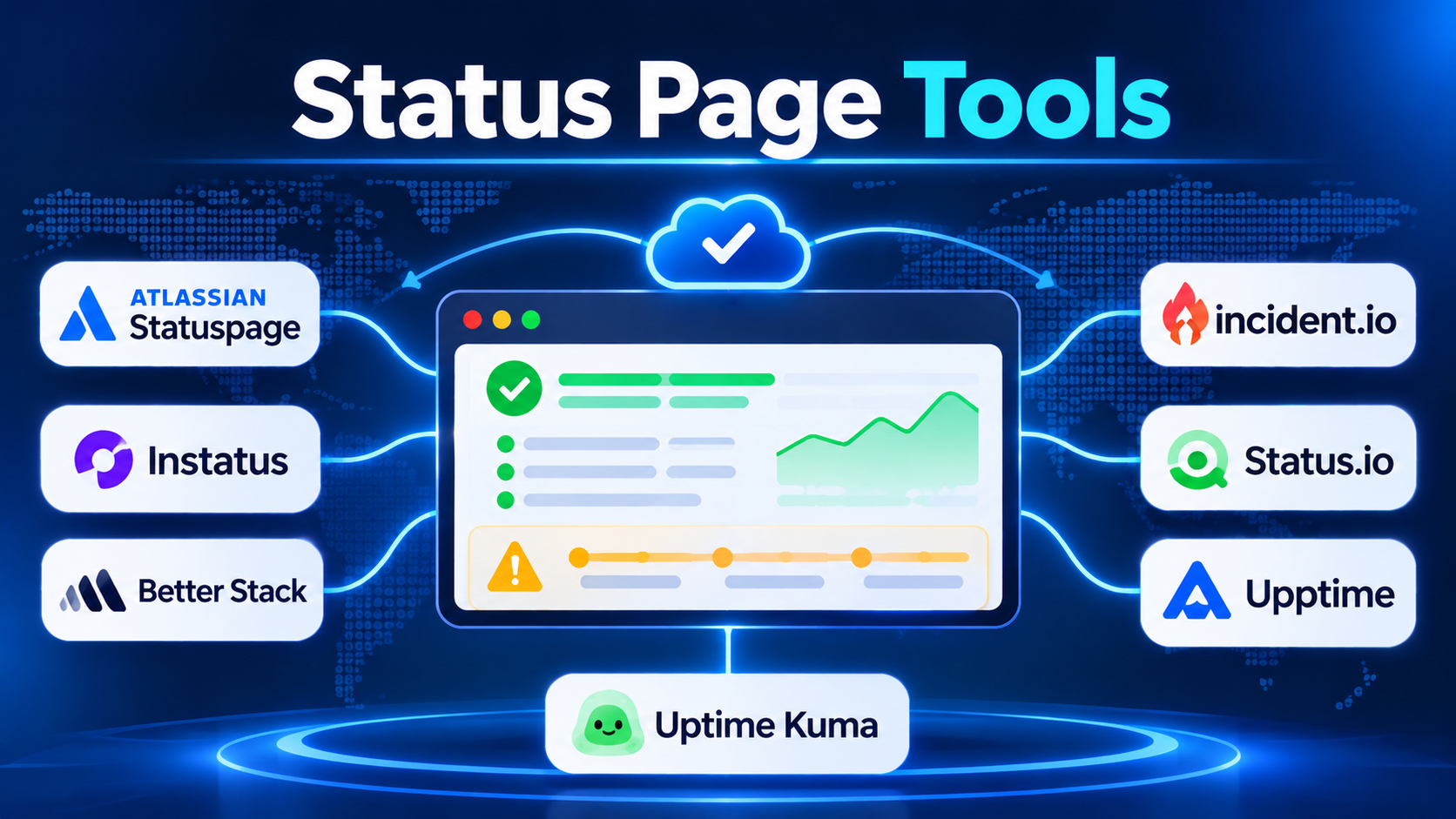
Hosting a status page on the exact same Kubernetes cluster, DNS provider, or cloud region as your primary production application defeats its core purpose: the moment your infrastructure goes offline, your status page disappears with it. Yet infrastructure isolation is only half the problem. During an active outage, support teams get flooded with duplicate tickets when a status page requires manual dashboard edits, lacks automated component state transitions, or sends generic incident blasts to customers whose specific region or product tier is unaffected.
Status page tools solve external and internal outage communication, but the market spans starkly different architectures. Hosted commercial SaaS status platforms prioritize multi-region fault isolation, subscriber management (email, SMS, Slack, webhooks, RSS), and ChatOps integration; all-in-one uptime and observability bundles pair synthetic probing directly with public status boards; and open-source, GitOps-backed status generators publish static pages onto global CDNs with zero recurring subscriber taxes. Selecting the right platform requires matching infrastructure independence, audience segmentation, and incident-workflow integration to your organization’s customer communication model.
Three Architectural Models in Status Page Software
Before comparing specific products, engineering, support, and SRE teams should separate the three operational models that govern how status pages stay online and update during incidents.
1. Isolated Multi-Region Commercial SaaS Status Platforms
Dedicated platforms such as Atlassian Statuspage, Instatus, Status.io, and Cachet (hosted) run on independent cloud infrastructure separate from your application stack—providing built-in subscriber databases, email/SMS delivery pipelines, custom domain TLS, and component-level status APIs.
- Core strength: True fault isolation from your production hosting environment alongside turnkey subscriber notifications and customer-facing SLA uptime history.
- Primary trade-off: Commercial pricing tiers frequently gate essential features—such as SSO authentication for private internal status pages, custom CSS/HTML branding, or high subscriber counts—behind escalating monthly plans.
2. Static-Site and GitOps-Driven Open-Source Status Pages
Tools like Upptime (powered by GitHub Actions, GitHub Issues, and GitHub Pages) and cState (built on Hugo) generate static HTML/JSON status pages deployed directly to edge CDNs (Cloudflare Pages, GitHub Pages, Netlify).
- Core strength: Near-zero hosting cost, massive CDN survivability during traffic spikes, and full Git auditability of every incident update.
- Primary trade-off: Lacks native multi-channel SMS/webhook subscriber engines and requires technical familiarity with Git workflows rather than point-and-click support-team dashboards.
3. Bundled Uptime Monitoring and Incident-Suite Status Pages
Platforms like Better Stack Uptime, incident.io Status Pages, Rootly, and UptimeRobot embed status pages directly inside broader alerting or incident-response suites—automatically flipping component states when synthetic health checks fail or when an Incident Commander posts an update inside a Slack war room.
- Core strength: Eliminates tool fragmentation by connecting automated uptime probes and ChatOps incident coordination directly to customer-facing updates.
- Primary trade-off: Couples your public communication layer to your alerting or ChatOps vendor, making independent multi-cloud isolation harder to verify unless the vendor hosts status pages on separate edge infrastructure.
Notable Status Page Tools Across Ecosystems
Atlassian Statuspage — Enterprise Ecosystem and Subscriber Standard
Atlassian Statuspage remains the most widely recognized commercial status page platform across B2B SaaS and cloud infrastructure providers. It separates status communication into Public Pages (for external customers), Audience-Specific Pages (displaying only the components relevant to a specific enterprise customer or tenant), and Private Pages (authenticated via SAML SSO/Google Workspace for internal employees).
Statuspage integrates natively with Datadog, New Relic, PagerDuty, Pingdom, Opsgenie, and Jira Service Management, and supports automated third-party component dependencies (allowing you to display upstream AWS, Stripe, or Cloudflare outages directly on your own board). Its primary drawback is pricing structure: subscriber limits, team member seats, and private SSO pages scale steeply as organizations grow.
Instatus — Fast, Flat-Rate Status Pages with Unlimited Subscribers
Instatus emerged as a direct challenger to Atlassian Statuspage’s subscriber-based pricing model, offering unlimited subscribers and unlimited team members across its commercial tiers while serving static-cached status pages from global edge CDNs for fast load times during major incidents.
Instatus supports public and private SAML-authenticated pages, custom domains, multi-language localization, maintenance scheduling, and integrations with Slack, incident.io, PagerDuty, Datadog, and Prometheus Alertmanager. For fast-growing SaaS companies whose customer base outgrows per-subscriber pricing tiers, Instatus offers predictable economics without sacrificing modern UI polish or API automation.
Better Stack (Uptime + Status Pages) — Unified Synthetic Probes and Branded Boards
Better Stack combines multi-location synthetic uptime monitoring, on-call alerting, and customizable status pages inside a single product. When an HTTP, keyword, or heartbeat check fails across multiple verification checkpoints, Better Stack can automatically update the affected component on your status page—or hold updates for human confirmation to prevent false alarms.
Its status pages support custom domains, password/SSO protection, email and webhook subscriptions, and multi-language translations. Teams seeking both external synthetic probing and a clean public status hub gain strong operational consolidation, though organizations already standardized on separate enterprise incident tools may prefer decoupling status pages from their monitoring provider.
incident.io Status Pages — ChatOps-Native Outage Communication
For engineering organizations coordinating live outages inside Slack or Microsoft Teams via incident.io, its native Status Pages capability eliminates the risk of responders forgetting to update external customers while debugging in chat.
During an active incident, the Communications Lead drafts, previews, and publishes status updates—and toggles affected infrastructure components—directly from Slack prompts, keeping internal incident timelines synchronized with external customer notifications. Like Atlassian Statuspage and Instatus, it supports both public pages and SAML-protected internal pages, though its strongest ergonomic advantage applies to teams already using incident.io for war-room coordination.
Status.io — Granular Multi-Region and Container Component Modeling
Status.io is tailored to infrastructure providers and SaaS platforms operating across multiple geographic regions and modular service tiers. Its Infrastructure Visualization matrix lets organizations map components across both functional layers (API, Dashboard, Webhooks, Database) and geographic locations (US-East, EU-Central, AP-South) cleanly without cluttering the page with hundreds of flat rows.
Status.io provides a comprehensive REST API, multi-channel notifications (email, SMS, webhook, Twitter/X, RSS/Atom), and granular metric charting (such as API response-time graphs embedded alongside component health). Its UI feels more utilitarian than newer SaaS entrants, but its matrix modeling remains particularly clear for distributed cloud platforms.
Upptime and Uptime Kuma — Open-Source Self-Hosted and Serverless Alternatives
Engineering teams preferring open-source ownership have two distinct architectural options:
- Upptime runs entirely on GitHub infrastructure—using scheduled GitHub Actions workflows to ping endpoints, opening and closing GitHub Issues automatically when outages occur, and building a static status website hosted on GitHub Pages (or Cloudflare Pages). It requires zero dedicated servers and costs nothing for public repositories, though GitHub Actions scheduling intervals have a practical floor of roughly five minutes.
- Uptime Kuma is a popular self-hosted, Docker-deployed monitoring and status-page tool featuring a clean dashboard, multi-protocol checks (HTTP, TCP, DNS, Docker container status, Push heartbeats), and multiple public status pages. Because Uptime Kuma is self-hosted, teams must deploy it on an external VPS or secondary cloud region separate from their main production cluster so it stays reachable during an outage.
Comparison of Status Page Tools
| Tool / Platform | Hosting & Isolation Model | Pricing & Scaling Driver | Audience Segmentation | Standout Strength | Primary Trade-Off |
| Atlassian Statuspage | Isolated multi-region SaaS | Tiered by subscriber count, page type, & seats | Public, Private (SSO), & Audience-Specific | Deepest third-party monitoring integrations and tenant-specific views | Per-subscriber and private-page pricing escalates sharply at scale |
| Instatus | Edge-cached isolated SaaS | Flat-rate plans (unlimited subscribers & team) | Public & Private (SAML SSO) | Predictable flat pricing with unlimited subscribers and fast static edge delivery | Fewer legacy enterprise ITSM connectors than Atlassian |
| Better Stack | Isolated SaaS + global probe network | Metered by monitors, status pages, & seats | Public & Private (password/SSO) | Combines synthetic uptime probing, on-call paging, and automated status pages | Couples external status communication to your uptime monitoring vendor |
| incident.io Status Pages | Isolated SaaS tied to ChatOps platform | Bundled / tiered with incident.io plans | Public & Private (SSO) | Publishes verified customer updates directly from Slack/Teams war rooms | Best suited for organizations already adopting incident.io |
| Status.io | Isolated cloud SaaS | Tiered by subscribers & components | Public & Private | Clear component-by-region matrix modeling and embedded latency metrics | Interface design is less modern than newer developer-focused tools |
| Upptime | Serverless GitHub Actions + Edge CDN | Free / Open Source (GitHub Actions minutes) | Public (or private GitHub Pages) | Zero server maintenance and high CDN resilience via static generation | Minimum check interval (~5 min) and lacks native SMS/webhook subscriber engines |
| Uptime Kuma | Self-Hosted (Docker / Linux VM) | Free / Open Source | Public (multiple pages) | Fast self-hosted setup with rich protocol checks and clean UI | Requires hosting on isolated external infrastructure to survive main-cluster outages |
Four Operational Rules for Credible Status Pages
1. Never Host Your Status Page on Your Primary Production Infrastructure
If your status page resolves through the same load balancer, Kubernetes ingress, or single-region cloud VPC as your application, a major outage takes down both your product and your communication channel. Always use an independently hosted SaaS status provider or deploy open-source status pages to an isolated external provider and separate DNS zone.
2. Avoid Unfiltered Auto-Flipping on Public Components
Automatically flipping a public status component to “Major Outage” the second a single synthetic check times out creates false-positive panic among enterprise customers and triggers unnecessary SLA credit inquiries. Use automated monitoring to alert your on-call engineer immediately, while requiring human confirmation—or multi-region quorum verification—before publishing public outage banners.
3. Communicate Early with Concrete Impact and Next-Update Cadence
Customers tolerate infrastructure disruptions far better when they know you are aware of the issue and actively investigating. Publish an initial “Investigating” notice within 10–15 minutes of confirming customer impact—specifying which feature or region is degraded, whether data integrity is affected, and when the next update will arrive (for example, every 30 minutes)—even before root cause is known.
4. Separate Internal Stakeholder Pages from External Customer Pages
Support agents, account executives, and leadership need granular internal details (such as affected database shards, internal Slack war-room links, and estimated workaround steps) that do not belong on a public website. Maintain a private SSO-protected internal status page alongside your public board so internal teams stop interrupting incident responders for status checks.
Choosing the Right Status Page Tool
- For scaling B2B SaaS teams wanting predictable pricing with unlimited subscribers and fast global edge delivery: Instatus delivers strong value across both public and SSO-protected internal pages.
- For enterprises requiring tenant-specific audience views and deep Atlassian/Jira Service Management alignment: Atlassian Statuspage remains the most established enterprise standard.
- For engineering organizations coordinating incidents inside Slack or Microsoft Teams: incident.io Status Pages keeps customer communications tightly synchronized with live war-room workflows.
- For teams wanting unified synthetic uptime checks and automated status boards in one tool: Better Stack consolidates probing, alerting, and status communication cleanly.
- For open-source projects and lean engineering teams prioritizing zero recurring SaaS fees: Upptime (via GitHub Pages/Cloudflare) or Uptime Kuma (hosted on an isolated external VPS) provides reliable status visibility under full team control.
