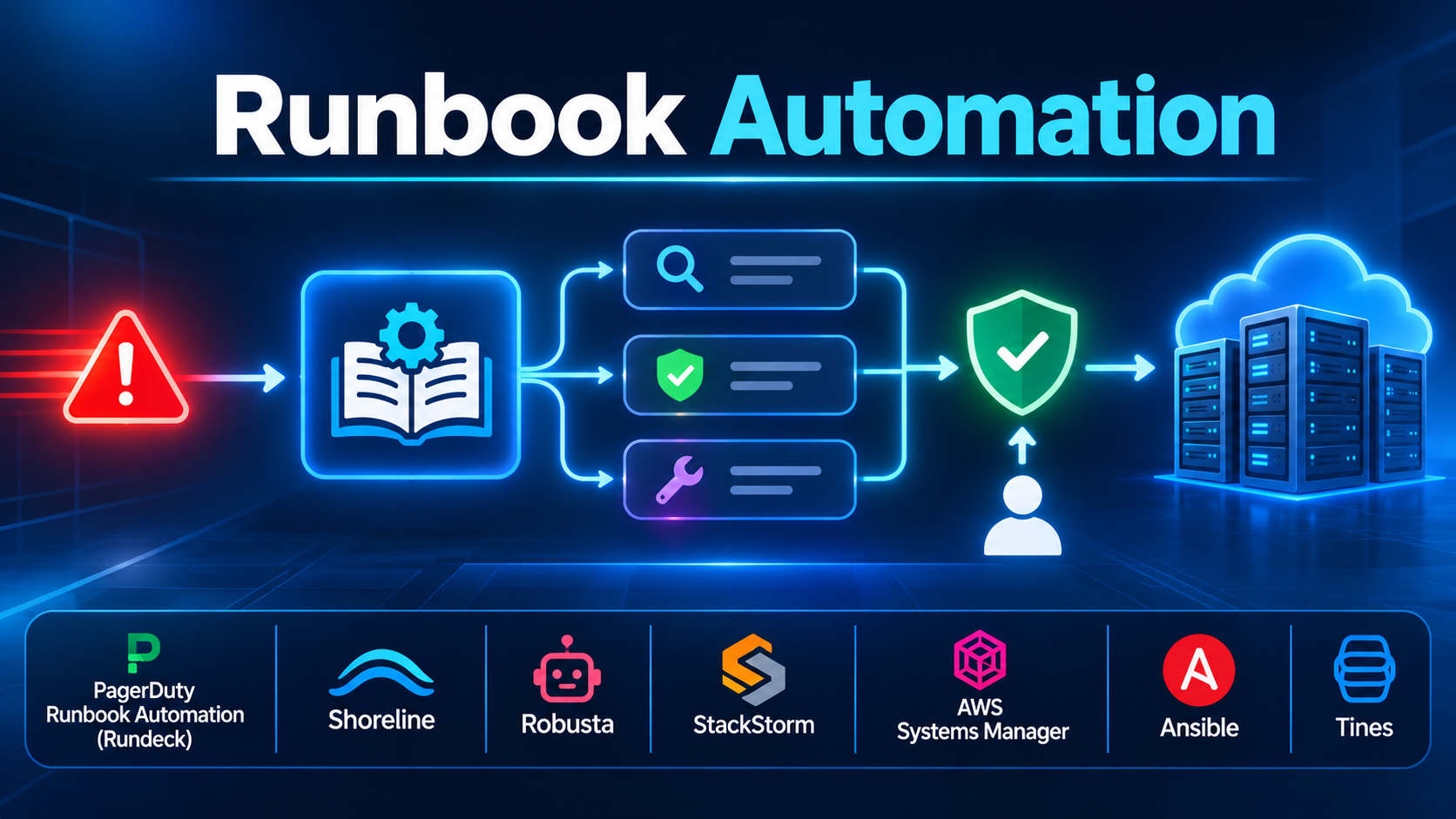
When an alert fires at 2:00 AM, static Markdown runbooks stored in Confluence or Notion frequently fail the on-call engineer. Commands go stale after infrastructure migrations, responders lack direct SSH or production Kubernetes permissions to execute recovery steps, and copying multi-line shell snippets under pressure invites catastrophic typos. Meanwhile, granting junior engineers or support staff unrestricted root access just so they can restart a stuck worker pool violates least-privilege security boundaries.
Runbook automation tools turn static operational documentation into executable, parameterized, and permission-scoped workflows. Rather than exposing raw production credentials, these platforms encapsulate diagnostic checks, service restarts, cache flushes, and failover procedures behind role-based access controls, approval gates, and immutable audit logs. However, the category spans sharply different architectures—from self-hosted job orchestrators and Kubernetes-native auto-remediation engines to no-code SaaS security and cloud operations platforms. Choosing the right tool depends on whether your primary bottleneck is event-driven incident remediation, self-service operational delegation, or cross-cloud workflow orchestration.
Three Distinct Approaches to Runbook Automation
Before comparing individual platforms, platform engineering and SRE teams should separate the three operational models that govern how automated runbooks are authored, triggered, and secured.
1. Self-Service Job and Script Orchestrators
Tools such as Rundeck (PagerDuty Runbook Automation) and Ansible Automation Platform (AWX) wrap existing Bash, Python, PowerShell, and Ansible playbooks inside a web UI and API with parameterized inputs, credential vaults, and node-level inventory targeting.
- Core strength: Lets senior engineers build guardrailed workflows that Tier-1 support, developers, or incident responders can trigger safely without direct SSH or cloud console access.
- Primary trade-off: Requires managing an orchestration server, node executors, and secret integrations across hybrid infrastructure.
2. Event-Driven Auto-Remediation and Kubernetes Controllers
Tools like Robusta, StackStorm, and AWS Systems Manager Automation connect directly to monitoring webhooks (Prometheus Alertmanager, Datadog, CloudWatch) to execute diagnostic data collection or automated healing steps the moment an alert triggers—before a human even acknowledges the page.
- Core strength: Cuts Mean Time to Resolution (MTTR) by attaching live pod logs, thread dumps, or metrics to Slack alerts automatically and resolving known transient failures hands-free.
- Primary trade-off: Poorly scoped auto-remediation rules can trigger remediation loops (for example, repeatedly restarting an unhealthy pod that is failing due to an upstream database outage).
3. Visual Cross-Cloud and SaaS Workflow Builders
Cloud-native automation platforms such as Tines, Torq, and Shoreline (NVIDIA) combine low-code visual workflow builders or fleet-wide real-time execution engines with hundreds of SaaS API connectors (Slack, Jira, Okta, AWS, Kubernetes, Datadog).
- Core strength: Excels at orchestrating multi-step workflows that span infrastructure commands, SaaS API calls, and human approval prompts in chat.
- Primary trade-off: Commercial SaaS licensing models can become expensive as workflow volume or managed node counts scale.
Notable Runbook Automation Tools Across Workflows
PagerDuty Runbook Automation (Rundeck) — Guardrailed Self-Service Operations
Built on the widely adopted open-source Rundeck engine, PagerDuty Runbook Automation is designed to safely delegate operational tasks across hybrid environments—spanning Linux/Windows servers, cloud APIs, databases, and Kubernetes clusters.
Administrators define jobs composed of sequential steps (shell commands, Ansible playbooks, HTTP requests, or AWS/GCP CLI actions) with strict input validation (such as dropdown lists of approved service names rather than free-text shell injection fields). Every execution runs under injected vault credentials and records complete stdout/stderr logs tied to the triggering user or PagerDuty incident. The open-source Rundeck Community edition remains viable for basic self-hosted job scheduling, while commercial tiers add high-availability clustering, runner edge proxies for private networks, and native PagerDuty incident triggers.
Shoreline (NVIDIA) — Real-Time Fleet Debugging and Automated Remediation
Engineered specifically for site reliability engineers managing large-scale cloud and Kubernetes fleets, Shoreline pairs an interactive distributed shell (Op language) with automated alarm-triggered remediation bots.
Rather than SSHing into individual nodes or writing heavyweight orchestration playbooks, engineers query metrics, inspect processes, and execute remediation actions across thousands of containers or VMs simultaneously in real time—and then convert those exact interactive commands into automated Alarms and Bots with built-in rate limits and circuit breakers. Shoreline is particularly strong for high-scale production debugging and fleet-wide auto-healing, though its commercial enterprise focus suits established cloud operations teams rather than small single-server setups.
Robusta — Kubernetes-Native Alert Enrichment and Auto-Remediation
Robusta focuses squarely on Kubernetes reliability, acting as an open-source automation engine that sits alongside Prometheus Alertmanager. When a Kubernetes alert fires (such as CrashLoopBackOff, OOMKilled, or high node disk usage), Robusta intercepts the webhook, gathers contextual diagnostics (pod logs, recent events, Java heap dumps, or node metrics), and posts an enriched summary directly to Slack or Microsoft Teams.
Teams configure YAML-based playbooks to trigger automated remediation steps—such as scaling deployments, deleting stuck jobs, or running diagnostic containers—while keeping configurations version-controlled in Git. Because Robusta is purpose-built for Kubernetes, organizations running primarily traditional virtual machines or legacy network appliances will need a broader hybrid orchestrator.
StackStorm — Event-Driven “If-This-Then-That” Infrastructure Automation
Maintained as an open-source, Python-based automation platform, StackStorm connects infrastructure sensors, trigger rules, and multi-step workflows (Orquesta) across hundreds of community packs (Linux, AWS, Kubernetes, Jira, Slack, VMware, and network devices).
StackStorm excels at complex event-driven automation where a monitoring alert, webhook, or message-queue event initiates conditional branching logic, diagnostic checks, and human-in-the-loop chat approvals (ChatOps). Its modular pack architecture offers deep extensibility with zero licensing fees, though self-hosting and upgrading its multi-service stack (RabbitMQ, MongoDB, PostgreSQL, and Python virtual environments) requires dedicated platform engineering maintenance.
AWS Systems Manager Automation — Native AWS Operational Runbooks
For organizations standardized on Amazon Web Services, AWS Systems Manager (SSM) Automation provides managed runbook execution defined in YAML or JSON documents without deploying external agents or orchestration servers.
SSM runbooks natively orchestrate EC2 instance restarts, AMI patching, RDS snapshots, IAM remediations, and auto-scaling actions—integrating directly with Amazon CloudWatch Alarms, EventBridge, and AWS Config compliance rules. Execution permissions are governed strictly by IAM roles and CloudTrail audit logs. Its primary limitation is scope: while SSM Hybrid Activations can manage on-premises servers, teams operating heavily across multi-cloud or complex SaaS API ecosystems often prefer cloud-agnostic orchestrators.
Ansible Automation Platform (and Open-Source AWX) — Configuration-as-Code Runbooks
When engineering teams already write infrastructure automation in Ansible, AWX (open source) and Red Hat Ansible Automation Platform turn existing playbooks into role-gated, API-callable operational runbooks.
By exposing Ansible inventories, encrypted credential stores, survey prompts, and webhook listeners through a centralized RBAC interface, teams reuse the exact same idempotent YAML playbooks for both scheduled configuration management and emergency incident remediation. For rapid, sub-second diagnostic queries across ephemeral Kubernetes pods, however, Ansible’s SSH/inventory execution model feels heavier than Kubernetes-native controllers or distributed fleet agents.
Tines — No-Code Workflow Orchestration Across Security and IT Operations
Originally adopted heavily by Security Operations Centers (SOAR) and increasingly used by IT and cloud operations teams, Tines provides a visual, storyboard-style workflow engine that connects any tool exposing a REST API.
Without writing custom glue code, engineers build automated triage and remediation flows that enrich alerts, post interactive approval buttons in Slack or Microsoft Teams, execute cloud API actions, and update Jira or ServiceNow tickets. Tines shines when runbooks span identity providers, ticketing systems, and cloud APIs, though deep OS-level shell execution still relies on pairing Tines with host-level runners such as AWS SSM or Rundeck.
Comparison of Runbook Automation Tools
| Tool / Platform | Primary Architecture | Target Infrastructure | Authoring & Execution Model | Standout Strength | Primary Trade-Off |
| PagerDuty Runbook Automation (Rundeck) | Self-service job & script orchestrator | Hybrid VMs, Linux/Windows, Cloud, K8s | Web UI, YAML/JSON jobs, Bash/Python/Ansible | Strict RBAC parameter guardrails and credential isolation for delegated ops | Self-hosted server and runner maintenance overhead |
| Shoreline (NVIDIA) | Distributed fleet execution & auto-remediation | Cloud VMs & Kubernetes fleets | Interactive Op CLI + automated Alarm/Bot rules | Real-time fleet-wide debugging converted directly into rate-limited auto-healing | Enterprise commercial pricing geared toward large cloud fleets |
| Robusta | Kubernetes alert-enrichment & playbook engine | Kubernetes clusters | YAML playbooks triggered by Prometheus alerts | Enriches alerts with live pod diagnostics and runs GitOps-friendly K8s actions | Scoped exclusively to Kubernetes environments |
| StackStorm | Open-source event-driven automation engine | Hybrid cloud, network, Linux, & ChatOps | Python actions + YAML Orquesta workflows | Flexible sensor-rule-action model with broad open-source integration packs | Multi-component self-hosted stack requires active administration |
| AWS Systems Manager Automation | Managed cloud operational runbook service | AWS services & hybrid managed nodes | YAML/JSON SSM Documents + EventBridge | Zero infrastructure hosting with native IAM permissions and CloudTrail auditing | Tied primarily to AWS infrastructure and APIs |
| Ansible AWX / AAP | Agentless configuration & job runner | Hybrid servers, network gear, & cloud APIs | Idempotent Ansible YAML playbooks + survey forms | Reuses existing configuration-management playbooks as RBAC-gated runbooks | Slower execution startup for real-time sub-second container diagnostics |
| Tines | Visual API & SaaS workflow orchestrator | Cloud APIs, ChatOps, ITSM, & security tools | Visual storyboard builder + HTTP/webhook steps | Fast cross-platform API orchestration with built-in chat approval workflows | Relies on external runners for direct OS-level shell commands |
Four Guardrails That Prevent Automated Runbooks from Causing Outages
1. Enforce Circuit Breakers and Cooldown Windows
An automated remediation rule that triggers infinitely can turn a minor degradation into a complete outage. Every event-driven runbook must enforce rate limits (for example, maximum two automated restarts per service within 30 minutes) and escalate to a human on-call engineer if the underlying symptom persists after automated intervention.
2. Distinguish Read-Only Diagnostics from Mutating Actions
The safest and highest-ROI starting point for runbook automation is zero-risk diagnostic enrichment: automatically capturing thread dumps, recent deployment diffs, slow query logs, or pod events the instant an alert fires. Reserve automated state-changing actions (restarts, failovers, traffic drains) for well-understood failure modes with verified rollback paths.
3. Eliminate Free-Text Shell Inputs in Self-Service Forms
When exposing runbooks to support engineers or developers, never pass unvalidated text fields directly into shell commands. Use strict dropdown enumerations, regex-validated parameters, and scoped service accounts so users can select only approved environments and targets.
4. Version-Control Runbooks Alongside Application Code
Runbooks stored exclusively inside a web database drift away from production reality just like static wikis. Store runbook definitions as YAML or JSON inside Git repositories—requiring pull-request reviews and staging dry runs whenever infrastructure or service topologies change.
Choosing the Right Runbook Automation Tool
- For delegating hybrid server, database, and cloud operational tasks safely to support and engineering teams: PagerDuty Runbook Automation (Rundeck) or Ansible AWX provides mature RBAC guardrails, credential vaults, and full audit logs.
- For Kubernetes-centric SRE teams drowning in noisy Prometheus alerts: Robusta immediately cuts triage time by enriching alerts with live pod context and executing declarative Kubernetes remediation playbooks.
- For large cloud operations teams debugging and auto-healing across thousands of nodes in real time: Shoreline bridges interactive fleet-wide diagnostics with automated remediation bots.
- For AWS-standardized organizations wanting managed, IAM-governed operational runbooks with zero server overhead: AWS Systems Manager Automation integrates natively with CloudWatch and EventBridge.
- For teams orchestrating multi-tool workflows across Slack, Jira, identity providers, and cloud APIs: Tines (or open-source StackStorm for self-hosted event-driven setups) connects APIs and human approval steps cleanly.
