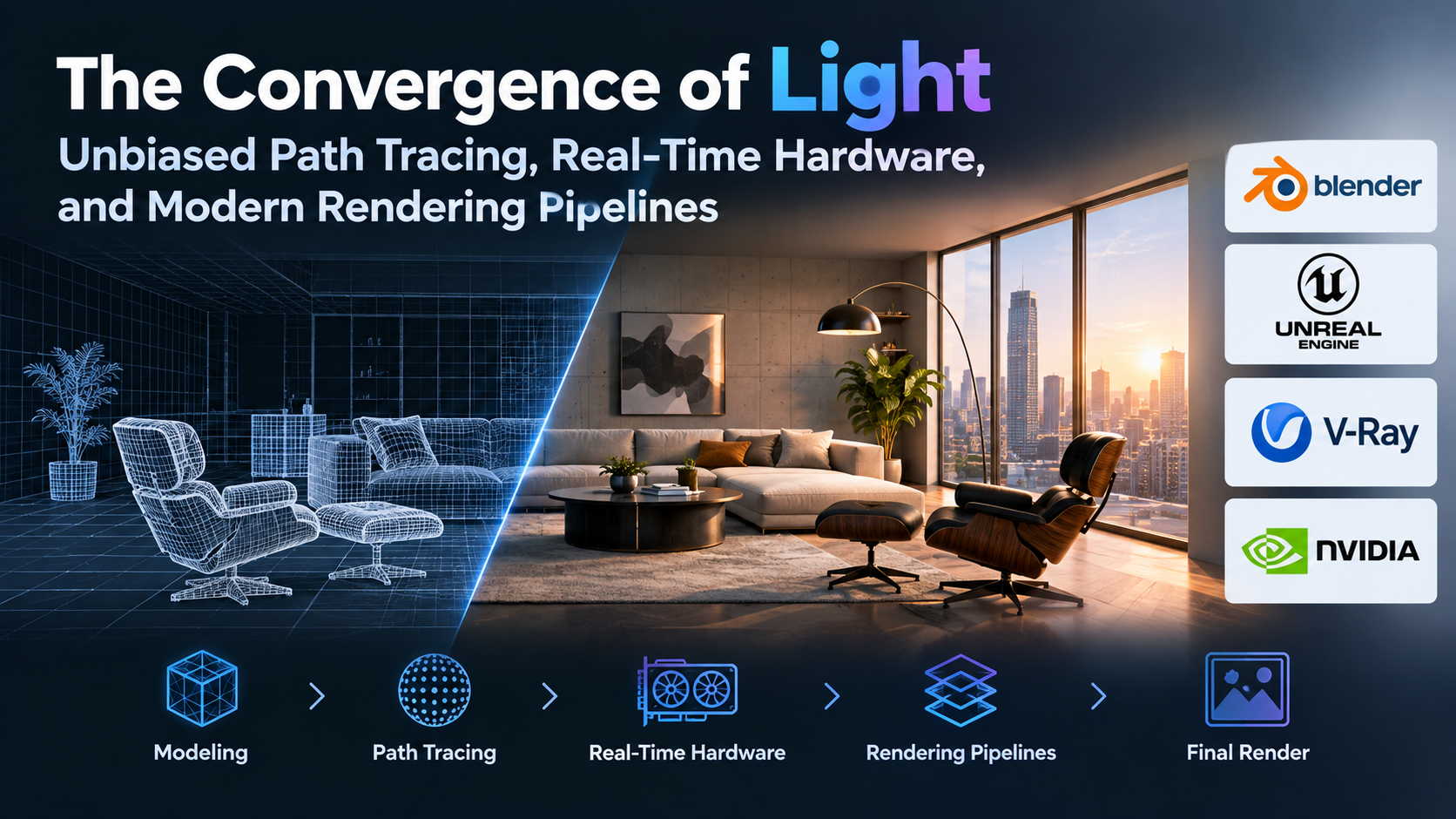
Producing a believable three-dimensional image requires solving the Rendering Equation—a complex mathematical formulation of light energy equilibrium across surfaces. For decades, the film, design, and visualization industries were forced into a sharp compromise: either spend hours per frame calculating the true physics of light bounces through offline CPU rendering, or accept the visual limitations of rasterization and screen-space approximations to maintain real-time viewport speeds.
Dedicated hardware-accelerated ray tracing, AI-driven spatial denoising, and unified GPU architectures have upended this traditional divide. The boundary between offline production rendering and interactive viewport feedback has largely collapsed.
Yet, as tools converge, the criteria for selecting a rendering engine have grown more demanding. Studios and visualization artists no longer debate simply whether an engine looks realistic. Instead, they must evaluate memory scalability across massive datasets, network licensing overhead, shader graph portability, and whether an engine favors physical truth or creative manipulation.
The Core Radiometry: How Modern Render Engines Solve Light
A rendering engine is primarily defined by how it samples light transport across digital geometry. Understanding the mathematical approaches that power these engines reveals why different tools behave differently in heavy production.
Biased vs. Unbiased Rendering
The distinction between biased and unbiased rendering lies at the heart of lighting calculation:
- Unbiased Rendering (Path Tracing): An unbiased engine uses Monte Carlo algorithms to sample light paths without introducing systematic mathematical shortcuts. Light rays originate at the camera sensor, pass through pixels, bounce off surfaces according to Bidirectional Reflectance Distribution Functions (BRDF), and terminate at light sources. Given sufficient sample iterations, an unbiased path tracer will converge on a physically accurate solution, capturing soft shadow penumbras, color bleeding, and indirect caustics naturally. The primary drawback is high-frequency noise (“fireflies”), which demands extensive sampling or post-process reconstruction to clean up.
- Biased Rendering: A biased engine intentionally introduces mathematical approximations and user-defined cutoff thresholds to reduce render times. It may clamp indirect light bounces, interpolate irradiance across spatial point clouds (irradiance caching), or suppress complex caustic paths. Biasing gives artists granular control to dial out noise manually and accelerate renders, but it requires technical expertise to prevent blotchy lighting artifacts, light leaks, and inconsistent frame-to-frame flickering in animations.
Pure Path Tracing vs. Photon Mapping and Manifold Exploration
Standard unidirectional path tracing excels at diffuse inter-reflections and direct illumination, but it struggles with complex indirect caustics—such as sunlight focused through a curved glass decanter onto a wooden tabletop or light refracting through ocean waves into an underwater pool.
Because the probability of a random ray tracing backward from the camera striking a pinpoint light source through multiple specular refractions is mathematically minuscule, pure path tracers exhibit severe noise in caustic regions.
Advanced engines address this by incorporating bidirectional path tracing, photon mapping, or Manifold Next Event Estimation (MNEE). These techniques shoot photons from the light source simultaneously with rays from the camera sensor, building bidirectional connections that resolve complex refractive paths with significantly fewer total samples.
Denoisers: Spectral Reconstruction vs. Machine-Learning Inference
Modern ray tracing relies heavily on denoising to make path tracing computationally viable for tight deadlines. Denoising filters examine incomplete, noisy render passes and reconstruct clean surfaces by referencing auxiliary data buffers:
- Surface Normal Buffers: Identify sharp physical edges to prevent the filter from blurring geometric boundaries.
- Albedo Buffers: Distinguish pure surface color and texture detail from light noise.
- Motion Vectors: Allow temporal denoisers to evaluate previous and future frames during animation, preventing temporal boil and crawling pixel artifacts.
Production environments rely on open, CPU/GPU-agnostic neural engines like Intel Open Image Denoise (OIDN) or proprietary, tensor-accelerated solutions like NVIDIA OptiX. While denoising can reduce render times significantly, aggressive denoising risks scrubbing away high-frequency specular micro-detail, softening fine hair grooms, and smoothing out detailed bump textures.
Evaluating the Leading Rendering and Ray Tracing Platforms
The rendering landscape encompasses standalone DCC plugins, enterprise visual effects production workhorses, and specialized architectural visualization suites.
Chaos V-Ray: The Production Workhorse of Visualization
V-Ray is one of the most widely deployed commercial renderers across architectural visualization, automotive styling, and commercial visual effects.
- Core Architecture: V-Ray features a dual-engine architecture: V-Ray CPU and V-Ray GPU. The CPU engine is a hybrid path tracer offering deep control over both biased approximations and brute-force unbiased rendering. The GPU engine utilizes CUDA and OptiX to accelerate ray tracing across local graphics hardware.
- Key Capabilities: Its material ecosystem—centered on the V-Ray Material (VRayMtl)—is an industry standard, handling complex translucency, sub-surface scattering (SSS), and thin-film iridescence with predictable physical accuracy. It includes built-in atmospheric simulation, aerial perspective, sun-and-sky systems, and the V-Ray Frame Buffer (VFB), which provides complete multi-layer color grading, lens flare generation, and light-mixing adjustments directly inside the application without round-tripping to compositing software.
- Operational Limitations: The split between V-Ray CPU and V-Ray GPU remains an operational friction point. Certain advanced shader nodes, edge-case plugins, and memory configurations supported in the CPU engine do not always carry absolute feature parity in the GPU engine, requiring pipeline supervisors to design assets specifically for their target hardware pipeline.
Chaos Corona: Streamlined Photorealism for Architectural Visualization
Developed alongside V-Ray within the Chaos ecosystem, Corona is tailored specifically for architectural visualization, interior design, and commercial product rendering.
- Core Architecture: Unlike V-Ray’s expansive technical settings, Corona is an intentionally streamlined, CPU-based unbiased path tracer (with GPU acceleration utilized for interactive previews). It abstracts away complex ray sampling sliders, irradiance caches, and anti-aliasing subdivisions in favor of an intuitive, photography-centric workflow.
- Key Capabilities: Corona is renowned for its LightMix technology, which allows artists to alter the color, intensity, and active state of individual light groups during or after the rendering process without re-rendering the scene. Its procedural sky models, automated tone mapping, and integrated material libraries allow artists to achieve production-grade realism with minimal technical calibration.
- Operational Limitations: Corona remains firmly focused on the architectural and design visualization markets. It lacks the deep Linux shell pipeline integrations, OpenUSD layer authoring, and complex arbitrary output variable (AOV) configurations required by high-end Hollywood VFX and character animation facilities.
Autodesk Arnold: Unbiased Elegance and Studio Pipeline Predictability
Originally developed by Marcos Fajardo and acquired by Autodesk, Arnold transformed film VFX by proving that pure, brute-force Monte Carlo path tracing was practical for large-scale movie production.
- Core Architecture: Arnold functions as an unbiased, unidirectional path tracer. It was engineered to eliminate the manual caching and trickery previously required by biased engines, prioritizing mathematically correct light transport and predictable rendering behavior across distributed render farms.
- Key Capabilities: Arnold’s memory management is exceptionally robust. It natively streams massive, multi-gigabyte open-format assets (via Arnold ASS files) without loading entire environments into active RAM, enabling studios to render dense forest environments and intricate mechanical assemblies seamlessly. Arnold GPU allows artists to toggle between CPU processing and GPU acceleration using the same core shader networks, while its standard surface shader serves as a clean, standardized implementation of physical shading.
- Operational Limitations: While Arnold GPU has matured, Arnold’s foundational architecture remains deeply optimized for large CPU render farms. For small studios or independent artists lacking large render clusters, Arnold’s pure path-tracing approach can yield longer baseline frame render times compared to engines built from the ground up purely for multi-GPU crunch.
Cycles: Open-Source Democratization and Production Scale
Cycles is the native, open-source path tracer developed by the Blender Foundation, also available as a standalone plugin for applications like Rhino.
- Core Architecture: Cycles is a physically based path tracer optimized for modern multi-threaded CPU and GPU hardware. Re-architected under the “Cycles X” initiative, it features a modern scheduling core that combines wave-front execution with dedicated hardware ray tracing APIs (NVIDIA OptiX, AMD HIP, Intel OneAPI, and Apple Metal).
- Key Capabilities: Cycles provides zero-cost access to world-class path tracing. It offers complete feature parity between CPU and GPU hardware, native integration with Open Image Denoise, micro-polygon displacement, and advanced volume scattering for fire, smoke, and clouds. Its tight coupling with Blender’s node graph and Geometry Nodes enables artists to build procedural shading and instancing pipelines without commercial licensing fees.
- Operational Limitations: When deployed outside the native Blender environment, standalone Cycles integrations lack the turnkey pipeline support and mature plugin ecosystems enjoyed by established commercial competitors. In studios running hybrid proprietary DCC pipelines, its asset management and specialized AOV management require internal technical development to match enterprise platforms.
Maxon Redshift: High-Octane Biased GPU Acceleration
Redshift was engineered from inception as a dedicated, production-focused GPU renderer designed to meet the speed demands of broadcast graphics, commercial animation, and tight agency deadlines.
- Core Architecture: Redshift is a biased GPU renderer. It allows artists to tune ray termination parameters, decouple sample counts across individual lights and materials, and selectively approximate complex lighting paths to maximize frame throughput across NVIDIA and Apple Silicon hardware.
- Key Capabilities: Raw speed is Redshift’s defining attribute. By giving artists the flexibility to bias renders and prioritize fast approximations over strict physical simulation, it excels at high-frame-rate turnaround for motion graphics in Cinema 4D and Maya. Its “out-of-core” architecture allows it to offload system memory dynamically when geometry or texture files exceed local GPU VRAM, preventing out-of-memory crashes on dense scenes.
- Operational Limitations: Redshift’s biased nature means that achieving visual accuracy requires hands-on calibration. Artists must carefully manage sample distribution across diffuse, reflection, and shadow channels to eliminate grain without blowing out render times, making it more technically complex to balance than modern “set-it-and-forget-it” unbiased engines.
LuxCoreRender: Advanced Open-Source Optical Accuracy
LuxCoreRender is an open-source physically based renderer dedicated to uncompromising optical accuracy and complex physical simulation.
- Core Architecture: Built upon the academic roots of PBRT (Physically Based Ray Tracing), LuxCoreRender specializes in fully unbiased bidirectional path tracing, photon mapping, and advanced spectral light transport.
- Key Capabilities: LuxCoreRender handles complex optical physics that defeat standard commercial path tracers. It resolves true refractive and reflective glass caustics, dispersion (splitting white light into optical rainbow spectrums), and volumetric illumination with high mathematical fidelity. It runs across heterogeneous hardware environments via open standards.
- Operational Limitations: The engine lacks commercial studio adoption and dedicated third-party DCC integration support. Its focus on physical accuracy over artistic biasing makes it impractical for tight commercial production deadlines or narrative character animation where non-physical artistic lighting adjustments are required.
Technical Comparison Matrix
| Engine | Primary Rendering Method | Target Hardware | Primary Operational Fit | Key Technical Differentiator | Practical Trade-Off |
| Chaos V-Ray | Hybrid Path Tracer (Biased/Unbiased) | CPU & GPU (CUDA/OptiX) | ArchViz, commercial VFX, automotive, product design | Comprehensive VFB tooling, robust material ecosystem | Feature discrepancies between CPU and GPU operational modes |
| Chaos Corona | Unbiased Path Tracer | CPU (Interactive GPU preview) | Architectural interiors, residential design visualization | Turnkey setup, interactive LightMix post-processing | CPU-bound production; limited VFX and studio pipeline integration |
| Autodesk Arnold | Unbiased Monte Carlo Path Tracer | CPU & GPU (OptiX) | Feature film VFX, episodic TV, complex character pipelines | Exceptional memory handling, stable procedural geometry streaming | Baseline render times can be high without extensive CPU render farms |
| Cycles | Physically Based Path Tracer | Heterogeneous GPU/CPU (OptiX, HIP, Metal, OneAPI) | Indie animation, VFX, commercial art, open-source pipelines | Zero licensing cost, modern wave-front scheduling architecture | Less turn-key out-of-the-box integration into proprietary enterprise DCCs |
| Maxon Redshift | Biased GPU Accelerator | GPU-centric (NVIDIA CUDA, Apple Metal) | Motion graphics, broadcast design, fast commercial turnarounds | Out-of-core VRAM handling, high frame throughput | Requires manual tuning of sampling noise; non-physical artistic bias |
| LuxCoreRender | Unbiased Bidirectional Path Tracer | Heterogeneous OpenCL/C++ CPU/GPU | Academic research, physical optical simulation, jewelry rendering | Exceptional refractive caustic and spectral dispersion resolution | Limited commercial DCC plugins; slower convergence on complex scenes |
Critical Factors in Enterprise Render Pipeline Architecture
Selecting an engine involves evaluating how the software interacts with physical compute hardware, networking, and asset management systems.
VRAM Limits and the Out-of-Core Challenge
GPU rendering delivers massive speed advantages over CPU clusters, but it introduces an architectural ceiling: Video Random Access Memory (VRAM).
While a typical enterprise CPU server can easily house 256GB to 1TB of system RAM, professional workstation GPUs generally top out at 24GB to 48GB per card. When an intricate scene—packed with 8K UDIM texture sets, billions of instanced grass blades, and dense volumetric atmosphere—exceeds local GPU memory, the renderer faces a critical choice:
- Immediate Crash: The driver throws an out-of-memory (OOM) error and terminates the process.
- NVLink Interconnect: If supported hardware is paired via high-speed bridge links, VRAM pools can be mirrored or shared across adjacent cards, though this requires dedicated enterprise hardware configurations.
- Out-of-Core Paging: The rendering engine dynamically pages overflow assets from fast system RAM over PCIe lanes. While out-of-core paging prevents scene crashes, it introduces PCIe bus bandwidth bottlenecks that can degrade rendering performance.
For studios handling massive datasets, testing an engine’s behavior under out-of-core stress is vital before abandoning CPU render farms.
Shader Portability: MaterialX and Open Shading Language (OSL)
Proprietary material networks create severe studio lock-in. Rebuilding a photorealistic asset library originally developed in one engine for a different renderer requires hundreds of hours of shader recreation.
To prevent this, production pipelines rely increasingly on:
- Open Shading Language (OSL): Developed by Sony Pictures Imageworks, OSL allows technical directors to write custom, programmable shader nodes that compile across multiple production engines without rewriting source code.
- MaterialX: An open standard originally developed by Industrial Light & Magic. MaterialX enables artists to package surface properties, sub-surface profiles, and procedural texture coordinates into an open, XML-based description. A MaterialX asset authored in a look-development package can be ingested and rendered identically by Arnold, V-Ray, or real-time USD Hydra delegates without manual material translation.
The Real-Time Paradigm: Offline Path Tracing vs. Real-Time Engines
The growth of game engines like Unreal Engine and real-time ray-tracing environments has led many organizations to question whether offline renderers are becoming obsolete.
Real-time engines excel at experiential delivery: virtual production LED stages, interactive architectural configurators, and fast visualization previews. However, they rely on temporal accumulation, screen-space limits, and aggressive geometric Level of Detail (LOD) caching to maintain real-time frame rates.
When an assignment demands deep sub-surface light penetration across layered skin tissue, true micro-facet hair dispersion, complex glass caustics, and ultra-high-resolution print output, offline path tracing remains the standard of physical truth. Rather than replacing offline renderers, real-time tools serve as complementary systems for interactive review and experiential production.
Strategic Selection Framework
To identify the right rendering tool, evaluate your technical pipeline against these distinct operational paths:
Path A: The High-Volume Architectural and Visualization Studio
- Core Priority: Photorealistic lighting turnaround, fast client revisions, intuitive material configuration.
- Recommended Platform: Chaos Corona (for streamlined residential/interior design) or Chaos V-Ray (for complex master-planning, commercial builds, and multi-DCC facilities).
- Deciding Factor: Post-render flexibility. Corona’s and V-Ray’s integrated frame buffers eliminate external compositing steps by allowing artists to adjust atmospheric glare, tone map curves, and individual lighting groups after the frame has finished computing.
Path B: The Feature Film, Episodic VFX, and Character Pipeline
- Core Priority: Mathematical predictability, deep pipeline programmability, massive dataset streaming.
- Recommended Platform: Autodesk Arnold.
- Deciding Factor: Pipeline scalability and data handling. Arnold’s rock-solid memory management, native OpenUSD support, standardized surface shaders, and predictable CPU/GPU behavior make it the safest choice for large technical facilities managing hundreds of remote render nodes and complex shot dependencies.
Path C: The Motion Design, Commercial, and Fast-Turnaround Agency
- Core Priority: Frame render speed, stylization, high-throughput delivery across local workstation hardware.
- Recommended Platform: Maxon Redshift.
- Deciding Factor: Biased performance optimization. When producing 30-second commercial spots or animated brand identity sequences, absolute optical accuracy is secondary to stylistic control and raw rendering velocity across local GPU hardware.
Path D: The Independent Creator or Agile Studio
- Core Priority: Complete pipeline capability, zero licensing overhead, modern GPU acceleration.
- Recommended Platform: Cycles.
- Deciding Factor: Cost-to-performance efficiency. Cycles delivers top-tier, production-ready path tracing without per-seat subscription overhead, freeing up studio capital to invest directly in powerful multi-GPU workstation hardware and high-speed network storage.
Validating an Engine Before Studio Deployment
Before signing multi-seat licensing contracts or migrating an existing asset library, run a structured technical pilot test that pushes the software past standard marketing scenes:
- The VRAM Saturation Benchmark: Build a test scene that intentionally exceeds the VRAM capacity of your primary graphics cards by combining 8K uncompressed textures, heavy displacement modifiers, and dense instanced foliage. Test how the engine responds: does it crash, degrade gracefully via out-of-core memory paging, or halt the local system?
- The Complex Caustic and Transmission Test: Set up an interior room lit solely by sunlight entering through a curved, colored glass vase. Evaluate how many samples and how much compute time the engine requires to resolve indirect caustics without introducing firefly noise or blotchy interpolation artifacts.
- The Denoising Fidelity Audit: Render a character asset featuring fine hair strands and micro-detail skin pores at low sample rates. Apply the engine’s primary denoising algorithms (OptiX, OIDN, or proprietary filters) and inspect the high-frequency areas. Confirm whether the denoiser preserves delicate strands and tactile pore structures or washes them out into plastic-looking surfaces.
- The Pipeline Integration and Licensing Check: Verify the engine’s deployment footprint across your network. Test how seamlessly it functions across non-interactive batch render nodes (headless rendering), review network licensing behavior during high-concurrency jobs, and confirm how cleanly its custom shaders translate across neutral exchange standards like OpenUSD and MaterialX.
