Introduction
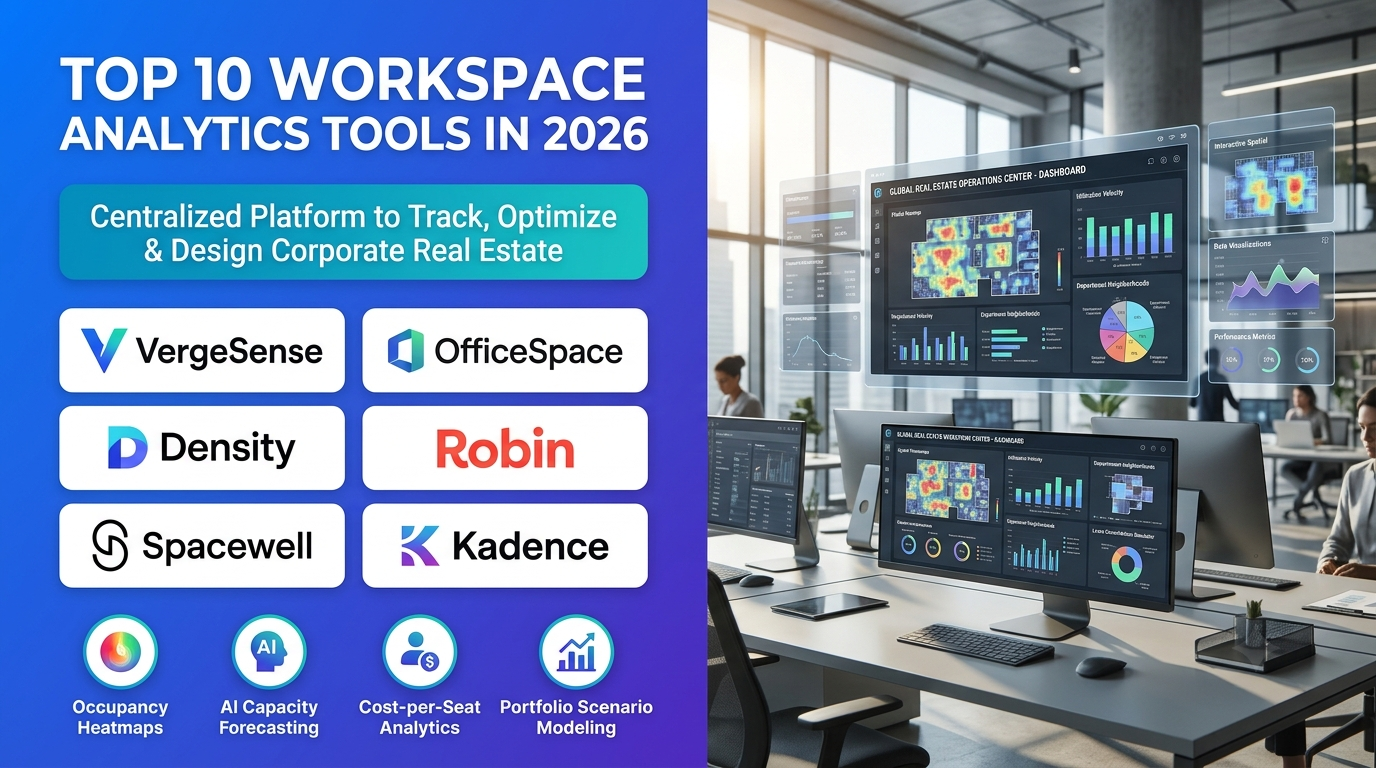
Workspace analytics tools play an important role across major industries in 2026, helping organizations track physical and hybrid office utilization, optimize real estate footprints, and enhance the overall employee experience. These digital solutions provide a centralized platform where corporate real estate, facilities, and human resources teams can aggregate occupancy metrics to minimize operational waste and make data-driven infrastructure decisions.
The limitations and high overhead costs of traditional, manual tracking methods—such as manual headcount logs, guesswork estimates, and disconnected badge-swipe records—often result in massive real estate overspending and mismanaged floor layouts. By adopting dedicated workspace analytics platforms, organizations eliminate these blind spots and replace assumptions with transparent spatial data.
Modern capabilities offered by these software solutions extend far beyond basic headcounts, incorporating AI-powered attendance forecasting, IoT sensor feeds, spatial heatmaps, and deep calendar integrations. These intelligence layers allow workplace strategists to predict peak occupancy days, automate no-show room cancellations, and align office layouts with actual employee collaboration habits.
Choosing the right tool matters significantly for both beginners and experienced corporate real estate professionals, as operational success heavily depends on matching data granularity with infrastructure budgets. Implementing an overly complex hardware-heavy sensor array can strain budgets unnecessarily, whereas selecting a purely software-based tool may lack the room-level precision required for major lease consolidations.
Key selection factors include portfolio size, available budget, technical deployment requirements (hardware vs. cloud-only), and specific data integration needs. For example, a fast-growing tech startup with a single hybrid office requires a lightweight, booking-integrated analytics dashboard, whereas a multi-national financial enterprise demands depth-sensing AI sensors and comprehensive portfolio scenario modeling.
This comprehensive guide covers everything needed to navigate the workspace analytics software selection process, including individual tool breakdowns, a comparative summary table, customized user persona recommendations, a step-by-step practical workflow, and frequently asked questions.
What Is Workspace Analytics Tools?
Workspace analytics tools refer to digital software platforms designed to measure, analyze, and optimize how physical office environments are utilized by employees and guests. Conceptually, these systems operate by ingesting data from multi-source pipelines—including Wi-Fi connection logs, badge access systems, desk reservation apps, and IoT occupancy sensors—to construct comprehensive utilization metrics.
For instance, a corporate real estate manager utilizing these platforms can analyze multi-floor occupancy trends to discover that Wednesday peak attendance reaches 85% while Friday occupancy drops to 15%, justifying a strategic floor consolidation plan. This structured data environment improves operational efficiency by lowering square footage overhead, reducing energy consumption on underoccupied floors, and ensuring collaborative spaces match actual demand.
Common applications of workspace analytics tools include:
- Real Estate Portfolio Optimization: Analyzing multi-building utilization rates to justify lease reductions, square footage downsizings, or building exits.
- Hybrid Policy Tuning: Evaluating core in-office days and team co-attendance patterns to refine hybrid work mandates.
- Space Planning and Architecture: Modeling floor plan layout shifts and converting underused private offices into collaborative team zones.
- Energy and Facility Cost Reduction: Dynamically adjusting HVAC and lighting schedules based on real-time zone occupancy metrics.
- Desk and Meeting Room Right-Sizing: Tracking unbooked squatting, ghost meetings, and no-show rates to reallocate workstation inventory.
- Employee Experience Improvement: Identifying friction points such as chronic overcrowding, noise pollution, or scarce quiet focus areas.
- Capacity and Safety Compliance: Monitoring real-time human density limits to maintain building safety and regulatory standards.
- Workplace Technology Auditing: Measuring adoption rates of desk booking apps and hardware sign-in systems across business units.
Top 10 Workspace Analytics Tools in 2026
1. VergeSense
VergeSense is developed by VergeSense and serves as an AI-powered occupancy intelligence and predictive planning platform designed for large enterprises. It targets corporate real estate and workplace teams managing multi-building portfolios who require high-accuracy data to justify consolidation and lease decisions. Its standout technical advantage is its Large Spatial Model (LSM), which combines proprietary depth-sensing hardware with machine learning to track active and passive occupancy. The platform excels in ecosystem scalability, offering unified data layers that consolidate sensor, Wi-Fi, badge, and booking inputs.
– AI Occupancy Intelligence: Leverages depth-sensing area sensors to capture active presence and passive indicators like laptops and personal items. – Predictive Scenario Modeling: Models space mix, headcount growth, and hybrid policy shifts to identify right-sizing opportunities before capital commitment. – Unified Data Layer: Consolidates sensor telemetry, Wi-Fi connection logs, badge access swipes, and desk bookings into a single source of truth. – Space Booking Automation: Automatically releases abandoned meeting rooms and synchronizes live availability across major workplace platforms. – Portfolio Benchmarking: Compares internal space utilization metrics against an extensive real-world workplace dataset. – Privacy-First Processing: Executes on-device data processing without video streaming or storing personally identifiable information. – Native Enterprise Integrations: Connects seamlessly with Microsoft 365, Google Workspace, ServiceNow, and Archibus. – Real-Time Heatmapping: Generates granular spatial utilization maps to visualize traffic flow and zone demand.
- Combines high-accuracy sensor hardware with advanced AI predictive forecasting.
- Helps real estate teams cut excess lease expenditures through verified portfolio data.
- Reduces ghost meetings and unclaimed desk reservations automatically.
- Supports complex scenario planning for future headcount distributions.
- Provides robust privacy protections via anonymous, non-video optical processing.
- Makes cross-system data stitching effortless with pre-built enterprise integrations.
- Offers reliable benchmark comparisons against industry standards.
- Industry-leading AI predictive planning and large spatial modeling capabilities.
- Extremely high occupancy tracking accuracy exceeding ninety-five percent.
- Comprehensive multi-source data unification framework.
- Privacy-compliant sensor architecture protecting employee identity.
- Extensive ecosystem of enterprise facility management connectors.
- Hardware deployment requires upfront capital expenditure and physical installation.
- Subscription pricing model and hardware costs are tailored primarily for large enterprises.
- Setup complexity demands dedicated facilities management oversight.
- Advanced predictive modeling features require clean historical baseline data.
- Overwhelming configuration depth for smaller organizations with simple office setups.
- Enterprise Lease Consolidation: Analyzing multi-building footprints to execute strategic downsizing and cost reductions.
- Global Portfolio Space Planning: Managing spatial allocation and headcount changes across international corporate offices.
- Hybrid Attendance Forecasting: Predicting weekly office population surges to optimize catering and facilities operations.
- Meeting Room Optimization: Reclaiming underutilized conference rooms using automated no-show release protocols.
- Executive Real Estate Reporting: Presenting data-backed portfolio utilization summaries directly to the CFO.
- Workplace Safety Auditing: Monitoring high-density zone occupancy to ensure structural capacity compliance.
- Enterprise corporate real estate (CRE) directors.
- Global workplace experience strategists.
- Corporate finance and portfolio planning analysts.
- Enterprise facilities operations leads.
- Commercial real estate consultants.
2. OfficeSpace
OfficeSpace is developed by OfficeSpace Software and provides an enterprise-grade workspace management and analytics platform. It targets large organizations and corporate real estate teams seeking advanced floor plan visualization and real estate forecasting. Its standout technical advantage is its multi-source data engine that merges Wi-Fi telemetry, badge access logs, desk booking data, and IoT sensor feeds into interactive floor plan heatmaps. The platform excels in enterprise space planning, offering robust scenario modeling and cost-per-seat analytics.
– Interactive Visual Floor Plans: Maps out office layouts dynamically to visualize seating arrangements and department neighborhoods. – Multi-Source Occupancy Analytics: Ingests data from Wi-Fi access points, physical badge turnstiles, and reservation apps. – Cost-per-Seat Reporting: Calculates real estate expenditure relative to actual desk utilization rates. – Real Estate Forecasting: Projects future space requirements based on company hiring trajectories and growth trends. – Scenario Planning Tools: Models seating and department layout modifications on floor plans before physical execution. – Move Management Workflows: Coordinates employee desk relocations, equipment transfers, and team neighborhood transitions. – Visitor Registration Integration: Tracks guest foot traffic alongside internal employee attendance metrics. – Comprehensive BI Dashboards: Generates executive-ready reports displaying utilization percentages by day, week, and zone.
- Centralizes complex facility layouts into intuitive, interactive visual floor plans.
- Helps real estate teams calculate accurate cost-per-seat financial metrics.
- Reduces change management friction during large-scale departmental move projects.
- Supports forward-looking real estate forecasting against hiring targets.
- Provides robust multi-source data integration without separate manual tracking.
- Makes scenario modeling accessible before altering physical office structures.
- Offers clear visualization of underperforming spatial zones.
- Highly polished, interactive visual floor plan mapping interface.
- Strong multi-source data ingestion combining badge, Wi-Fi, and booking feeds.
- Advanced move management and scenario modeling capabilities.
- Clear cost-per-seat analytics for financial optimization.
- Scalable architecture designed for enterprise real estate portfolios.
- Custom per-employee pricing model lacks public transparency.
- Does not offer a self-service free trial for software testing.
- Initial floor plan vectorization and cleanup require dedicated onboarding effort.
- Advanced scenario planning features require administrative expertise.
- Mobile application is less optimized for complex floor plan editing than desktop.
- Enterprise Office Consolidation: Merging multiple regional offices into a single optimized corporate facility.
- Departmental Neighborhood Planning: Restructuring floor layouts to co-locate interdependent business units.
- Real Estate Financial Auditing: Reviewing cost-per-seat metrics to justify lease renewals or downsizings.
- Large-Scale Employee Relocations: Managing complex seating move projects across multi-story buildings.
- Hybrid Seating Allocation: Balancing assigned desks with flexible neighborhood hot-desking zones.
- Visitor Traffic Analysis: Tracking guest and contractor volume to size reception areas accurately.
- Enterprise workplace planners.
- Corporate real estate asset managers.
- Facilities operations directors.
- Enterprise change management leads.
- Corporate finance planning officers.
3. Density
Density is developed by Density Inc. and specializes in anonymous, real-time people-counting and spatial occupancy analytics. It targets privacy-sensitive enterprise workplaces, financial institutions, and corporate campuses requiring highly accurate physical counting without video surveillance. Its standout technical advantage is its proprietary radar-based sensor technology (such as the Waffle sensor) that measures human presence anonymously with extreme precision. The platform excels in real-time occupancy tracking, providing second-by-second footfall data across entry points and individual rooms.
– Privacy-Safe Radar Sensors: Uses advanced radio-frequency and infrared hardware to count humans without capturing imagery or personal data. – Real-Time People Counting: Measures exact entry, exit, and occupancy counts across zones and rooms instantly. – Space Utilization Analytics: Evaluates dwell times, peak usage hours, and spatial capacity thresholds. – Automated Capacity Alerts: Triggers notifications when specific zones approach maximum safety or comfort limits. – API Data Export: Streams raw occupancy telemetry into external corporate data lakes and BI platforms. – Historical Trend Reporting: Analyzes long-term utilization patterns to evaluate real estate portfolio efficiency.
- Multi-Building Aggregation: Combines data streams from multiple office locations into a centralized dashboard. – Calibration and Health Monitoring: Tracks sensor operational status remotely to ensure ongoing data accuracy.
- Delivers 100% anonymous occupancy tracking that respects employee privacy standards.
- Helps facilities teams measure exact real-time human density across zones.
- Reduces real estate guesswork with objective, sensor-verified footfall data.
- Supports seamless integration with external enterprise data lakes via robust APIs.
- Eliminates reliance on subjective badge swipes or flawed manual headcounts.
- Makes safety and capacity compliance automated and reliable.
- Offers reliable hardware durability and long operating lifespans.
- Industry-leading anonymous radar sensor technology ensuring complete privacy.
- High-precision real-time people counting and dwell time measurement.
- Robust API architecture for custom data pipeline development.
- Simple, transparent combination of hardware unit costs and software subscriptions.
- Strong adoption among privacy-conscious corporate enterprises.
- Requires physical hardware purchasing and professional installation.
- Software subscription is billed in addition to hardware unit expenses.
- Focuses heavily on counting telemetry rather than broader workplace reservation workflows.
- Internet connectivity is required for continuous cloud data synchronization.
- Initial sensor placement engineering requires careful spatial planning.
- Privacy-First Office Monitoring: Tracking footfall and zone utilization without triggering employee surveillance concerns.
- Cafeteria and Amenity Sizing: Measuring peak crowd volumes in shared dining and breakout areas.
- Conference Room Utilization Audits: Verifying actual meeting room body counts against calendar reservation logs.
- Corporate Campus Security Auditing: Monitoring building entry throughput and zone population densities.
- Real Estate Footprint Right-Sizing: Using objective body-count data to justify lease reductions.
- Workspace Ventilation Optimization: Informing HVAC systems of actual room occupancy levels for energy savings.
- Corporate privacy and compliance officers.
- Enterprise real estate optimization directors.
- Facilities engineering operations leads.
- Workplace experience managers.
- Building automation system integrators.
4. Robin
Robin is developed by Robin Powered, Inc. and provides a comprehensive workplace management and analytics platform tailored for hybrid offices. It targets mid-market to enterprise companies looking to streamline desk booking, room scheduling, and hybrid attendance coordination. Its standout technical advantage is its advanced space optimization engine that analyzes reservation habits and attendance patterns to recommend ideal office policy changes. The platform excels in hybrid office coordination, offering robust mobile applications and deep calendar tool integrations.
– Hybrid Attendance Scheduling: Coordinates office days so team members can see when colleagues plan to be on-site. – Desk and Room Booking Analytics: Tracks reservation volumes, no-show frequencies, and space utilization rates. – Space Optimization Engine: Recommends layout adjustments based on actual booking and check-in behavior. – Interactive Office Maps: Visualizes desk availability and meeting room statuses in real time. – Visitor Management: Registers incoming guests and notifies hosts automatically upon arrival. – Comprehensive Reporting Dashboards: Summarizes office utilization trends and peak attendance days for leadership review. – Calendar Integrations: Syncs natively with Microsoft 365 and Google Calendar to manage scheduling friction. – Mobile Companion App: Enables employees to book desks and locate colleagues directly from their smartphones.
- Simplifies hybrid work coordination with intuitive peer visibility features.
- Helps organizations identify chronic desk hoarding and unutilized space.
- Reduces administrative scheduling friction through deep calendar synchronization.
- Supports data-driven office policy adjustments using concrete booking trends.
- Provides engaging mobile applications that drive high employee adoption rates.
- Makes guest check-in seamless with integrated visitor management workflows.
- Offers clear visualization of meeting room demand versus actual usage.
- Highly intuitive user interface focused on hybrid employee experience.
- Strong calendar and collaboration tool integrations.
- Actionable space optimization recommendations built into dashboards.
- Excellent mobile application experience for on-the-go reservations.
- Rapid deployment capability for cloud-first organizations.
- Less focused on raw passive sensor hardware telemetry than enterprise-only platforms.
- Advanced real estate portfolio modeling requires higher-tier subscription plans.
- Relies heavily on employee compliance with desk check-in habits for accurate data.
- Custom report building requires navigating specific menu structures.
- Pricing scales with active user headcounts.
- Hybrid Office Policy Coordination: Managing staggered in-office team schedules and neighborhood rotations.
- Desk Hoteling Administration: Tracking hot-desk utilization and preventing permanent seat hoarding.
- Meeting Room Demand Planning: Analyzing conference room booking frequencies to optimize AV investments.
- Employee Co-Attendance Scheduling: Aligning collaborative team days to maximize face-time value.
- Visitor Reception Management: Streamlining guest check-in procedures for corporate headquarters.
- Small Office Space Optimization: Right-sizing growing startup office layouts without expensive hardware.
- Mid-market hybrid workplace managers.
- People operations and HR directors.
- Corporate office experience leads.
- IT workplace technology administrators.
- Fast-growing startup operations teams.
5. Spacewell
Spacewell is developed by Spacewell (Nemetschek Group) and delivers an enterprise-grade workplace and facility management analytics platform. It targets large corporate real estate portfolios, property managers, and facility executives requiring end-to-end building intelligence. Its standout technical advantage is its robust IoT integration engine that connects sensor hardware, building management systems (BMS), and workspace analytics into a single dashboard. The platform excels in facility and space optimization, offering deep IWMS (Integrated Workplace Management System) capabilities.
– IoT Sensor Integration: Connects environmental and occupancy sensors to track real-time building telemetry. – Space Utilization Analytics: Measures desk, room, and zone usage across massive global real estate portfolios. – Building Management System (BMS) Linking: Coordinates environmental controls with actual room occupancy for energy conservation. – Integrated Workplace Management (IWMS): Combines real estate portfolio tracking, maintenance management, and workspace analytics. – Dynamic Cleaning Schedules: Triggers custodial cleaning tasks based on actual room usage rather than rigid fixed timetables. – Energy Consumption Monitoring: Evaluates utility efficiency per occupied square foot. – Portfolio Financial Tracking: Manages lease agreements, occupancy costs, and capital expenditures. – Advanced Scenario Modeling: Simulates complex organizational real estate strategies and consolidation plans.
- Provides a complete end-to-end workplace and facility management ecosystem.
- Helps enterprises reduce energy consumption through intelligent, occupancy-driven building controls.
- Reduces custodial operational waste by automating cleaning schedules based on real usage.
- Supports massive global real estate portfolios with scalable architecture.
- Combines maintenance tracking with spatial analytics for unified oversight.
- Makes lease portfolio financial management transparent.
- Offers rigorous enterprise security and compliance standards.
- Comprehensive end-to-end integration combining facilities, IoT, and analytics.
- Exceptional scalability for massive multinational corporate real estate portfolios.
- Advanced energy monitoring and smart building automation features.
- Robust IWMS foundation supporting complete asset lifecycles.
- High data accuracy through multi-sensor IoT telemetry.
- Steep learning curve and complex implementation timeline.
- High cost structure designed strictly for large enterprise deployments.
- Requires dedicated administrative personnel to manage IoT hardware integrations.
- User interface can feel dense and heavily technical for casual business users.
- Custom report creation requires advanced configuration knowledge.
- Multinational Real Estate Portfolio Management: Overseeing workspace efficiency across global corporate headquarters.
- Smart Building Energy Optimization: Automating HVAC and lighting based on real-time room occupancy.
- Enterprise Facility Maintenance Operations: Coordinating building repairs and cleaning workflows with space analytics.
- Corporate Lease Financial Auditing: Tracking global lease liabilities and cost-per-square-foot metrics.
- Hybrid Workplace Strategic Planning: Managing long-term portfolio right-sizing initiatives.
- IoT Sensor Infrastructure Management: Overseeing large-scale sensor deployments across multiple facilities.
- Enterprise real estate vice presidents.
- Global facility operations directors.
- Corporate sustainability and energy managers.
- Enterprise smart building architects.
- Corporate asset portfolio controllers.
6. Kadence
Kadence is developed by Kadence and functions as a smart workplace platform designed to coordinate hybrid teams and optimize office real estate. It targets growing enterprises and modern distributed organizations seeking AI-driven insights into hybrid scheduling. Its standout technical advantage is its AI-powered insights engine that automatically suggests team neighborhood allocations and optimal office attendance schedules. The platform excels in smart workplace coordination, offering clean mobile user experiences and intuitive desk booking analytics.
– AI-Driven Neighborhood Planning: Recommends optimal seating arrangements and team zones based on collaboration habits. – Hybrid Schedule Coordination: Organizes team in-office days to ensure cross-functional colleagues overlap effectively. – Utilization Analytics Dashboards: Tracks desk booking trends, peak occupancy days, and space wastage. – Interactive Office Wayfinding: Helps employees locate booked desks, meeting rooms, and colleagues on digital maps. – Visitor and Host Management: Coordinates guest arrivals and alerts internal staff members instantly. – Mobile-First Experience: Optimizes all scheduling and analytics features for smartphone navigation. – Calendar and Chat Integrations: Syncs with Slack, Microsoft Teams, Google Workspace, and Outlook. – Automated No-Show Release: Frees up unused reserved desks automatically if employees fail to check in.
- Streamlines hybrid work coordination with intelligent AI neighborhood recommendations.
- Helps organizations eliminate wasted desk reservations through automated no-show releases.
- Reduces communication friction for distributed teams planning office days.
- Provides clean, modern mobile applications that drive high employee engagement.
- Makes office wayfinding effortless for returning staff members.
- Offers clear analytics dashboards detailing space utilization efficiency.
- Supports fast cloud deployment without hardware installation requirements.
- Clean, modern user interface with strong mobile-first design.
- Intelligent AI-driven neighborhood and schedule planning insights.
- Seamless integration with popular collaboration chat tools like Slack and Teams.
- Automated no-show release keeping desk data accurate.
- Rapid setup speed for cloud-connected hybrid offices.
- Less suited for deep industrial facility management or heavy IoT sensor engineering.
- Advanced financial portfolio modeling is more limited than enterprise IWMS suites.
- Relies heavily on active employee check-in compliance for precise utilization data.
- Custom reporting builder lacks deep ad hoc data manipulation flexibility.
- Pricing scales with active user growth.
- Distributed Team Hybrid Coordination: Managing rotating office days for remote-first technology companies.
- Neighborhood Seating Optimization: Organizing department seating clusters using AI collaboration insights.
- Desk Hoteling Analytics: Tracking hot-desk utilization rates to determine true spatial demand.
- Meeting Space Management: Monitoring conference room reservation frequencies and cleaning cycles.
- Office Wayfinding Implementation: Helping hybrid staff navigate large workspaces easily.
- Visitor Experience Coordination: Managing client and candidate check-in flows smoothly.
- Modern hybrid workplace operations leads.
- People operations and employee experience directors.
- Distributed team engineering managers.
- IT workplace technology specialists.
- Growing tech startup founders.
7. Serraview
Serraview (by Accesso / Eptura) is developed as an enterprise-grade workplace analytics and strategic real estate planning platform. It targets large corporate real estate executives and workplace strategists managing complex global portfolios. Its standout technical advantage is its advanced scenario planning engine that allows real estate teams to simulate massive portfolio restructurings, consolidations, and hybrid policy rollouts. The platform excels in enterprise real estate optimization, offering deep integration with badge access data and strategic headcount forecasting.
– Strategic Scenario Planning: Simulates complex multi-building portfolio changes and lease expiration impacts. – Enterprise Occupancy Analytics: Evaluates long-term space utilization trends across global corporate real estate holdings. – Headcount and Space Forecasting: Projects future real estate needs based on organizational growth projections. – Badge and Pass Data Ingestion: Analyzes historical building entry telemetry to track actual portfolio utilization. – Cost-per-Employee Metrics: Evaluates financial efficiency across regional offices and building floors. – Floor Plan Visualization: Maps out spatial allocations and department boundaries visually. – Lease Administration Tracking: Monitors key lease dates, financial terms, and square footage commitments. – Executive Reporting Suites: Generates high-level portfolio summaries for board-level real estate reviews.
- Empowers enterprise real estate leaders to execute data-driven portfolio consolidation.
- Helps organizations model complex scenario outcomes before signing multi-million dollar leases.
- Reduces long-term real estate expenditures through accurate capacity forecasting.
- Supports rigorous badge data analysis to measure true building engagement.
- Provides comprehensive lease administration tracking alongside utilization analytics.
- Makes executive board reporting reliable and mathematically sound.
- Offers enterprise-grade security architecture.
- Powerful enterprise scenario planning and portfolio modeling capabilities.
- Deep historical data analysis connecting badge telemetry with real estate costs.
- Robust lease administration and financial tracking features.
- Designed specifically for large multinational corporate real estate teams.
- Reliable executive-level reporting and forecasting suites.
- High enterprise software licensing cost and long deployment timeline.
- Less focused on casual day-to-day employee desk booking compared to hybrid tools.
- Requires clean historical badge and lease data for accurate scenario modeling.
- User interface is engineered for professional analysts rather than casual employees.
- Custom configuration requires specialized real estate software expertise.
- Multinational Real Estate Portfolio Restructuring: Planning global office downsizings and lease consolidations.
- Long-Term Lease Expiration Strategy: Evaluating whether to renew or exit major corporate facility leases.
- Executive Real Estate Budget Planning: Reconciling corporate headcount growth with spatial capacity.
- Badge Telemetry Auditing: Analyzing actual building attendance trends to right-size square footage.
- Strategic Mergers and Acquisitions Planning: Modeling spatial integration for newly acquired corporate entities.
- Capital Expenditure Allocation: Determining where to invest in office upgrades based on utilization data.
- Corporate real estate vice presidents.
- Global portfolio strategists.
- Enterprise lease administrators.
- Corporate finance capital planners.
- Real estate investment trust (REIT) asset managers.
8. Yardi Kube
Yardi Kube is developed by Yardi Systems and provides specialized workspace analytics and management software tailored for coworking spaces, shared offices, and flexible business hubs. It targets flex-space operators, coworking managers, and landlords offering shared commercial real estate. Its standout technical advantage is its native integration between workspace utilization analytics and automated tenant billing systems. The platform excels in coworking operations, offering automated invoicing, visitor tracking, and member portal analytics in a single unified suite.
– Coworking Space Analytics: Tracks desk, office, and meeting room utilization across flexible shared environments. – Automated Tenant Billing: Links space booking and resource usage directly to automated member invoicing. – Member Portal Management: Provides self-service booking, community networking, and account management for tenants. – Visitor and Guest Logging: Tracks foot traffic and registers external visitors entering shared facilities. – Meeting Room Monetization: Analyzes conference room booking revenue and peak rental hours. – Multi-Location Management: Oversees operations and utilization across multiple coworking branch locations. – Access Control Integration: Connects with smart door locks and turnstiles to automate member entry. – Financial Reporting Dashboards: Summarizes monthly recurring revenue (MRR), space occupancy, and billing health.
- Combines workspace utilization tracking directly with automated financial billing.
- Helps coworking operators maximize revenue per square foot in shared real estate.
- Reduces administrative overhead through self-service member portals.
- Supports multi-location flex-space expansion seamlessly.
- Provides secure smart access control integrations for automated entry.
- Makes conference room monetization transparent and trackable.
- Offers reliable financial reporting tailored specifically for flex-space business models.
- Purpose-built specifically for coworking and flexible workspace business models.
- Seamless integration between space utilization analytics and automated billing.
- Comprehensive member self-service portal functionality.
- Robust multi-location management for growing flex-space operators.
- Strong access control and smart lock ecosystem connections.
- Tailored strictly for flexible workspace and coworking operations, limiting traditional enterprise use.
- Implementation requires adopting Yardi’s broader financial ecosystem architecture.
- Less optimized for internal corporate hybrid office policy planning.
- Customizing billing rule sets requires careful administrative configuration.
- Software pricing structure aligns with coworking seat capacities.
- Coworking Space Revenue Optimization: Maximizing desk and private office monetization across flexible shared hubs.
- Multi-Branch Flex-Office Management: Overseeing tenant occupancy and billing across regional coworking locations.
- Automated Member Invoicing: Reconciling monthly tenant dues, printing fees, and meeting room rentals.
- Conference Room Rental Tracking: Analyzing profitable booking hours and corporate client usage.
- Smart Access Control Automation: Granting secure digital keycard access based on active member subscriptions.
- Shared Amenity Utilization Audits: Evaluating demand for common lounge and phone booth areas.
- Coworking space founders and operators.
- Flexible commercial real estate landlords.
- Shared office community managers.
- Flex-space financial controllers.
- Commercial property management executives.
9. Maptician
Maptician is developed by Maptician and provides a cloud-based workspace analytics and hybrid office management platform. It targets professional services firms, law practices, and corporate offices requiring precise presence tracking and visual floor plan insights. Its standout technical advantage is its multi-signal presence tracking engine that combines desk bookings, calendar data, IP address connections, and manual check-ins to verify real-time office attendance. The platform excels in professional services deployment, offering specialized formatting and reporting language tailored for law firms and corporate consultants.
– Multi-Signal Presence Tracking: Combines calendar events, IP connections, check-in apps, and bookings to verify attendance. – Interactive Floor Plan Maps: Visualizes seat occupancy, department zones, and facility layouts dynamically. – Cost-per-Seat Analytics: Calculates real estate expenditure relative to actual professional utilization rates. – Team Presence Reporting: Analyzes attendance by group, department, and geographic location. – Professional Services Customization: Formats reports and metrics specifically to meet the compliance and billing habits of law and consulting firms. – Contact Tracing and Health Safety: Maintains logs of physical office presence for internal safety and compliance audits. – Visitor Management: Tracks client and vendor visits alongside internal staff attendance. – Calendar Integrations: Syncs smoothly with Microsoft Outlook and Google Calendar to streamline scheduling.
- Delivers multi-signal presence tracking that avoids relying on a single flawed data source.
- Helps professional services firms track hybrid office policy compliance accurately.
- Uses reporting formats and terminology specifically tailored for law and consulting practices.
- Provides clear visual floor plan mapping without complex hardware installations.
- Supports cost-per-seat financial analysis for partner review meetings.
- Makes office safety and contact tracing records easy to generate.
- Offers responsive customer support geared toward professional service workflows.
- Purpose-built reporting and terminology tailored for professional services and law firms.
- Robust multi-signal presence tracking combining IP, calendar, and check-in data.
- Clean interactive floor plan visualization interface.
- Accurate cost-per-seat financial reporting.
- Straightforward cloud deployment without heavy sensor hardware requirements.
- Quote-based pricing model lacks public cost transparency.
- Less suited for massive industrial manufacturing plants or complex IoT smart-building automation.
- Requires active user participation in check-in protocols for maximum data accuracy.
- Custom graphic mapping of complex architectural floor plans requires initial setup effort.
- Advanced predictive scenario modeling is less robust than enterprise-only real estate suites.
- Law Firm Hybrid Office Management: Tracking partner and associate attendance to justify expensive downtown office leases.
- Professional Services Cost-per-Seat Analysis: Reconciling square footage overhead against billable staff presence.
- Departmental Presence Auditing: Verifying adherence to mandatory hybrid in-office attendance policies.
- Client Meeting Room Scheduling: Coordinating high-end conference room availability for client presentations.
- Secure Visitor Tracking: Logging external legal counsels and client visitors for security compliance.
- Multi-Floor Office Wayfinding: Helping staff locate colleagues across professional office suites.
- Law firm operations and administrative directors.
- Professional services managing partners.
- Corporate consulting office managers.
- Enterprise compliance and security officers.
- Legal IT infrastructure leads.
10. Awaio
Awaio is developed by Awaio and provides a flexible, hardware-free workspace analytics and resource booking platform. It targets enterprises and growing businesses looking for rapid, cost-effective space optimization across desks, meeting rooms, parking spaces, and lockers. Its standout technical advantage is its hardware-free data model that derives accurate utilization analytics purely from booking behavior, digital check-ins, and smart locker telemetry. The platform excels in agile resource management, offering per-resource pricing and forward-looking occupancy planning without expensive sensor investments.
– Hardware-Free Analytics: Generates utilization insights without requiring expensive physical sensor installations. – Multi-Resource Booking: Manages reservations for desks, collaboration rooms, parking bays, and storage lockers in one app. – Forward-Looking Demand Forecasting: Predicts upcoming office population and resource bottlenecks based on advance reservations. – No-Show Reporting: Identifies chronic reservation hoarders and automatically reclaims unused spaces. – Locker and Asset Utilization: Tracks physical locker opening data to measure hardware asset demand. – Intuitive Analytics Dashboards: Presents clean, straightforward utilization metrics readable by managers without data backgrounds. – Flexible Per-Resource Pricing: Charges based on active resources managed rather than complex enterprise seat tiers. – Mobile and Web Access: Facilitates quick resource reservations via responsive mobile applications.
- Eliminates the need for expensive physical sensor hardware purchases and installations.
- Helps organizations optimize multiple resource types (desks, parking, lockers) in a single platform.
- Reduces administrative reporting friction with clean, simple dashboards anyone can read.
- Supports forward-looking planning using advance reservation trends.
- Provides affordable per-resource pricing structures suitable for growing budgets.
- Makes no-show tracking transparent to curb wasted office inventory.
- Offers rapid deployment speed with zero infrastructure downtime.
- Completely hardware-free deployment model saves significant upfront capital expenditure.
- Versatile management covering desks, rooms, parking, and lockers simultaneously.
- Transparent, flexible per-resource pricing model.
- Clean, accessible analytics dashboards requiring zero data science background.
- Strong forward-looking reservation analytics.
- Lacks passive real-time sensor detection for employees who occupy unbooked spaces.
- Relies completely on user check-in and booking compliance for accurate analytics.
- Less suited for massive multi-building enterprise portfolio scenario modeling.
- Third-party integration ecosystem is smaller than legacy enterprise suites.
- Advanced custom BI reporting options are more limited.
- Rapid Hybrid Office Optimization: Deploying quick space analytics without hardware delays.
- Parking Bay and Garage Management: Tracking parking space utilization alongside indoor office desks.
- Multi-Resource Locker Tracking: Evaluating physical storage locker demand across hybrid teams.
- Small-to-Midmarket Real Estate Right-Sizing: Reclaiming unneeded office square footage using booking data.
- No-Show Policy Enforcement: Identifying staff who book resources and fail to show up.
- Forward-Looking Attendance Planning: Preparing office catering and facilities based on advance reservations.
- Growing enterprise workplace managers.
- Small-to-medium business operations directors.
- Facilities coordinators seeking hardware-free solutions.
- Hybrid office administrators.
- Corporate office experience leads.
Comparison Table: Top 10 Workspace Analytics Tools
| Tool Name | Best For | Platform(s) | Standout Feature | Pricing |
| VergeSense | Enterprise AI predictive planning & sensors | Cloud + Hardware | Large Spatial Model & depth sensors | Quote-based enterprise SaaS |
| OfficeSpace | Enterprise visual floor plan analytics | Cloud | Multi-source heatmaps & cost-per-seat | Custom per employee |
| Density | Privacy-safe anonymous radar counting | Cloud + Hardware | 100% anonymous radio-frequency radar | Hardware + software subscription |
| Robin | Hybrid office attendance coordination | Cloud | Space optimization booking engine | Free and paid tiers |
| Spacewell | Enterprise IoT building management | Cloud | End-to-end IoT sensor & IWMS integration | Enterprise SaaS |
| Kadence | AI-driven hybrid neighborhood planning | Cloud | AI collaboration insight recommendations | Free and paid tiers |
| Serraview | Global real estate portfolio scenario modeling | Cloud | Advanced multi-building lease forecasting | Enterprise license |
| Yardi Kube | Coworking space analytics & automated billing | Cloud | Integrated workspace analytics & tenant invoicing | Per-resource subscription |
| Maptician | Professional services & law firm presence tracking | Cloud | Multi-signal presence and compliance logging | Quote-based professional tier |
| Awaio | Hardware-free multi-resource desk & parking analytics | Cloud | Hardware-free booking telemetry | Per-resource pricing |
Note: Pricing, licensing, supported platforms, and available features can change. Check the official vendor websites for current plans, educational access, and regional availability.
Which Workspace Analytics Tool Is Right for You?
Selecting the ideal workspace analytics tool depends heavily on organizational structure, hardware infrastructure budgets, and hybrid work policies. Matching the appropriate platform to specific operational workflows prevents wasted capital investment and ensures high data accuracy across office locations.
For Enterprise Real Estate Teams: VergeSense and Serraview
Large global enterprises managing multiple multi-story facilities require advanced predictive planning, depth-sensing telemetry, and portfolio-wide scenario modeling. VergeSense delivers AI-powered spatial intelligence with depth sensors, while Serraview specializes in long-term lease forecasting and headcount scenario planning. Choose VergeSense if you need high-accuracy passive occupancy sensors and AI demand forecasting. Choose Serraview if your primary focus is global portfolio lease consolidation and strategic Echelon modeling.
For Visual Floor Plan Planners: OfficeSpace
Organizations that rely heavily on interactive CAD floor plans to manage seating charts, department neighborhoods, and relocation moves need dedicated spatial visualization tools. OfficeSpace merges multi-source telemetry with polished floor plan heatmaps and cost-per-seat analytics. Choose OfficeSpace if your primary operational goal is managing visual seating charts and dynamic move-management workflows.
For Privacy-Sensitive Enterprises: Density
Corporations and financial institutions bound by strict employee privacy standards require occupant tracking that completely avoids video surveillance or personal data collection. Density utilizes radio-frequency radar hardware to capture anonymous, real-time footfall and zone occupancy counts. Choose Density if your organization mandates 100% anonymous human counting without optical cameras or biometric identifiers.
For Hybrid Office Coordination: Robin and Kadence
Companies transitioning to hybrid work models need intuitive employee-facing applications that coordinate office attendance days and streamline desk reservations. Robin offers robust hybrid scheduling and calendar integrations, while Kadence provides AI-driven neighborhood planning recommendations. Choose Robin if you want deep calendar tool synchronization and reliable desk hoteling. Choose Kadence if you want AI insights to automatically organize team in-office collaboration neighborhoods.
For Smart Building & Facility Managers: Spacewell
Organizations looking to unify workspace analytics with smart building automation, IoT environmental sensors, and maintenance management require comprehensive IWMS platforms. Spacewell connects environmental telemetry with occupancy data to optimize energy consumption and custodial schedules. Choose Spacewell if you manage smart building infrastructure and need to link room usage directly to HVAC and facility maintenance.
For Coworking & Flex-Space Operators: Yardi Kube
Flexible workspace providers and commercial landlords renting out shared desks and private suites need software that merges space utilization tracking with automated tenant billing. Yardi Kube integrates member portals, access control, and recurring revenue accounting into a single suite. Choose Yardi Kube if you operate flexible coworking facilities and require integrated tenant invoicing.
For Professional Services & Law Firms: Maptician
Law practices and professional consulting firms require multi-signal presence tracking and reporting frameworks tailored to partner billing habits and office compliance. Maptician combines IP logging, calendar data, and check-ins to monitor professional staff presence accurately. Choose Maptician if you manage a professional services firm and need compliance-friendly attendance tracking.
For Hardware-Free & Budget-Conscious Teams: Awaio
Growing companies wanting fast space optimization without investing in expensive physical sensor hardware or complex installations need lightweight booking analytics. Awaio tracks utilization across desks, meeting rooms, parking, and lockers purely through booking behavior and digital check-ins. Choose Awaio if you want rapid, hardware-free analytics charged on a flexible per-resource pricing model.
Best Workspace Analytics Tools for Different Users
| User Type | Recommended Software | Why? |
| Enterprise CRE Directors | VergeSense | Delivers AI predictive planning and depth-sensing occupancy intelligence. |
| Visual Floor Plan Planners | OfficeSpace | Combines multi-source heatmaps with advanced move management. |
| Privacy-Sensitive Corporations | Density | Uses 100% anonymous radar telemetry without video surveillance. |
| Hybrid Workplace Managers | Robin | Streamlines desk hoteling and peer attendance coordination. |
| Smart Building Executives | Spacewell | Unifies IoT sensors, BMS automation, and IWMS facilities tracking. |
| Distributed Team Leads | Kadence | Provides AI-driven neighborhood planning and mobile scheduling. |
| Global Portfolio Strategists | Serraview | Executes advanced multi-building lease scenario modeling. |
| Coworking Space Operators | Yardi Kube | Integrates workspace utilization analytics with automated tenant billing. |
| Law Firm Administrators | Maptician | Offers multi-signal presence tracking tailored for professional services. |
| Hardware-Free Operations Teams | Awaio | Provides flexible resource booking analytics without sensor hardware costs. |
Practical Example: Implementing a Workspace Analytics and Hybrid Optimization Initiative
Optimizing a corporate office footprint requires aligning actual employee attendance patterns with real estate lease commitments. Utilizing a platform like VergeSense or Robin allows workplace operations teams to centralize multi-source telemetry, identify underperforming spatial zones, and roll out data-driven hybrid policies without relying on guesswork.
The workflow below outlines the exact sequential steps required to take a workspace analytics initiative from initial data auditing to final real estate lease consolidation. Following this structured methodology ensures that spatial changes improve employee experience while cutting unnecessary overhead.
Step 1: Audit Existing Data Sources and Infrastructure
Assess current data telemetry streams across the organization, including badge access turnstiles, Wi-Fi router connection logs, and existing desk reservation tools. Determine whether passive sensor hardware installation is necessary or if cloud-based booking telemetry is sufficient for initial baselines.
- Catalog all active building access points and Wi-Fi coverage maps.
- Establish baseline data governance rules to ensure employee privacy compliance.
Step 2: Deploy and Integrate the Workspace Analytics Platform
Implement the chosen workspace software suite (such as VergeSense or OfficeSpace) and configure API connectors to ingest badge, calendar, and booking data into a single unified data layer.
- Upload vectorised architectural floor plans into the system dashboard.
- Calibrate IoT sensors or Wi-Fi triangulation parameters to ensure high data accuracy.
Step 3: Establish Utilization Baselines Over a Monitoring Window
Run the analytics platform passively for a standard 30-to-60-day monitoring window to capture authentic employee attendance rhythms and peak occupancy days without interference.
- Segment utilization data by day of the week, floor level, and department neighborhood.
- Identify recurring discrepancies between scheduled desk reservations and actual physical presence (no-show rates).
Step 4: Identify Spatial Inefficiencies and Hotspots
Analyze generated heatmaps and utilization reports to pinpoint chronic spatial mismatches, such as 90% conference room crowding juxtaposed against 20% open-desk occupancy.
- Flag underperforming floors or wings experiencing persistent under-utilization.
- Evaluate cost-per-seat metrics against local real estate rental market benchmarks.
Step 5: Implement Hybrid Policy and Layout Corrections
Translate analytics findings into actionable operational changes, such as adjusting core in-office days, converting empty private offices into collaboration hubs, or releasing unneeded leases.
- Configure automated no-show room release rules within booking software to reclaim ghost meetings.
- Communicate neighborhood layout adjustments to affected teams clearly.
Step 6: Model Future Scenarios Using Predictive AI
Leverage the platform’s AI forecasting and scenario modeling engines to simulate the financial impact of downsizing square footage or absorbing projected headcount growth over the next fiscal year.
- Test various hybrid attendance policy variations against predicted space demand.
- Present data-backed portfolio consolidation recommendations to corporate finance leadership.
Step 7: Execute Real Estate Consolidation and Continuous Review
Finalize lease modifications, execute physical floor consolidation projects, and maintain an ongoing cadence of monthly analytics reviews to monitor long-term spatial efficiency.
- Archive historical baseline reports to measure year-over-year cost savings.
- Continuously tune hybrid policies based on evolving employee collaboration trends.
This structured workflow transforms abstract office attendance habits into concrete, verifiable real estate optimizations while maintaining high employee satisfaction.
SECTION 7: Frequently Asked Questions (FAQs)
1. What are workspace analytics tools?
Workspace analytics tools are software platforms that measure, analyze, and report on how physical office spaces and desks are utilized by employees. They ingest data from sensors, Wi-Fi networks, badge swipes, and booking systems to help organizations optimize real estate costs and improve hybrid work policies.
2. What is the best workspace analytics tool for beginners?
Awaio and Robin are widely regarded as the best options for beginners. Awaio offers a hardware-free, flexible booking analytics model, while Robin provides intuitive hybrid attendance scheduling with gentle learning curves.
3. Are there free or open-source workspace analytics options available?
Many hybrid booking platforms offer robust free tier plans for small teams or basic office layouts. However, deep enterprise workspace analytics suites typically require custom paid subscriptions or hardware investments.
4. What is the core difference between workspace analytics and employee monitoring software?
- Workspace Analytics: Focuses entirely on aggregate spatial utilization, room occupancy rates, and real estate efficiency without tracking individual worker productivity.
- Employee Monitoring Software: Focuses on individual computer activity, keystrokes, application usage, and personal worker output metrics.
5. What is the best option for privacy-sensitive enterprises?
Density is the top choice for privacy-sensitive organizations, utilizing anonymous radio-frequency radar hardware to count human presence without capturing video footage or personal imagery.
6. What is the best software for massive global real estate portfolios?
VergeSense, Serraview, and Spacewell are the top choices for large enterprise portfolios. They offer advanced scenario planning, IoT building integration, and multi-building lease forecasting.
7. How well do workspace analytics tools integrate with adjacent workplace systems?
Modern workspace analytics platforms integrate extensively with calendar tools (Microsoft 365, Google Workspace), chat apps (Slack, Microsoft Teams), visitor management systems, and IWMS maintenance software.
8. What is the difference between active occupancy and passive occupancy sensing?
- Active Occupancy: Measured through explicit user actions such as desk reservations, calendar bookings, or manual digital check-ins.
- Passive Occupancy: Measured automatically through physical sensors, depth cameras, or Wi-Fi telemetry regardless of whether the user booked the space.
9. What is cost-per-seat financial reporting in corporate real estate?
Cost-per-seat reporting is a metric that divides total real estate leasing and operating expenditures by the actual number of actively utilized workstations, helping finance teams identify inefficient spatial spending.
10. How do hardware-free analytics tools differ from sensor-backed platforms?
- Hardware-Free Tools: Rely entirely on booking data, check-ins, and digital reservations to estimate utilization, eliminating hardware costs.
- Sensor-Backed Platforms: Utilize physical IoT hardware, optical depth sensors, or radar units to track actual physical presence regardless of reservations.
11. What is the best workspace tool for professional services and law firms?
Maptician is ideal for professional services and law firms, providing multi-signal presence tracking and reporting frameworks tailored to partner billing habits and office compliance.
12. Can workspace analytics tools be used across different industries?
Yes, these platforms adapt successfully to corporate technology headquarters, financial institutions, legal practices, flexible coworking spaces, government offices, and professional consulting firms.
13. What hardware and system requirements are needed?
Cloud-first analytics platforms require only a stable internet connection and modern web browsers. Advanced sensor platforms require physical ceiling or wall-mounted hardware units connected via Power over Ethernet (PoE) or long-life batteries.
14. What are the key criteria for choosing the right tool?
- Assess portfolio size, office footprint, and budget constraints.
- Determine whether physical hardware installation is feasible or if a hardware-free model is preferred.
- Verify required integrations with existing calendar and badge access systems.
15. How does workspace analytics differ from Facility Management Software (FMS)?
- Workspace Analytics: Focuses primarily on space utilization, occupancy patterns, seating optimization, and real estate footprint right-sizing.
- Facility Management Software: Focuses broader on maintenance work orders, asset lifecycles, vendor management, janitorial scheduling, and building repairs.
16. What is the best option for flex-space and coworking operators?
Yardi Kube is the premier choice for coworking operators, combining flexible workspace utilization analytics directly with automated tenant billing and member portal management.
Final Thoughts
Workspace analytics tools play an indispensable role in modern corporate real estate and hybrid office management, replacing wasteful guesswork with verified spatial intelligence and data-driven cost reductions.
VergeSense excels in enterprise AI predictive planning and depth-sensing occupancy intelligence. OfficeSpace provides polished visual floor plan heatmaps and cost-per-seat analytics. Density delivers 100% anonymous radar-based human counting for privacy-conscious organizations. Robin streamlines hybrid office attendance coordination and desk hoteling. Spacewell unifies IoT sensor telemetry with enterprise IWMS facility management. Kadence offers AI-driven neighborhood planning for distributed teams. Serraview specializes in global real estate portfolio scenario modeling. Yardi Kube integrates coworking utilization analytics with automated tenant billing. Maptician provides multi-signal presence tracking tailored for professional services firms. Awaio delivers flexible, hardware-free resource booking analytics.
When selecting your platform, carefully evaluate your infrastructure budget, physical hardware requirements, portfolio scale, and hybrid work strategy. Take advantage of software demonstrations and pilot programs to verify data accuracy before committing to a permanent enterprise deployment.
