Introduction
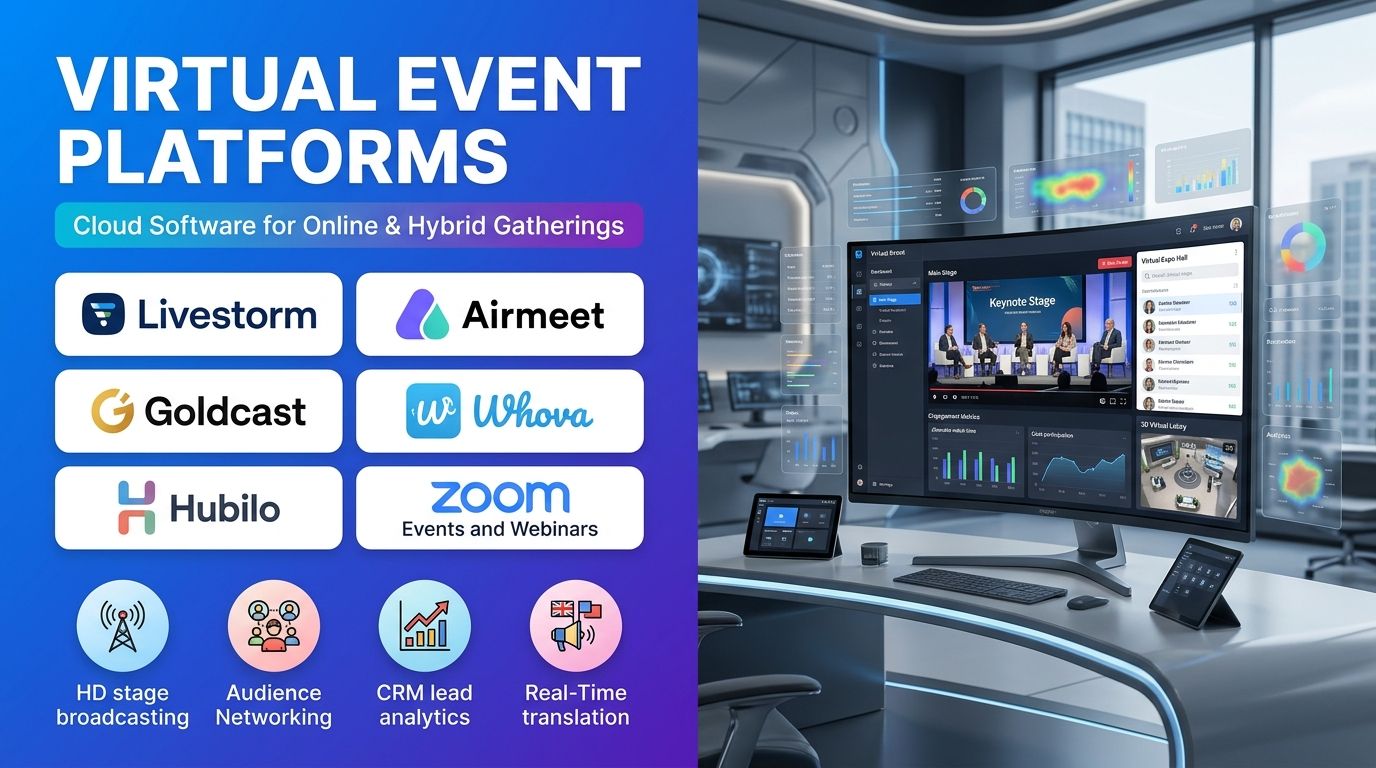
Virtual event platforms serve as the foundational digital infrastructure for online conferences, enterprise webinars, hybrid summits, virtual trade shows, and internal corporate town halls in 2026. These comprehensive software suites enable organizers to broadcast high-definition video streams, manage multi-track agendas, host virtual sponsor booths, and drive interactive audience networking within a centralized digital venue.
Traditional video conferencing tools—such as basic meeting links or standard webinar software—frequently result in attendee fatigue, poor sponsor visibility, fragmented audience data, and limited engagement options. Relying on disconnected tools also prevents organizers from creating branded lobby environments and tracking deep behavioral metrics across sessions.
Modern virtual event platforms extend far beyond basic video streaming by offering immersive virtual lobbies, AI-powered networking matchmaking, gamification leaderboards, real-time multilingual translation, and deep Customer Relationship Management (CRM) integrations. Many systems also bridge the gap between physical and digital audiences by supporting synchronized hybrid event agendas and on-demand video hubs.
Selecting the right virtual event platform is a critical operational decision for both boutique webinar hosts and enterprise event marketing teams. An appropriately matched platform protects event ROI by delivering stable stream performance while engaging participants throughout multi-day digital programs.
Key selection factors include event format (single-speaker webinars, complex multi-track virtual conferences, or immersive 3D expos), expected attendee volume, budget constraints, required branding depth, and CRM integration needs. For example, a B2B marketing team running recurring lead-generation webinars benefits from a browser-based, automation-friendly streaming platform, whereas a global association hosting a 5,000-person multi-day hybrid convention requires enterprise streaming redundancy, sponsor lead retrieval, and robust attendee matchmaking.
This guide examines the top 10 Virtual Event Platforms in 2026, detailing key features, benefits, pros, cons, and ideal use cases. It also includes a side-by-side comparison table, a buyer selection framework, a step-by-step practical workflow, and answers to frequently asked questions.
What Is a Virtual Event Platform?
A Virtual Event Platform is specialized cloud software designed to design, host, manage, and analyze online and hybrid gatherings. It unifies registration landing pages, branded virtual lobbies, HD stage broadcasting, breakout rooms, sponsor exhibition halls, and post-event analytics in a single system.
Conceptually, the platform acts as a digital venue replacing physical convention centers and auditoriums. When an attendee logs in via their web browser or mobile app, they enter a customized virtual lobby where they can view live sessions on the main stage, explore sponsor booths, schedule 1-to-1 video chats with peers, and participate in live polls and Q&A sessions.
In a typical event lifecycle, an organizer configures registration forms, uploads multi-track agenda schedules, sets up branded stage backdrops, runs live or pre-recorded (simulive) broadcasts, and exports comprehensive engagement reports measuring attendee watch time, chat participation, and booth visits.
By centralizing digital hosting, audience engagement, and lead attribution, virtual event platforms eliminate technical fragmentation, boost attendee retention, and generate verified ROI for sponsors and organizers.
Common applications of virtual event platforms include:
- Enterprise B2B Webinars and Lead Generation: Marketing teams broadcast product launches, educational seminars, and thought-leadership panels, syncing attendee watch data straight into CRM pipelines.
- Multi-Track Virtual and Hybrid Conferences: Associations and enterprise organizations host complex multi-day events featuring concurrent keynote stages, breakout workshops, poster sessions, and physical-digital audience sync.
- Virtual Trade Shows and Expo Floors: Organizers build digital exhibition halls where attendees navigate interactive sponsor booths, download collateral, and chat live with vendor representatives.
- Internal Corporate Town Halls and All-Hands: Enterprise HR and internal communications teams host secure, company-wide broadcasts with Q&A moderation, live translation, and executive polling.
- Virtual Community and Creator Summits: Independent creators and community builders host recurring online member gatherings, interactive workshops, and networking roundtables.
- Academic and Medical Symposia: Researchers and medical professionals present clinical studies and academic papers across specialized virtual session tracks with secure document sharing.
Top 10 Virtual Event Platforms in 2026
1. Livestorm
Short Description
Livestorm is a browser-based, all-in-one video engagement and virtual event platform built specifically for B2B marketing, lead generation, customer training, and recurring webinars. It eliminates software download friction for attendees while providing robust automation and analytics.
The platform serves B2B marketing teams, customer success departments, remote educational institutions, and corporate communication groups. Its workflows emphasize fast browser accessibility, marketing automation, and clean lead-attribution tracking.
Livestorm’s standout technical advantage is its 100% browser-based architecture requiring zero downloads or plugins for hosts or attendees, paired with automated “simulive” streaming (broadcasting pre-recorded video as a live event).
Within its broader ecosystem, Livestorm integrates natively with HubSpot, Salesforce, Marketo, Slack, Zapier, and Google Workspace, offering robust engagement tools including live polls, Q&A moderation, breakout rooms, and automatic session recordings.
Key Features
– 100% Browser-Based Access: Runs instantly in any modern web browser on desktop or mobile devices without forcing attendees to download desktop apps or browser extensions. – Automated and Simulive Webinar Hosting: Broadcasts pre-recorded video content as a live event with automated chat and Q&A to run recurring webinar programs effortlessly. – Customizable Registration Pages and Emails: Builds branded registration landing pages and automated email reminder sequences to maximize event show-up rates. – Interactive Engagement Tools (Polls, Q&A, Chat): Boosts audience participation using live polls, upvoted Q&A queues, emoji reactions, and structured chat rooms. – Breakout Rooms for Small-Group Discussions: Splits large virtual sessions into intimate breakout rooms for interactive workshops or networking circles. – Deep CRM and Marketing Automations: Syncs registration data, attendance duration, and engagement scores directly into HubSpot, Salesforce, Marketo, and Zapier. – Instant Automated Recordings and Analytics: Generates cloud recordings immediately after events end and compiles comprehensive participant analytics dashboards. – Multi-Language Support and Subtitles: Provides translated captions and multi-language support to engage international attendee audiences.
Benefits
- Eliminates technical drop-off by allowing attendees to join sessions instantly via browser clicks.
- Saves team bandwidth by running recurring webinar programs on automated and simulive schedules.
- Proves marketing ROI by syncing detailed attendance metrics straight into HubSpot and Salesforce.
- Enhances audience retention using built-in polls, Q&A moderation, and breakout rooms.
- Streamlines post-event follow-up with instant cloud recordings and engagement reports.
- Protects brand consistency with customizable registration pages and email templates.
- Offers a reliable free tier alongside scalable paid plans for growing B2B teams.
Pros
- Unmatched browser-based simplicity eliminates all download friction for attendees.
- Excellent automation features for recurring webinars, simulive broadcasts, and email reminders.
- Strong native integrations with major B2B CRM and marketing automation platforms.
- Clean, intuitive interface that requires virtually no user training.
- Reliable video stream stability and high-quality recording outputs.
- Responsive customer support and extensive online documentation.
Cons
- Not designed for massive multi-track 3D virtual trade shows or complex physical badge printing kiosks.
- Advanced custom virtual expo hall floor plans are less specialized than dedicated expo platforms like vFairs.
- Free tier includes strict attendee credit limits per year.
- Pricing scales based on active contact and attendee volume tiers.
- Custom CSS design styling offers fewer layout extremes than heavy enterprise developer tools.
Use Cases
- B2B Software Product Demonstrations: Marketing teams run weekly automated product webinars that sync qualified lead scores directly into HubSpot.
- Customer Success Training Academies: Education teams host recurring multi-session training classes with automated attendee attendance tracking.
- Enterprise Remote Town Halls: Corporate communications broadcast all-hands meetings with Q&A moderation and instant recording archives.
- Lead-Generation Partner Panels: Industry experts host joint marketing webinars with custom registration branding and shared lead attribution.
- On-Demand Content Hub Hosting: Companies publish past webinar recordings inside branded resource centers for continuous lead generation.
- Global Partner Briefings: Organizations broadcast live updates with translated captions to international partner networks.
Best For
- B2B marketing teams focused on lead generation and demand creation
- Companies running recurring webinar and customer training programs
- Teams wanting browser-based accessibility with zero attendee download friction
- Organizations integrating event engagement data with HubSpot or Salesforce
- Corporate communications hosting secure internal town halls
- Marketers prioritizing automated simulive broadcasting and email sequences
2. Airmeet
Short Description
Airmeet is an interactive virtual and hybrid event platform built specifically for high-engagement conferences, community summits, and professional B2B networking. It combines high-production stage broadcasting with social networking lounges that replicate real-world conference interactions.
The platform serves B2B tech companies, remote community builders, HR associations, and professional event organizers. Its workflows prioritize social engagement, table-based networking, and seamless backstage speaker coordination.
Airmeet’s standout technical advantage is its Social Lounge and Speed Networking engine. Unlike standard webinar tools where attendees remain passive viewers, Airmeet features virtual tables where participants sit together on video, start spontaneous discussions, and join automated speed-networking rounds.
Within its broader ecosystem, Airmeet integrates natively with HubSpot, Salesforce, Marketo, Eventbrite, and Stripe, offering multi-track scheduling, virtual sponsor booths, and real-time engagement analytics.
Key Features
– Immersive Social Lounges and Virtual Tables: Recreates real-world conference networking using interactive virtual tables where attendees turn on cameras and mics to converse.– Backstage Speaker Preparation Area: Provides a secure green-room backstage space where moderators and speakers test audio, review slides, and prep before going live. – Multi-Track Event Scheduling: Manages complex multi-day conference agendas with simultaneous keynote stages and breakout room tracks.– Virtual Sponsor and Expo Booths: Displays customizable sponsor booths featuring video streams, downloadable collateral, and live vendor chat representatives. – Gamification and Engagement Leaderboards: Rewards active attendee participation in polls, Q&A, and networking with points and leaderboard rankings. – Automated Speed-Networking Rounds: Pairs attendees randomly or by matching criteria for timed 1-to-1 video chats to spark organic community connections. – Comprehensive CRM and Marketing Integrations: Syncs registrant data and engagement metrics directly with HubSpot, Salesforce, and Marketo. – HD Streaming and Recording Suite: Delivers broadcast-quality video streams with instant cloud recording archives for on-demand playback.
Benefits
- Maximizes attendee engagement by replacing passive webinar watching with interactive social tables.
- Simplifies speaker stress using a dedicated green-room backstage prep area.
- Drives sponsor ROI through interactive virtual expo booths with live lead capture.
- Fosters community relationship building via automated speed-networking and lounge tables.
- Supports multi-track conference formats without requiring separate video conferencing tools.
- Connects attendee engagement behavior directly to CRM marketing pipelines.
- Offers a structured free plan alongside accessible professional subscription tiers.
Pros
- Industry-leading social lounge and table-networking features foster genuine community interaction.
- Intuitive backstage speaker management prevents technical mishaps before going live.
- Strong gamification leaderboards actively encourage participant engagement.
- Comprehensive virtual expo floor with sponsor lead generation tools.
- Clean, modern user interface for both organizers and attendees.
- Reliable integrations with HubSpot, Salesforce, and Marketo.
Cons
- Requires active participation from attendees to fully benefit from networking lounges.
- Large multi-thousand-person enterprise trade shows with physical badge printing require heavier enterprise tools.
- Advanced custom CSS branding options are more restricted than developer-focused platforms.
- Pricing scales based on attendee capacity tiers and host seats.
- Mobile browser networking requires stable internet connectivity on attendee devices.
Use Cases
- Remote Community Annual Summits: Tech communities host 3-day virtual conferences featuring keynote stages and informal social lounge meetups.
- HR and Leadership Virtual Conferences: Human resources associations run multi-track sessions with speed-networking rounds for peer collaboration.
- Sponsored Industry Expos: Organizers sell virtual expo booths where software vendors demo products to visiting attendees.
- Professional Association Member Meetups: Associations host monthly interactive roundtables to foster continuous member engagement.
- Corporate Partner Summits: Enterprises bring global partners together for keynote broadcasts and breakout discussion tables.
- Educational Masterclass Series: Academics deliver structured lectures followed by table-based Q&A breakout circles.
Best For
- Virtual and hybrid conferences prioritizing audience networking and community
- Associations, remote communities, and HR event organizers
- Teams wanting table-based social lounges and speed networking
- Organizers needing professional backstage speaker prep management
- Events featuring virtual sponsor expo booths
- Organizers seeking robust gamification and engagement leaderboards
3. Goldcast
Short Description
Goldcast is a B2B event marketing and virtual event platform built specifically for field marketers, demand-generation teams, and enterprise event marketers. It focuses on turning virtual events, webinars, and field marketing roadshows into predictable revenue pipelines.
The platform serves B2B SaaS companies, enterprise marketing departments, financial services firms, and professional service organizations. Its workflows emphasize deep marketing analytics, brand consistency, and automated CRM pipeline attribution.
Goldcast’s standout technical advantage is its event-to-pipeline attribution engine and modular “Event-in-a-Box” content repurposing tools. After a virtual event concludes, Goldcast automatically segments attendee engagement data and uses AI to slice long webinar recordings into short clips for social media and marketing campaigns.
Within its broader ecosystem, Goldcast integrates natively with HubSpot, Salesforce, Marketo, Eloqua, 6Sense, and Slack, providing seamless data sync for modern revenue operations (RevOps) teams.
Key Features
– Enterprise-Grade Event Branding and Customization: Deploys fully branded registration pages, virtual stages, and email templates matching exact corporate brand guidelines without coding. – AI-Powered Content Repurposing (Goldcast Clips): Automatically extracts highlight clips and quotes from webinar recordings to accelerate post-event social marketing and content distribution. – Advanced B2B Engagement Analytics & Attribution: Measures exact session watch time, poll responses, and question engagement, attributing pipeline revenue directly to specific event touchpoints. – Immersive Stage and Breakout Room Controls: Manages smooth transitions between keynote presentations, panel discussions, and intimate interactive breakout rooms. – Native RevOps and CRM Integrations: Syncs granular engagement data bi-directionally with HubSpot, Salesforce, Marketo, and intent data platforms like 6Sense. – Secure Enterprise Security and Compliance: Operates under strict SOC 2 compliance, GDPR standards, and SSO access controls demanded by enterprise IT security teams. – Automated Post-Event Follow-Up Workflows: Triggers targeted email sequences instantly based on whether attendees watched live, left early, or watched on-demand recordings. – Dedicated Event Producer Support: Offers white-glove customer success and live event producer assistance for critical high-visibility marketing webinars.
Benefits
- Proves exact B2B marketing ROI by linking webinar engagement directly to CRM pipeline revenue.
- Accelerates post-event marketing by automatically generating social clips from webinar recordings using AI.
- Maintains strict corporate brand guidelines across all registration pages and virtual stages.
- Streamlines RevOps data synchronization with robust native Salesforce, HubSpot, and Marketo integrations.
- Secures enterprise sign-off easily with SOC 2 compliance, SSO, and advanced security controls.
- Boosts conversion rates through polished, distraction-free attendee interfaces.
- Eliminates technical stress on show days with dedicated live event producer support.
Pros
- Purpose-built specifically for B2B marketers and demand-generation revenue teams.
- Outstanding AI content repurposing tool turns long webinars into short social clips instantly.
- Deep, reliable CRM integrations attribute event engagement directly to pipeline revenue.
- Exceptional design customization delivers a polished, premium corporate aesthetic.
- Enterprise-grade security, SSO, and compliance standards.
- White-glove customer support and live event producer assistance.
Cons
- Premium enterprise pricing is positioned for B2B marketing budgets rather than small indie creators.
- Lacks a consumer public discovery marketplace for selling open entertainment tickets.
- Physical badge printing and on-site expo floor logistics require separate tools.
- Smaller companies with basic webinar needs may underutilize its advanced RevOps attribution depth.
- Custom pricing requires formal sales consultations rather than self-service monthly tiers.
Use Cases
- B2B SaaS Enterprise Product Launches: Marketing teams host high-visibility product webinars, tracking which enterprise accounts attended live versus on-demand.
- Field Marketing Executive Roadshows: Regional marketing managers run recurring digital executive roundtables synced directly to Salesforce campaigns.
- Partner and Channel Marketing Briefings: Enterprises broadcast partner updates while measuring engagement scores across partner tiers.
- Post-Event Social Content Amplification: Demand-gen teams use automated clips to flood LinkedIn and Twitter with highlight quotes hours after a webinar ends.
- Intent-Driven Account-Based Marketing (ABM): Revenue teams combine Goldcast engagement data with 6Sense intent signals to prioritize sales outreach.
- Global Financial Analyst Briefings: Public companies broadcast secure quarterly earnings and investor presentations under strict SSO controls.
Best For
- B2B marketers and demand-generation teams
- Enterprises focused on revenue attribution and CRM pipeline ROI
- Companies wanting AI-powered webinar content repurposing for social media
- Marketing organizations using HubSpot, Salesforce, Marketo, or 6Sense
- Teams requiring SOC 2 compliance and white-glove live event producer support
- High-visibility corporate product launches and executive roadshows
4. Whova
Short Description
Whova is an award-winning all-in-one virtual, hybrid, and in-person event management platform renowned for its exceptional community-building, networking features, and comprehensive mobile app. It unifies event registration, multi-track agendas, AI matchmaking, and attendee engagement in a single ecosystem.
The platform serves large academic conferences, professional associations, corporate annual meetings, and community summits. Its workflows prioritize attendee networking, community discussion boards, and effortless administrative setup.
Whova’s standout technical advantage is its AI-powered attendee matchmaking and Community Board. Whova automatically analyzes attendee professional profiles and interests to suggest 1-to-1 meetings, while its active community board sparks pre-event discussions and organic peer connections weeks before the event starts.
Within its broader ecosystem, Whova offers a top-rated native mobile app, web portal, virtual exhibitor booths, live streaming integrations, and post-event analytics.
Key Features
– AI-Powered Attendee Matchmaking: Recommends relevant professional peers and mentors based on attendee background, industry, and networking goals to drive 1-to-1 connections.– Active Pre-Event Community Board: Launches discussion boards where attendees share insights, organize meetups, post job openings, and interact before the event begins.– Top-Rated Native Mobile App: Provides a polished iOS and Android app (rated 4.9 stars across tens of thousands of reviews) for both virtual and on-site participants.– Comprehensive Event Management Suite: Handles online registration, ticketing, multi-track agenda building, speaker bios, and sponsor showcases in one system.– Virtual Expo Floor and Sponsor Showcases: Displays interactive sponsor booths with video streams, promotional handouts, and lead-generation contact forms. – Live Polling, Gamification, and Leaderboards: Encourages active participation with live Q&A moderation, polling, and gamified scavenger hunts with leaderboard prizes.– Hybrid Flexibility (In-Person and Virtual Sync): Connects remote attendees seamlessly with physical venue streams, room schedules, and hybrid chat boards.– Post-Event Analytics and Engagement Reports: Compiles detailed attendance metrics, survey feedback, and networking statistics for organizers and sponsors.
Benefits
- Maximizes attendee networking satisfaction through intelligent AI matchmaking and community boards.
- Delivers a world-class mobile app experience praised by attendees for its ease of use.
- Simplifies event planning by housing registration, agenda management, and streaming in one platform.
- Drives sponsor ROI using interactive virtual expo booths with verified lead-generation forms.
- Boosts participation across multi-day conferences using built-in gamification and live polling.
- Connects virtual and physical audiences effortlessly in unified hybrid formats.
- Backed by over a decade of proven event tech reliability and high customer ratings.
Pros
- Industry-leading community board and AI matchmaking foster exceptional attendee networking.
- Highly rated native mobile app provides seamless multi-device access.
- Comprehensive feature coverage handles registration through post-event analytics.
- Excellent hybrid capabilities bridge remote and in-person audiences.
- Proven reliability across thousands of academic and professional association conferences.
- Responsive customer support and thorough administrative knowledge base.
Cons
- Custom pricing requires custom quote requests rather than transparent self-service tiers.
- Less focused on automated B2B marketing lead-generation pipelines compared to platforms like Goldcast.
- Deep CSS branding customization is more structured than open-ended developer web builders.
- Primarily tailored for structured conferences and associations rather than quick single-speaker webinars.
- Advanced CRM data sync requires structured configuration.
Use Cases
- Annual Academic and Research Conferences: Universities host multi-track academic symposia where researchers network via AI matchmaking and discuss papers on the Community Board.
- Professional Industry Association Conventions: National associations manage registration, speaker schedules, and virtual exhibitor booths for thousands of members.
- Global Non-Profit Member Summits: Non-profits connect dispersed international members through interactive virtual sessions and community discussion boards.
- Corporate Annual Employee Retreats: Enterprises run internal company-wide summits with gamified scavenger hunts and leadership Q&A streams.
- Hybrid Chamber of Commerce Events: Local business chambers stream monthly keynote panels to remote members while in-person guests attend locally.
- Special Interest Community Gatherings: Niche hobby or professional groups build ongoing engagement hubs using Whova’s year-round community boards.
Best For
- Academic conferences, professional associations, and industry conventions
- Organizers prioritizing attendee networking, community building, and AI matchmaking
- Events requiring a top-rated native mobile app for participants
- Multi-track virtual and hybrid conferences needing all-in-one management
- Associations looking for proven reliability and high attendee satisfaction ratings
- Organizers wanting gamification and active pre-event discussion boards
5. Hubilo
Short Description
Hubilo is an enterprise-grade virtual and hybrid event platform built for event marketers and enterprise organizations focused on high-impact brand experiences, engagement, and deep marketing attribution. It combines cinematic broadcast production tools with robust attendee interaction and marketing integrations.
The platform serves global enterprises, B2B media brands, technology companies, and professional event agencies. Its workflows prioritize cinematic streaming quality, customizable virtual venue branding, and multi-channel marketing attribution.
Hubilo’s standout technical advantage is its Hubilo Studio broadcast production suite paired with high-end visual customizability. Organizers can brand every corner of the virtual venue to match exact corporate guidelines while broadcasting television-quality multi-speaker panels directly from the browser.
Within its broader ecosystem, Hubilo integrates natively with HubSpot, Salesforce, Marketo, Eloqua, and major streaming encoders, providing robust analytics dashboards that measure attendee engagement down to the individual second.
Key Features
– Hubilo Studio HD Broadcasting Suite: Powers professional multi-speaker live streams with custom overlays, lower-thirds, green-screen effects, and backstage green rooms without external software. – Deep Visual Branding and Customization: Allows event marketers to customize lobbies, reception areas, stage backgrounds, and sponsor banners to match corporate identity. – Interactive Audience Engagement Suite: Drives participation through live chat streams, pinned Q&A moderation, customized polls, and emoji reactions. – Virtual Expo Floor and Sponsor Showcases: Displays immersive sponsor booths featuring video loops, downloadable collateral, and real-time lead-generation routing. – Networking Lounges and 1-to-1 Video Matchmaking: Connects attendees via lounge tables and automated networking algorithms to foster professional relationships. – Comprehensive Marketing and CRM Integrations: Syncs registration data, session drop-in times, and engagement scores seamlessly with HubSpot and Salesforce. – Real-Time Engagement Scoring and Analytics: Ranks attendees by participation level, giving sales and marketing teams qualified lead scores for post-event outreach. – Enterprise Security and Dedicated Support: Operates under strict enterprise security standards supported by 24/7 dedicated customer success managers.
Benefits
- Delivers broadcast-quality visual presentation without requiring complex external video production software.
- Elevates brand perception through deep visual customization across every virtual venue room.
- Maximizes sponsor ROI via interactive expo booths and qualified lead-generation data routing.
- Keeps audiences engaged using live chat moderation, polls, and networking lounges.
- Simplifies post-event sales follow-up by scoring attendees based on real-time engagement metrics.
- Scales reliably to support thousands of concurrent enterprise viewers on global streams.
- Backed by dedicated customer success managers guiding event setup and live execution.
Pros
- Outstanding Hubilo Studio broadcasting suite produces television-quality live streams easily.
- Exceptional visual customizability ensures virtual venues reflect corporate brand guidelines.
- Strong sponsor expo floor and lead-generation routing capabilities.
- Deep, reliable integrations with enterprise CRM platforms like HubSpot and Salesforce.
- Robust attendee engagement scoring identifies hot sales leads automatically.
- Enterprise-grade reliability and dedicated customer support.
Cons
- Premium enterprise pricing is positioned for corporate marketing budgets rather than small indie budgets.
- Complex visual customizability requires initial design planning to configure the virtual venue.
- Physical on-site badge printing and venue kiosk hardware require separate integrations.
- Smaller companies with basic webinar needs will underutilize its enterprise production depth.
- Custom pricing requires formal sales consultations.
Use Cases
- Global Enterprise Annual Customer Summits: Technology brands host 3-day virtual customer conferences with cinematic keynote broadcasts and custom expo halls.
- B2B Media Brand Industry Awards: Media companies stream multi-category awards ceremonies with branded lower-thirds and sponsor spotlights.
- High-Impact Product Launch Broadcasts: Marketing teams unveil major new products using Hubilo Studio’s professional broadcast overlays and live Q&A.
- Enterprise Partner Network Conferences: Corporations bring global partners together for strategic briefings and breakout networking lounges.
- Sponsored Virtual Trade Shows: Organizers manage dozens of software vendor booths with automated lead capture and sponsor ROI analytics.
- Executive Leadership Town Halls: Corporations broadcast secure, polished internal updates with interactive polling and moderated executive Q&A.
Best For
- Enterprise event marketers and global B2B organizations
- Brands prioritizing cinematic broadcast quality and deep visual customizability
- Events featuring extensive virtual sponsor expo floors and lead generation
- Companies wanting automated attendee engagement scoring for CRM sales follow-up
- Teams requiring dedicated customer success support and enterprise reliability
- Large-scale multi-day virtual and hybrid conferences
6. Zoom Events and Webinars
Short Description
Zoom Events and Webinars is a robust virtual and hybrid event platform built on top of Zoom’s universally trusted video communications infrastructure. It combines familiar one-click meeting reliability with enterprise registration, ticketing, multi-session agendas, and expo networking.
The platform serves businesses of all sizes, educational institutions, enterprise corporations, and independent creators who want reliable video hosting without teaching attendees a new software interface.
Zoom Events’ standout technical advantage is its massive global brand familiarity and video stability. Because nearly every professional attendee already has Zoom installed, technical onboarding friction is virtually zero, ensuring exceptionally high live attendance conversion rates.
Within its broader ecosystem, Zoom Events integrates natively with HubSpot, Salesforce, Marketo, Eventbrite, Stripe, and Slack, offering hub features like multi-track ticketing, Expo floors, backstage green rooms, and robust analytics.
Key Features
– Universal Brand Familiarity and Zero Learning Curve: Leverages Zoom’s ubiquitous interface, eliminating technical hurdles and software downloads for participants. – Multi-Track Ticketing and Registration Hub: Creates custom registration landing pages, sells paid or free event tickets, and manages multi-session agendas. – Expo Floor and Sponsor Booths: Displays virtual expo spaces where attendees visit sponsor booths, watch product videos, and chat with vendors.– Backstage Green Room and Speaker Controls: Provides a secure holding area for speakers and moderators to prep before entering the live broadcast stage. – Interactive Engagement (Polls, Q&A, Chat, Reactions): Engages audiences using live polling, moderated Q&A queues, hand raising, and emoji reactions. – Production Studio Integration: Customizes video layouts, adds virtual backgrounds, and brands live streams with professional graphic overlays. – Comprehensive Post-Event Analytics: Measures registrant numbers, live attendance duration, engagement scores, and Q&A transcripts. – Native CRM and Payment Integrations: Connects registration data and ticket sales with Stripe, HubSpot, and Salesforce.
Benefits
- Maximizes attendee turnout by utilizing a video platform everyone already knows how to use.
- Simplifies event setup with intuitive registration pages, ticketing, and agenda builders.
- Eliminates video streaming instability thanks to Zoom’s proven global infrastructure.
- Supports multi-track conferences and virtual expo floors under a single trusted ecosystem.
- Lowers training overhead for both event organizers and participants.
- Integrates ticketing and payment processing smoothly via Stripe.
- Offers predictable licensing models for existing Zoom enterprise customers.
Pros
- Universal attendee familiarity virtually eliminates technical support issues on show days.
- Exceptional video streaming stability backed by global cloud infrastructure.
- Strong all-in-one features including registration, ticketing, expo floors, and multi-track agendas.
- Reliable integrations with Stripe, HubSpot, and Salesforce.
- Cost-effective for organizations already subscribed to Zoom enterprise tiers.
- Robust security, waiting rooms, and encryption controls.
Cons
- Visual branding and lobby customizability are more standardized than cinematic design platforms like Hubilo.
- Lacks advanced AI-driven B2B pipeline attribution depth found in Goldcast.
- Not specialized for physical on-site badge printing and venue kiosk hardware.
- Advanced community networking lounges are less immersive than Airmeet or Whova.
- License costs scale based on webinar capacity tiers.
Use Cases
- Enterprise Corporate Town Halls: Large corporations broadcast secure internal updates to thousands of employees using familiar Zoom controls.
- Professional Training and Certification Webinars: Training organizations sell ticketed educational webinars with automated registration tracking.
- Multi-Session Virtual Industry Conferences: Associations host 2-day virtual events across multiple simultaneous Zoom webinar tracks.
- Global Product Showcase Demos: Tech companies host virtual product unveiling events with live Q&A and polling.
- University Academic Lectures: Higher-education institutions broadcast guest lectures and seminars to remote student bodies.
- Client Advisory Board Meetings: Financial and consulting firms host secure multi-speaker advisory sessions.
Best For
- Organizations wanting universal attendee familiarity and zero technical friction
- Teams already subscribed to Zoom enterprise ecosystems
- Multi-track virtual conferences and professional webinars
- Organizers needing reliable, stable video streaming infrastructure
- Companies selling paid tickets via Stripe for online seminars
- Enterprises prioritizing high-security internal and external video broadcasts
7. SpotMe
Short Description
SpotMe is an enterprise-grade virtual, hybrid, and in-person event platform engineered with an intense focus on accessibility, enterprise security, brand customization, and deep professional networking. It provides a highly polished digital experience for Fortune 500 corporations and medical associations.
The platform serves life sciences, pharmaceutical enterprises, global financial institutions, and enterprise medical associations. Its workflows prioritize regulatory compliance, professional medical congress features, and flawless enterprise branding.
SpotMe’s standout technical advantage is its industry-leading accessibility and inclusion features—including live closed captioning, multi-language translation, keyboard navigation, and high-contrast screen reader support—ensuring every attendee participates fully.
Within its broader ecosystem, SpotMe integrates natively with Veeva, Salesforce, Marketo, and enterprise SSO, offering branded mobile event apps, interactive breakout rooms, and secure document vaults.
Key Features
– Industry-Leading Accessibility and Inclusion: Complies with strict WCAG accessibility standards, offering live closed captions, screen reader optimization, and multi-language translation.– High-End Enterprise Branding and Customization: Tailors every pixel of the virtual portal and mobile app to match strict corporate identity guidelines. – Life Sciences and Pharma Compliance (Veeva Sync): Manages medical congress compliance, HCP (Healthcare Professional) interactions, and secure document sharing via Veeva integration. – Interactive Engagement and Networking Hub: Fosters connections using 1-to-1 video chat, activity feeds, gamification, and moderated Q&A. – Multi-Track Hybrid and Virtual Agendas: Manages complex corporate agendas with concurrent breakout tracks, polling, and document resource centers. – Enterprise Security, SSO, and Compliance: Delivers enterprise-grade data protection, ISO certification, GDPR compliance, and single sign-on (SSO). – Comprehensive Analytics and Engagement Reporting: Tracks attendee participation metrics, session popularity, and individual engagement scores. – Dedicated Professional Services and Support: Provides white-glove event production and technical project management for high-stakes enterprise programs.
Benefits
- Ensures full compliance with accessibility mandates through industry-leading WCAG and captioning tools.
- Secures life sciences and pharmaceutical compliance with specialized Veeva CRM integration.
- Elevates brand prestige with immaculate, high-end visual customization across web and mobile.
- Protects sensitive corporate data using enterprise SSO and strict ISO/GDPR security standards.
- Engages professional audiences effectively through structured networking and moderated Q&A.
- Backed by white-glove professional services and dedicated project management.
- Scales reliably across global enterprise deployments and multi-day medical congresses.
Pros
- Unmatched accessibility and inclusion features set the industry standard.
- Specialized life sciences and pharmaceutical compliance (Veeva integration) is rare among competitors.
- Impeccable enterprise branding and visual polish across web portals and mobile apps.
- Robust enterprise security, SSO, and global data privacy compliance.
- Dedicated white-glove project management ensures flawless live execution.
- Powerful engagement and networking tools for professional audiences.
Cons
- High enterprise pricing makes it cost-prohibitive for small businesses, indie creators, or casual webinars.
- Complex configuration requires dedicated project planning rather than instant self-service setup.
- Over-engineered for simple single-speaker marketing webinars or casual community meetups.
- Custom pricing requires formal sales consultations.
- Relies heavily on professional services coordination for optimal custom branding.
Use Cases
- Global Pharmaceutical Medical Congresses: Life sciences companies host compliant HCP medical symposia with secure document vaults and Veeva CRM sync.
- Enterprise Financial Services Annual Meetings: Global banks broadcast secure shareholder updates with strict SSO authentication and live translation.
- Healthcare Association Continuing Education: Medical associations manage multi-track clinical education sessions adhering to strict accessibility standards.
- Fortune 500 Executive Leadership Summits: Corporations run high-stakes internal leadership conferences with flawless white-glove production support.
- Regulated Industry Product Advisory Boards: Enterprises host secure, confidential advisory sessions with restricted document sharing.
- International Multi-Language Corporate Training: Enterprises train global workforces using multi-language translated streams and closed captioning.
Best For
- Life sciences, pharmaceutical, and healthcare organizations
- Enterprise corporations requiring strict accessibility (WCAG) and security compliance
- Global financial institutions and regulated industry associations
- Organizers needing white-glove professional services and dedicated project management
- Events requiring specialized Veeva CRM compliance integration
- High-stakes corporate summits and medical congresses
8. vFairs
Short Description
vFairs is an immersive virtual, hybrid, and in-person event platform celebrated for its lifelike 3D virtual environments, interactive expo halls, and gamified attendee networking. It simulates physical trade shows and campus environments entirely online.
The platform serves global trade show organizers, university virtual career fairs, HR recruiting teams, and enterprise product exhibitions. Its workflows prioritize visual exploration, virtual booth interactivity, and gamified engagement.
vFairs’ standout technical advantage is its customizable 3D virtual venue designs—including lobbies, auditoriums, and exhibit halls where avatars or click-to-navigate avatars move between booths, download brochures into virtual swag bags, and chat live with vendors.
Within its broader ecosystem, vFairs integrates with major CRM and payment platforms while offering physical on-site badge printing hardware and mobile event apps for hybrid events.
Key Features
– Immersive 3D Virtual Venues and Expo Halls: Recreates photorealistic 3D lobbies, auditoriums, and exhibition booths that attendees explore visually. – Interactive Virtual Booths and Swag Bags: Empowers sponsors to display video feeds, chat reps, and digital brochures that attendees collect in virtual swag bags. – Gamification (Scavenger Hunts and Leaderboards): Drives booth traffic and session attendance using gamified scavenger hunts with real-time leaderboard prizes. – Multi-Track Live Streaming and Webinars: Broadcasts keynote presentations and breakout panel discussions with integrated live Q&A and polling. – 1-to-1 Video and Text Chat Networking: Connects job seekers, buyers, and vendors via private video calls and structured networking lounges. – Hybrid On-Site Badge Printing and Mobile Apps: Bridges virtual environments with physical venues using integrated check-in apps and badge printers. – Comprehensive Lead Retrieval and Analytics: Provides exhibitors with real-time lead capture reports and gives organizers deep event ROI dashboards. – Dedicated Project Manager Support: Assigns a dedicated technical project manager to build and test 3D environments prior to live event days.
Benefits
- Creates memorable, gamified attendee experiences using interactive 3D virtual environments.
- Maximizes sponsor and exhibitor ROI with dedicated virtual booths and downloadable swag bags.
- Facilitates effective virtual recruiting and trade shows with built-in video chat and lead retrieval.
- Bridges virtual and physical audiences seamlessly in hybrid trade show formats.
- Eliminates technical setup stress with a dedicated project manager assigned to every event.
- Boosts participation across multi-day exhibitions using scavenger hunts and leaderboards.
- Offers robust reporting metrics tracking booth visits, document downloads, and chat volume.
Pros
- Industry-leading 3D virtual trade show and career fair environments.
- Excellent gamification features (scavenger hunts, leaderboards) drive high attendee engagement.
- Dedicated project manager support ensures smooth design and execution.
- Strong virtual booth lead-generation tools for trade show exhibitors.
- Effective hybrid capabilities combining virtual 3D halls with on-site badge printing.
- Comprehensive post-event analytics for both organizers and sponsors.
Cons
- 3D virtual environments can feel overly gamified for formal B2B corporate boardrooms or executive seminars.
- Custom 3D graphic design requires lead time before event launch.
- Enterprise pricing is higher than basic webinar tools like Livestorm or Zoom.
- Not optimized for quick, spontaneous single-speaker marketing webinars.
- Custom pricing requires formal sales consultations.
Use Cases
- Virtual University Career Fairs: Universities host multi-employer hiring fairs where students visit 3D company booths and video-chat with recruiters.
- Global Industry Trade Shows: Association organizers host virtual expos with dozens of interactive sponsor booths and keynote auditoriums.
- Enterprise Virtual Onboarding Fairs: HR teams introduce new remote employees to company departments via interactive virtual welcome booths.
- Non-Profit Virtual Fundraising Galas: Organizations host virtual donor appreciation events with interactive exhibition galleries.
- Specialized Product Exhibitions: Manufacturing brands showcase heavy machinery and product catalogs inside 3D virtual showrooms.
- Government Agency Public Expos: Public sector agencies host virtual community outreach and informational exhibitions.
Best For
- Virtual trade shows, expos, and career fairs
- University recruiting events and HR onboarding fairs
- Organizers wanting photorealistic 3D virtual venues and booths
- Events heavily reliant on sponsor exhibition booths and lead retrieval
- Teams seeking dedicated project manager support for virtual event design
- Organizers wanting gamified scavenger hunts and leaderboards
9. RingCentral Events (formerly Hopin)
Short Description
RingCentral Events (formerly Hopin) is a highly scalable, all-in-one virtual and hybrid event platform designed to power digital gatherings ranging from intimate team workshops to massive multi-thousand-person virtual festivals. It provides a comprehensive suite of stages, sessions, expo booths, and networking areas.
The platform serves enterprise corporations, media companies, community associations, and professional event agencies. Its workflows prioritize modular event construction, high-concurrency streaming stability, and seamless hybrid integration.
RingCentral Events’ standout technical advantage is its modular “Expo and Stage” architecture backed by RingCentral’s global telecommunications infrastructure. Organizers can mix and match virtual rooms—adding multiple parallel stages, breakout sessions, sponsor booths, and randomized networking (Speed Networking)—into a single unified attendee portal.
Within its broader ecosystem, RingCentral integrates natively with Marketo, HubSpot, Salesforce, Stripe, and leading broadcast encoders, offering robust REST APIs for custom enterprise workflows.
Key Features
– Modular Multi-Stage and Session Architecture: Builds complex virtual venues with multiple concurrent keynote stages, breakout rooms, and dedicated workshop tracks. – Interactive Expo Hall and Sponsor Booths: Displays customizable sponsor booths with video broadcasts, live chat reps, and downloadable lead-capture assets. – Randomised Speed Networking: Recreates serendipitous hallway encounters by pairing attendees for timed 1-to-1 video chats automatically. – High-Concurrency Enterprise Streaming: Powers rock-solid live streaming capable of supporting massive concurrent audiences without buffering delays. – Broad CRM and Marketing Integrations: Syncs registration data, session attendance, and booth lead lists bi-directionally with HubSpot, Salesforce, and Marketo. – Branded Event Customization: Tailors event lobbies, stage backdrops, and email notifications to align with corporate branding. – Comprehensive Engagement Analytics: Measures registration conversion, stage viewership, chat participation, and expo booth traffic. – Robust REST API and Developer Tools: Enables enterprise IT teams to build custom registration flows and integrate external event apps.
Benefits
- Scales effortlessly from small internal team workshops to massive multi-thousand-person digital festivals.
- Prevents technical streaming failures during high-traffic events using enterprise telecommunications infrastructure.
- Fosters attendee connection through randomized speed networking and interactive expo booths.
- Simplifies multi-track event planning with flexible, modular stage and session building blocks.
- Connects attendee engagement metrics straight into HubSpot, Salesforce, and Marketo pipelines.
- Backed by RingCentral’s enterprise reliability and global customer support infrastructure.
- Offers robust developer APIs for custom enterprise integrations.
Pros
- Exceptional scalability handles massive concurrent audience volumes reliably.
- Highly flexible modular event architecture (stages, sessions, expo, networking).
- Proven speed networking feature drives active participant interaction.
- Strong enterprise CRM integrations (HubSpot, Salesforce, Marketo).
- Backed by RingCentral’s robust global telecom and video infrastructure.
- Robust developer APIs for bespoke technical setups.
Cons
- Transition following the Hopin rebrand to RingCentral requires navigating updated menu structures.
- Pricing scales based on event tier capacity and feature modules.
- Lacks physical on-site badge printing hardware compared to specialized hybrid tools like Cvent.
- Advanced custom visual branding requires initial layout configuration.
- Smaller companies with basic webinar needs may find its modular capacity broader than required.
Use Cases
- Massive Multi-Track Virtual Festivals: Media companies host multi-day digital music and culture festivals with simultaneous artist stages.
- Enterprise Global All-Hands Meetings: Multinational corporations broadcast secure company-wide updates to thousands of remote employees.
- Large-Scale Virtual Industry Associations: Professional groups host annual conventions featuring keynote stages and virtual expo halls.
- Sponsored Virtual Job Fairs: Recruitment agencies run large-scale hiring events with employer expo booths and speed networking.
- Developer Community Hackathons: Tech enterprises host multi-day virtual hackathons with breakout workshop tracks.
- Corporate Partner Ecosystem Summits: Businesses bring global reseller networks together for product showcases and networking.
Best For
- Large-scale virtual and hybrid events requiring massive scalability
- Enterprises and media companies hosting multi-track digital festivals
- Organizers wanting flexible, modular stage and session building blocks
- Teams needing robust speed networking and virtual expo halls
- Organizations requiring enterprise CRM integrations (HubSpot, Salesforce)
- Events backed by trusted telecommunications reliability
10. ON24
Short Description
ON24 is an enterprise-grade digital engagement and virtual event platform built specifically for B2B demand generation, revenue marketing, and customer education. It focuses on turning digital events into actionable first-party buyer data and continuous content hubs.
The platform serves global B2B enterprises, technology companies, financial institutions, and medical device manufacturers. Its workflows prioritize rich interactive audience widgets, AI-driven content recommendations, and deep marketing automation attribution.
ON24’s standout technical advantage is its extensive library of interactive engagement console widgets (such as resource lists, surveys, CTAs, product carousels, and social sharing) paired with the ON24 Intelligence Engine. Rather than treating a webinar as a passive video stream, ON24 tracks every click and interaction to score buyer intent.
Within its broader ecosystem, ON24 integrates natively with Salesforce, Marketo, HubSpot, Eloqua, and Oracle CX, powering automated lead routing and multi-channel marketing campaigns.
Key Features
– Interactive Engagement Console Widgets: Embeds customizable CTAs, resource downloads, product carousels, surveys, and polls directly inside the live viewing console.– AI-Powered Content Hubs (ON24 Target): Transforms past webinars and virtual events into persistent, on-demand content resource centers that recommend relevant assets to visitors automatically. – First-Party Buyer Intent Scoring: Tracks granular audience interactions to generate rich first-party data profiles, alerting sales teams when leads exhibit high buying intent. – Enterprise Webinar and Virtual Conference Suites: Scales smoothly from single-speaker demand-gen webinars to multi-day virtual summits. – Native Enterprise CRM and Marketing Automation Sync: Connects bi-directionally with Salesforce, Marketo, HubSpot, Eloqua, and Microsoft Dynamics. – Global Security, Compliance, and SSO: Enforces strict enterprise security standards, GDPR privacy governance, and single sign-on authentication. – Automated Console Personalization: Tailors interactive console widgets and calls-to-action dynamically based on attendee persona or geographic region. – Dedicated Enterprise Customer Success: Provides strategic program management, technical training, and live production assistance.
Benefits
- Unlocks deep first-party buyer intent data by tracking every click and interaction inside the engagement console.
- Converts one-time webinars into evergreen lead-generation engines using persistent on-demand content hubs.
- Accelerates sales follow-up by routing high-intent leads straight to Salesforce and Marketo.
- Enhances audience participation with a rich variety of interactive console widgets and CTAs.
- Satisfies strict enterprise IT security, compliance, and SSO requirements globally.
- Scales reliably across global B2B enterprise marketing programs.
- Backed by dedicated customer success and strategic program consulting.
Pros
- Industry-leading interactive console widgets drive exceptional audience engagement.
- Powerful first-party intent scoring identifies warm sales leads automatically.
- Excellent on-demand content hub features (ON24 Target) extend content lifespan.
- Deep, reliable integrations with enterprise CRM and marketing automation platforms.
- Enterprise-grade reliability, security, and global scalability.
- Comprehensive analytics measure true audience interest beyond passive view time.
Cons
- Premium enterprise pricing is positioned for large B2B marketing budgets rather than small indie teams.
- Interface setup requires strategic planning to configure interactive widgets and CRM field mappings.
- Physical on-site badge printing and venue kiosk hardware are outside its digital core.
- Less focused on casual community social lounges or 3D virtual trade show avatars.
- Custom pricing requires formal sales consultations.
Use Cases
- B2B Enterprise Demand-Generation Programs: Technology brands run high-volume lead-generation webinars that score buyer intent for sales teams.
- Persistent On-Demand Resource Centers: Enterprises publish cataloged webinar libraries where prospects consume content 24/7.
- Global Financial Analyst and Investor Briefings: Financial institutions host secure corporate webcasts with interactive Q&A and document vaults.
- Channel Partner Education and Training: Companies conduct ongoing training webinars for global reseller networks with downloadable certification resources.
- Account-Based Marketing (ABM) Executive Briefings: Marketing teams target specific enterprise accounts with customized webinar consoles and CTAs.
- Healthcare and Medical Device Education: Medical companies host clinical education webcasts with compliant resource sharing.
Best For
- Enterprise B2B marketers focused on demand generation and pipeline revenue
- Companies wanting rich first-party buyer intent scoring and CRM lead routing
- Organizations building persistent on-demand content hubs
- Teams requiring deep integrations with Salesforce, Marketo, HubSpot, or Eloqua
- High-volume corporate webinar programs needing enterprise reliability
- Marketers prioritizing interactive console widgets and actionable engagement metrics
Comparison Table: Top 10 Virtual Event Platforms
| Tool Name | Best For | Platform(s) | Standout Feature | Pricing |
| Livestorm | All-in-one browser-based webinars and lead generation | Web, iOS, Android | 100% browser-based access with automated simulive streaming and HubSpot sync | Free and paid plans |
| Airmeet | Virtual conferences prioritizing networking and community | Web, iOS, Android | Social lounges with virtual tables and automated speed-networking rounds | Free and paid plans |
| Goldcast | B2B marketers and demand-generation pipeline attribution | Web, iOS, Android | Event-to-pipeline attribution with AI-powered video content clipping | Paid subscription |
| Whova | Academic conferences and professional associations | Web, iOS, Android | AI attendee matchmaking and active pre-event community discussion boards | Paid subscription |
| Hubilo | Enterprise event marketers wanting cinematic broadcast production | Web, iOS, Android | Hubilo Studio HD broadcasting suite with deep visual venue customizability | Paid subscription |
| Zoom Events | Organizations wanting universal familiarity and zero friction | Web, iOS, Android | Universal attendee familiarity with stable global video streaming infrastructure | Paid subscription |
| SpotMe | Life sciences, pharma, and accessibility-focused enterprises | Web, iOS, Android | Industry-leading WCAG accessibility, closed captioning, and Veeva CRM sync | Paid subscription |
| vFairs | Virtual trade shows, expos, and university career fairs | Web, iOS, Android | Immersive 3D virtual venues and booths with gamified scavenger hunts | Paid subscription |
| RingCentral Events | Large-scale virtual and hybrid festivals with massive scale | Web, iOS, Android | Modular multi-stage architecture backed by enterprise telecom reliability | Paid subscription |
| ON24 | Enterprise B2B demand gen and first-party intent scoring | Web, iOS, Android | Interactive console widgets and ON24 Target on-demand content hubs | Paid subscription |
Note: Pricing, licensing, supported platforms, and available features can change. Check the official vendor websites for current plans, educational access, and regional availability.
Which Virtual Event Platform Is Right for You?
No single virtual event platform fits every organization because technical and commercial priorities differ sharply between a weekly B2B marketing webinar, an academic research symposium, an immersive 3D trade show, and an enterprise all-hands town hall. A platform built for gamified 3D expo floors may overwhelm a marketing team running simple lead-generation webinars, while a browser-based webinar tool will not support multi-track academic matchmaking.
Evaluating your event format, audience size, branding depth, and CRM integration needs will quickly narrow your shortlist. Below is a breakdown of the top virtual event platform recommendations matched to eight distinct use-case profiles.
For B2B Marketing and Recurring Webinars: Livestorm and Goldcast
B2B marketing teams running weekly demand-generation webinars, product demos, or customer training programs need browser-based accessibility with zero download friction and deep CRM sync. Livestorm and Goldcast lead this category.
Livestorm offers a 100% browser-based experience with automated simulive broadcasting, breakout rooms, and seamless HubSpot/Salesforce integration. Goldcast is purpose-built for B2B marketers seeking event-to-pipeline revenue attribution and AI-powered content clipping for social media.
Choose Livestorm if you want an all-in-one browser platform for recurring marketing webinars and customer training. Choose Goldcast if your primary goal is proving B2B marketing pipeline ROI and repurposing webinar recordings into social clips with AI.
For Networking, Communities, and Associations: Airmeet and Whova
Conferences and professional associations whose primary success metric is attendee networking, peer collaboration, and community building need specialized interaction tools. Airmeet and Whova excel at connecting participants.
Airmeet recreates physical hallway chats using virtual lounge tables and automated speed-networking rounds. Whova provides an award-winning mobile app, AI-powered professional matchmaking, and active pre-event community discussion boards.
Choose Airmeet if you want table-based social lounges and automated speed networking for remote communities. Choose Whova if you host academic conferences or professional associations needing AI matchmaking and top-rated mobile apps.
For Cinematic Broadcasts and Enterprise Marketing: Hubilo and RingCentral Events
Enterprise organizations and media brands hosting high-visibility virtual summits, product launches, or digital festivals require television-quality broadcast production and massive concurrency scaling. Hubilo and RingCentral Events deliver enterprise-grade streaming power.
Hubilo features the Hubilo Studio suite for professional broadcast overlays and deep visual venue branding. RingCentral Events provides robust modular multi-stage architecture backed by telecom-grade streaming reliability.
Choose Hubilo if you prioritize cinematic broadcast quality and deep visual venue customizability. Choose RingCentral Events if you need massive scalability for multi-thousand-person multi-track virtual festivals.
For Universal Familiarity and Zero Technical Friction: Zoom Events
When hosting audiences whose technical literacy varies widely—or when eliminating software installation barriers is paramount—Zoom Events provides the most frictionless attendee experience.
Zoom Events leverages universal brand familiarity, allowing attendees to join multi-track sessions, expo floors, and webinars without downloading unfamiliar software.
Choose Zoom Events if your audience already uses Zoom daily and you want guaranteed streaming stability with zero technical support hurdles.
For Life Sciences, Pharma, and Accessibility Compliance: SpotMe
Life sciences enterprises, medical associations, and regulated financial institutions operating under strict compliance mandates and accessibility requirements need specialized security. SpotMe leads in these areas.
SpotMe delivers industry-leading WCAG accessibility, closed captioning, multi-language translation, and specialized Veeva CRM integration for medical congress compliance.
Choose SpotMe if you require strict enterprise security (SSO/ISO), medical regulatory compliance (Veeva), and top-tier WCAG accessibility standards.
For 3D Trade Shows and Virtual Career Fairs: vFairs
Events simulating physical exhibition floors, university hiring fairs, or product showrooms where participants navigate visually benefit from immersive virtual environments.
vFairs creates photorealistic 3D virtual lobbies, auditoriums, and exhibitor booths complete with gamified scavenger hunts and virtual swag bags.
Choose vFairs if you host virtual trade shows, university career fairs, or expos requiring immersive 3D venue exploration.
For B2B Intent Data and On-Demand Content Hubs: ON24
Enterprise marketing organizations focused on capturing buyer intent data, scoring leads, and turning webinars into evergreen lead-generation engines rely on specialized engagement analytics.
ON24 features rich interactive console widgets and ON24 Target on-demand content hubs that nurture prospects 24/7.
Choose ON24 if you want advanced first-party buyer intent scoring and persistent on-demand webinar content hubs.
Best Virtual Event Platforms for Different Users
| User Type | Recommended Software | Why? |
| B2B Marketer / Webinar Host | Livestorm | Browser-based accessibility with automated simulive streaming and HubSpot sync. |
| Community Builder / Association | Airmeet | Social lounges with virtual tables and automated speed-networking rounds. |
| Demand-Gen Marketer Seeking ROI | Goldcast | Event-to-pipeline revenue attribution with AI-powered video content clipping. |
| Academic Conference / Association | Whova | AI attendee matchmaking and active pre-event community discussion boards. |
| Enterprise Brand / Product Launch | Hubilo | Hubilo Studio HD broadcasting suite with deep visual venue customizability. |
| Corporate Team Wanting Zero Friction | Zoom Events | Universal attendee familiarity with stable global video streaming infrastructure. |
| Pharma / Life Sciences / Enterprise | SpotMe | Industry-leading WCAG accessibility, closed captioning, and Veeva CRM sync. |
| Virtual Trade Show / Career Fair | vFairs | Immersive 3D virtual venues and booths with gamified scavenger hunts. |
| Large-Scale Virtual Festival | RingCentral Events | Modular multi-stage architecture backed by enterprise telecom reliability. |
| Enterprise B2B Intent-Data Marketer | ON24 | Interactive console widgets and ON24 Target on-demand content hubs. |
Practical Example: Launching, Hosting, and Analyzing a 1,000-Person Virtual B2B Summit Using a Virtual Event Platform
To see how a virtual event platform operates in real-world practice, consider a realistic scenario: a B2B SaaS company is hosting a 1,000-person virtual industry summit featuring a main keynote stage, two simultaneous breakout workshop tracks, an interactive sponsor expo hall, and live Q&A moderation. Managing this across disconnected video links and spreadsheets would result in technical confusion, missed sponsor leads, and zero reliable engagement metrics.
Using a modern virtual event platform such as Goldcast, Hubilo, or Livestorm, an event marketing team can launch a branded registration hub, broadcast cinematic multi-speaker panels, facilitate sponsor booth interactions, and sync verified lead scores straight into CRM pipelines.
Below is the seven-step operational workflow demonstrating how marketing teams execute a professional virtual summit from setup through post-event analysis.
Step 1: Configure Branded Registration Pages and Email Sequences
The marketing team begins by creating the virtual summit workspace, uploading corporate logos, and publishing branded registration landing pages. Custom registration form fields capture attendee job titles, company sizes, and specific track interests.
Automated email sequences are scheduled to dispatch instant registration confirmations, calendar invite attachments, and 24-hour reminder notifications to maximize live attendance conversion.
Step 2: Build the Multi-Track Agenda and Stage Backdrops
Next, the coordinator builds the multi-session agenda inside the platform dashboard—assigning keynotes to Stage A while routing specialized technical workshops to Breakout Tracks B and C.
Using the platform’s broadcast production suite (such as Hubilo Studio or Goldcast), the team designs custom virtual stage overlays, branded lower-thirds with speaker titles, and waiting-room countdown screens.
Step 3: Populate Virtual Expo Booths and Sponsor Collateral
Sponsor success managers work with participating software vendors to populate virtual expo booths. Each booth is configured with a looping product demo video, live chat representatives, downloadable PDF brochures, and lead-capture contact forms that route inquiries directly to respective vendor sales reps.
Step 4: Conduct Backstage Speaker Rehearsals and Technical Checks
Forty-eight hours prior to the live event, the production manager invites all keynote speakers and moderators into the virtual green-room backstage area. The team tests microphones, verifies camera angles, reviews slide-deck progression, and practices queuing live Q&A questions from the moderator dashboard.
Step 5: Execute Live Broadcasts and Moderate Audience Engagement
On the day of the summit, the virtual lobby opens 30 minutes prior to the keynote, playing welcome music alongside sponsor logo carousels. As 1,000 attendees stream in, moderators manage live chat rooms, launch interactive polls, and upvote audience questions during panel sessions.
Breakout room facilitators run interactive Q&A workshops while real-time engagement scores track participant attention spans across every minute of the broadcast.
Step 6: Trigger Post-Event Surveys and AI Content Repurposing
The moment the closing keynote concludes, the platform automatically triggers an on-screen feedback survey. Simultaneously, backend AI tools process the multi-track recording archives—generating short video highlight clips of keynote soundbites for the marketing team to share on social media channels within hours.
Step 7: Sync Engagement Metrics to CRM and Execute Sales Follow-Up
Within 24 hours of event close, the platform’s bi-directional CRM integration syncs verified attendance logs, session watch times, poll interactions, and sponsor booth visits directly into HubSpot and Salesforce.
Sales development representatives receive automated lead alerts prioritizing prospects who attended live and asked questions, turning virtual event engagement into closed sales pipeline revenue.
Frequently Asked Questions (FAQs)
1. What is a virtual event platform?
A virtual event platform is cloud-based software designed to host online and hybrid gatherings, uniting registration pages, branded lobbies, HD stage streaming, breakout rooms, sponsor expo halls, and post-event analytics in a single system.
Unlike basic video conferencing links, virtual event platforms provide structured agendas, audience engagement widgets (polls, Q&A, chat), networking lounges, and direct CRM marketing integrations.
2. Which virtual event platform is best for beginners and small teams?
Livestorm and Zoom Events are the best options for beginners and lean teams hosting webinars or virtual events. Livestorm offers 100% browser-based accessibility with zero download friction, automated simulive scheduling, and easy HubSpot integration.
Zoom Events leverages universal brand familiarity, allowing attendees to join multi-session agendas and webinars instantly using Zoom controls they already know.
3. Are there free virtual event platforms available?
Yes, several reputable platforms offer free plans or tiers. Livestorm provides a free forever plan (capped at attendee credits per year), Airmeet offers a structured free plan for community events, and Microsoft Teams includes virtual event capabilities within existing Microsoft 365 enterprise licenses.
However, large-scale multi-track enterprise conferences, advanced 3D expos, and deep CRM attribution suites typically require paid subscription tiers.
4. What is the difference between webinar software and a virtual event platform?
Webinar software (such as basic Zoom Webinars or GoToWebinar) focuses primarily on broadcasting a single video presentation from a host to an audience via slides, chat, and Q&A.
A virtual event platform encompasses webinar streaming while adding multi-track agenda building, virtual lobby environments, sponsor expo floors, 1-to-1 networking lounges, gamification leaderboards, and comprehensive multi-room event management.
5. Which virtual event platform is best for B2B marketers and lead generation?
Goldcast and ON24 are premier choices for B2B marketers and demand-generation teams. Goldcast specializes in event-to-pipeline revenue attribution and AI-powered video content clipping.
ON24 provides rich interactive engagement console widgets and persistent ON24 Target on-demand content hubs that score first-party buyer intent for sales teams.
6. Which virtual event platform is best for attendee networking and community building?
Airmeet and Whova are industry leaders for attendee networking. Airmeet features interactive social tables and automated speed-networking rounds that replicate physical hallway chats.
Whova offers an award-winning mobile app, AI-powered professional matchmaking, and active pre-event community discussion boards.
7. Does a virtual event platform integrate with CRM and marketing automation tools?
Yes, leading virtual event platforms connect natively with major B2B CRM and marketing automation systems including HubSpot, Salesforce, Marketo, Eloqua, and Dynamics 365.
This bi-directional integration syncs registration data, session watch time, and engagement scores automatically, allowing sales teams to follow up with qualified leads immediately after an event concludes.
8. What is “simulive” streaming in virtual events?
Simulive (simulated-live) streaming allows organizers to broadcast a pre-recorded video presentation as if it were happening live.
During a simulive session, attendees watch the polished pre-recorded video on the virtual stage while human hosts or speakers participate live in the text chat and Q&A queue, ensuring flawless production execution without live technical risks.
9. Can virtual event platforms handle hybrid events (in-person + virtual)?
Yes, many top-tier platforms—such as Whova, Accelevents, SpotMe, and vFairs—natively support hybrid event formats.
They bridge physical venue live streams with remote attendee portals, share unified multi-track agendas, and sync registration and engagement analytics across both audiences.
10. Which virtual event platform offers immersive 3D virtual trade show floors?
vFairs is the leading platform for photorealistic 3D virtual trade shows, university career fairs, and expo halls.
It provides interactive 3D lobbies, auditoriums, and exhibitor booths where attendees explore visually, collect digital brochures in virtual swag bags, and chat live with vendors.
11. What hardware and system requirements are needed to run a virtual event?
For organizers and attendees, modern virtual event platforms operate entirely inside standard web browsers (Google Chrome, Safari, Edge) on desktop computers, laptops, and mobile devices—no specialized software installation is required.
For high-end broadcasts, professional streaming studios (like Hubilo Studio or Goldcast) benefit from stable, high-speed broadband internet (at least 20 Mbps upload), HD webcams, and external microphones.
12. How do I choose the right virtual event platform for my event?
Follow a structured four-step evaluation process before signing a software contract:
- Define your primary event goal: Choose a demand-gen tool like Goldcast or ON24 if you want CRM sales leads; a networking tool like Airmeet or Whova if community connection is key; or an expo tool like vFairs for trade shows.
- Verify CRM and streaming compatibility: Confirm certified native integrations with your exact CRM (HubSpot, Salesforce) and check streaming concurrency limits.
- Test the attendee browser experience: Run a live test session on a smartphone and laptop to verify zero-download browser accessibility and chat/polling speed.
- Evaluate pricing models: Compare active attendee volume tiers against flat annual subscriptions to ensure cost predictability.
13. What security and privacy standards should I look for in enterprise virtual events?
For enterprise corporations, financial institutions, and healthcare organizations, critical security certifications include SOC 2 Type II compliance, GDPR and CCPA data privacy governance, Single Sign-On (SSO) integration, and encrypted AES-256 stream transmission.
Platforms like SpotMe, Goldcast, and SpotMe specialize in meeting these rigorous enterprise IT standards.
14. What is the difference between a virtual event platform and an event ticketing platform?
An event ticketing platform (such as Eventbrite or Ticket Tailor) focuses primarily on e-commerce, public registration landing pages, payment processing, and door QR code scanning.
A virtual event platform (such as Livestorm, Hubilo, or Whova) focuses on the actual digital hosting environment—broadcasting HD video streams, managing multi-track session agendas, powering sponsor expo floors, and driving live audience engagement.
15. Can virtual event platforms automatically translate languages for international audiences?
Yes, several advanced platforms—including Livestorm, SpotMe, HiJiffy, and Whova—offer real-time automated closed captioning and multi-language translation.
This breaks down language barriers for global attendees, allowing participants worldwide to follow keynote sessions and participate in live chat in their native languages.
16. Which virtual event platform is best for life sciences and medical congresses?
SpotMe is the premier platform for life sciences enterprises, pharmaceutical companies, and medical associations.
It provides industry-leading WCAG accessibility, closed captioning, multi-language translation, and specialized Veeva CRM integration for medical congress compliance.
Final Thoughts
Virtual event platforms have matured into sophisticated digital venues and demand-generation powerhouses, replacing basic video links with cinematic broadcasts, AI-driven networking, and deep CRM revenue attribution. Selecting a platform aligned with your event format, audience size, and marketing goals ensures engaging participant experiences and measurable business ROI.
Across the top 10 platforms, Livestorm leads for all-in-one browser-based webinars, Airmeet excels with virtual tables and automated speed networking, and Goldcast sets the standard for B2B pipeline revenue attribution. Whova dominates academic and association community building with AI matchmaking, Hubilo provides cinematic broadcast production, and Zoom Events delivers universal attendee familiarity.
For specialized operational needs, SpotMe delivers life sciences compliance and WCAG accessibility, vFairs powers immersive 3D trade shows, RingCentral Events scales massively for multi-track digital festivals, and ON24 drives first-party buyer intent scoring and on-demand content hubs.
Before committing to a subscription, map your event requirements against attendee engagement needs, verify CRM integrations, and test the live browser experience during platform demos. Choosing the right virtual venue foundation will elevate your digital events and generate lasting value for organizers, sponsors, and attendees alike.
