Introduction
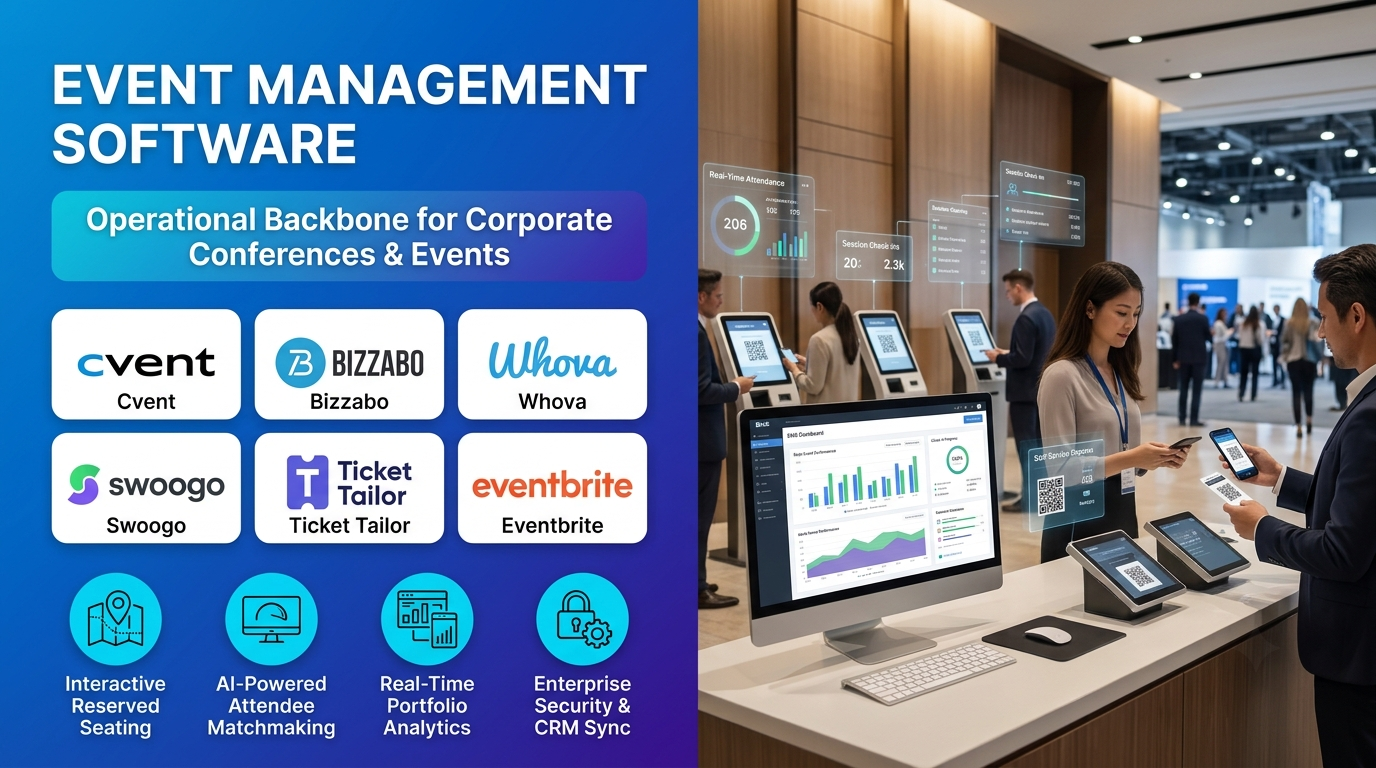
Event Management Software (EMS) serves as the core operational backbone for corporate conferences, trade shows, professional associations, and multi-event portfolios in 2026. These comprehensive platforms help event planners, marketers, and operations teams handle complex workflows ranging from strategic budgeting and venue sourcing to attendee registration, mobile apps, on-site badge printing, and post-event data analytics.
Traditional manual coordination methods—such as disconnected spreadsheets, isolated email threads, and fragmented point tools—frequently lead to data silos, administrative gridlock, and poor attendee experiences. Relying on disconnected software also prevents marketing and revenue teams from accurately attributing event engagement directly to CRM sales pipelines.
Modern event management platforms extend far beyond basic registration forms by offering conditional logic web builders, AI-powered attendee matchmaking, wearable networking tech, self-service check-in kiosks, and deep bi-directional syncing with enterprise CRM systems like Salesforce and HubSpot.
Selecting the right event management platform is a critical operational decision for organizations running anything from a single flagship user conference to dozens of regional field marketing events every year. An appropriately matched system automates manual logistics while providing clean data visibility for stakeholders.
Key selection factors include portfolio scale (single flagship event versus multi-event corporate programs), budget flexibility, team technical bandwidth, and specialized on-site requirements (such as badge printing or hotel block management). For example, a mid-market B2B marketing team running an annual conference benefits from a collaborative event experience platform with built-in mobile apps, whereas a large enterprise organization running hundreds of global events requires a unified system of record with venue sourcing and enterprise security.
This guide examines the top 10 Event Management Software platforms in 2026, detailing key features, benefits, pros, cons, and ideal use cases. It also includes a side-by-side comparison table, a buyer selection framework, a step-by-step operational workflow, and answers to frequently asked questions.
What Is Event Management Software?
Event Management Software (EMS) is specialized B2B software designed to plan, promote, execute, and measure live, virtual, and hybrid events. It acts as the central command center uniting event marketing websites, registration flows, session tracking, mobile applications, and on-site hardware management.
Conceptually, an EMS unifies the entire event lifecycle into a single system of record. When a registrant fills out an intake form online, the platform evaluates their inputs against session capacities, applies registration rules, processes secure payments, and populates their record in the mobile app and check-in database automatically.
In a typical operational workflow, event teams use the platform to source venues, publish branded landing pages, manage multi-track agendas, coordinate speaker submissions, track sponsor deliverables, and deploy self-service QR code kiosks at venue doors. After the event, the system compiles comprehensive analytics dashboards measuring attendance, session popularity, and lead generation ROI.
By centralizing planning data and automating repetitive tasks, event management software eliminates administrative bottlenecks, protects data accuracy, and proves the business impact of corporate events.
Common applications of event management software include:
- Enterprise Annual User Conferences: Corporations manage thousands of attendees, complex multi-track agendas, speaker portals, and sponsor booths across multi-day flagship gatherings.
- Association and Medical Conventions: Professional associations coordinate abstract submissions, continuing education (CE) credit tracking, member verification tiers, and badge printing.
- Field Marketing and Roadshow Portfolios: Regional marketing teams deploy standardized branded landing pages across dozens of smaller, recurring multi-city events.
- Trade Shows and Exhibitions: Organizers manage intricate floor plans, exhibitor portals, and lead-retrieval badge-scanning apps for sponsors.
- Government and Academic Symposia: Public sector and educational teams handle compliance-heavy registration flows, multi-session tracking, and secure reporting.
Top 10 Event Management Software Platforms in 2026
1. Cvent
Short Description
Cvent is the undisputed enterprise standard in event management software, providing a massive, all-in-one platform built to manage every phase of the event lifecycle across global corporate portfolios. It combines strategic venue sourcing, event marketing, complex registration, mobile apps, and on-site badge printing kiosks.
The platform serves Fortune 500 enterprises, global financial institutions, large association networks, and corporate event departments running dozens or hundreds of annual programs. Its workflows accommodate complex ticket tiers, multi-track session routing, hotel room block management, and enterprise-grade reporting.
Cvent’s standout technical advantage is its unmatched breadth as a true single system of record paired with the industry’s largest venue-sourcing marketplace. Organizers can search and contract hotel venues, build intricate multi-path registration websites, and deploy Cvent OnArrival iPad kiosks for instantaneous on-site badge printing.
Within its broader ecosystem, Cvent integrates with enterprise CRM platforms (Salesforce, HubSpot), mobile event apps, and financial ERP systems, providing board-level rollups across multi-event portfolios.
Key Features
– Industry-Leading Venue Sourcing Marketplace: Accesses the world’s largest database of hotel properties and conference spaces to issue RFPs and contract event venues directly.– Complex Enterprise Registration Engine: Handles multi-tiered ticket structures, group registrations, approval workflows, and conditional session-track logic at massive scale.– Cvent Attendee Hub & Event Marketing: Unifies event websites, email communications, and attendee engagement layers into a cohesive branded hub. – OnArrival Check-In and Kiosk Badge Printing: Powers fast self-service check-in stations and thermal badge printers that print custom badges on demand in seconds. – Integrated Hotel Room Block Housing: Manages complex hotel housing blocks, rooming lists, and cutoff dates alongside event registration. – Enterprise CRM and Marketing Automation Sync: Connects bi-directionally with Salesforce, Marketo, and HubSpot to attribute registration data to sales pipeline revenue. – Multi-Event Portfolio Reporting: Consolidates budget tracking, registration pace, and attendance metrics across regional and global corporate portfolios. – Global Security and Compliance Controls: Enforces strict enterprise data governance, SSO authentication, GDPR standards, and SOC 2 security.
Benefits
- Provides a true end-to-end system of record covering budgeting, venue sourcing, registration, and on-site execution.
- Handles massive enterprise scale with complex ticket logic, multi-track agendas, and group housing.
- Eliminates manual badge-printing bottlenecks at large conferences using Cvent OnArrival kiosks.
- Simplifies venue procurement through an integrated global hotel marketplace.
- Delivers board-level reporting rollups across hundreds of multi-city corporate events.
- Protects enterprise data integrity via rigorous SSO, GDPR, and SOC 2 security protocols.
- Streamlines marketing attribution by syncing attendee engagement straight into CRM pipelines.
Pros
- Unrivaled functional depth spanning the entire enterprise event lifecycle.
- The industry’s only platform with a built-in global venue-sourcing marketplace.
- Proven enterprise scalability for multi-thousand-attendee flagship conferences.
- Robust on-site badge printing and check-in hardware integration.
- Deep executive reporting capabilities for large corporate portfolios.
- Extensive enterprise integration ecosystem.
Cons
- High enterprise contract pricing and implementation costs make it impractical for small events or teams.
- Steep learning curve and complex configuration require dedicated administrative staff.
- Pricing is opaque and gated behind custom sales consultations rather than transparent self-service tiers.
- Implementation ramp time is substantial compared to agile mid-market tools.
- Overkill for anything under a true enterprise event portfolio.
Use Cases
- Fortune 500 Annual Flagship User Conferences: Enterprises manage 5,000+ attendees across 80 breakout tracks, hotel blocks, and on-demand badge printing kiosks.
- Global Multi-City Corporate Roadshow Portfolios: Field marketing teams deploy standardized registration templates across 50 regional executive seminars.
- Corporate Hotel Venue Sourcing & Contracting: Event procurement teams source and contract hotel conference spaces directly via the Cvent venue marketplace.
- Association Convention Housing Management: Large associations coordinate multi-hotel room blocks and custom rooming lists for members.
Best For
- Large enterprise organizations running portfolios of events
- Flagship corporate user conferences and multi-city roadshows
- Teams requiring integrated venue sourcing alongside registration
- Organizations needing robust on-site badge printing and hotel block housing management
2. Bizzabo (Event Experience OS)
Short Description
Bizzabo is a modern, marketing-led Event Experience Operating System built to power B2B conferences, industry summits, and high-engagement corporate events. It combines a customizable website builder, registration engine, branded mobile app, and wearable networking technology into a cohesive platform.
The platform serves mid-market to enterprise B2B marketing teams, tech companies, financial institutions, and creative agencies. Its workflows emphasize brand-forward event websites, attendee networking, and sharp CRM revenue attribution.
Bizzabo’s standout technical advantage is its end-to-end Event Experience OS architecture paired with proprietary Klik SmartBadge wearable technology. Attendees use smart badges to exchange contact details with a tap, while organizers capture real-time booth traffic and session heatmaps.
Within its broader ecosystem, Bizzabo includes 24/7/365 customer support on all tiers, native mobile apps, and deep integrations with HubSpot, Salesforce, Marketo, and leading marketing automation suites.
Key Features
– Conversion-Optimized Registration & Website Builder: Deploys modern, branded event websites and registration flows with flexible ticket tiers and discount codes.– Klik SmartBadge Wearable Technology: Utilizes NFC-enabled smart badges for touchless attendee networking, lead capture, and session tracking.– Branded Mobile Event App: Delivers interactive agendas, live Q&A, polling, push notifications, and attendee messaging in a polished mobile app.– Comprehensive Content Management Layer: Organizes speaker bios, sponsor showcases, and multi-track agendas cleanly across the event site. – Enterprise CRM and Marketing Attribution Sync: Connects ticket purchases and session engagement directly to Salesforce, HubSpot, and Marketo sales pipelines.– 24/7/365 Included Customer Support: Provides round-the-clock live support included at every pricing tier rather than sold as an expensive add-on. – On-Site Badge Printing & Check-In: Supports rapid check-in workflows and badge printing for physical venue arrivals. – Virtual and Hybrid Streaming Suite: Extends event reach with integrated virtual session broadcasting and hybrid attendee engagement tools.
Benefits
- Delivers a polished, brand-forward attendee experience across event websites and mobile apps.
- Enhances physical networking and sponsor lead capture using innovative Klik SmartBadge wearables.
- Includes 24/7/365 customer support across all pricing tiers without hidden add-on costs.
- Proves B2B marketing ROI by attributing event participation directly to CRM sales pipelines.
- Simplifies multi-track agenda management and speaker content publishing.
- Offers a more modern, agile user interface compared to legacy enterprise event systems.
Pros
- Genuine hardware innovation with Klik SmartBadge wearables for networking.
- 24/7/365 support included at every tier.
- Strong branded mobile app and website builder.
- Excellent fit for marketing-led B2B conferences.
- Modern interface that marketing teams adopt quickly.
Cons
- Per-seat pricing model includes a hard multi-seat minimum entry floor, making it costly for small teams.
- Many advanced capabilities (such as Klik badges, virtual streaming, and CRM integrations) are paid add-ons.
- Not built for consumer public event discovery or high-volume ticketing marketplaces.
- Overkill for small local workshops or internal team meetings.
Use Cases
- B2B Software Flagship Annual User Conferences: Tech companies host 2,000-person conferences utilizing Klik smart badges for seamless booth lead capture.
- Marketing-Led Industry Summits: B2B marketing teams build custom registration websites and mobile apps to drive professional networking.
- Multi-Track Corporate Conferences: Enterprises manage complex speaker lineups, sponsor showcases, and attendee engagement scoring.
Best For
- Mid-market to enterprise B2B marketing teams
- Flagship annual conferences where the on-site attendee experience is central to the brand
- Events prioritizing professional networking, mobile apps, and SmartBadge lead capture
- Teams wanting 24/7/365 support included in their platform subscription
3. Whova
Short Description
Whova is an award-winning event management and community-building platform renowned for its top-rated native mobile app, exceptional attendee networking features, and streamlined administrative setup. It unifies online registration, agenda management, mobile apps, attendee matchmaking, and check-in tools in a single ecosystem.
The platform serves professional associations, academic conferences, corporate annual meetings, and community summits. Its workflows prioritize peer networking, community discussion boards, and high attendee satisfaction ratings.
Whova’s standout technical advantage is its active pre-event Community Board and AI-powered attendee networking. Rather than treating the event app as a static digital brochure, Whova encourages attendees to connect before arrival, organize self-guided meetups, and contribute meaningfully to ongoing discussions.
Within its broader ecosystem, Whova offers multi-channel support, name-badge printing tools, virtual/hybrid streaming integration, and post-event analytics.
Key Features
– Top-Rated Native Mobile App: Provides a polished iOS and Android app (consistently rated 4.8/5 stars) for both virtual and on-site event participants. – Active Pre-Event Community Board: Launches discussion boards where attendees share insights, organize meetups, and network weeks before the event starts.– AI-Powered Attendee Matchmaking: Recommends relevant professional peers based on industry background, shared interests, and networking goals. – All-in-One Registration and Ticketing: Handles online ticketing, custom intake forms, promo codes, and automated attendee confirmation emails.– Multi-Track Agenda and Speaker Management: Organizes complex conference schedules, session rooms, and speaker bios into clear mobile views. – Virtual and In-Person Check-In Tools: Provides fast QR code scanning apps and name-badge printing workflows for venue entrance desks.– Gamification and Leaderboards: Encourages active participation with meaningful community contributions, live polling, and gamified leaderboards.– Post-Event Analytics and Surveys: Compiles attendance reports, survey feedback, and networking statistics for organizers.
Benefits
- Delivers a world-class mobile app experience praised by attendees for its usability.
- Fosters genuine peer-to-peer networking and community engagement through active discussion boards.
- Streamlines event planning by housing registration, agenda management, and check-in in one platform.
- Simplifies multi-track conference scheduling for complex academic and association programs.
- Encourages participation using meaningful gamification rather than hollow button-clicking.
- Backed by multi-channel customer support and dedicated account managers.
Pros
- Industry-leading community boards and AI networking drive exceptional attendee satisfaction.
- Top-rated native mobile app.
- Highly reliable for academic conferences and professional associations.
- Meaningful gamification fosters actual peer conversation.
- Excellent customer support infrastructure.
Cons
- Lacks enterprise venue-sourcing marketplaces or heavy corporate housing modules found in Cvent.
- Advanced CRM pipeline attribution for B2B demand-generation is less specialized than Bizzabo or Goldcast.
- Deep visual website design customization is more structured than open-ended web builders.
- Primarily tailored for structured conferences and associations rather than general public ticket sales.
Use Cases
- Annual Academic and Research Symposia: Universities host multi-track academic conferences where researchers network via AI matchmaking and discuss papers.
- Professional Association Conventions: National associations manage registration, speaker schedules, and member networking for thousands of attendees.
- Corporate Annual Employee Retreats: Enterprises run internal company-wide summits with gamified leaderboards and leadership Q&A.
Best For
- Professional associations and academic conferences
- Organizers prioritizing attendee networking, community building, and discussion boards
- Events requiring a top-rated native mobile app for participants
- Teams wanting straightforward event setup with multi-channel support
4. Swoogo
Short Description
Swoogo is a cloud-based event registration and marketing platform praised across the industry for its incredible speed, flexible page builder, and unlimited-events pricing architecture. It enables event organizers to build sophisticated registration workflows and event websites without opening support tickets.
The platform serves corporate event teams, agencies, and associations managing high volumes of events or complex registration logic. Its workflows prioritize conditional registration flexibility, rapid page creation, and clean tech-stack integration.
Swoogo’s standout technical advantage is its powerful conditional logic engine paired with an unlimited-events licensing model. Organizers can build complex intake forms that adapt dynamically based on previous answers, while managing infinite separate event websites under a single account without per-event penalty fees.
Within its broader ecosystem, Swoogo integrates cleanly with mobile event apps, email marketing tools, CRMs, and payment gateways, providing fast, reliable data flow across the tech stack.
Key Features
– Advanced Conditional Logic Registration: Builds dynamic registration forms that show or hide questions, ticket types, and session tracks based on attendee responses.– Flexible Drag-and-Drop Page Builder: Creates responsive, branded event websites quickly without requiring technical web development or vendor support tickets.– Unlimited-Events Licensing Model: Allows organizers to launch as many events, microsites, and registration portals as needed under a predictable flat subscription. – Built-In Email Marketing and Communication: Sends automated confirmation emails, reminders, and targeted attendee campaigns directly from the platform.– Seamless Third-Party Tech Integration: Connects cleanly with mobile event apps (such as Amego), CRM platforms, and payment processors. – Comprehensive Reporting and Data Management: Tracks registration pace, ticket revenue, and attendee metadata in clean, exportable dashboards. – Multi-Language and Global Currency Support: Supports international events with localized registration paths and multi-currency checkout.
Benefits
- Eliminates vendor support ticket bottlenecks by empowering teams to build and modify registration pages independently.
- Offers predictable, cost-effective scaling through unlimited-events subscription pricing.
- Handles intricate conditional logic registration paths for complex corporate event requirements.
- Integrates cleanly with mobile apps and CRM tools without data-sync friction.
- Accelerates event launch timelines using a fast, responsive page builder.
- Provides full control over form design and attendee data management.
Pros
- Highly flexible conditional logic registration engine.
- Fast, intuitive page builder allows independent site creation.
- Unlimited-events pricing model provides exceptional value for high-volume programs.
- Clean API integrations play nicely with the rest of the tech stack.
- Highly responsive customer support and live chat.
Cons
- Does not include a built-in mobile app natively, relying instead on clean integrations with app partners.
- Lacks an integrated global venue-sourcing marketplace like Cvent.
- Physical on-site badge printing and kiosk hardware require third-party tool coordination.
- Primarily focused on registration and marketing websites rather than virtual 3D expo floors.
Use Cases
- High-Volume Corporate Event Portfolios: Teams managing dozens of regional field marketing events launch separate microsites quickly under one subscription.
- Complex Reg-Path Corporate Summits: Organizations build intricate registration forms requiring manager approvals, dietary notes, and track selections.
- Association Member Registration Portals: Associations manage member versus non-member ticket pricing tiers dynamically via conditional forms.
Best For
- Event teams wanting a fast, flexible registration and website tool without paying for bloated modules
- Organizers managing high volumes of events who benefit from unlimited-events pricing
- Teams needing advanced conditional logic intake forms
- Planners who want to build and edit pages independently without engineering help
5. Ticket Tailor
Short Description
Ticket Tailor is an independent event ticketing platform renowned for its low flat-fee pricing structure, white-label checkout customization, and instant direct-to-organizer payment payouts. Unlike marketplace platforms that hold ticket funds and charge high percentage commissions, Ticket Tailor acts purely as a software box office powering the organizer’s brand.
The platform serves independent venues, nonprofits, festivals, workshops, community groups, and attractions worldwide. Its workflows prioritize low ticket fees, complete data ownership, and immediate cash flow.
Ticket Tailor’s standout technical advantage is its direct merchant integration model paired with pre-paid credit pricing. Ticket buyers pay directly into the organizer’s connected Stripe, PayPal, or Square account, meaning revenue deposits instantly in the organizer’s bank account while Ticket Tailor charges a tiny flat per-ticket fee.
Within its broader ecosystem, Ticket Tailor offers embeddable website widgets, reserved seating charts, recurring event schedules, free iOS/Android check-in apps, and Zapier integrations.
Key Features
– Ultra-Low Flat-Fee and Credit Pricing: Charges a small flat fee per ticket (with discounted pre-paid credits that never expire) and zero percentage commission on ticket prices. – Direct-to-Merchant Payment Payouts: Connects directly to Stripe, PayPal, or Square so ticket revenue deposits straight into the organizer’s merchant account immediately. – Full White-Label Branding and Embeddable Widgets: Customizes box-office colors, fonts, and checkout widgets so buyers stay entirely on the organizer’s website. – Free Tier for Zero-Price Events: Allows organizers to issue thousands of free tickets per year at zero platform cost. – Interactive Reserved Seating Chart Builder: Supports custom venue layouts with tiered seat pricing and visual seat selection at checkout. – Ticket Tailor Check-In App: Provides free mobile barcode scanning for iOS and Android devices, supporting offline sync and multi-gate entry. – Recurring Events and Timed-Entry Management: Simplifies multi-date schedules and hourly entry slots with bulk editing tools. – Complete Organizer Data Ownership: Gives organizers full ownership of attendee emails and marketing data, syncing via Zapier.
Benefits
- Saves thousands of dollars on ticket fees compared to percentage-commission platforms.
- Delivers immediate working capital by routing buyer payments straight into your Stripe, PayPal, or Square account.
- Protects brand identity with clean white-label checkout pages and zero marketplace distractions.
- Offers generous free ticket allowances for community events, free workshops, and member gatherings.
- Provides full control over refunds, customer data, and marketing opt-ins.
- Scales smoothly from local workshops to multi-day festivals and attractions.
Pros
- Industry-leading low flat-fee pricing with zero percentage commission on ticket prices.
- Instant direct payouts via Stripe, PayPal, or Square improve cash flow.
- Clean white-label experience keeps your brand front and center.
- Generous free ticket allowance for zero-cost events.
- Intuitive, clutter-free interface.
Cons
- Does not include a built-in consumer discovery marketplace to drive organic search traffic.
- Requires setting up and connecting your own Stripe, PayPal, or Square merchant account before selling paid tickets.
- Organizers handle customer refunds directly inside their connected payment processor.
- Enterprise B2B conference networking apps and hotel housing blocks are outside its scope.
Use Cases
- High-Ticket Nonprofit Fundraising Galas: Charities keep maximum funds from fundraising tickets by paying a tiny flat fee instead of percentage commissions.
- Independent Music Festivals: Promoters receive ticket revenue directly into Stripe months before the event to fund artist deposits.
- Branded Website Ticket Checkout: Cultural institutions embed white-label checkout widgets directly on their own websites.
- Community Theater Reserved Seating: Local theaters build custom seating maps with tiered pricing zones.
Best For
- Cost-conscious organizers seeking the lowest flat per-ticket fees
- Nonprofits, charities, and fundraising gala planners
- Independent festivals, venues, and cultural attractions needing immediate Stripe payouts
- Brands prioritizing white-label website checkout over marketplace discovery
- Organizers hosting free events who want generous zero-cost ticket limits
6. Eventbrite
Short Description
Eventbrite is a leading global self-service event ticketing and discovery platform designed to help organizers launch, promote, and sell tickets to public and private gatherings quickly. It combines an intuitive event page builder with a massive consumer marketplace visited by millions of active ticket buyers.
The platform serves independent event creators, music venues, workshop hosts, community organizers, and mid-sized public festivals. Its workflows prioritize rapid event setup, built-in promotional tools, and effortless mobile ticket delivery.
Eventbrite’s standout technical advantage is its consumer discovery marketplace and algorithmic recommendation engine. When organizers publish public events, Eventbrite automatically surfaces listings to local users searching for weekend activities, concerts, and classes, driving organic ticket sales without external ad spend.
Within its broader ecosystem, Eventbrite offers native mobile organizer apps for door scanning, built-in email and social ad tools, and integrations with Mailchimp, Zoom, and Meta Pixel for conversion tracking.
Key Features
– Built-In Consumer Discovery Marketplace: Publishes public events to Eventbrite’s high-traffic search directory and personalized email digests to reach local audiences organically. – Fast Self-Service Event Builder: Configures ticket tiers, promo codes, early-bird deadlines, and event descriptions in minutes with zero coding required. – Eventbrite Organizer Mobile App: Provides real-time ticket sales monitoring, attendee lookups, and fast smartphone QR code check-in at event doors. – Interactive Reserved Seating Designer: Lets venues build custom floor plans with sections, rows, tables, and tiered pricing zones. – Automated Waitlists and Timed-Entry Slots: Captures interested buyers automatically once tickets sell out and supports recurring multi-date schedules. – Built-In Marketing and Tracking Tools: Includes promotional email campaigns, social media sharing tools, affiliate tracking links, and native Meta Pixel integration. – Flexible Fee Pass-Through Options: Allows organizers to either absorb service fees into the ticket price or pass platform processing fees directly to buyers. – Broad Third-Party Integrations: Connects natively with Mailchimp, Salesforce, HubSpot, and Zoom.
Benefits
- Drives organic ticket discovery through one of the world’s largest consumer event marketplaces.
- Launches public or private event pages in minutes with an intuitive, beginner-friendly interface.
- Costs nothing upfront for free events, making it accessible for community meetups and workshops.
- Simplifies attendee arrival with native mobile wallet tickets and reliable smartphone barcode scanning.
- Supports recurring schedules and reserved seating charts without requiring separate venue software.
- Tracks marketing campaign ROI accurately via built-in affiliate links and ad-pixel integrations.
Pros
- Unmatched built-in consumer search traffic and organic event discovery engine.
- Exceptionally easy setup and familiar checkout experience trusted by millions of buyers.
- Free to use for events that do not charge for tickets.
- Reliable mobile check-in app capable of scanning tickets across multiple entry gates.
- Extensive library of native marketing integrations.
Cons
- Per-ticket service and payment processing fees become expensive on high-priced or high-volume paid tickets.
- Limited white-label branding—Eventbrite logos and marketplace cross-promotions remain visible during checkout.
- Default payouts typically process after the event concludes rather than depositing immediately.
- Complex B2B conference features like multi-track session agendas are limited.
Use Cases
- Public Concerts and Nightlife Promotion: Independent music promoters leverage Eventbrite’s local discovery feed to sell out club shows and DJ nights.
- Community Workshops and Meetups: Local organizers host free or low-cost seminars with automated RSVP confirmations and QR check-in.
- Pop-Up Exhibitions and Timed Tours: Cultural spaces manage hourly timed-entry ticket slots across multi-week runs.
Best For
- Public, ticketed, high-volume events relying on organic marketplace discovery
- Concerts, nightlife promoters, festivals, and social gatherings
- Community workshops, classes, and local networking meetups
- Organizers hosting free events who want zero platform fees
- Teams needing fast setup without technical web development
7. vFairs
Short Description
vFairs is an immersive virtual, hybrid, and in-person event platform celebrated for its lifelike 3D virtual environments, interactive expo halls, and comprehensive hybrid event management capabilities. It simulates physical trade shows, corporate conferences, and university career fairs across digital and physical spaces.
The platform serves global trade show organizers, university virtual career fairs, HR recruiting teams, and enterprise hybrid event planners. Its workflows prioritize visual exploration, virtual booth interactivity, and on-site badge printing.
vFairs’ standout technical advantage is its versatile hybrid architecture paired with customizable 3D virtual environments and dedicated project management. Organizers can build photorealistic lobbies and expo halls online while deploying physical badge-printing hardware and check-in apps for venue attendees.
Within its broader ecosystem, vFairs integrates with major CRM and payment platforms while offering 24/7 live customer support and dedicated project managers for every event.
Key Features
– Immersive 3D Virtual Venues and Expo Halls: Recreates photorealistic 3D lobbies, auditoriums, and exhibition booths that online attendees explore visually. – Hybrid On-Site Badge Printing and Mobile Apps: Bridges virtual environments with physical venues using integrated check-in apps and thermal badge printers.– Interactive Virtual Booths and Swag Bags: Empowers sponsors to display video feeds, chat reps, and digital brochures that attendees collect in virtual swag bags. – Multi-Track Live Streaming and Webinars: Broadcasts keynote presentations and breakout panel discussions with integrated live Q&A and polling. – Gamification (Scavenger Hunts and Leaderboards): Drives booth traffic and session attendance using gamified scavenger hunts with real-time leaderboard prizes. – 1-to-1 Video and Text Chat Networking: Connects job seekers, buyers, and vendors via private video calls and structured networking lounges. – Comprehensive Lead Retrieval and Analytics: Provides exhibitors with real-time lead capture reports and gives organizers deep event ROI dashboards.– Dedicated Project Manager Support: Assigns a dedicated technical project manager to build and test virtual and hybrid environments prior to event days.
Benefits
- Creates memorable, gamified attendee experiences using interactive 3D virtual environments.
- Bridges virtual and physical audiences seamlessly in complex hybrid event formats.
- Maximizes sponsor and exhibitor ROI with dedicated virtual booths and downloadable swag bags.
- Eliminates technical setup stress with a dedicated project manager assigned to every event.
- Provides robust reporting metrics tracking booth visits, document downloads, and chat volume.
- Backed by 24/7 live customer support.
Pros
- Industry-leading virtual-first expos and trade show capabilities.
- Excellent hybrid execution combining 3D environments with on-site badge printing.
- Dedicated project manager support ensures smooth design and execution.
- Strong virtual booth lead-generation tools for trade show exhibitors.
- 24/7 live customer support.
Cons
- 3D virtual environments can feel overly gamified for formal B2B corporate boardrooms or executive seminars.
- Custom 3D graphic design requires lead time before event launch.
- Enterprise pricing is higher than basic webinar tools.
- Not optimized for quick, spontaneous single-speaker marketing webinars.
Use Cases
- Virtual and Hybrid University Career Fairs: Universities host multi-employer hiring fairs where students visit 3D company booths and video-chat with recruiters.
- Global Industry Trade Shows: Association organizers host hybrid expos with interactive sponsor booths and keynote auditoriums.
- Enterprise Virtual Onboarding Fairs: HR teams introduce new remote employees to company departments via interactive virtual welcome booths.
Best For
- Virtual and hybrid expos and trade shows
- University recruiting events and HR onboarding fairs
- Organizers wanting photorealistic 3D virtual venues and booths
- Events heavily reliant on sponsor exhibition booths and lead retrieval
- Teams seeking dedicated project manager support
8. Accelevents
Short Description
Accelevents is an all-in-one event management and ticketing platform built for mid-market conferences, hybrid events, trade shows, and association gatherings. It combines customizable event ticketing and badge printing with native virtual event hosting, exhibitor booths, and networking tools.
The platform serves corporate event teams, associations, universities, and mid-sized conference organizers seeking enterprise-grade capabilities without the complexity or cost of legacy enterprise suites. Its workflows bridge online ticket registration directly with on-site check-in kiosks and mobile event apps.
Accelevents’ standout technical advantage is its seamless parity between in-person and virtual event execution inside a single platform. Whether an organizer sells an in-person VIP badge, a virtual livestream pass, or a hybrid bundle, the platform handles registration, mobile check-in, live streaming, and exhibitor lead capture natively.
Within its broader ecosystem, Accelevents integrates natively with Salesforce, HubSpot, Marketo, Stripe, and Zapier, while providing 24/7 live customer support throughout event setup and live show days.
Key Features
– Customizable Registration and Tiered Ticketing: Supports conditional registration paths, group discounts, promo codes, early-bird waves, and custom attendee badge fields. – On-Site Kiosk Check-In and On-Demand Badge Printing: Enables rapid self-service QR check-in and instant thermal badge printing via iPad kiosks at venue entrances. – Unified In-Person, Virtual, and Hybrid Hosting: Connects physical ticket tiers with built-in live streaming, breakout rooms, virtual exhibitor booths, and on-demand video libraries. – Branded Mobile Event App and Networking: Equips in-person and virtual attendees with personalized agendas, AI networking matchmaking, live polling, and 1-to-1 chat. – Exhibitor Portal and Lead-Retrieval App: Allows sponsors to manage booth profiles and scan attendee badges on smartphones to capture and score qualified leads. – Native CRM and Marketing Integrations: Syncs ticket purchases, session check-ins, and booth scans directly into HubSpot, Salesforce, and Marketo. – Automated Payouts and Transparent Pricing: Processes ticket payments securely via Stripe with clear, predictable platform pricing compared to opaque enterprise quotes. – 24/7 Live Human Support: Provides round-the-clock live chat support with rapid response times during event setup and live show hours.
Benefits
- Unifies ticketing, on-site badge printing, mobile apps, and virtual streaming in one mid-market platform.
- Deploys faster and at a significantly lower cost than heavy legacy enterprise systems.
- Simplifies hybrid conference logistics by managing in-person and online ticket holders in one dashboard.
- Maximizes sponsor and exhibitor satisfaction with built-in mobile badge scanning and lead portals.
- Connects registration and session engagement data straight into Salesforce and HubSpot pipelines.
- Reduces on-site arrival queues through self-service kiosk check-in and instant badge printing.
- Provides reassuring 24/7 live support when teams are on-site running live events.
Pros
- Strong balance of enterprise conference features and mid-market usability and transparent pricing.
- True native support for in-person, virtual, and hybrid event formats.
- Includes mobile event app, badge printing, and exhibitor lead retrieval in one cohesive suite.
- Fast onboarding without requiring weeks of paid implementation consulting.
- Responsive 24/7 live customer support.
Cons
- Lacks a public consumer discovery marketplace for selling casual entertainment or concert tickets.
- Interactive theater-style reserved seating maps are less specialized than dedicated performing arts platforms.
- Complex multi-hotel room block housing workflows are lighter than Cvent’s enterprise housing module.
- Small local workshops running simple general admission events may find conference modules broader than needed.
Use Cases
- Mid-Market Hybrid Industry Conferences: Associations host 800 in-person attendees and 1,200 remote viewers with unified ticketing, mobile apps, and streaming.
- Corporate Summits with On-Site Badge Printing: Event managers deploy iPad check-in kiosks that print custom attendee badges upon QR scan.
- Trade Show and Expo Lead Capture: Exhibitors use the Accelevents mobile app to scan visitor badges and export leads straight to their CRM.
Best For
- Mid-market corporate conference and summit teams
- Hybrid and virtual event organizers needing unified ticketing and streaming
- Professional associations and trade show producers
- Teams seeking an approachable, cost-effective alternative to Cvent
- Organizers needing on-site badge printing and exhibitor lead-retrieval apps
9. Spektrix
Short Description
Spektrix is a cloud-based ticketing, CRM, marketing, and fundraising platform built specifically for the performing arts, theaters, orchestras, museums, and cultural venues. It unifies box-office sales, complex reserved seating, season subscriptions, donor management, and audience analytics in one specialized system.
The platform serves regional theaters, symphony orchestras, dance companies, arts centers, cinemas, and cultural festivals across the UK, North America, and Europe. Its workflows accommodate multi-performance runs, flexible subscription packages, and integrated patron fundraising.
Spektrix’s standout technical advantage is its deep integration of reserved-seating box office operations with patron CRM and fundraising tools. When a patron buys theater tickets online, the system recognizes their donor tier, offers priority seat access, suggests subscription upgrades, and prompts for charitable donations in one seamless checkout.
Within its broader ecosystem, Spektrix offers white-label website checkout iframes, dynamic pricing tools, barcode access control, and open APIs connecting with accounting, email marketing, and digital signage platforms.
Key Features
– Advanced Performing Arts Reserved Seating Engine: Manages complex multi-tier auditoriums, sightline holds, accessible companion seats, and best-available seat selection algorithms. – Season Subscriptions and Flexible Multi-Show Packages: Automates fixed-seat season renewals, build-your-own multi-show bundles, and self-service ticket exchanges online. – Integrated Patron CRM and Fundraising Module: Tracks ticket purchase history alongside donor giving levels, Gift Aid/tax receipts, and membership benefits in one unified profile. – Checkout Donation Prompts and Upsells: Embeds targeted fundraising donation requests, pre-show dining vouchers, and program add-ons directly inside the ticket checkout flow. – White-Label Website Integration: Embeds fully branded seat selection and checkout flows directly onto venue websites so patrons never leave the arts organization’s domain. – Dynamic Pricing and Automated Yield Rules: Adjusts seat prices automatically based on performance demand, remaining inventory thresholds, and advance booking windows. – Omni-Channel Box Office and Barcode Scanning: Supports walk-up counter sales, phone bookings, print-at-home PDFs, mobile wallet tickets, and fast handheld venue scanners.
- Deep Cultural Sector Reporting: Builds behavioral segments (such as first-time attendees or lapsed subscribers) to trigger automated email journeys.
Benefits
- Unifies box-office ticketing, season subscriptions, and donor fundraising in one cultural-sector platform.
- Eliminates box-office phone bottlenecks by letting subscribers exchange seats and renew packages online.
- Increases philanthropic donations through integrated checkout prompts and donor-tier priority seating.
- Maximizes ticket revenue on popular performances using automated dynamic pricing rules.
- Protects institutional branding with white-label website seat maps and zero third-party marketplace fees.
- Empowers marketing teams with deep audience segmentation based on attendance and giving history.
- Delivers responsive customer support staffed by specialists with real performing arts box-office backgrounds.
Pros
- Purpose-built for performing arts venues, theaters, orchestras, and cultural institutions.
- Unmatched subscription package, seat exchange, and donor-priority seating capabilities.
- Combines ticketing CRM and fundraising without needing separate donor database software.
- Complete venue ownership of patron data and white-label checkout experience.
- Highly knowledgeable customer support team dedicated exclusively to arts organizations.
Cons
- Enterprise pricing model (typically percentage-of-sales with minimum commitments) is geared toward established venues rather than solo event hosts.
- Overly specialized for general admission corporate B2B conferences or casual networking meetups.
- Lacks a public consumer discovery marketplace like Eventbrite.
- Initial setup of complex auditorium seating maps, subscription rules, and donor tiers requires structured implementation.
Use Cases
- Regional Theater Season Subscriptions: A 600-seat theater automates annual subscriber seat renewals, flexible four-play packages, and online date exchanges.
- Symphony Orchestra Donor Priority Access: Performing arts organizations grant major donors 48-hour early access to premium orchestra seats before general public on-sale.
- Museum Timed-Entry and Membership Ticketing: Cultural museums verify active member passes automatically at checkout to apply free admission and member guest discounts.
Best For
- Regional theaters, performing arts centers, and playhouses
- Symphony orchestras, opera houses, and dance companies
- Museums, galleries, and cultural heritage attractions
- Arts festivals managing multi-venue passes and reserved seating
- Nonprofit cultural organizations combining ticketing and donor fundraising
10. Splash
Short Description
Splash is a brand-forward event marketing and management platform built specifically for marketing teams running high volumes of brand-heavy field marketing programs, customer dinners, experiential activations, and regional events. It emphasizes stunning visual design consistency, rapid event launching, and automated brand governance.
The platform serves enterprise marketing departments, consumer brands, tech companies, and field marketing agencies running dozens to hundreds of smaller regional experiences. Its workflows prioritize brand-controlled templates, beautiful landing page creation, and seamless RSVP tracking.
Splash’s standout technical advantage is its centralized design system and template locking mechanism. Corporate marketing headquarters can build pristine, branded event templates and lock design guardrails, ensuring that regional field marketers across the globe launch on-brand event pages in minutes without violating corporate identity guidelines.
Within its broader ecosystem, Splash integrates natively with Salesforce, HubSpot, Marketo, Slack, and Zoom, providing real-time event analytics and attendance tracking.
Key Features
– Brand-Controlled Design System and Templates: Enables central marketing teams to build locked, on-brand event templates that regional field marketers deploy effortlessly. – High-Converting RSVP and Registration Pages: Creates stunning, modern landing pages optimized for mobile conversions and brand-heavy experiential events.– Automated Field Marketing Workflows: Simplifies the creation of multi-city roadshows, recurring customer dinners, and brand activations at high volume. – Native CRM and Marketing Automation Sync: Bi-directionally syncs registrant data, check-ins, and attendance metrics into HubSpot, Salesforce, and Marketo. – Built-In Email and Communication Suite: Dispatches branded invitations, reminder sequences, and post-event follow-up messages directly from the platform. – On-Site Check-In and Guest List App: Provides fast mobile check-in apps for door staff at regional dinners and brand activations. – Real-Time Portfolio Analytics: Tracks regional event frequency, registration velocity, and attendance ROI across global marketing teams.
Benefits
- Protects corporate brand consistency across hundreds of regional field marketing events.
- Accelerates event launch timelines for field marketers using locked, pre-approved design templates.
- Drives higher registration conversion rates with stunning, brand-forward landing pages.
- Simplifies multi-city roadshow coordination and guest list management.
- Connects field marketing attendance data straight into CRM and marketing automation pipelines.
- Eliminates rogue brand styling by empowering central marketing teams with governance controls.
Pros
- Unmatched brand consistency and design flexibility for field marketing programs.
- Beautiful landing page builder creates stunning consumer-facing experiences.
- Excellent templated approach scales efficiently across high-volume regional events.
- Strong native integrations with HubSpot, Salesforce, and Marketo.
- Intuitive user interface for regional marketers.
Cons
- Less focused on heavy enterprise multi-track logistics, hotel housing blocks, or academic abstract management.
- Not built for complex theater reserved-seating map design.
- Pricing is tailored to marketing departments running high volumes of events rather than solo indie creators.
- Virtual 3D expo halls and complex trade show floor management are outside its brand-marketing scope.
Use Cases
- Multi-City Enterprise Field Marketing Roadshows: Tech companies deploy localized dinner and happy-hour landing pages across 30 cities in a week.
- Brand-Heavy Experiential Product Launches: Consumer brands launch invite-only VIP parties with strict visual branding and check-in apps.
- Recurring Regional Customer Dinners: Account executives invite clients to local advisory dinners using pre-approved corporate templates.
Best For
- Field marketing programs and brand-heavy events
- Marketing teams running high volumes of smaller regional experiences (dinners, meetups, roadshows)
- Organizations requiring strict brand governance across distributed regional teams
- Teams wanting stunning, modern landing page design combined with HubSpot or Salesforce sync
Comparison Table: Top 10 Event Management Software Platforms
| Tool Name | Best For | Platform(s) | Standout Feature | Pricing |
| Cvent | Enterprise events, venue sourcing, and multi-event portfolios | Web, iOS, Android | Global venue-sourcing marketplace and OnArrival badge kiosks | Paid subscription |
| Bizzabo | Marketing-led B2B conferences and networking | Web, iOS, Android | Klik SmartBadge wearables and 24/7 support included | Paid subscription |
| Whova | Professional conferences and association events | Web, iOS, Android | Top-rated mobile app and pre-event community discussion boards | Paid subscription |
| Swoogo | Teams needing fast registration and conditional logic | Web, iOS, Android | Flexible page builder and unlimited-events licensing model | Paid subscription |
| Ticket Tailor | Cost-conscious organizers, nonprofits, and white-label sites | Web, iOS, Android | Ultra-low flat per-ticket fees with instant direct Stripe payouts | Free and paid plans |
| Eventbrite | Public events needing organic marketplace discovery | Web, iOS, Android | High-traffic consumer discovery marketplace and fast self-service setup | Free and paid plans |
| vFairs | Hybrid and virtual expos and trade shows | Web, iOS, Android | Immersive 3D virtual environments and dedicated project managers | Paid subscription |
| Accelevents | Mid-market hybrid events, conferences, and trade shows | Web, iOS, Android | Unified in-person badge printing, mobile app, and virtual streaming | Paid subscription |
| Spektrix | Performing arts venues, theaters, orchestras, and museums | Web, iOS, Android | Advanced reserved seating, season subscriptions, and donor CRM fundraising | Paid subscription |
| Splash | Field marketing programs and brand-heavy events | Web, iOS, Android | Centralized design templates ensuring strict brand governance | Paid subscription |
Note: Pricing, licensing, supported platforms, and available features can change. Check the official vendor websites for current plans, educational access, and regional availability.
Which Event Management Software Is Right for You?
No single event management platform fits every organization because operational priorities differ sharply between a Fortune 500 enterprise managing a global portfolio, a professional association hosting an academic symposium, a field marketing team running regional dinners, and a regional theater managing season subscriptions.
Evaluating your event portfolio scale, registration complexity, on-site hardware needs (such as badge printing), and CRM integration depth will quickly narrow your shortlist. Below is a breakdown of top event management recommendations matched to eight distinct organizer profiles.
For Large Enterprise Portfolios and Venue Sourcing: Cvent
Organizations running dozens or hundreds of corporate events annually—spanning multi-city roadshows and massive flagship user conferences—require a comprehensive system of record that unifies budgeting, venue sourcing, registration, hotel housing, and badge printing. Cvent is the undisputed enterprise standard.
Choose Cvent if you manage an enterprise event portfolio, need integrated hotel venue sourcing, and require robust on-site badge printing kiosks.
For B2B Marketing Conferences and Wearable Networking: Bizzabo
Marketing-led B2B conference teams where the on-site attendee experience is central to the brand benefit from polished mobile apps, content management, and innovative Klik SmartBadge wearables for touchless networking.
Choose Bizzabo if you run mid-market to enterprise B2B conferences, value professional networking, and want 24/7 support included in your subscription.
For Professional Associations and Academic Conferences: Whova
Professional associations, academic symposia, and community conferences that prioritize attendee peer networking, active pre-event discussion boards, and top-rated mobile apps find their ideal match in Whova.
Choose Whova if you run professional association events or academic conferences and want exceptional mobile app usability and community engagement.
For Fast Registration Building and Unlimited Events: Swoogo
Event teams that manage high volumes of programs and need advanced conditional logic intake forms without paying per-event penalties or waiting on vendor support tickets rely on Swoogo.
Choose Swoogo if you want a fast, flexible registration and website tool with an unlimited-events licensing model and advanced conditional logic.
For Cost-Conscious Nonprofits and White-Label Box Offices: Ticket Tailor
Organizers who drive their own website traffic and sell paid tickets can avoid high percentage-based commissions by using direct-merchant platforms. Ticket Tailor offers ultra-low flat per-ticket fees and instant payouts into Stripe, PayPal, or Square.
Choose Ticket Tailor if you are a nonprofit, charity, independent festival, or venue wanting low flat fees and immediate direct payouts.
For Field Marketing Programs and Brand Governance: Splash
Central marketing headquarters that need to maintain strict brand consistency across hundreds of regional field marketing dinners, roadshows, and brand activations executed by distributed teams rely on Splash.
Choose Splash if you run high volumes of field marketing events and need locked, brand-governed templates for regional teams.
For Performing Arts and Donor Fundraising: Spektrix
Theaters, symphony orchestras, arts centers, and museums requiring complex auditorium reserved seating charts, season subscription renewals, and integrated patron CRM fundraising choose Spektrix.
Choose Spektrix if you operate a performing arts venue or museum needing specialized reserved seating and donor CRM management.
For Hybrid Expos and Virtual Trade Shows: vFairs
Organizers running virtual or hybrid trade shows, university career fairs, and exhibitor expos that benefit from photorealistic 3D virtual environments and dedicated project management select vFairs.
Choose vFairs if you host virtual or hybrid expos requiring immersive 3D virtual booths and dedicated project support.
Best Event Management Software Platforms for Different Users
| User Type | Recommended Software | Why? |
| Enterprise Portfolio / Venue Sourcing | Cvent | Global venue marketplace, massive scale, and OnArrival badge kiosks. |
| B2B Conference / Wearable Networking | Bizzabo | Klik SmartBadge wearables, mobile apps, and 24/7 support included. |
| Association / Academic Conference | Whova | Top-rated mobile app and active pre-event community discussion boards. |
| Conditional Registration / High Volume | Swoogo | Fast page builder with unlimited-events pricing and conditional logic. |
| Nonprofit / Direct Payout Ticketing | Ticket Tailor | Ultra-low flat fees with instant direct Stripe payouts and white-label checkout. |
| Field Marketing / Brand Governance | Splash | Centralized design templates ensuring strict corporate brand compliance. |
| Performing Arts / Theater Venue | Spektrix | Advanced reserved seating, season subscriptions, and integrated donor CRM. |
| Hybrid Expo / Virtual Trade Show | vFairs | Immersive 3D virtual environments and dedicated project managers. |
Practical Example: Planning, Executing, and Analyzing a 1,000-Person Corporate Summit Using Event Management Software
To see how event management software operates in real-world practice, consider a common scenario: a mid-market B2B software company is organizing a 1,000-person hybrid annual summit featuring 700 in-person attendees (across General Admission and VIP tiers) and 300 virtual livestream participants, spread across four breakout tracks and an exhibitor expo hall. Managing this across spreadsheets and disconnected email threads would result in registration errors, long badge-pickup queues, and lost sponsor leads.
Using a comprehensive event management platform such as Bizzabo, Accelevents, or Cvent, the event operations team can launch a branded registration hub, automate multi-track agendas, deploy self-service badge-printing kiosks, and sync engagement metrics straight into HubSpot or Salesforce.
Below is the seven-step operational workflow demonstrating how event teams execute a professional conference from setup through post-event pipeline attribution.
Step 1: Configure Registration Workflows and Website Branding
The event operations team begins by creating the event workspace inside the EMS, uploading brand guidelines, and publishing a mobile-responsive registration website. Conditional logic forms are configured so that in-person buyers are prompted for hotel preferences and dietary needs, while virtual buyers select streaming ticket options.
Step 2: Build the Multi-Track Agenda and Speaker Portals
Next, the coordinator populates the multi-day agenda—assigning keynotes to the main plenary stage while routing specialized technical deep-dives into Breakout Rooms B, C, and D. Speaker management portals are opened so presenters can upload their headshots, bios, and presentation slides independently.
Step 3: Set Up On-Site Check-In and Badge-Printing Kiosks
For the physical venue arrival experience, the operations team configures the on-site check-in module and pairs iPad check-in kiosks with thermal badge printers. Badge layout templates are designed to print attendee names, companies, and QR codes instantly upon scan.
Step 4: Launch Promotional Campaigns and Monitor Real-Time Pace
As marketing campaigns launch across email and social media, the team monitors daily ticket velocity, promo code redemptions, and revenue totals inside real-time dashboard analytics. Automated confirmation emails with calendar invite attachments dispatch immediately upon successful registration.
Step 5: Execute On-Site Arrival and Wearable Networking
On the morning of the summit, 700 attendees arrive at the venue and approach self-service check-in kiosks. Scanning their confirmation QR codes prompts thermal badge printers to produce their name badges in under 5 seconds.
As attendees enter the conference hall, they tap their NFC-enabled smart badges to exchange contact details with peers and sponsors effortlessly.
Step 6: Moderate Live Sessions and Virtual Hybrid Streams
Throughout the multi-day conference, stage managers moderate live Q&A queues and polling via the mobile app, while virtual attendees stream sessions simultaneously from the digital portal. Session attendance scans record exact room capacities for fire-marshal compliance.
Step 7: Sync Engagement Metrics to CRM and Measure Pipeline ROI
Within 24 hours of event close, the platform’s bi-directional integration syncs verified attendance logs, session check-ins, and sponsor booth scans directly into HubSpot or Salesforce.
Sales development representatives receive automated lead scoring alerts, enabling the business to measure exact event-to-pipeline revenue attribution.
Frequently Asked Questions (FAQs)
1. What is Event Management Software?
Event management software (EMS) is specialized B2B technology that centralizes the planning, promotion, execution, and analysis of live, virtual, and hybrid events. It unifies event websites, registration workflows, agenda management, mobile applications, on-site badge printing, and CRM pipeline attribution.
2. Which event management software is best for large enterprise events?
Cvent is the undisputed enterprise standard for large organizations managing multi-event portfolios, complex ticket logic, hotel room block housing, and global venue sourcing.
For marketing-led enterprise B2B conferences, Bizzabo offers an exceptional all-in-one Event Experience OS with SmartBadge networking and 24/7 support.
3. Are there free event management software options available?
Yes, several platforms offer free tiers or zero-cost plans for free events. Eventbrite charges zero platform fees for free community meetups or workshops. Ticket Tailor allows organizers to issue thousands of free tickets annually at no cost, and Zoho Backstage includes a free starter tier for basic event management.
4. What is the difference between event ticketing software and full event management software?
Event ticketing software (such as Ticket Tailor or Eventbrite) focuses primarily on e-commerce, public landing pages, payment processing, and door QR code scanning.
Full event management software (such as Cvent, Bizzabo, or Whova) encompasses ticketing while adding multi-track agenda builders, speaker management portals, mobile event networking apps, on-site badge printing kiosks, and CRM revenue attribution.
5. Which event management platform is best for professional associations and academic conferences?
Whova is widely recognized as the top platform for academic conferences and professional associations. It features a top-rated mobile app, AI-powered professional matchmaking, and active pre-event community discussion boards.
6. Can event management software handle hybrid events (in-person + virtual)?
Yes, many top-tier platforms—including Accelevents, vFairs, and Bizzabo—natively support hybrid event formats. They bridge physical venue live streams with remote attendee portals, share unified multi-track agendas, and sync registration and engagement analytics across both audiences.
7. Does event management software integrate with CRM and marketing automation tools?
Yes, leading platforms connect bi-directionally with enterprise CRM and marketing automation systems including Salesforce, HubSpot, and Marketo.
This integration syncs registration data, session attendance, and engagement scores automatically, allowing sales teams to follow up with qualified leads immediately after an event concludes.
8. What hardware is required for on-site event check-in and badge printing?
For standard events, no specialized hardware is required—staff simply download the platform’s free iOS or Android check-in app onto existing smartphones or tablets to scan QR codes.
For high-volume enterprise conferences requiring instant physical name badges, platforms like Cvent and Accelevents pair iPad check-in kiosks with dedicated thermal badge printers.
9. What is an unlimited-events pricing model in event software?
An unlimited-events pricing model (offered by platforms like Swoogo) charges a predictable flat annual subscription fee that allows organizers to launch as many separate event websites, microsites, and registration portals as needed without per-event penalty fees.
10. How do I choose the right event management software for my organization?
Follow a structured four-step evaluation process before signing a software contract:
- Audit your portfolio scale: Choose an enterprise platform like Cvent if you manage a large global portfolio, or an agile tool like Swoogo if you run high volumes of regional events.
- Determine on-site hardware needs: Confirm whether your event requires self-service badge printing kiosks or mobile QR code scanning.
- Verify CRM compatibility: Ensure certified native integration with your exact CRM (Salesforce, HubSpot) to track revenue attribution.
- Evaluate pricing structures: Compare per-seat pricing floors, flat subscription models, and per-ticket commission fees to ensure cost predictability.
Final Thoughts
Event management software has evolved into a sophisticated enterprise category, replacing fragmented spreadsheets and manual checklists with unified systems of record that streamline logistics, elevate attendee engagement, and prove marketing ROI. Selecting a platform aligned with your portfolio scale, registration complexity, and on-site hardware requirements ensures smooth live execution.
Across the top 10 platforms, Cvent sets the enterprise standard with global venue sourcing and badge printing, Bizzabo dominates B2B conferences with SmartBadge networking, and Whova leads academic and association community building. Swoogo excels with flexible page builders and unlimited-events pricing, Ticket Tailor provides low flat-fee direct payouts, and Splash ensures strict brand governance for field marketing.
For specialized operational needs, vFairs powers immersive 3D trade shows, Accelevents unifies mid-market hybrid conferences, and Spektrix equips performing arts venues with season subscriptions and donor CRM fundraising.
Before committing to an annual subscription, audit your team’s recurring event workflows, test conditional registration logic during vendor demos, and verify CRM data-sync capabilities. Choosing the right event management foundation will eliminate administrative friction and maximize the business impact of every gathering you host.
