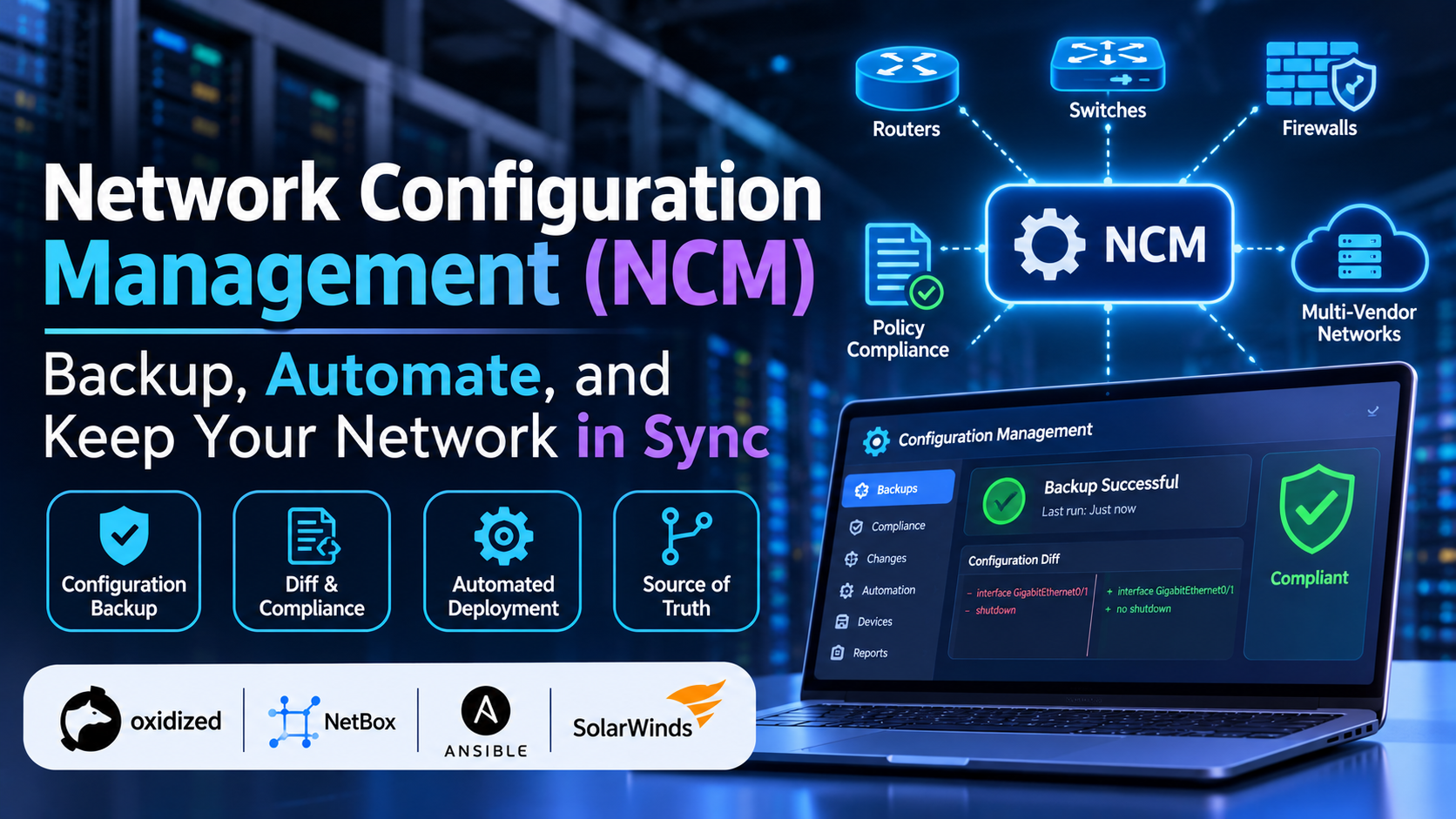
A core BGP routing change pushed at midnight breaks regional transit, and the engineer on call discovers that the last saved running-config on the jump host is four months old. Worse, nobody can confirm whether the outage stems from that night’s ACL edit or an undocumented hotfix applied during an emergency maintenance window weeks earlier. Network configuration management (NCM) exists to prevent that exact failure mode, yet buyers frequently stall because “NCM” spans everything from lightweight Git-backed CLI scrapers to enterprise policy engines and declarative automation frameworks.
Choosing the right platform depends less on how many vendor models a brochure lists and more on how your team governs state: whether you need automated backup and compliance auditing over existing manual workflows, or whether you are transitioning toward declarative, infrastructure-as-code (IaC) provisioning across multi-vendor switches, routers, and firewalls.
Two Competing Philosophies in Network Configuration Management
Before comparing individual products, separate NCM platforms into two distinct operational models. Mixing them up during procurement leads either to shelfware or to dangerous automation gaps.
- Backup, Diff, and Compliance Auditing (Reactive and Governance-First): The NCM platform connects to network devices via SSH, Telnet, or REST/NETCONF APIs, pulls running and startup configurations on a schedule or upon syslog trap triggers, stores versioned diffs, and checks text blocks against regulatory or internal policy rules (such as CIS benchmarks, PCI-DSS, or DISA STIG). Engineers still make day-to-day changes through CLI or vendor consoles, while the NCM system acts as the safety net, audit trail, and bulk-script executor.
- Declarative and Intent-Based Automation (Proactive and State-Driven): Instead of scraping CLI text after the fact, engineers define the desired network state—VLANs, BGP peers, VRFs, firewall zones—in structured data models (YAML, JSON, or Python) stored in Git. An orchestration engine renders templates and pushes idempotent changes to devices via NETCONF, RESTCONF, gNMI, or CLI drivers, continuously reconciling live device state against the Git source of truth.
Most mid-sized and enterprise networks run a hybrid: a dedicated NCM tool for universal backup, firmware lifecycle management, and compliance reporting across legacy and branch hardware, paired with automation frameworks for standardized data center fabrics.
Leading Network Configuration Management Platforms and Tools
The following tools represent credible, actively maintained choices across open-source, commercial mid-market, and enterprise automation workflows.
Oxidized: Lightweight, Git-Native Configuration Backup
is an open-source network device configuration backup tool written in Ruby that replaced RANCID in many modern Linux-centric operations teams. Instead of relying on CVS or Subversion, Oxidized integrates natively with Git, allowing engineers to treat device configuration histories like application source code—complete with commit diffs, blame tracking, and webhook triggers.
- Where it excels: Fast, low-overhead configuration collection across more than 130 operating systems (Cisco IOS/NX-OS, Juniper Junos, Arista EOS, MikroTik, Fortinet, Palo Alto, and others). It exposes a REST API and pairs cleanly with LibreNMS, Observium, and NetBox so inventory changes automatically update backup targets.
- Operational trade-offs: Oxidized is strictly a configuration collector and version-control bridge. It does not include built-in compliance policy engines, role-based approval workflows for pushing changes, or automated firmware upgrade orchestration.
- Deployment and cost: Free and open-source under the Apache 2.0 license, deployed on Linux servers or via official Docker containers.
NetBox + Ansible / Nornir: Source-of-Truth Driven Configuration Automation
When organizations outgrow manual CLI edits, pairing NetBox
(an open-source Network Source of Truth for IPAM and DCIM) with Ansible
or the Python-native Nornir
framework establishes a declarative NCM pipeline. NetBox holds the authoritative database of interfaces, IP prefixes, VLANs, and device roles; Jinja2 templates translate that data into vendor-specific syntax; and Ansible or Nornir pushes the rendered configuration over SSH or NETCONF.
- Where it excels: Eliminating configuration drift before it happens. Because configurations are generated dynamically from structured data rather than copied and pasted from old text files, provisioning a new leaf switch or updating NTP/SNMP servers across hundreds of devices becomes deterministic and peer-reviewable via Git pull requests.
- Operational trade-offs: This stack requires software engineering discipline. Teams must write and maintain Jinja2 templates, handle vendor-specific idempotency quirks (especially on legacy CLI-only platforms lacking transactional commit/rollback), and build CI/CD testing pipelines.
- Deployment and cost: Core open-source editions of NetBox, Ansible, and Nornir carry zero licensing fees; commercial enterprise editions with RBAC extensions, SSO, and vendor support are available from NetBox Labs and Red Hat.
SolarWinds Network Configuration Manager (NCM)
SolarWinds Network Configuration Manager
is a dedicated commercial NCM platform built for enterprise IT teams that need automated backups, real-time change detection, vulnerability correlation, and compliance remediation inside a structured GUI.
- Where it excels: Out-of-the-box governance and multi-vendor lifecycle tasks. SolarWinds NCM monitors syslog and SNMP traps to capture configuration diffs immediately after an engineer logs out, highlights unauthorized edits, checks configurations against built-in DISA STIG, HIPAA, and PCI policy templates, and flags Cisco or Juniper OS versions exposed to published CVEs. It also automates multi-step firmware upgrades with pre- and post-check validation.
- Operational trade-offs: Licensing scales by the number of managed nodes, and the platform requires Windows Server and Microsoft SQL Server infrastructure. Its CLI-template scripting works well for standardized tasks, though complex, multi-device transactional orchestration is less flexible than full Python/NETCONF frameworks.
- Deployment and cost: Commercial subscription or perpetual node-based licensing, deployed on-premises on Windows Server or in cloud IaaS environments.
ManageEngine Network Configuration Manager
ManageEngine Network Configuration Manager
provides a comprehensive, multi-vendor NCM suite tailored to distributed enterprises and managed service providers (MSPs) seeking straightforward administration without heavy scripting overhead.
- Where it excels: Granular role-based access control (RBAC) and change-approval workflows. Junior administrators can execute pre-approved “Configlets” (parameterized command templates) on assigned device groups while senior engineers review and approve sensitive changes before deployment. It supports real-time change notifications, baseline configuration pinning, and automated compliance auditing across switches, routers, firewalls, and load balancers.
- Operational trade-offs: Deep customization of device parsers for uncommon or newly released hardware models can depend on vendor template updates, and organizations heavily invested in GitOps pipelines may find its GUI-first workflow harder to integrate into pure code repositories.
- Deployment and cost: Commercial tiered licensing based on managed device count, available as an on-premises installation (Windows or Linux) or as an MSP multi-tenant edition.
Cisco Catalyst Center (formerly Cisco DNA Center)
is Cisco’s enterprise network controller and management platform for campus, branch, and wireless infrastructure. Within the NCM domain, it replaces manual CLI management with intent-based network profiles, golden image management, and software-defined access provisioning.
- Where it excels: Organizations standardized on Cisco Catalyst switching, routing, and wireless hardware that want zero-touch provisioning (ZTP), automated software image compliance (marking “Golden” IOS-XE releases and staging upgrades), and policy-driven segmentation across large campus environments.
- Operational trade-offs: Catalyst Center is tightly coupled to the Cisco ecosystem and requires dedicated high-specification physical or virtual appliances alongside Cisco DNA/Catalyst licensing tiers. Heterogeneous environments running Juniper, Arista, Fortinet, or Palo Alto gear still require a separate multi-vendor NCM tool.
- Deployment and cost: Commercial enterprise licensing bundled with Cisco hardware subscriptions, deployed on dedicated Cisco appliances or supported cloud/virtual infrastructure.
Itential Automation Platform
bridges traditional CLI-managed network infrastructure with modern API-driven cloud networking, ITSM ticketing systems, and source-of-truth databases. Rather than replacing existing tools like Ansible, NetBox, or ServiceNow, Itential acts as an orchestration and compliance layer across hybrid networks.
- Where it excels: Large enterprises and service providers automating end-to-end change requests—for example, taking an approved ServiceNow ticket, validating the proposed change against Golden Configuration compliance rules, executing pre-checks, pushing updates across both on-premises routers and AWS/Azure transit gateways, and closing the ticket automatically.
- Operational trade-offs: Itential is an enterprise orchestration platform designed for complex, cross-domain workflows; smaller IT teams managing fewer than a few hundred switches will find its architecture and commercial footprint excessive compared to PRTG, ManageEngine, or Oxidized.
- Deployment and cost: Commercial enterprise subscription available as a cloud-hosted SaaS platform or self-hosted deployment.
Comparing Network Configuration Management Approaches
| Tool / Stack | Architectural Model | Multi-Vendor Scope | Configuration Push & Remediation | Compliance & Audit Reporting | Deployment & Licensing |
| Oxidized | Git-backed CLI backup collector | Broad (130+ network OS drivers) | None (backup and diff only) | Basic via external Git webhooks/scripts | Self-hosted Linux/Docker; Open Source (Apache 2.0) |
| NetBox + Ansible / Nornir | Declarative Source-of-Truth + IaC | Broad (via vendor modules/NAPALM) | Full idempotent push & template rendering | Custom via CI/CD validation tests | Self-hosted Linux; Open Source + Commercial Enterprise tiers |
| SolarWinds NCM | Centralized backup, diff & policy suite | Broad (Cisco, Juniper, Arista, HP, etc.) | Bulk CLI scripts, remediation & firmware upgrades | Built-in DISA STIG, PCI, HIPAA & CVE checks | Self-hosted Windows/SQL; Commercial per-node license |
| ManageEngine NCM | GUI-driven backup, RBAC & workflow suite | Broad (200+ device templates) | Parameterized Configlets with approval gates | Built-in SOX, HIPAA, PCI & custom policy rules | Windows/Linux on-prem or MSP; Commercial per-device license |
| Cisco Catalyst Center | Intent-based vendor controller | Cisco campus, branch & wireless focus | Zero-Touch Provisioning, templates & Golden Images | Built-in software image & intent drift compliance | Dedicated appliance/VM; Commercial Cisco subscription |
| Itential | Cross-domain API & CLI orchestration | Hybrid (on-prem network + cloud + ITSM) | Event-driven workflows with pre/post validation | Golden Config tree enforcement across CLI & APIs | SaaS or self-hosted; Commercial enterprise subscription |
Critical Evaluation Criteria Beyond Device Support Lists
When evaluating NCM vendors, spec sheets almost always claim support for every major switch and firewall brand. Real operational friction emerges in four technical areas that buyers should test during a proof of concept:
- Transport Protocol Coverage (CLI Scraping vs. NETCONF/RESTCONF/gNMI): Scraping unstructured CLI text over SSH works universally, but screen-scraping breaks easily when a vendor alters prompt formatting or pagination output in a minor OS update. Platforms that support structured YANG models over NETCONF, RESTCONF, or gNMI parse configuration state reliably and support atomic candidate-config commits with automatic rollback if a change severs management connectivity.
- Secret Masking and Credential Vault Integration: Network configurations routinely contain hashed passwords, SNMP community strings, RADIUS shared secrets, and BGP MD5 keys. Verify whether the NCM platform strips or encrypts sensitive strings before writing backups to disk or Git, and whether it integrates with external secrets managers (such as HashiCorp Vault or CyberArk) rather than storing device enable passwords in a local database.
- Real-Time Change Detection Mechanics: Scheduled nightly backups leave a 24-hour blind spot during which unauthorized edits can go unnoticed. Look for platforms that listen for syslog messages (such as Cisco
%SYS-5-CONFIG_I) or SNMP configuration-change traps to trigger an immediate configuration pull and attribute the diff to the specific TACACS+/RADIUS user session. - Firmware Lifecycle Staging: Pushing OS images to remote WAN routers over congested links frequently fails without automated MD5/SHA-256 checksum verification, flash-space checks, boot-variable updates, and automated rollback timers. If firmware upgrades consume significant engineering hours, prioritize tools with built-in multi-stage upgrade workflows rather than generic file-transfer scripts.
Matching the Right NCM Stack to Your Environment
If your immediate pain point is a lack of reliable backups, audit trails, and compliance reporting across an existing multi-vendor network where engineers configure devices manually, a dedicated governance platform such as SolarWinds NCM or ManageEngine NCM delivers rapid time-to-value—while Oxidized provides a zero-cost, Git-native alternative for Linux-savvy teams that only need rock-solid versioned backups.
Conversely, if your team is building standardized data center fabrics, automating repetitive VLAN/BGP provisioning, or eliminating manual CLI access altogether, invest in a NetBox + Ansible/Nornir pipeline (or Itential when integrating approvals with ServiceNow and multi-cloud APIs). Before committing to any platform, test it against your most complex production firewall and core router configurations—specifically verifying how it handles multi-context configurations, encrypted secrets, and rollback recovery when a pushed change drops the management session.
