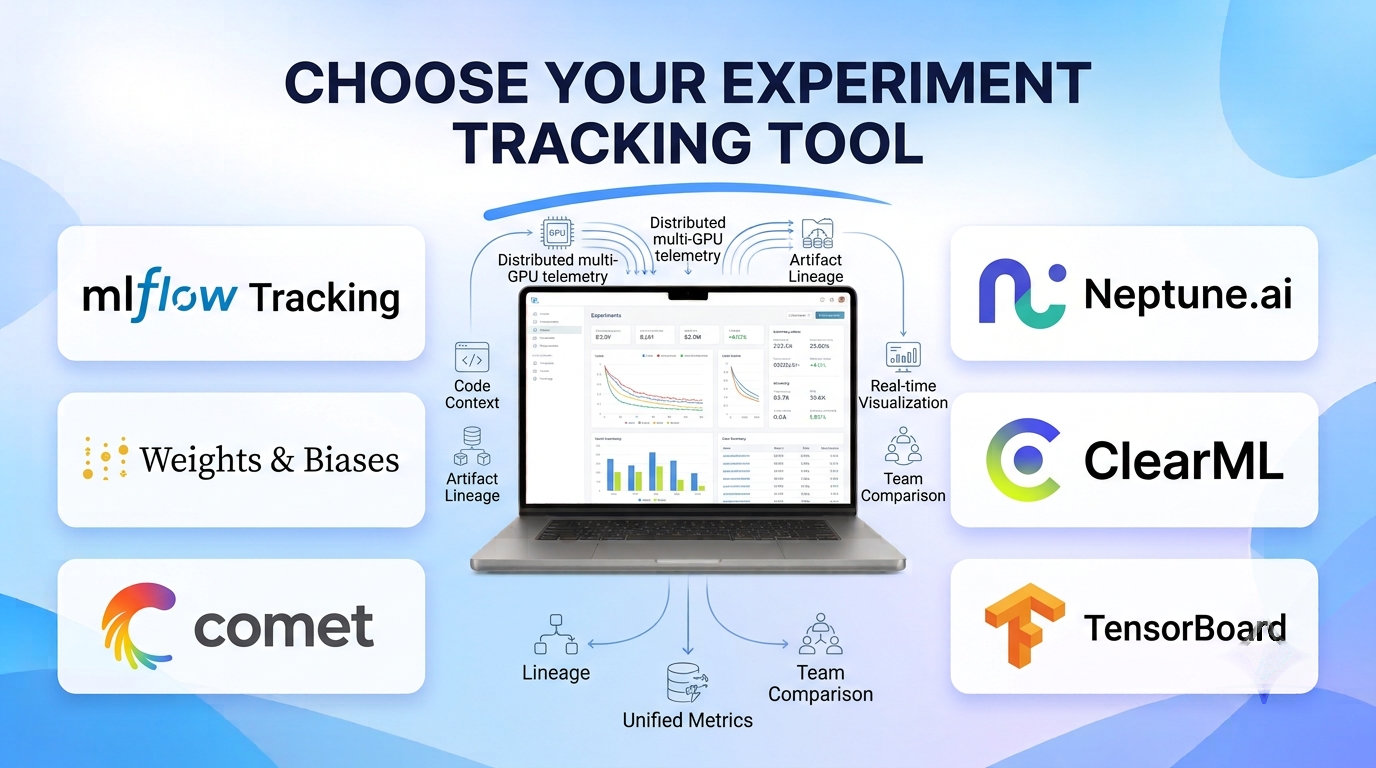
Experiment tracking helps data scientists find a promising model; a model registry governs how that model reaches production safely—and how it gets rolled back when real-world data shifts. Without a centralized registry, organizations fall back on fragile conventions: production APIs pointing to hardcoded S3 paths like s3://ml-models/churn_v3_final_FINAL.pkl, undocumented preprocessing dependencies, and zero visibility into which team owns a running endpoint.
A model registry acts as the system of record between model development and production deployment. Evaluating registry tools requires examining how they handle model lineage, environment packaging, alias-based promotion workflows, role-based access control, and automated CI/CD webhook triggers.
Core Capabilities That Separate a Model Registry From Object Storage
Storing .pt, .onnx, or .safetensors files in Amazon S3 or Google Cloud Storage provides durability, not governance. A dedicated model registry provides five essential controls:
- Semantic Versioning and Aliases: Grouping iterations under a logical model entity (
fraud-detectorversions1, 2, 3...) while exposing mutable deployment aliases (@champion,@challenger,@production) so serving infrastructure updates cleanly without hardcoding version numbers. - Input/Output Schema Signatures and Environment Contracts: Enforcing expected tensor shapes, column types, and pinned Conda/Docker dependencies so inference containers fail fast on incompatible inputs rather than silently mispredicting.
- Lineage and Provenance Linking: Tracing every registered model version back to its exact training run, Git commit, feature table snapshot, and validation evaluation metrics.
- Approval Gates and Audit Trails: Requiring automated validation checks (latency benchmarks, fairness thresholds) and human sign-off before promoting a candidate from staging to production.
- Event-Driven Deployment Hooks: Emitting webhooks or CI/CD events whenever a model version receives a production alias, triggering automated container builds or canary rollouts.
Leading Model Registry Platforms and Architectural Models
MLflow Model Registry (and Unity Catalog Integration)
MLflow Model Registry is the most widely adopted open-source model registry, building directly on MLflow’s standardized MLmodel packaging format. Models are registered under unique names with sequential versions, enriched with key-value tags and mutable aliases (replacing legacy fixed stage names with flexible deployment pointers like champion or shadow), and loaded downstream via uniform URIs (models:/credit-risk@champion). Inside Databricks, MLflow Registry integrates directly with Unity Catalog, extending governance across workspaces with centralized role-based access control, cross-workspace model sharing, and end-to-end table-to-endpoint lineage.
Teams seeking an open-source, framework-agnostic registry that pairs seamlessly with CI/CD pipelines—or enterprises already governing data in Databricks Unity Catalog—rely heavily on MLflow. Self-hosted open-source deployments require configuring external authentication and webhook automation to enforce strict enterprise approval gates.
Hugging Face Hub (and Enterprise Hub)
For organizations working with foundation models, large language models, embeddings, and computer vision checkpoints, Hugging Face Hub (and self-hosted/VPC Enterprise Hub) has become the de facto registry standard. Built on Git and Git-LFS with structured Model Cards, safetensors serialization security, automated evaluation metadata, commit-level revision pinning, and role-based organization repositories, it natively integrates with transformers, vLLM, TGI (Text Generation Inference), and major cloud inference platforms.
AI engineering teams fine-tuning, quantizing, and deploying open-weight LLMs or multimodal models gain frictionless interoperability from Hugging Face Hub. For classical tabular ML workflows (XGBoost, scikit-learn) tightly coupled to internal data warehouse lineage, traditional MLOps registries remain more natural.
Amazon SageMaker Model Registry
Amazon SageMaker Model Registry provides AWS’s enterprise model governance layer within SageMaker. Organizing models into Model Packages inside Model Package Groups, it tracks evaluation metrics, bias/explainability reports (via SageMaker Clarify), inference container specifications, and explicit approval statuses (PendingManualApproval, Approved, Rejected)—natively triggering AWS EventBridge and CodePipeline deployments across dev, staging, and production AWS accounts.
AWS-centric enterprises operating multi-account governance topologies benefit from SageMaker Model Registry’s cross-account IAM permissions and native EventBridge automation. Its trade-off is tight coupling to AWS infrastructure and SageMaker container conventions.
Google Cloud Vertex AI Model Registry
Vertex AI Model Registry centralizes model lifecycle management on Google Cloud, uniting custom-trained models, BigQuery ML models, and tuned foundation models in one catalog. Supporting version aliases, side-by-side evaluation comparisons, integrated explainability metadata, and one-click deployment to Vertex AI Endpoints or batch prediction jobs, it keeps GCP-based ML assets governed under Google Cloud IAM.
Organizations standardized on Google Cloud and BigQuery gain streamlined lineage between BigQuery training datasets and managed prediction endpoints, though portability outside GCP requires exporting underlying artifacts manually.
Weights & Biases Registry
Weights & Biases Registry connects experiment tracking directly to production delivery by allowing teams to promote top-performing artifacts from W&B runs into a centralized, cross-project Model Registry. Each registered model preserves full upstream lineage—linking back to training loss curves, dataset artifacts, and evaluation tables—while firing webhooks into GitHub Actions, Jenkins, or cloud deployment pipelines upon alias updates.
Teams already using Weights & Biases for experiment tracking gain immediate workflow continuity without synchronizing metadata across two separate tools. Organizations not using W&B for tracking rarely adopt its registry in isolation.
Vertex / Azure ML Registry & Kubeflow Model Registry
Azure Machine Learning Registries enable cross-workspace model, environment, and component sharing across enterprise Azure subscriptions with Microsoft Entra ID governance. Meanwhile, Kubeflow Model Registry provides an open-source, Kubernetes-native metadata service that bridges model development and KServe inference deployments inside open-source Kubernetes clusters.
Model Registry Comparison
| Platform | Deployment & Licensing | Packaging & Format Focus | Governance & Approval Controls | Ecosystem & Portability | Best Fit |
| MLflow Model Registry | Open-source (Apache 2.0) + Databricks Unity Catalog | Standardized MLmodel multi-flavor packaging | Version aliases, tags, and Unity Catalog RBAC/lineage | Very High (framework- and cloud-agnostic) | General ML teams wanting an open, portable registry standard |
| Hugging Face Hub | Cloud SaaS + Enterprise Hub (VPC / On-Prem) | Git-LFS repositories, safetensors, Model Cards | Org RBAC, commit pinning, security scanning, audit logs | High across LLM/vision ecosystems (vLLM, transformers) | Teams fine-tuning and serving LLMs and foundation models |
| SageMaker Model Registry | Managed AWS service | Docker inference images + S3 model artifacts | Explicit approval workflows + cross-account EventBridge hooks | AWS-native (IAM, CodePipeline, SageMaker Endpoints) | Multi-account AWS enterprises with strict release gates |
| Vertex AI Model Registry | Managed GCP service | Custom containers, BigQuery ML, and tuned foundation models | Version aliases, IAM permissions, and Vertex deployment links | GCP-native (BigQuery and Vertex Endpoints) | Organizations building ML and AI pipelines on Google Cloud |
| W&B Registry | Commercial SaaS + Private Cloud | Framework-agnostic artifact bundles linked to W&B runs | Collection-level permissions, aliases, and CI/CD webhooks | Cloud-agnostic (integrates with GitHub Actions/cloud) | Teams already standardized on Weights & Biases tracking |
| Azure ML Registry | Managed Microsoft Azure service | MLflow and custom Azure ML model packages | Cross-subscription enterprise RBAC and Purview lineage | Microsoft Azure ecosystem | Regulated enterprises standardized on Azure |
Four Governance Practices That Prevent Registry Sprawl
- Ban Production Deployment from Raw Storage Paths: Configure CI/CD deployment pipelines so production serving containers accept only registered model URIs with verified
@championor@productionaliases—never direct S3 or GCS bucket URLs. - Enforce Model Signatures at Registration Time: Require every registered model to declare strict input column names, data types, and output schemas so incompatible upstream feature changes fail validation before reaching live traffic.
- Automate Smoke Tests on Registration: Trigger a lightweight CI pipeline upon model registration that spins up the packaged inference environment, runs sample payloads, and verifies latency budgets before allowing human approval.
- Define Archival and Retention Policies: Uncurated registries quickly accumulate thousands of experimental versions. Enforce clear naming conventions and automated archival for superseded versions.
Selecting the Right Model Registry
Match your registry choice to your model types and infrastructure boundaries. For general-purpose tabular and deep learning workflows across clouds, MLflow Model Registry offers the cleanest vendor-neutral standard—and scales seamlessly into enterprise governance if your organization adopts Databricks Unity Catalog. Teams building primarily with open-weight LLMs and multimodal foundation models will move fastest with Hugging Face Enterprise Hub, while enterprises standardized on AWS, Google Cloud, or Azure gain built-in cross-account approvals and deployment automation from their native cloud registries.
