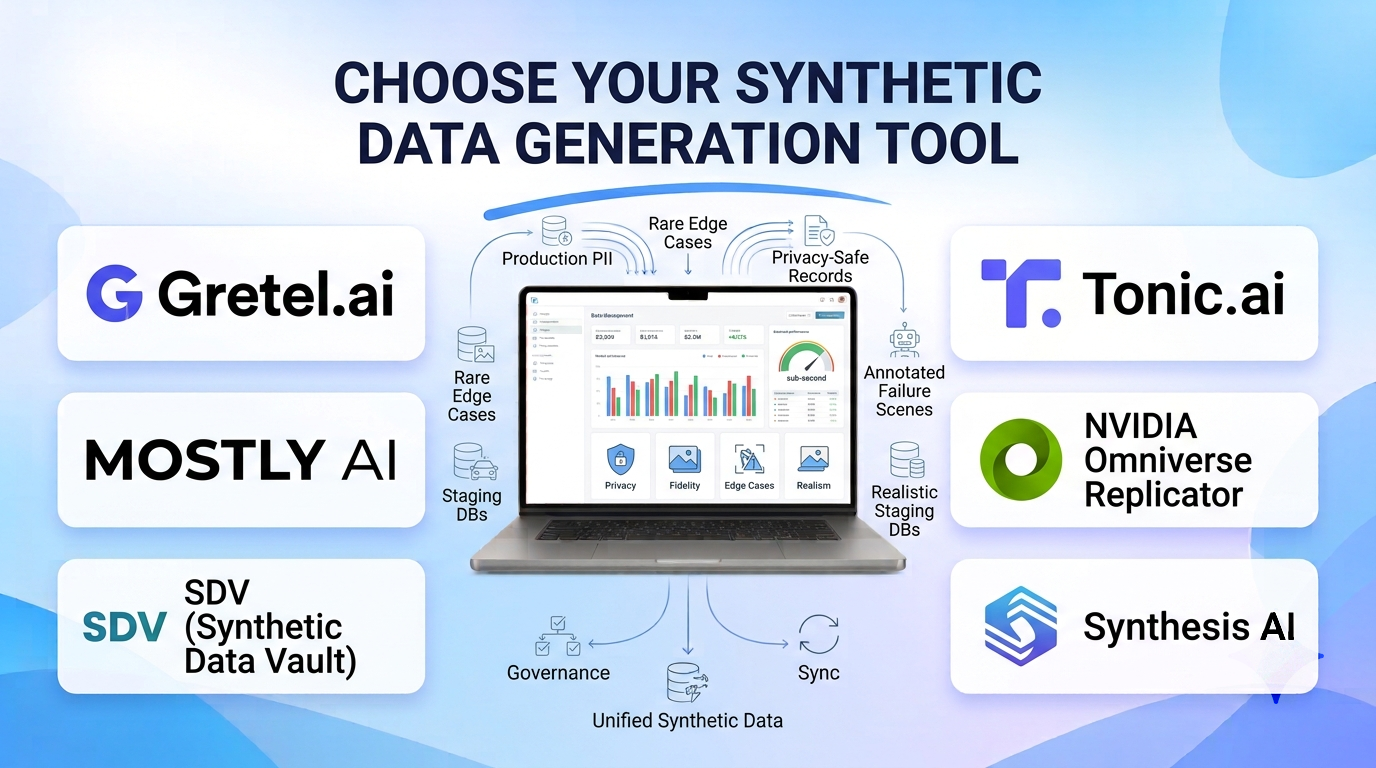
Real-world datasets frequently block AI development before training even begins. Healthcare and financial institutions sit on rich patient or transaction records locked behind HIPAA, GDPR, and PCI-DSS privacy mandates; autonomous vehicle and manufacturing teams lack enough rare edge-case failure footage; and software engineering teams struggle to populate realistic staging databases without risking production PII leaks.
Synthetic data generation tools create artificial datasets that preserve the statistical distributions, relational schemas, or visual physics of real data without exposing sensitive records. Choosing the right platform requires distinguishing between three fundamentally different technical domains—tabular relational synthesis, 3D visual simulation, and LLM-driven text generation—and verifying statistical fidelity alongside formal privacy guarantees.
Three Distinct Categories of Synthetic Data Generation
Treating “synthetic data” as a single product category leads to mismatched evaluations. Tools divide cleanly by data modality:
- Tabular and Relational Data Synthesizers: Train generative models (diffusion models, GANs, variational autoencoders, or autoregressive transformers) on real database tables to generate statistically faithful synthetic rows while preserving multi-table primary/foreign key integrity.
- 3D Simulation and Computer Vision Generators: Use physics-based rendering engines and procedural 3D environments to produce pixel-accurate synthetic images and video complete with automatic bounding boxes, depth maps, and semantic segmentation masks.
- LLM-Driven Text and Instruction Data Generators: Generate diverse conversational trajectories, domain-specific Q&A pairs, and edge-case evaluation prompts for fine-tuning and testing large language models.
Leading Synthetic Data Platforms and Libraries Compared
Gretel.ai
Gretel.ai provides an enterprise synthetic data platform (alongside open-source Python SDKs) spanning structured tabular data, time-series sequences, and unstructured text/LLM datasets. Supporting multiple generative architectures—including tabular diffusion models, fine-tuned language models, and differential privacy training mechanisms—Gretel automatically detects and redacts PII before synthesis and generates quality reports comparing synthetic versus real statistical correlations and privacy protection scores.
Engineering and data science teams needing flexible API-driven synthetic data across both tabular databases and LLM fine-tuning pipelines—with hybrid deployment options keeping sensitive data inside their own VPC—benefit strongly from Gretel’s breadth. As a commercial platform with usage-based enterprise tiers, smaller teams with straightforward single-table anonymization needs may start with lightweight open-source libraries first.
MOSTLY AI
MOSTLY AI specializes in high-fidelity, privacy-safe tabular and relational database synthesis for regulated enterprises. Using purpose-built generative deep learning architectures engineered specifically for multi-table relational schemas, MOSTLY AI preserves complex parent-child referential integrity, sequential time-series patterns, and subtle multivariate correlations while applying built-in overfitting guards so synthetic records cannot be reverse-engineered back to individual customers.
Banks, insurers, and telecom providers sharing realistic customer datasets across analytics teams, external vendors, or cross-border jurisdictions rely heavily on MOSTLY AI’s relational fidelity and privacy assurance reports. Its focus centers squarely on structured tabular and behavioral sequence data rather than 3D imagery or video.
Tonic.ai
Tonic.ai approaches synthetic data from a database engineering and DevOps perspective, helping software teams generate realistic, de-identified replicas of production relational databases (PostgreSQL, MySQL, SQL Server, Oracle, Snowflake, Databricks) for staging, QA testing, and developer environments—alongside Tonic Textual for redacting and synthesizing unstructured documents for LLM pipelines.
Software engineering and QA organizations slowed down by masked or broken staging databases gain immediate productivity from Tonic’s schema-aware subsetting and foreign-key preservation. Teams training complex predictive ML models on subtle multivariate statistical distributions should compare Tonic’s generative modeling options against ML-centric synthesizers like MOSTLY AI or SDV.
SDV (Synthetic Data Vault)
Maintained by DataCebo and rooted in MIT research, SDV (Synthetic Data Vault) is the leading open-source Python ecosystem for tabular and relational synthetic data generation. Offering implementations of Gaussian Copula, CTGAN, TVAE, and multi-table HMA (Hierarchical Modeling Algorithm) synthesizers alongside the SDMetrics evaluation suite, SDV lets data scientists train, evaluate, and generate synthetic datasets locally in Python with full source transparency.
Researchers, Python practitioners, and privacy-conscious organizations wanting self-hosted, auditable open-source synthesis without vendor lock-in consistently choose SDV. Scaling multi-table synthesis to massive enterprise warehouse schemas with strict differential privacy guarantees requires significant tuning or DataCebo’s commercial enterprise extensions.
NVIDIA Omniverse Replicator
For computer vision and robotics teams, NVIDIA Omniverse Replicator is an extensible synthetic data generation framework built on Universal Scene Description (OpenUSD) and RTX ray-traced physics simulation. Developers construct procedural 3D scenes—varying lighting, weather, camera angles, object textures, and sensor noise via domain randomization—and output photorealistic images, LiDAR point clouds, and ground-truth 2D/3D annotations automatically.
Autonomous vehicle developers, warehouse robotics engineers, and industrial defect-inspection teams rely on Omniverse Replicator to generate rare edge cases (such as damaged packages or hazardous road conditions) that would be dangerous or prohibitively expensive to photograph in the real world. Running Omniverse requires NVIDIA RTX GPU hardware and 3D scene-building expertise.
Synthesis AI and Datagen / Parallel Domain
Specialized computer vision synthetic platforms such as Synthesis AI (focused on human-centric computer vision, facial geometry, and body pose estimation) and autonomous perception simulation providers generate physically accurate, bias-balanced visual datasets with guaranteed pixel-level annotations, helping vision teams eliminate human labeling errors and demographic dataset blind spots.
Argilla / Distilabel (Open-Source LLM Synthetic Data)
For teams building domain-specific language models, open-source Python frameworks like Distilabel (by Argilla/Hugging Face) enable reproducible synthetic text generation, preference-pair creation (DPO), and LLM-as-a-judge filtering pipelines across open-weight and commercial foundation models.
Synthetic Data Tool Comparison
| Platform | Primary Modality | Core Technical Approach | Privacy & Governance Focus | Deployment Model | Best Fit |
| Gretel.ai | Tabular, time-series, and text/LLM | Tabular diffusion, LLMs, and differential privacy | Automated PII detection, privacy scoring, hybrid VPC | Cloud SaaS or customer-hosted hybrid VPC | AI teams needing unified tabular + LLM synthetic data |
| MOSTLY AI | Multi-table relational & behavioral tabular | Deep generative models for relational schemas | Strict overfitting prevention and privacy audit reports | Cloud SaaS or self-hosted enterprise | Banks, insurers, and regulated analytics data sharing |
| Tonic.ai | Relational databases + unstructured text | Deterministic masking, subsetting, and generative synthesis | Schema-preserving de-identification for Dev/QA & RAG | Self-hosted on-prem/VPC or Cloud SaaS | Software engineering staging DBs and enterprise RAG pipelines |
| SDV (Synthetic Data Vault) | Single- and multi-table tabular data | Open-source CTGAN, TVAE, Gaussian Copula, HMA | Open-source SDMetrics quality/privacy evaluation | Open-source Python library (local/self-hosted) | Python data scientists wanting transparent OSS synthesis |
| NVIDIA Omniverse Replicator | 3D imagery, video, and LiDAR sensors | OpenUSD ray-traced simulation + domain randomization | Eliminates real-world PII capture; automated ground truth | Local workstation or cloud NVIDIA RTX GPUs | Robotics, autonomous vehicles, and industrial computer vision |
| Distilabel | Text, instruction tuning, and preference pairs | Multi-LLM generation + automated quality filtering | Full pipeline reproducibility in Python | Open-source Python library | Teams fine-tuning or evaluating custom LLMs |
Three Risks Every Synthetic Data Buyer Must Verify
- Statistical Utility vs. Privacy Memorization: An overfitted generative model can achieve near-100% statistical similarity by accidentally memorizing and reproducing real customer rows verbatim. Always audit Distance to Closest Record (DCR) and membership-inference metrics alongside correlation scores.
- Model Collapse from Recursive Synthetic Training: Training successive generations of models exclusively on uncurated synthetic outputs amplifies subtle distributional biases and erodes tail-event diversity. Always anchor synthetic generation to real seed data and human-validated ground-truth benchmarks.
- Domain-to-Real Gap in Computer Vision: Models trained purely on overly clean 3D renders can fail when deployed on noisy, low-light real cameras unless pipelines incorporate realistic sensor noise, lens distortion, and mixed real-plus-synthetic fine-tuning.
Choosing the Right Synthetic Data Tool
Match the platform to your data modality and compliance goal. If your priority is populating realistic staging databases for software QA without exposing production customer records, Tonic.ai fits directly into database workflows. When data science teams need high-fidelity, privacy-certified tabular data across complex multi-table schemas, MOSTLY AI and Gretel.ai lead enterprise deployments, while SDV offers the strongest open-source Python starting point. Finally, for physical AI, robotics, and visual inspection teams starved of labeled edge-case imagery, NVIDIA Omniverse Replicator turns 3D simulation into an unlimited annotation engine.
