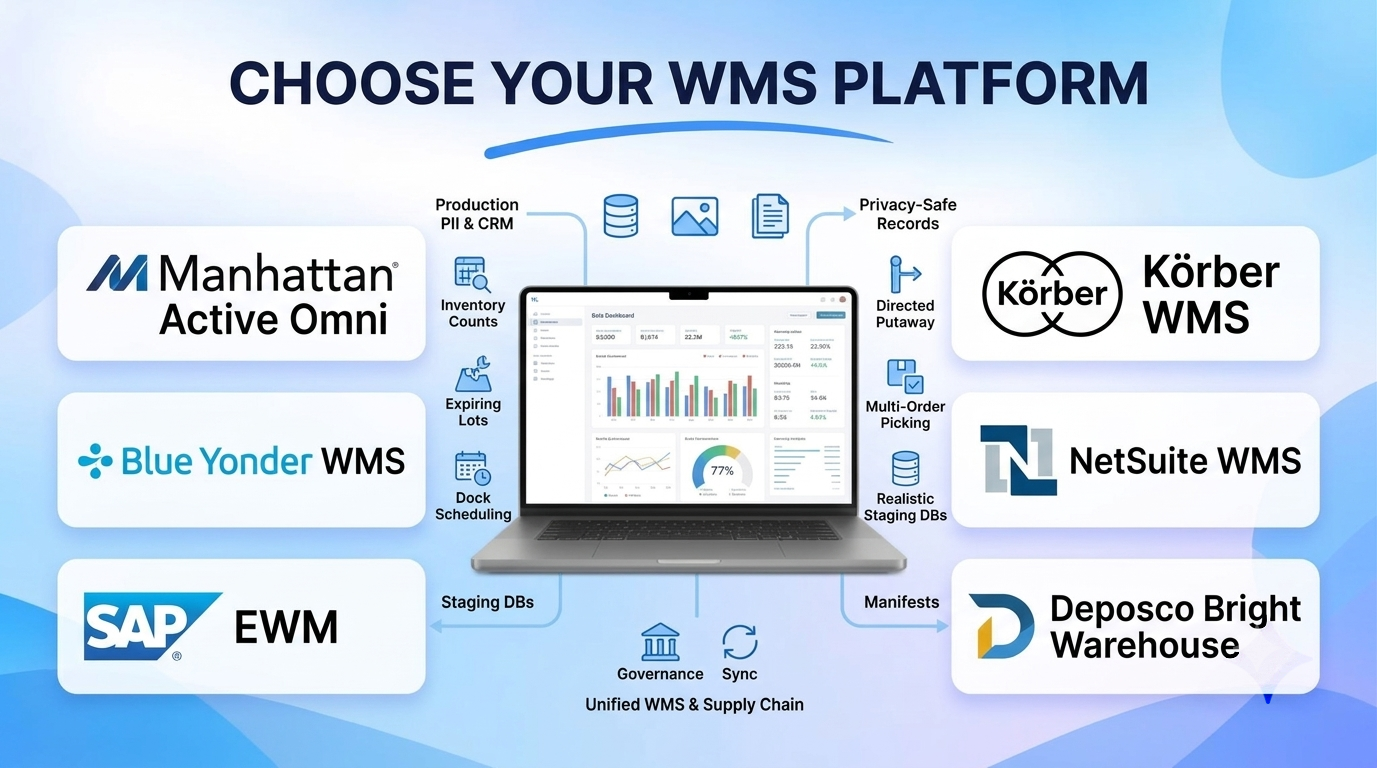
An Inventory Management System tells you that you own 400 units of SKU-904 in your Dallas warehouse; a Warehouse Management System (WMS) tells a picker exactly which aisle, bay, and shelf holds the oldest expiring lot, sequences their walk path to pick twelve orders in one pass, verifies every scan via RF/voice terminals, prints compliant carrier/EDI labels, and confirms the trailer manifest before the dock door closes.
Evaluating WMS platforms requires distinguishing between Tier-1 enterprise supply-chain WMS suites (engineered for automated high-volume distribution centers), cloud-native mid-market and 3PL WMS platforms, and modern e-commerce fulfillment WMS tools built for fast-moving D2C brands.
Five Core Capabilities That Separate True WMS From Basic Inventory Apps
When evaluating a WMS for self-operated distribution centers or third-party logistics (3PL) facilities, inspect five operational engines:
- Directed Putaway and Dynamic Slotting: Automatically assigning incoming pallets to optimal bin locations based on SKU velocity (placing fast-moving “A” movers near packing stations), weight/crushability constraints, temperature zones, and hazmat segregation—and recommending periodic re-slotting as seasonal demand shifts.
- Wave, Waveless, and Multi-Order Picking Optimization: Grouping orders intelligently into wave, batch, cluster, or zone-picking runs—calculating serpentine or shortest-path walk sequences on mobile RF scanners or voice-directed headsets to cut operator travel time (typically 50%+ of warehouse labor).
- Mobile RF Barcode/RFID Verification and Cartonization: Enforcing mandatory location-and-item barcode scans at every putaway, pick, replenishment, and pack step to eliminate mis-picks—paired with 3D cartonization algorithms that select the smallest optimal shipping box and rate-shop parcels across carriers.
- Labor Management System (LMS) and Yard/Dock Scheduling: Tracking engineered labor standards per task (picks per hour, putaways per hour), balancing workload across floor zones in real time, and scheduling inbound/outbound carrier dock appointments to prevent yard congestion.
- 3PL Multi-Tenant Billing and Automation (WCS/WES) Integration: For 3PL providers, automating client-specific storage, pick/pack, and value-added-service billing per pallet or cubic foot; for automated facilities, integrating cleanly with Warehouse Execution Systems (WES), conveyors, goods-to-person AMRs, and AS/RS shuttles.
Leading Warehouse Management Systems (WMS)
Manhattan Active Warehouse Management
Manhattan Active WMS is widely recognized as the Tier-1 enterprise benchmark for high-volume retail, grocery, pharmaceutical, and global distribution centers. Built on a cloud-native, microservices architecture with embedded Labor Management, Yard Management, and Warehouse Execution System (WES) orchestration for robotics and conveyors, Manhattan Active receives continuous versionless updates without disruptive multi-year upgrade projects.
Enterprise retailers and high-throughput distribution networks operating complex, semi-automated facilities standardize on Manhattan Active WMS—accepting enterprise subscription investments and comprehensive implementation engagements.
Blue Yonder WMS and SAP Extended Warehouse Management (EWM)
- Blue Yonder WMS rivals Manhattan at the top of the enterprise market—excelling in task interleaving (combining putaway and picking in a single forklift trip), deep labor productivity optimization, and complex cold-chain/grocery distribution.
- SAP Extended Warehouse Management (EWM) delivers deep, native warehouse execution inside SAP S/4HANA environments—providing granular bin-level control, cross-docking, kitting, and automated material-flow control without external middleware for SAP-centric manufacturing and distribution enterprises.
Körber WMS (formerly HighJump)
Körber WMS bridges the upper mid-market and enterprise segments with a highly adaptable workflow architecture—allowing operations teams to customize screens, picking rules, and voice/AMR integrations without modifying core source code, alongside strong native support for voice picking and autonomous mobile robots.
NetSuite WMS and Deposco Bright Warehouse (Mid-Market Cloud WMS)
- NetSuite WMS provides mobile RF barcode scanning, directed putaway, wave picking, and cycle counting natively inside the Oracle NetSuite ERP database—eliminating sync latency for mid-market companies already running NetSuite.
- Deposco (Bright Warehouse) delivers a modern, fast-deploying cloud WMS + DOM suite tailored for high-growth omnichannel brands, wholesale distributors, and mid-market 3PLs—combining intuitive mobile workflows, 150+ pre-built ERP/marketplace/carrier connectors, and rapid implementation timelines.
ShipHero, Logiwa, and Extensiv 3PL Warehouse Manager (E-Commerce & 3PL Specialists)
For fast-growing D2C fulfillment centers and modern Third-Party Logistics (3PL) operators:
- ShipHero is a purpose-built cloud WMS for high-velocity e-commerce brands and D2C 3PLs—featuring intuitive iPad/mobile tote-picking apps, multi-warehouse routing, client billing portals, and fast setup without legacy enterprise complexity.
- Logiwa IO targets high-volume D2C fulfillment and 3PL networks with AI-assisted wave optimization, dynamic slotting, and deep marketplace/carrier automation.
- Extensiv (formerly 3PL Central) remains one of the most widely adopted cloud WMS platforms specifically engineered for multi-client 3PL warehouses—offering automated client billing, EDI compliance, and dedicated customer inventory portals out of the box.
Warehouse Management Systems (WMS) Comparison
| WMS Platform | Target Facility Profile | Core Architectural Strength | Automation & Labor Depth | Deployment & Ecosystem | Best Fit |
| Manhattan Active WMS | Tier-1 high-volume & automated DCs | Cloud-native microservices + built-in WES & LMS | Very High (AMRs, conveyors, task interleaving & LMS) | Enterprise Cloud SaaS (versionless) | Global retailers & high-throughput distribution centers |
| Blue Yonder / SAP EWM | Large enterprise & SAP-centric distribution | Deep labor/interleaving (Blue Yonder) / native S/4HANA (SAP EWM) | Very High (automated material flow & yard control) | Cloud SaaS & On-Premises | Enterprise supply chains & SAP S/4HANA enterprises |
| Körber WMS | Mid-to-large adaptable warehouses | Configurable workflow engine + strong voice/robotics integration | High (voice picking, AMR orchestration & LMS) | Cloud & On-Premises | Growing enterprises needing custom warehouse workflows |
| Deposco / NetSuite WMS | Mid-market omnichannel & NetSuite facilities | Fast cloud omnichannel WMS (Deposco) / single-DB ERP sync (NetSuite) | Moderate–High (wave/zone picking & cartonization) | Cloud SaaS | Mid-market brands & distributors scaling warehouse operations |
| ShipHero / Logiwa IO | High-velocity D2C e-commerce & modern 3PLs | Rapid mobile picking, carrier automation & fast deployment | Moderate (batch/tote picking & AI wave rules) | Cloud SaaS | Fast-moving D2C fulfillment centers & e-commerce 3PLs |
| Extensiv 3PL Warehouse Manager | Multi-client 3PL providers | Purpose-built 3PL billing, client portals & retail EDI | Moderate (multi-client billing & RF scanning) | Cloud SaaS | Third-party logistics (3PL) operators managing dozens of clients |
Common WMS Implementation Pitfalls to Avoid
- Deploying a WMS Before Labeling Physical Aisles, Bins, and SKUs: Software cannot direct a picker to
Aisle-04-Bay-12-Shelf-Bif warehouse racks lack scannable barcode placards or incoming vendor cartons lack uniform UPC/GS1 labels. Complete physical bin mapping and barcode labeling before software configuration. - Ignoring Wi-Fi Dead Zones Inside High-Bay Metal Racking: Steel pallet racks loaded with liquids or electronics absorb 5 GHz RF signals—causing mobile barcode scanners to freeze mid-pick and corrupt session states. Conduct an active RF site survey across fully loaded racks before go-live.
- Underestimating Change Management for Floor Supervisors: Switching veteran warehouse pickers from memorized paper pick lists to system-directed RF paths initially slows throughput during week one. Invest in hands-on floor training and shadow parallel runs before peak shipping seasons.
Selecting the Right Warehouse Management System
Match your WMS investment to your daily order volume, client billing model, and ERP ecosystem:
- For High-Velocity D2C E-Commerce Fulfillment: Evaluate ShipHero or Logiwa IO for fast mobile tote picking, cartonization, and rapid deployment.
- For Multi-Client Third-Party Logistics (3PL) Operators: Choose Extensiv 3PL Warehouse Manager (or Logiwa IO / Deposco for high-volume e-commerce 3PLs) to automate complex client storage and activity billing.
- For Mid-Market Omnichannel or NetSuite-Centric Warehouses: Deploy Deposco or NetSuite WMS for tight ERP continuity and structured wave picking.
- For Enterprise High-Throughput or Automated Distribution Centers: Standardize on Manhattan Active WMS, Blue Yonder WMS, or SAP EWM.
