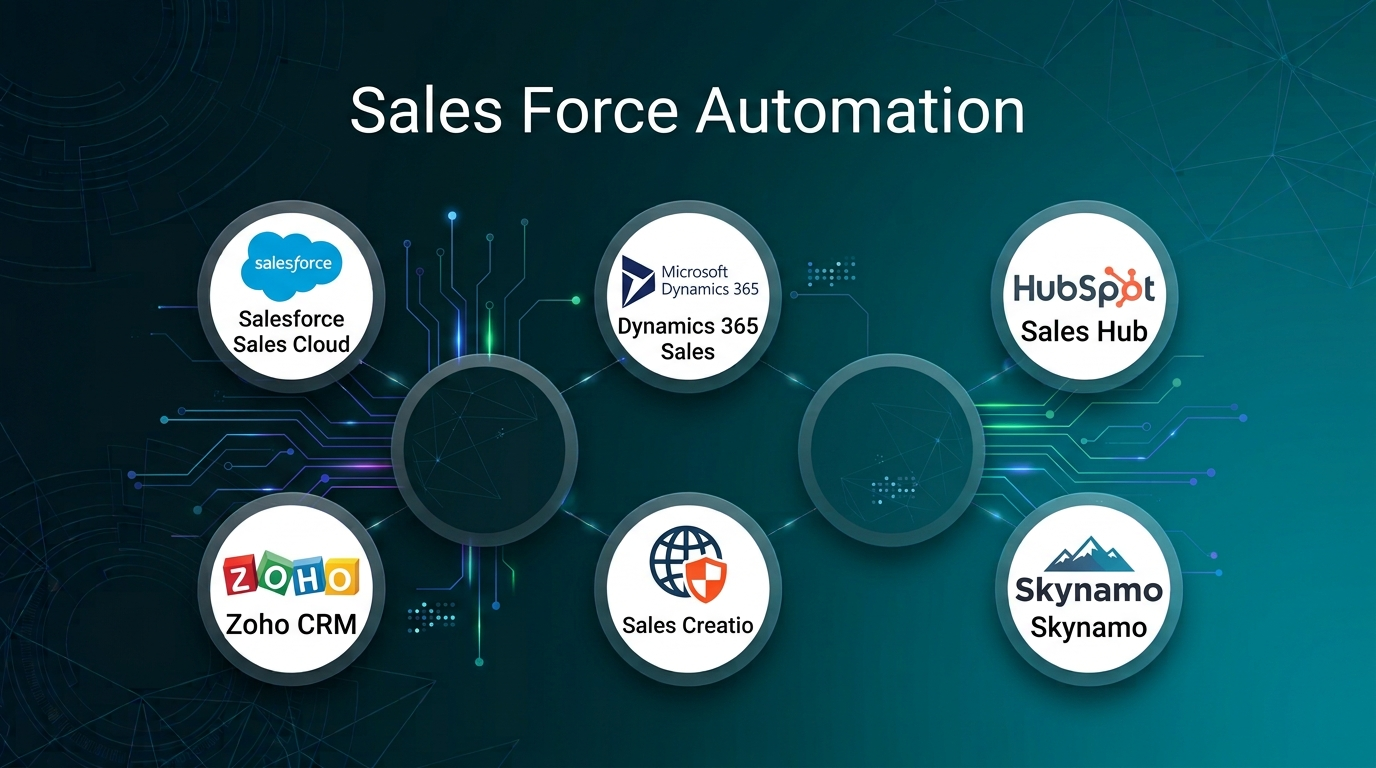
While Customer Relationship Management (CRM) acts as the broad database of customer record, Sales Force Automation (SFA) represents the active operational engine within and around that database. When sales reps spend less than a third of their week actually selling—spending the rest manually logging call notes, scheduling follow-ups, re-assigning inbound leads, and updating pipeline close dates—revenue growth stalls under administrative friction.
SFA platforms automate the mechanical stages of the sales cycle: distributing leads based on territory rules, triggering automated email and call cadences, enforcing stage-gate qualification criteria, and generating activity-driven pipeline forecasts. Evaluating SFA tools requires distinguishing between comprehensive CRM-native enterprise automation suites, field-sales and retail execution platforms, and high-velocity inside-sales dialer and cadence engines.
Five Core Capabilities That Define Modern Sales Force Automation
Basic contact databases store names and phone numbers; mature SFA engines drive execution velocity across five critical workflows:
- Automated Lead Routing, Scoring, and Account Matching: Matching incoming leads to existing target accounts (Lead-to-Account matching), scoring them dynamically on demographic fit and intent signals, and routing them instantly across territories via round-robin, capacity-weighted, or geographic assignment rules.
- Multi-Channel Sales Cadences and Activity Capture: Guiding reps through structured outreach sequences (email, phone, LinkedIn, WhatsApp) while automatically logging sent emails, calendar meetings, and call recordings into the core opportunity record without manual data entry.
- Pipeline Inspection and Opportunity Stage-Gate Governance: Enforcing mandatory qualification frameworks (such as MEDDPICC or BANT) at each pipeline stage transition, flagging stalled opportunities, and tracking close-date slippage automatically.
- Mobile and Offline Field Sales Automation: Equipping field reps with mobile-first route planning, geo-verified client check-ins, barcode scanning, order-taking, and offline data caching for field merchandising, medical device sales, and industrial distribution.
- AI-Assisted Activity Summarization and Conversational Guidance: Transcribing sales calls in real time, auto-generating CRM meeting summaries, recommending next-best sales actions, and detecting competitor mentions or pricing objections during live conversations.
Leading Sales Force Automation Platforms
Salesforce Sales Cloud
Salesforce Sales Cloud is the enterprise benchmark for Sales Force Automation. Providing an extraordinarily deep workflow engine (Salesforce Flow), complex multi-tiered territory management, lead assignment rules, and AI capabilities (Einstein 1), Sales Cloud allows global enterprises to automate intricate sales operations across thousands of reps, business units, and global territories.
Enterprises with complex organizational hierarchies, multi-channel partner sales networks, and extensive custom data requirements standardize on Salesforce Sales Cloud. Its primary trade-offs are significant administration overhead, high total cost of ownership, and reliance on certified developers or administrators to maintain complex automations.
Microsoft Dynamics 365 Sales
Microsoft Dynamics 365 Sales delivers enterprise-grade SFA deeply embedded within the Microsoft 365, Teams, and Power Platform ecosystem. Its standout strength is contextual collaboration: reps can manage opportunities directly inside Microsoft Outlook, collaborate on deals within Teams channels, and use Copilot to auto-draft client emails and synthesize CRM records from meeting transcripts without context-switching.
Enterprises already standardized on Microsoft infrastructure, Azure, and Teams gain a cohesive productivity layer and lower license friction compared to standalone stacks.
HubSpot Sales Hub
HubSpot Sales Hub transformed SFA by prioritizing rep adoption, clean UI ergonomics, and unified front-office data. Rather than bolting together disparate acquisitions, HubSpot built its sales sequences, meeting schedulers, document tracking, mobile calling, and pipeline management natively on a single CRM database shared seamlessly with Marketing Hub and Service Hub.
High-growth startups, mid-market companies, and agile commercial teams seeking rapid deployment, minimal administrative overhead, and high rep engagement favor HubSpot Sales Hub. Highly customized global matrix enterprise routing can still require custom API engineering.
Zoho CRM
Zoho CRM provides comprehensive Sales Force Automation at an exceptionally competitive price point. Powered by its Zia AI assistant and Blueprint process-management engine, Zoho CRM allows operations managers to visually map rigid sales routines (mandating specific actions before a deal can advance), automate lead scoring, and trigger omni-channel outreach across email, phone, and social media.
Mid-market businesses, regional organizations, and cost-conscious enterprises seeking deep automation functionality without paying enterprise-tier per-seat costs rely heavily on Zoho CRM.
Creatio and SugarCRM (Composable & Agile SFA Engines)
- Sales Creatio differentiates itself through a no-code composable architecture—allowing RevOps teams to build custom sales workflows, field-service interfaces, and approval processes using visual drag-and-drop builders without technical debt.
- SugarCRM (Sugar Sell) emphasizes automated data enrichment and low-touch administration, predicting deal risks and surfacing customer intelligence out of the box for mid-market teams.
Field Sales Automation Specialists (Skynamo, Repsly, Badger Maps)
For outside sales, medical equipment, and wholesale distribution where reps travel physically to customer locations:
- Repsly and Skynamo provide dedicated field sales automation—handling route optimization, mobile order entry, shelf audit surveys, and GPS-verified client check-ins.
- Badger Maps acts as a route-planning and territory-management layer that integrates directly with existing CRMs to optimize driving routes for field reps.
Sales Force Automation Platforms Comparison
| Platform | Architectural Model | Workflow & Lead Routing Depth | Rep Usability & Adoption | Ecosystem & Integration Fit | Best Fit |
| Salesforce Sales Cloud | Enterprise extensible cloud platform | Very High (Salesforce Flow, Einstein & complex territory trees) | Moderate (Powerful, but requires UI curation to prevent bloat) | Unrivaled global ecosystem, AppExchange & enterprise ERP links | Global enterprises with complex multi-team sales processes |
| Microsoft Dynamics 365 | Enterprise Microsoft-native SFA | Very High (Power Automate & Copilot cross-app logic) | High for Outlook & Teams users; moderate standalone | Deepest native Microsoft 365, Teams & Azure integration | Enterprises standardized on the Microsoft corporate ecosystem |
| HubSpot Sales Hub | Unified, intuitive inbound/outbound SFA | High (Visual sequences, lead routing & stage-gates) | Very High (Consistently high rep adoption & clean UX) | Native HubSpot CRM database + 1,500+ marketplace apps | Startups, scale-ups & mid-market teams wanting rapid adoption |
| Zoho CRM | Feature-rich, modular SFA suite | High (Blueprint guided process rules, Zia AI & webhooks) | Moderate–High (Clean interface, extensive customization) | Native Zoho One suite + standard cloud business tools | SMBs & mid-market companies seeking deep features per dollar |
| Sales Creatio | No-code composable CRM & SFA | High (Visual drag-and-drop process and workflow builder) | High (Customizable, role-tailored interface) | Open REST APIs & pre-built connectors | Mid-market & enterprise teams wanting no-code workflow agility |
| Repsly / Skynamo | Mobile-first field sales execution | Specialized (Territory routes, shelf audits, mobile ordering) | Very High on iOS/Android for traveling reps | Connects to standard CRMs (Salesforce) & ERP systems | Field sales, retail merchandising & wholesale distributors |
Common Sales Force Automation Pitfalls to Avoid
- Over-Automating Outreach Without Personalization Guardrails: Unleashing aggressive, fully automated 12-step email cadences that blast generic messaging burns your corporate domain reputation and alienates target accounts. Use automation to queue personalized tasks for reps rather than spamming prospects autonomously.
- Enforcing 40 Mandatory Fields on Deal Creation: If an SFA implementation requires an AE to fill out 40 manual data fields just to log a discovery call, reps will avoid entering opportunities until they are already closing. Keep required intake fields minimal, enriching firmographic data automatically via third-party data APIs.
- Leaving Sales Automation Disconnected From Marketing and Post-Sales: If sales automations do not ingest prior marketing engagement data, or fail to hand off account details cleanly to customer onboarding upon deal close, buyers experience disconnected, repetitive conversations.
Selecting the Right Sales Force Automation Tool
Choose your SFA solution based on your primary sales motion, team structure, and software ecosystem:
- For Large Global Enterprises With Complex Territories and Custom Data Models: Standardize on Salesforce Sales Cloud or Microsoft Dynamics 365 Sales.
- For Fast-Moving Inside-Sales Teams Prioritizing User Adoption: Choose HubSpot Sales Hub for intuitive cadences, fast onboarding, and high daily rep usage.
- For High-Feature Flexibility on a Balanced Budget: Evaluate Zoho CRM or Sales Creatio.
- For Physical Route-Driven Field Sales and Merchandising: Deploy a specialized layer like Repsly or Skynamo connected to your primary CRM.
