Introduction
Mastering Azure DevOps is no longer just about learning a tool; it is about adopting a comprehensive mindset that integrates people, processes, and products. This guide is designed for professionals looking to navigate the complex landscape of cloud-native delivery and platform engineering. Whether you are a software engineer or a manager, understanding how to leverage the Master in Azure DevOps program is essential for making informed career decisions. By focusing on automated workflows and collaborative culture, this guide helps you identify the right learning path to become a proficient Site Reliability Engineer or DevOps lead.
What is the Master in Azure DevOps?
Master in Azure DevOps represents a holistic approach to the modern software development lifecycle, moving far beyond basic CI/CD pipelines. It exists to provide engineers with a production-focused framework that mirrors how top-tier enterprises actually build and ship software at scale. This mastery is not rooted in theoretical whitepapers but in the practical application of Azure Boards, Repos, Pipelines, Test Plans, and Artifacts.
In the real world, this program aligns with the shift toward platform engineering, where the goal is to reduce cognitive load for developers. By mastering these tools, you learn to build “internal developer platforms” that are secure, compliant, and highly available. It bridges the gap between traditional operations and modern cloud engineering, ensuring that every deployment is predictable and every infrastructure change is version-controlled.
Why it Matters in Today’s Software, Cloud, and Automation Ecosystem
In the current landscape, speed and reliability are the primary competitive advantages for any technology-driven organization. Azure DevOps provides a unified platform that reduces the friction between siloed teams, allowing for faster feedback loops and more stable releases. As organizations move away from monolithic structures toward microservices, the ability to automate complex environments is critical. Professionals who understand how to secure these pipelines and manage cloud costs effectively are becoming the backbone of modern engineering departments. The shift to cloud-native DevOps is no longer optional; it is a strategic necessity for scaling securely while maintaining governance and compliance.
Why Certifications are Important for Engineers and Managers
Certifications serve as a standardized benchmark for technical proficiency in an industry that evolves daily. For engineers, they provide a structured learning path that fills gaps in self-taught knowledge and proves competence to global employers, often leading to higher-paying roles in platform engineering and site reliability. For managers, certifications offer a reliable way to assess the skill levels of their team members and ensure a common technical language across the department. In a competitive hiring market, certified professionals act as a trust signal, helping organizations reduce project risks and ensure that industry best practices are applied to production environments consistently.
Why Choose DevOpsSchool?
DevOpsSchool has established itself as a leader in technical education by focusing on practical, hands-on learning rather than just theory. Their curriculum is designed by industry practitioners who understand the real-world challenges faced in production environments, aligning with global job descriptions. They provide a balanced approach that combines the philosophy of DevOps with deep-dive technical training on the Azure platform. This ensures that students are not just ready to pass an exam, but are prepared to solve complex architectural problems. With lifetime LMS access, a robust interview preparation kit, and mentorship from experienced trainers, DevOpsSchool ensures students stay industry-ready long after their course ends.
Complete Master in Azure DevOps Certification Table
| Track | Level | Who it’s for | Prerequisites | Skills Covered | Recommended Order |
|---|---|---|---|---|---|
| Core DevOps | Foundation | Aspiring Engineers | Basic IT Knowledge | Azure Boards, Repos, Git | 1 |
| Engineering | Professional | DevOps/Cloud Engineers | 1-2 years experience | YAML Pipelines, Artifacts | 2 |
| Architecture | Advanced | Senior Leads/Architects | 3+ years experience | Scaling, Security, Governance | 3 |
| SRE | Specialized | SRE/Platform Engineers | Core DevOps Level | Monitoring, SLOs, SLIs | 4 |
| Security | Specialized | Security Engineers | Core DevOps Level | Policy, Scanning, Compliance | 4 |
Detailed Guide for Each Master in Azure DevOps Certification
What it is
This certification validates a candidate’s basic understanding of the Azure DevOps services and how they collaborate to support the software development lifecycle. It focuses on the fundamental “Five Pillars” of the Azure DevOps suite.
Who should take it
This is suitable for junior developers, system administrators, or project managers who are new to the Azure ecosystem and need a solid baseline of knowledge to collaborate with technical teams.
Skills you’ll gain
- Navigation of the Azure DevOps portal and organization settings.
- Basic work item tracking using Azure Boards and Sprints.
- Understanding of version control concepts within Azure Repos.
Real-world projects you should be able to do
- Create a basic project structure with scrum or agile boards.
- Set up a simple Git repository and perform basic branching.
- Run a pre-configured build pipeline for a static website.
Preparation plan
- 7-14 Days: Focus on the official documentation and the user interface.
- 30 Days: Complete basic lab exercises for every service module.
- 60 Days: Participate in a small-scale pilot project or simulated lab environment.
Common mistakes
- Ignoring the “Boards” and “Test Plans” sections to focus only on pipelines.
- Not understanding the difference between Git and TFVC options.
Best next certification after this
- Same-track: Master in Azure DevOps – Professional
- Cross-track: Certified Site Reliability Engineer – Foundation
- Leadership: Agile Project Management Foundation
Choose Your Learning Path
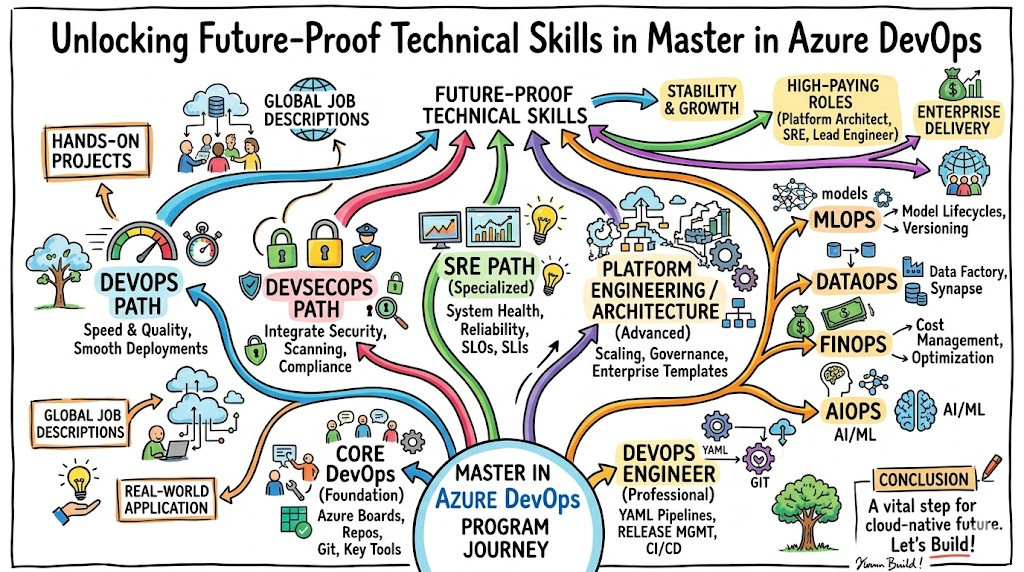
DevOps Path
The DevOps path focuses heavily on the speed and quality of delivery. It starts with mastering Azure Boards for planning and moves rapidly into complex YAML pipelines and release management. This path is ideal for those who want to be the primary facilitators between development teams and production, ensuring that code moves smoothly and safely through every environment.
DevSecOps Path
In this path, the priority is integrating security into every step of the Azure DevOps lifecycle. You will learn to use tools like Mend, Snyk, or Azure’s native Defender for Cloud within your pipelines. It is designed for engineers who believe that security is everyone’s responsibility and want to automate compliance checks, secret scanning, and vulnerability assessments.
SRE Path
The SRE path is about the long-term health and reliability of systems. While it utilizes the same Azure DevOps tools, the focus shifts toward observability, post-mortem analysis, and capacity planning. This is the right choice for engineers who enjoy deep-diving into system internals and creating automated self-healing mechanisms for cloud infrastructure.
AIOps Path
This path explores the use of machine learning and artificial intelligence to improve IT operations. It involves using Azure’s AI capabilities to analyze massive amounts of log and metric data to predict failures before they happen. This is a forward-looking path for engineers who want to manage complex, large-scale systems with intelligent automation.
MLOps Path
MLOps focuses on the unique challenges of deploying and maintaining machine learning models. You will learn how to build pipelines that not only version code but also version data and models. This path is essential for data scientists and engineers who need to bring the discipline of DevOps to the world of artificial intelligence.
DataOps Path
The DataOps path applies DevOps principles to data engineering and data integration. It focuses on improving the quality and reducing the cycle time of data analytics. By using Azure DevOps to manage Data Factory pipelines or Synapse workspaces, professionals in this path ensure that data flows are as reliable as application code.
FinOps Path
FinOps is about bringing financial accountability to the variable spend of the cloud. This path teaches you how to use Azure DevOps and Azure Cost Management together to track project-level spending and optimize resources. It is perfect for professionals who want to bridge the gap between engineering, finance, and business leadership.
Role → Recommended Master in Azure DevOps Certifications
| Role | Recommended Certifications |
|---|---|
| DevOps Engineer | Master in Azure DevOps – Professional |
| SRE | Certified Site Reliability Engineer – Foundation |
| Platform Engineer | Master in Azure DevOps – Advanced |
| Cloud Engineer | Master in Azure DevOps – Professional |
| Security Engineer | Master in Azure DevOps – DevSecOps Track |
| Data Engineer | Master in Azure DevOps – DataOps Track |
| FinOps Practitioner | Master in Azure DevOps – FinOps Track |
| Engineering Manager | Master in Azure DevOps – Foundation & Leadership |
Next Certifications to Take After Master in Azure DevOps
Same Track Progression
Once you have achieved professional-level mastery, the next logical step is to dive into architectural governance. This involves learning how to manage multiple Azure DevOps organizations, setting up enterprise-level security policies, and designing shared pipeline templates that can be used by hundreds of teams. This ensures you move from being a “doer” to a “designer.”
Cross-Track Expansion
If you have mastered the delivery aspect, consider expanding into cloud infrastructure or security. Gaining an Azure Solutions Architect Expert certification provides the necessary context for the environments your pipelines deploy into. Alternatively, exploring Kubernetes-specific certifications like CKA can help you manage containerized workloads more effectively within your Azure pipelines.
Leadership & Management Track
For those looking to move into people or project management, certifications in Agile, Scrum, or ITIL can be beneficial. These provide the framework for leading the teams that use Azure DevOps. Understanding the business value of DevOps allows you to communicate effectively with stakeholders and justify investments in automation and reliability.
Training & Certification Support Providers for Master in Azure DevOps
- DevOpsSchool
DevOpsSchool provides an extensive library of hands-on labs and instructor-led sessions specifically tailored for the Azure ecosystem. Their focus is on bridging the gap between classroom learning and industry requirements through project-based training and expert mentorship.
- Cotocus
Cotocus specializes in high-end technical consulting and training for cloud-native technologies. They offer customized bootcamps that focus on real-world implementation of Azure DevOps, ensuring that participants can immediately apply their skills to production environments.
- Scmgalaxy
Scmgalaxy is a well-known community and training hub for software configuration management and DevOps professionals. They provide a wealth of free resources, tutorials, and certification guides that help engineers stay updated with the latest trends in the Azure space.
- BestDevOps
BestDevOps focuses on delivering practical, job-oriented training for modern engineering roles. Their curriculum is designed by industry veterans who emphasize the importance of automation, culture, and measurement within the Azure DevOps framework.
- Devsecopsschool
Devsecopsschool is dedicated to the integration of security into the DevOps workflow. They offer specialized modules for Azure DevOps that cover everything from static analysis to container security, making it the go-to source for aspiring DevSecOps engineers.
- Sreschool
Sreschool focuses on the disciplines of reliability, availability, and performance. Their training for Azure DevOps includes deep dives into monitoring and observability, helping engineers transition from reactive troubleshooting to proactive system management.
- Aiopsschool
Aiopsschool provides cutting-edge training on the intersection of AI and IT operations. Their courses demonstrate how to use Azure’s machine learning tools to automate the analysis of DevOps data, leading to smarter and more efficient delivery cycles.
- Dataopsschool
Dataopsschool addresses the unique needs of data professionals by applying DevOps methodologies to data management. Their training shows how Azure DevOps can be used to version, test, and deploy data pipelines with the same speed as traditional software.
- Finopsschool
Finopsschool helps professionals master the art of cloud financial management. Their Azure-focused curriculum teaches engineers how to build cost-aware pipelines and implement automated governance to prevent unexpected cloud spending.
Frequently Asked Questions (General)
- How difficult is it to master Azure DevOps?
While the interface is user-friendly, mastering the full integration of all services requires a deep understanding of both development and operations. It is moderately challenging but highly rewarding. - How much time does it take to get certified?
A foundation-level certification can typically be achieved in 30 days, while professional and advanced levels may take 3 to 6 months of dedicated study and practice. - Are there any prerequisites for the foundation level?
No formal prerequisites are required, though a basic understanding of software development and cloud concepts will significantly speed up your learning process. - What is the ROI of this certification?
Professionals often see immediate benefits in terms of job opportunities and salary increases, as Azure DevOps is a core requirement for most modern enterprise IT roles. - In what order should I take the certifications?
It is highly recommended to start with the Foundation level, move to Professional, and then specialize in a track like SRE or DevSecOps based on your career goals. - Does this certification help with career growth in India?
Yes, India has one of the largest bases of Azure users globally. This certification is highly recognized by top Indian IT service companies and global capability centers. - Is hands-on experience mandatory?
While you can learn the theory, the certification assessment is designed to test practical skills. Hands-on experience is essential for passing the higher-level tracks. - Can a manager benefit from this technical certification?
Absolutely. Managers need to understand the capabilities and limitations of the tools their teams use to make better hiring and strategic decisions. - Does Azure DevOps replace the need for Jenkins or GitLab?
It doesn’t necessarily replace them, but it offers a more integrated alternative. Many companies use Azure DevOps alongside other tools for specific niche requirements. - How often should I renew my certification?
Cloud technologies evolve rapidly. It is best to review and update your certification every two years to ensure you are familiar with the latest features and best practices. - Are there lab environments available for practice?
Yes, most training providers like DevOpsSchool offer dedicated lab environments that simulate real-world production scenarios for a safe learning experience. - Is this certification valid globally?
Yes, the principles and practices taught are industry-standard and recognized by engineering organizations across North America, Europe, and Asia.
FAQs on Master in Azure DevOps
- What are the key components of the Azure DevOps suite?
Azure DevOps consists of five main services: Azure Boards for planning, Azure Repos for source control, Azure Pipelines for CI/CD, Azure Test Plans for quality assurance, and Azure Artifacts for package management. - How does Azure DevOps support multi-cloud environments?
While native to Azure, Azure Pipelines can deploy code to any cloud provider, including AWS and GCP, as well as on-premise servers, making it a versatile tool for hybrid strategies. - What is the difference between Azure DevOps Server and Services?
Azure DevOps Services is a cloud-hosted SaaS offering, while Azure DevOps Server is the on-premise version. Most certifications focus on the Services version due to its wider adoption. - Can I use my own build agents with Azure Pipelines?
Yes, you can use Microsoft-hosted agents for convenience or set up self-hosted agents on your own infrastructure for more control over the build environment and security. - How does Azure DevOps handle secrets and sensitive data?
It integrates directly with Azure Key Vault, allowing you to reference secrets in your pipelines without ever exposing them in your source code or log files. - What is YAML and why is it important in Azure DevOps?
YAML is a human-readable data serialization language used to define pipelines as code. This allows your CI/CD process to be versioned, reviewed, and audited alongside your application code. - Does Azure DevOps support mobile app development?
Yes, through integrations with App Center and specific build tasks, you can automate the build and distribution of iOS and Android applications. - How do I track progress in Azure DevOps?
You can use Azure Boards to create customizable dashboards, burn-down charts, and velocity reports to track the real-time progress of your development teams and individual projects.
Conclusion: Is Master in Azure DevOps Worth It?
If you are looking for a career path that offers both stability and growth, mastering Azure DevOps is one of the most practical investments you can make. The industry is moving away from manual operations toward “everything-as-code,” and this ecosystem provides the perfect platform to lead that transition. It is not about chasing a trend; it is about building a foundation in how modern software is delivered at an enterprise scale.
As a mentor, my advice is to look past the marketing and focus on the practical ability to solve delivery problems. A certification alone won’t do the work, but the journey to mastering these tools will give you the technical depth and architectural perspective needed to excel in any senior engineering role. If you are committed to the cloud-native future, this mastery is a vital step forward.

I developed deeper expertise in Azure DevOps practices and automation, and I will apply these skills to enhance enterprise delivery speed and operational efficiency.
Mastering Core Engineering Competencies In Cloud Integration Enhances Technical Proficiency While Building Practical Strategic Knowledge For Professional Career Advancement And Sustainable Innovation In Modern Infrastructure Ecosystems Successfully
Great insights on building future-ready Azure DevOps skills. The practical approach makes learning cloud automation and deployment strategies much easier.