Introduction
Modern organizations depend on data moving reliably between applications, databases, analytics platforms, and business teams. A small change to a data field can disrupt dashboards, machine learning pipelines, operational reports, and downstream applications.
For example, an engineering team might rename a customer identifier in an event stream. Although the change appears minor, it could break several downstream data pipelines that depend on the original field.
Traditional data quality monitoring often identifies problems after data has already reached downstream systems. By that point, employees may be working with incomplete information, incorrect reports, or failed processing jobs.
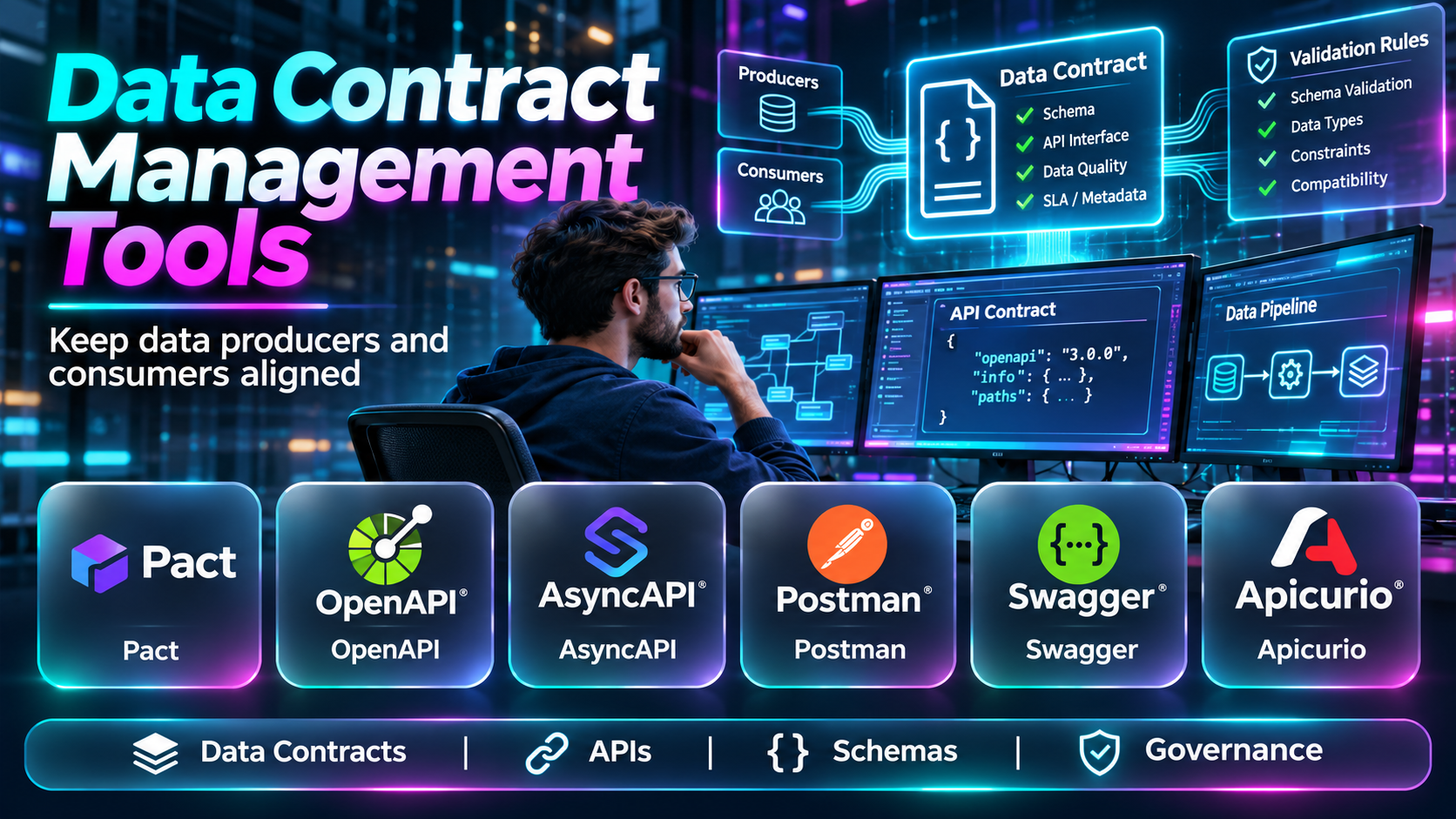
Data contract management tools address this challenge by establishing explicit agreements about the structure, meaning, quality, and expected behavior of data exchanged between producers and consumers.
These agreements help teams understand what data should contain, which changes are acceptable, and how compatibility should be maintained.
A data contract might specify field names, data types, required attributes, allowed values, ownership information, and expectations about data freshness.
Some tools also support automated validation, schema compatibility checks, version management, and integration with software delivery pipelines.
However, data contract management is an emerging software category. Some solutions specialize in contract definitions and enforcement, while others provide related capabilities through schema registries, data catalogs, testing frameworks, and data observability platforms.
Choosing the right platform requires understanding how data contracts will be created, tested, published, monitored, and maintained throughout the data lifecycle.
This guide compares ten relevant platforms and frameworks, explains their strengths and limitations, and provides a practical approach to implementing data contracts.
What Are Data Contract Management Tools?
Data contract management tools help organizations define, validate, version, distribute, and enforce agreements between data producers and data consumers.
A data producer is an application, service, or team responsible for generating or publishing information.
A data consumer is an application, pipeline, analytics team, or business process that depends on that information.
A data contract establishes expectations about the data exchanged between them.
These expectations may include schemas, data types, required fields, semantic definitions, quality rules, freshness requirements, ownership, and compatibility policies.
Unlike a simple database schema, a data contract can describe operational expectations and responsibilities in addition to technical structure.
For example, a customer events contract may require an event identifier, customer identifier, timestamp, and event type. It may also specify that timestamps follow a particular format and that certain fields cannot contain null values.
How Data Contract Management Works
- Identify Data Products: Determine which datasets, events, APIs, or tables require explicit agreements.
- Assign Ownership: Identify responsible producers and important consumers.
- Define the Schema: Specify field names, types, required attributes, and permitted structures.
- Document Semantics: Explain the business meaning of important fields.
- Set Quality Expectations: Establish validation rules and accepted values.
- Define Compatibility Policies: Specify how changes should affect existing consumers.
- Publish the Contract: Store the agreement in a discoverable, version-controlled location.
- Validate Changes: Check proposed updates before deployment.
- Monitor Production Data: Detect deviations from agreed expectations.
- Manage Evolution: Coordinate contract changes, approvals, and consumer migration.
Common Applications
- Data pipeline governance.
- Event streaming schema management.
- Analytics dataset contracts.
- Data warehouse ingestion.
- Data mesh architectures.
- API and event compatibility.
- Machine learning feature pipelines.
- Customer data integration.
- Financial reporting data.
- Healthcare data exchange.
- Product analytics events.
- Data quality enforcement.
- Data platform modernization.
- Producer-consumer collaboration.
- Continuous integration testing.
- Enterprise metadata governance.
Benefits of Data Contract Management
Fewer Breaking Changes: Compatibility checks can identify schema changes before they disrupt consumers.
Improved Data Reliability: Explicit expectations help teams detect unexpected structures and invalid values.
Clearer Ownership: Contracts identify the teams responsible for maintaining important datasets.
Better Collaboration: Producers and consumers agree on requirements instead of relying on undocumented assumptions.
Earlier Validation: Automated tests can detect problems during development rather than after deployment.
More Consistent Definitions: Shared semantic descriptions reduce conflicting interpretations of business fields.
Stronger Governance: Versioning, documentation, and approval processes support controlled data evolution.
Reduced Maintenance: Reliable interfaces can reduce repeated debugging and emergency pipeline repairs.
Top 10 Data Contract Management Tools
The following comparison includes dedicated data contract solutions, schema management platforms, and complementary testing or metadata tools. Their coverage differs, so organizations should distinguish complete contract lifecycle management from individual contract enforcement capabilities.
1. Data Contract CLI
Short Description
Data Contract CLI is an open-source tool designed to help teams work with machine-readable data contracts.
It supports a contract-as-code approach in which agreements are stored as structured files and maintained alongside software or data pipeline definitions.
For example, a data engineering team can define the expected structure of a customer transactions dataset and maintain the contract in a Git repository.
When a developer changes the dataset, the team can run applicable contract checks as part of its development workflow.
The tool is particularly relevant to organizations that want data contracts to become part of established software engineering practices.
It can support structured definitions and validation workflows without requiring every team to adopt a large enterprise governance platform.
However, organizations may need to build surrounding processes for approvals, ownership, production monitoring, and broader enterprise adoption.
Key Features
- Contract-as-Code: Stores data agreements in machine-readable files.
- Schema Definitions: Describes expected dataset structures and field types.
- Validation Commands: Supports checking contracts and compatible data sources.
- Command-Line Interface: Enables use in scripts and development environments.
- CI/CD Integration: Can be incorporated into automated delivery pipelines.
- Version Control: Works with Git-based change management.
- Open Standards Orientation: Supports portable contract definitions.
- Developer Workflows: Fits engineering-oriented validation processes.
- Documentation Support: Helps make contract definitions inspectable.
Benefits
- Makes data expectations explicit.
- Supports automated validation.
- Encourages version-controlled agreements.
- Reduces undocumented schema changes.
- Fits developer workflows.
- Avoids dependence on a proprietary interface.
- Supports repeatable contract checks.
Pros
- Open source.
- Contract-as-code approach.
- Automation-friendly.
- Git compatibility.
- Developer-oriented design.
- Portable definitions.
Cons
- Requires technical knowledge.
- Enterprise governance may need additional tools.
- Business-user interfaces are limited.
- Production monitoring is not its primary purpose.
- Implementation requires ownership and process design.
Use Cases
Data Engineering: Validate dataset structures before deployment.
Platform Engineering: Add contract checks to CI/CD pipelines.
Data Mesh: Define producer-owned data products.
Analytics Engineering: Document expected source tables.
Best For
Engineering teams seeking open-source, version-controlled data contract definitions and validation.
2. Bitol Data Contract Standard
Short Description
The Bitol Data Contract Standard is an open specification for describing data contracts rather than a commercial software platform.
It provides a structured approach to representing agreements about data products, schemas, ownership, and relevant quality expectations.
For example, an organization building a data mesh may want different teams to describe data products using a consistent contract format.
A shared specification helps reduce the risk of each department inventing incompatible contract documents.
The standard can be used alongside supporting tools, including contract validation and automation utilities.
Its principal value lies in portability, consistency, and the establishment of common terminology.
However, a specification alone does not provide a complete hosted management interface, operational monitoring system, or approval workflow.
Key Features
- Structured Contract Format: Defines machine-readable agreements.
- Schema Representation: Describes expected data structures.
- Metadata Fields: Captures relevant contextual information.
- Ownership Definitions: Supports producer and stakeholder identification.
- Quality Expectations: Represents relevant data requirements.
- Standardized Terminology: Promotes consistency across teams.
- Portability: Reduces dependence on one vendor’s format.
- Tool Interoperability: Supports compatible tooling ecosystems.
- Version-Control Compatibility: Allows specifications to be managed as code.
Benefits
- Encourages common contract definitions.
- Improves portability.
- Supports cross-team alignment.
- Reduces inconsistent documentation.
- Enables compatible automation.
- Supports data product governance.
- Establishes a reusable contract foundation.
Pros
- Open specification.
- Vendor-neutral approach.
- Machine-readable structure.
- Supports governance consistency.
- Suitable for data mesh initiatives.
- Compatible with contract-as-code practices.
Cons
- Not a standalone management application.
- Requires supporting tools.
- Does not independently monitor production data.
- Organizational adoption requires training.
- Approval workflows must be implemented separately.
Use Cases
Enterprise Architecture: Standardize contract formats.
Data Mesh Programs: Define shared data product expectations.
Platform Teams: Establish reusable contract templates.
Governance Teams: Align contract terminology.
Best For
Organizations seeking an open, consistent foundation for data contracts across tools and teams.
3. Confluent Schema Registry
Short Description
Confluent Schema Registry manages schemas for event-driven data systems, particularly those using Apache Kafka.
It helps producers and consumers agree on the structure of serialized event data.
For example, an ecommerce application may publish order events consumed by payment, fulfillment, and analytics services.
If the application changes an event schema, compatibility policies can help prevent changes that would unexpectedly break downstream consumers.
Schema Registry supports schema management and compatibility validation for supported serialization formats.
Its capabilities are especially valuable in event streaming environments where many applications depend on shared event structures.
However, schema governance does not automatically cover every aspect of a broader data contract, such as business semantics, service-level expectations, or all production quality requirements.
Key Features
- Centralized Schema Registry: Stores and manages event schemas.
- Schema Versioning: Tracks changes across schema versions.
- Compatibility Rules: Checks supported backward, forward, and full compatibility modes.
- Serialization Support: Supports relevant schema formats.
- Kafka Integration: Connects with event streaming workflows.
- Producer Validation: Helps control published event structures.
- Consumer Compatibility: Supports safer schema evolution.
- API Access: Enables programmatic schema operations.
- Governance Integration: Supports relevant metadata and policy workflows.
Benefits
- Reduces event schema incompatibilities.
- Supports controlled evolution.
- Improves streaming reliability.
- Centralizes schema definitions.
- Supports automated development checks.
- Helps producers and consumers coordinate.
- Reduces certain integration failures.
Pros
- Strong Kafka ecosystem integration.
- Schema versioning.
- Compatibility enforcement.
- Programmatic management.
- Mature streaming use cases.
- Suitable for event-driven architectures.
Cons
- Focused primarily on schema governance.
- Full business contracts require complementary tools.
- Kafka-centered deployments may introduce operational complexity.
- Compatibility policies require careful configuration.
- Schema compatibility does not guarantee data quality.
Use Cases
Event Streaming: Govern Kafka message structures.
Microservices: Maintain compatible event interfaces.
Financial Systems: Standardize transaction events.
Analytics Pipelines: Control streaming data changes.
Best For
Kafka-oriented organizations requiring schema compatibility and controlled event evolution.
4. Apicurio Registry
Short Description
Apicurio Registry is an open-source registry for managing schemas and API-related artifacts.
It is relevant to organizations seeking centralized control over schemas used in event-driven and integration architectures.
For example, a company operating several event-producing microservices may need a shared registry for Avro, JSON Schema, or other supported artifacts.
Apicurio Registry can help teams organize versions and apply relevant compatibility rules.
Its open-source approach can be attractive to organizations seeking control over deployment and integration.
The platform provides useful building blocks for schema-focused data contract enforcement.
However, teams requiring comprehensive business semantics, dataset quality monitoring, or formal contract approval workflows may need additional components.
Key Features
- Artifact Registry: Stores schemas and supported artifacts.
- Schema Versioning: Maintains historical versions.
- Compatibility Rules: Supports relevant validation policies.
- API Access: Enables programmatic registry operations.
- Multiple Artifact Types: Supports relevant schema and API formats.
- Open-Source Deployment: Allows self-managed implementations.
- Event Integration: Supports streaming architectures.
- Schema Discovery: Provides centralized artifact access.
- Automation Support: Fits compatible development pipelines.
Benefits
- Centralizes schema definitions.
- Supports compatibility governance.
- Reduces inconsistent artifacts.
- Enables automated checks.
- Supports open-source architectures.
- Helps coordinate service teams.
- Improves schema discoverability.
Pros
- Open source.
- Multiple artifact types.
- Version management.
- Compatibility capabilities.
- API access.
- Flexible deployment options.
Cons
- Primarily a registry rather than a complete contract platform.
- Requires operational management.
- Business-level quality rules need complementary tools.
- Governance processes require configuration.
- Implementation expertise may be necessary.
Use Cases
Platform Engineering: Operate a shared schema registry.
Microservices: Govern event definitions.
Integration Teams: Manage API-related artifacts.
Streaming Systems: Validate schema changes.
Best For
Technical teams seeking an open-source registry for schema and event contract foundations.
5. AWS Glue Schema Registry
Short Description
AWS Glue Schema Registry helps organizations manage and enforce schemas in supported AWS streaming data workflows.
It is particularly relevant to teams using AWS services for event processing and data integration.
For example, an organization may publish operational events through Amazon Kinesis and process them with downstream applications.
A centralized schema registry can help ensure that producers and consumers use compatible structures.
AWS Glue Schema Registry supports schema definitions, versions, and compatibility settings for relevant integrations.
Its integration with AWS services can simplify schema governance for cloud-native architectures.
However, it does not replace comprehensive data contract lifecycle management or broader business data quality governance.
Key Features
- Schema Storage: Maintains supported event schemas.
- Version Management: Tracks schema evolution.
- Compatibility Settings: Applies supported compatibility checks.
- AWS Integration: Connects with relevant streaming services.
- Schema Discovery: Provides centralized definitions.
- Serialization Support: Works with supported data formats.
- API Integration: Enables programmatic access.
- Cloud-Native Management: Fits AWS environments.
- Producer-Consumer Coordination: Helps standardize event structures.
Benefits
- Supports consistent streaming schemas.
- Reduces certain breaking changes.
- Fits AWS-based architectures.
- Centralizes definitions.
- Supports schema evolution.
- Helps automate validation.
- Reduces manual coordination.
Pros
- AWS ecosystem integration.
- Schema versioning.
- Compatibility controls.
- Managed cloud capabilities.
- Programmatic interfaces.
- Useful for streaming applications.
Cons
- AWS-oriented.
- Not a complete business data contract platform.
- Quality monitoring requires other tools.
- Cloud architecture dependencies apply.
- Compatibility configuration needs planning.
Use Cases
AWS Streaming: Govern event schemas.
Cloud Applications: Coordinate producer-consumer structures.
Analytics Engineering: Manage streaming ingestion formats.
Data Platforms: Standardize event definitions.
Best For
AWS organizations seeking managed schema governance for supported streaming workflows.
6. dbt
Short Description
dbt is an analytics engineering framework that helps teams transform, test, document, and manage data models.
It is not primarily a general-purpose data contract management platform, but its model contracts provide important contract-like enforcement for supported analytics models.
For example, an analytics team may publish a customer revenue model consumed by executive dashboards.
A dbt model contract can specify expected column names and data types, helping detect incompatible changes during model development.
dbt also supports data tests, documentation, dependencies, and software engineering workflows.
These capabilities make it particularly useful for managing expectations around curated warehouse data.
However, dbt model contracts do not cover every type of producer-consumer agreement, particularly for external event streams or operational APIs.
Key Features
- Model Contracts: Enforces supported model schema expectations.
- Data Tests: Checks configured data assertions.
- Documentation: Describes models and columns.
- Lineage: Shows dependencies between data models.
- Version Control: Supports Git-based development.
- CI Workflows: Enables automated validation.
- Model Versioning: Supports applicable model evolution.
- SQL Transformation: Builds curated analytics datasets.
- Development Collaboration: Supports analytics engineering practices.
Benefits
- Improves warehouse model reliability.
- Reduces accidental schema changes.
- Documents important datasets.
- Supports automated testing.
- Improves dependency visibility.
- Fits analytics development workflows.
- Encourages disciplined model evolution.
Pros
- Strong analytics engineering ecosystem.
- Model contract functionality.
- Data testing.
- Documentation and lineage.
- Git-based workflows.
- Suitable for warehouse data.
Cons
- Focused on analytics models.
- Not a universal event contract registry.
- Requires SQL and dbt knowledge.
- Some quality rules need additional tests.
- Contract coverage depends on supported adapters and configurations.
Use Cases
Analytics Engineering: Enforce model structures.
Data Warehouses: Protect curated datasets.
Business Intelligence: Reduce dashboard-breaking changes.
Data Teams: Automate model validation.
Best For
Analytics teams using dbt to manage reliable warehouse models and enforce schema expectations.
7. Soda
Short Description
Soda is a data quality platform that helps organizations define and monitor expectations about datasets.
Its testing and monitoring capabilities can complement data contract programs by verifying whether actual data meets agreed quality requirements.
For example, a finance team may require a transaction dataset to contain non-null transaction identifiers and values within expected ranges.
Soda can help evaluate configured quality checks and identify violations.
Its approach is useful when data contracts include requirements beyond column names and data types.
The platform can support data reliability workflows across supported sources.
However, data quality monitoring alone does not necessarily provide full producer-consumer contract negotiation, approval, or lifecycle governance.
Key Features
- Data Quality Checks: Validates configured dataset expectations.
- Schema Checks: Detects relevant structural changes.
- Null Monitoring: Identifies missing required values.
- Freshness Checks: Evaluates relevant timeliness expectations.
- Anomaly Detection: Supports detection of unexpected behavior.
- Data Source Connectivity: Works with supported data systems.
- Automated Testing: Fits relevant pipeline workflows.
- Issue Visibility: Helps teams investigate failed checks.
- Monitoring Workflows: Supports recurring data quality evaluation.
Benefits
- Detects quality violations.
- Supports contract-related assertions.
- Improves trust in datasets.
- Reduces manual inspection.
- Helps identify unexpected changes.
- Supports automated quality controls.
- Provides evidence for operational reliability.
Pros
- Data quality specialization.
- Flexible checks.
- Automated validation.
- Freshness monitoring.
- Multiple data source support.
- Useful for production monitoring.
Cons
- Not a complete contract negotiation platform.
- Checks require careful definition.
- Monitoring costs depend on deployment.
- False alerts require tuning.
- Ownership governance may need other systems.
Use Cases
Data Platforms: Validate published datasets.
Finance Analytics: Monitor required transaction fields.
ETL Pipelines: Detect invalid records.
Data Governance: Enforce quality expectations.
Best For
Organizations needing data quality validation and monitoring as part of a broader contract program.
8. Great Expectations
Short Description
Great Expectations is a data quality and validation framework that allows teams to express expectations about datasets.
It supports testable assertions such as required columns, accepted values, and completeness conditions.
For example, a data engineering team may expect a product inventory dataset to contain unique product identifiers and nonnegative stock quantities.
Great Expectations can help define and evaluate those requirements.
The framework is useful for incorporating data validation into pipelines and development workflows.
Its tests can serve as enforceable components of a data contract.
However, organizations may need additional tools to manage contract ownership, compatibility approvals, and consumer communication.
Key Features
- Data Expectations: Defines testable data assertions.
- Schema Validation: Checks expected columns and types.
- Value Validation: Evaluates accepted values and ranges.
- Completeness Checks: Detects missing data.
- Automated Validation: Integrates with relevant pipelines.
- Documentation: Makes expectations understandable.
- Data Source Support: Connects with supported systems.
- Programmatic Configuration: Fits engineering workflows.
- Validation Results: Reports test outcomes.
Benefits
- Makes quality requirements explicit.
- Supports automated testing.
- Improves data reliability.
- Reduces manual checks.
- Documents important expectations.
- Helps detect invalid records.
- Complements contract enforcement.
Pros
- Flexible validation framework.
- Rich expectation model.
- Programmatic workflows.
- Schema and quality testing.
- Useful documentation.
- Suitable for data engineering.
Cons
- Not a complete contract lifecycle platform.
- Requires engineering configuration.
- Validation coverage depends on authored tests.
- Operational monitoring needs implementation.
- Complex test suites require maintenance.
Use Cases
ETL Validation: Test incoming datasets.
Analytics Pipelines: Enforce quality rules.
Data Warehouses: Check curated tables.
Engineering Teams: Build contract-related tests.
Best For
Technical teams seeking configurable data quality assertions to support data contracts.
9. DataHub
Short Description
DataHub is a metadata platform that helps organizations discover, understand, and govern data assets.
Its metadata, ownership, lineage, and governance capabilities can support data contract programs.
For example, a large enterprise may need to identify the owners and downstream consumers of a critical customer dataset.
DataHub can help make these relationships visible.
This context is valuable when producers need to evaluate the impact of a proposed schema change.
DataHub also supports relevant data quality and governance integrations.
However, a metadata catalog should not automatically be treated as a complete contract enforcement solution without verifying the capabilities and deployment configuration.
Key Features
- Metadata Catalog: Organizes data asset information.
- Data Discovery: Helps users find datasets.
- Ownership Metadata: Identifies responsible teams.
- Data Lineage: Shows upstream and downstream relationships.
- Schema Metadata: Describes data structures.
- Governance Features: Supports relevant policies and classifications.
- Metadata APIs: Enables programmatic integration.
- Data Quality Context: Connects relevant quality information.
- Impact Analysis: Helps evaluate downstream dependencies.
Benefits
- Improves dataset discoverability.
- Clarifies ownership.
- Supports change impact analysis.
- Makes data relationships visible.
- Helps coordinate producers and consumers.
- Strengthens governance context.
- Supports contract program adoption.
Pros
- Broad metadata capabilities.
- Ownership and lineage.
- Data discovery.
- API integration.
- Governance support.
- Useful for large data estates.
Cons
- Cataloging is not equivalent to contract enforcement.
- Metadata ingestion requires configuration.
- Governance processes need ownership.
- Advanced workflows may need complementary tools.
- Deployment and maintenance can be substantial.
Use Cases
Data Governance: Track dataset ownership.
Data Mesh: Publish data product context.
Platform Engineering: Identify downstream consumers.
Enterprise Analytics: Improve metadata visibility.
Best For
Organizations requiring metadata, ownership, and lineage to support a broader data contract strategy.
10. OpenMetadata
Short Description
OpenMetadata is an open-source metadata management and data governance platform.
It helps organizations document data assets, identify ownership, understand lineage, and manage relevant quality information.
For example, a company may want to publish information about important warehouse tables and their responsible teams.
OpenMetadata can provide a centralized environment for describing those assets.
Its data quality and metadata capabilities can complement data contract practices by making expectations and responsibilities more visible.
The platform is particularly relevant to organizations seeking an open-source governance foundation.
However, comprehensive contract versioning, producer-consumer approvals, and pre-deployment enforcement may require additional workflows or tools.
Key Features
- Data Catalog: Organizes metadata about data assets.
- Schema Discovery: Documents columns and structures.
- Data Ownership: Associates assets with responsible teams.
- Data Lineage: Visualizes dependencies.
- Data Quality: Supports relevant quality tests.
- Glossary Management: Documents business terminology.
- Metadata APIs: Enables integration and automation.
- Governance Capabilities: Supports classifications and stewardship.
- Collaboration: Helps teams share data context.
Benefits
- Centralizes data documentation.
- Improves ownership visibility.
- Supports quality expectations.
- Helps identify dependencies.
- Encourages shared terminology.
- Supports open-source governance.
- Complements contract enforcement workflows.
Pros
- Open-source foundation.
- Metadata cataloging.
- Lineage visibility.
- Data quality capabilities.
- Ownership management.
- Business glossary support.
Cons
- Not exclusively a data contract platform.
- Requires implementation planning.
- Full enforcement may need complementary tooling.
- Metadata quality depends on maintenance.
- Enterprise deployment may require operational expertise.
Use Cases
Data Governance: Manage asset metadata.
Data Engineering: Document schemas and ownership.
Data Mesh: Publish data product information.
Analytics: Understand dataset dependencies.
Best For
Organizations seeking open-source metadata governance and quality capabilities to complement data contracts.
Comparison Table: Top 10 Data Contract Management Tools
| Tool | Primary Role | Best For | Main Limitation |
|---|---|---|---|
| Data Contract CLI | Contract definitions and validation | Engineering teams | Limited enterprise UI |
| Bitol Data Contract Standard | Open contract specification | Standards adoption | Not standalone software |
| Confluent Schema Registry | Streaming schema compatibility | Kafka users | Schema-focused |
| Apicurio Registry | Open-source artifact registry | Platform teams | Requires additional governance |
| AWS Glue Schema Registry | AWS schema governance | AWS streaming teams | AWS-oriented |
| dbt | Analytics model contracts | Warehouse teams | Analytics-model scope |
| Soda | Data quality monitoring | Data reliability teams | Not full lifecycle management |
| Great Expectations | Data validation | Data engineers | Requires complementary governance |
| DataHub | Metadata and ownership | Enterprise data teams | Catalog focus |
| OpenMetadata | Open-source data governance | Governance teams | Additional enforcement may be needed |
How to Choose the Best Data Contract Management Tool
1. Define the Scope of the Contract
Determine whether contracts will apply to Kafka events, warehouse tables, API payloads, data products, or several different types of assets.
A schema registry may be sufficient for streaming compatibility, but it may not cover broader business requirements.
2. Identify Producers and Consumers
Document which teams publish data and which systems depend on it.
This information helps determine contract ownership and change approval requirements.
3. Decide What Must Be Enforced
List the requirements that need automatic validation.
These may include schemas, nullability, accepted values, freshness, uniqueness, and compatibility.
4. Evaluate Contract Representation
Determine whether agreements should be stored in YAML, JSON, a schema registry, or a managed application.
Machine-readable contracts generally support stronger automation than informal documentation alone.
5. Review Compatibility Policies
Assess whether the platform can detect changes that may break existing consumers.
Compatibility rules should reflect the organization’s actual data evolution strategy.
6. Examine CI/CD Integration
Contract checks should run before deployment when practical.
This allows developers to identify breaking changes before they affect production consumers.
7. Evaluate Production Validation
Pre-deployment checks cannot detect every runtime issue.
Determine whether the platform can monitor actual data against agreed expectations.
8. Review Ownership and Approval Processes
Contracts require accountable owners and a process for reviewing important changes.
9. Assess Metadata and Lineage
Understanding downstream dependencies helps teams estimate the consequences of a contract change.
10. Consider Open Standards
Portable definitions can reduce dependence on one vendor and improve interoperability.
11. Evaluate Operational Complexity
Consider deployment, maintenance, integrations, user training, and the effort required to maintain rules.
12. Test a Representative Contract
Select a high-value dataset and implement the complete process before expanding adoption.
Best Data Contract Management Tools by User Type
Data Platform Engineers
Data Contract CLI is suitable for teams that want machine-readable contracts maintained through Git and automated pipelines.
Enterprise Architects
The Bitol Data Contract Standard provides a consistent foundation for contract definitions across multiple systems.
Kafka Engineers
Confluent Schema Registry helps manage streaming schema compatibility.
Open-Source Platform Teams
Apicurio Registry is relevant to teams seeking an open-source artifact and schema registry.
AWS Cloud Teams
AWS Glue Schema Registry supports schema governance in relevant AWS streaming workflows.
Analytics Engineers
dbt model contracts help protect curated analytics datasets from incompatible structural changes.
Data Reliability Teams
Soda supports quality monitoring that can enforce important contract expectations.
Data Validation Engineers
Great Expectations provides configurable assertions for testing datasets.
Enterprise Governance Teams
DataHub helps document ownership, metadata, and downstream dependencies.
Open-Source Governance Teams
OpenMetadata provides metadata management and data quality capabilities that complement contract programs.
| User Type | Relevant Tool | Primary Reason |
|---|---|---|
| Platform engineer | Data Contract CLI | Contract-as-code |
| Enterprise architect | Bitol standard | Common specification |
| Kafka engineer | Confluent Schema Registry | Schema compatibility |
| Open-source platform team | Apicurio Registry | Artifact governance |
| AWS engineer | AWS Glue Schema Registry | AWS integration |
| Analytics engineer | dbt | Model contracts |
| Data reliability engineer | Soda | Quality monitoring |
| Data validation engineer | Great Expectations | Testable expectations |
| Enterprise data steward | DataHub | Ownership and lineage |
| Open-source governance team | OpenMetadata | Metadata governance |
Practical Example: Implementing a Customer Data Contract
Consider an ecommerce organization that publishes customer transaction data to its analytics platform.
The company operates several services that generate order events, payment records, and customer account information.
Its analytics team uses these datasets for revenue reporting, customer segmentation, and operational dashboards.
Recently, an application update changed a field from customer_id to customer_identifier.
The change disrupted downstream processing and delayed business reporting.
The organization decides to establish formal data contracts.
Step 1: Identify the Critical Dataset
The team selects customer transaction events because they support several important business processes.
Step 2: Identify the Producer
The application engineering team is assigned responsibility for publishing the transaction events.
Step 3: Identify Consumers
The analytics team, finance reporting system, and customer operations platform are documented as consumers.
Step 4: Define the Schema
The contract specifies fields such as transaction identifier, customer identifier, amount, currency, and event timestamp.
Step 5: Define Field Types
The team specifies expected data types and required fields.
Step 6: Document Business Meaning
Each field receives a clear definition so consumers understand its intended use.
Step 7: Establish Quality Rules
The contract requires valid transaction identifiers, nonnegative amounts where appropriate, and supported currency codes.
Step 8: Define Compatibility Requirements
The organization establishes rules for adding, removing, or changing fields.
Step 9: Choose Supporting Tools
The team evaluates Data Contract CLI for contract definitions, a schema registry for event compatibility, and a quality framework for runtime checks.
Step 10: Store the Contract in Version Control
The agreement is committed to a repository alongside relevant development artifacts.
Step 11: Add Automated Validation
Contract checks are included in the deployment pipeline.
Step 12: Test a Breaking Change
The team deliberately renames a required field to confirm that validation detects the incompatible update.
Step 13: Establish a Change Process
Producers must notify affected consumers and coordinate migration for breaking changes.
Step 14: Monitor Production Data
Relevant quality checks run against published transactions.
Step 15: Record Ownership
The contract identifies the responsible producer team and escalation contacts.
Step 16: Review Results
The organization measures validation failures, contract violations, and downstream incidents.
Step 17: Expand Adoption
After validating the process, the team applies contracts to other critical datasets.
Common Mistakes to Avoid
1. Treating Schemas as Complete Contracts
Schemas describe structure but may not cover business meaning, quality, freshness, or ownership.
2. Writing Contracts Without Enforcement
Documentation alone cannot prevent breaking deployments.
3. Ignoring Consumers
Contracts should reflect the needs of the teams and applications that depend on the data.
4. Applying Excessively Strict Rules
Unnecessary restrictions can make legitimate schema evolution difficult.
5. Failing to Version Contracts
Changes should be traceable and understandable.
6. Skipping CI/CD Validation
Late detection increases the cost of correcting incompatible changes.
7. Ignoring Runtime Quality
A structurally valid dataset can still contain incorrect or incomplete values.
8. Neglecting Ownership
Without accountable producers, contract violations may remain unresolved.
9. Choosing a Tool Without Considering Architecture
Kafka registries, warehouse model contracts, and data catalogs address different technical requirements.
10. Attempting Organization-Wide Adoption Immediately
A focused pilot helps teams establish effective practices before expanding.
Frequently Asked Questions
1. What are data contract management tools?
They help teams define, validate, version, and govern expectations about data exchanged between producers and consumers.
2. What is a data contract?
A data contract is an agreement describing expected data structures, semantics, quality, and other relevant responsibilities.
3. Why are data contracts important?
They reduce undocumented assumptions and help prevent changes that disrupt downstream systems.
4. What is Data Contract CLI?
It is an open-source command-line tool for defining and validating machine-readable data contracts.
5. What is the Bitol Data Contract Standard?
It is an open specification for representing data contracts consistently.
6. What is Confluent Schema Registry?
It is a schema management service used to govern compatible event structures.
7. What is Apicurio Registry?
It is an open-source registry for schemas and related artifacts.
8. What is AWS Glue Schema Registry?
It is an AWS service for managing schemas in supported streaming workflows.
9. Does dbt support data contracts?
Yes. dbt supports model contracts for enforcing relevant analytics model schema expectations.
10. Can Soda support data contracts?
Soda can validate data quality requirements that form part of a broader data contract.
11. Can Great Expectations enforce contract rules?
It can validate many structural and quality assertions, although broader contract governance may require additional tools.
12. Is DataHub a data contract platform?
DataHub primarily provides metadata and governance capabilities that can support data contract programs.
13. Can OpenMetadata help with data contracts?
Yes. Its metadata, ownership, lineage, and quality capabilities can complement contract management.
14. What is schema compatibility?
Schema compatibility describes whether changes to a data structure remain usable by relevant producers and consumers.
15. What is backward compatibility?
Backward compatibility generally means newer schemas or consumers can continue working with relevant older data structures, according to the system’s compatibility model.
16. What is forward compatibility?
Forward compatibility generally concerns whether older consumers or schemas can tolerate relevant newer data structures.
17. What is contract-as-code?
It is the practice of maintaining data contract definitions as machine-readable files in software development workflows.
18. Can data contracts be stored in Git?
Yes. Machine-readable contracts can be maintained through version control.
19. Can data contracts run in CI/CD pipelines?
Yes. Compatible validation tools can check contracts during automated development and deployment.
20. Do data contracts replace data quality tools?
No. Data quality tools often provide the validation and monitoring needed to enforce contract expectations.
21. Are data contracts useful for data mesh?
Yes. They help establish explicit expectations between independently managed data products and their consumers.
22. Can data contracts prevent all pipeline failures?
No. They reduce certain risks but cannot prevent every operational, infrastructure, or business logic problem.
23. What information belongs in a data contract?
Typical elements include schemas, field definitions, ownership, quality rules, compatibility expectations, and relevant service requirements.
24. Who should own a data contract?
Ownership generally belongs to the producer responsible for the data, with appropriate consumer participation and governance oversight.
25. Can data contracts include freshness requirements?
Yes. Contracts may specify expected update frequency or timeliness, with supporting monitoring needed for enforcement.
26. What is the difference between a schema registry and a data contract platform?
A schema registry primarily manages data structures and compatibility, while broader contract management can include semantics, quality, ownership, and lifecycle governance.
27. Do data contracts require a commercial platform?
No. Organizations can build contract workflows using open specifications, version control, registries, and validation tools.
28. What are common data contract implementation challenges?
Typical challenges include unclear ownership, incomplete definitions, weak enforcement, inconsistent tooling, and limited producer-consumer coordination.
29. How should organizations begin using data contracts?
Start with one important dataset, identify its consumers, define measurable expectations, automate checks, and establish a change process.
30. Which data contract management tool is best?
The best choice depends on the data architecture, contract scope, required enforcement, integrations, team expertise, and governance requirements.
Final Thoughts
Data contract management tools help organizations establish clearer expectations between data producers and consumers.
Data Contract CLI and the Bitol standard provide foundations for machine-readable contract definitions.
Confluent Schema Registry, Apicurio Registry, and AWS Glue Schema Registry support schema governance in event-driven systems.
dbt helps analytics teams enforce structural expectations for supported warehouse models.
Soda and Great Expectations provide validation capabilities that can help enforce data quality requirements.
DataHub and OpenMetadata provide metadata, ownership, and lineage capabilities that support contract governance.
These tools are not interchangeable. Some define agreements, others validate data, and others provide the operational context needed to manage changes.
Organizations should begin by identifying critical datasets and the consequences of incompatible changes.
They should then establish explicit ownership, version-controlled contracts, automated validation, and clear procedures for evolving data interfaces.
A successful data contract program combines technical enforcement with communication and accountability.
When implemented carefully, data contracts can reduce avoidable failures, improve trust in shared datasets, and make data platforms easier to evolve.
