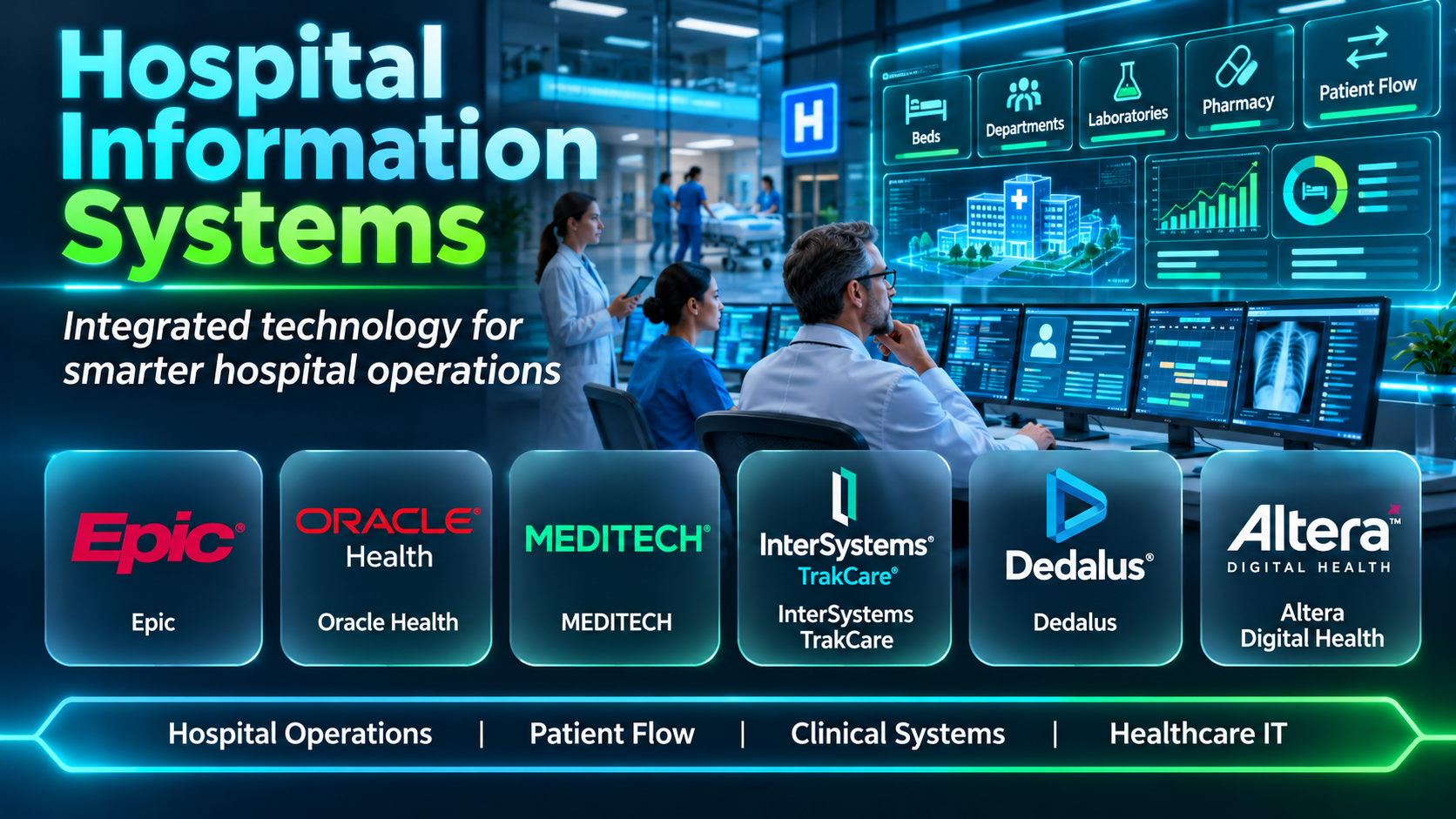
Hospital Information Systems, HIS Software, Hospital Management Software, Healthcare Information Systems, Hospital IT, Patient Administration, Epic, Oracle Health, MEDITECH Expanse, InterSystems TrakCare, Dedalus ORBIS, Bahmni, OpenMRS, GNU Health, Hospital Digital Transformation, Clinical Information Systems
Introduction
Hospitals coordinate clinical care, patient admissions, diagnostic services, staffing, billing, and many other activities. Managing these processes across disconnected systems can create delays, inconsistent records, and operational inefficiencies.
Hospital Information Systems (HIS) help healthcare organizations organize clinical and administrative information within connected digital workflows. Their scope can include electronic health records, patient administration, pharmacy operations, laboratory interfaces, and financial management.
Hospital software varies substantially in complexity, deployment requirements, and functional coverage. This guide compares ten hospital information systems and explains how organizations can evaluate them for different operational needs.
What Are Hospital Information Systems?
A Hospital Information System is a collection of software applications supporting hospital clinical, administrative, and financial operations. It may include an integrated platform or several connected modules.
Common functions include patient registration, admissions, transfers, discharge, clinical documentation, billing, and departmental coordination. Larger systems may also support enterprise analytics, supply chain processes, and interoperability.
Core HIS Functions
- Patient registration
- Admission, discharge, and transfer management
- Electronic patient records
- Clinical documentation
- Appointment scheduling
- Laboratory and imaging integration
- Pharmacy management
- Billing and financial workflows
- Bed and resource management
- Hospital reporting
An HIS should not be confused with an EHR alone. Although electronic health records may form an important component, hospital information systems can encompass broader operational processes.
Why Hospital Information Systems Matter
Hospitals depend on timely information exchange among clinical departments and administrative teams. Fragmented workflows can create duplicate data entry and reduce visibility into patient movement and resource use.
An HIS can connect patient information with admissions, orders, billing, and departmental processes. This may improve coordination and reduce reliance on disconnected records.
However, hospital implementations are complex and can affect patient safety. Successful adoption requires clinical participation, reliable integrations, controlled migration, and extensive testing.
Top 10 Hospital Information Systems
1. Epic
Short Description
Epic provides enterprise healthcare applications used by hospitals and integrated health systems. Its software supports clinical records, hospital operations, patient engagement, and related workflows.
Key Features
- Inpatient clinical documentation
- Patient administration
- Computerized provider order entry
- Medication management
- Departmental clinical workflows
- Patient engagement
- Interoperability
- Revenue cycle capabilities
- Enterprise analytics
Benefits
- Supports connected hospital workflows
- Centralizes clinical information
- Facilitates care coordination
- Connects administrative functions
- Supports patient access
- Enables operational reporting
- Helps standardize enterprise processes
Pros
- Broad hospital functionality
- Integrated application ecosystem
- Relevant to large health systems
- Extensive clinical workflows
- Enterprise reporting capabilities
- Patient engagement tools
Cons
- Significant implementation resources
- Commercial costs can be substantial
- Extensive training requirements
- Complex configuration
- Ongoing optimization needs
Use Cases
- Enterprise hospital systems
- Inpatient clinical records
- Hospital revenue cycle
- Multisite care coordination
- Patient administration
- Healthcare analytics
Best For
- Large hospitals
- Academic medical centers
- Integrated health systems
- Multispecialty hospital networks
- Organizations with extensive IT resources
- Enterprise healthcare modernization
2. Oracle Health
Short Description
Oracle Health provides hospital and clinical information systems associated with the Cerner technology portfolio. Its applications support patient records, clinical operations, and healthcare information management.
Key Features
- Electronic clinical records
- Inpatient workflows
- Patient administration
- Order management
- Medication workflows
- Clinical decision support
- Departmental integration
- Interoperability
- Healthcare analytics
Benefits
- Supports complex hospital operations
- Helps centralize clinical records
- Facilitates departmental coordination
- Enables clinical ordering
- Supports medication processes
- Provides enterprise integration
- Helps manage clinical information
Pros
- Established hospital technology
- Broad clinical functionality
- Enterprise healthcare focus
- Relevant to large organizations
- Interoperability capabilities
- Integrated technology ecosystem
Cons
- Implementation complexity
- Migration requires careful planning
- Product configurations vary
- Training demands can be high
- Ownership costs need evaluation
Use Cases
- Hospital EHR modernization
- Inpatient documentation
- Clinical order management
- Healthcare network integration
- Patient administration
- Enterprise clinical operations
Best For
- Hospitals
- Integrated healthcare networks
- Large clinical organizations
- Complex inpatient environments
- Enterprise IT departments
- Healthcare modernization programs
3. MEDITECH Expanse
Short Description
MEDITECH Expanse is a hospital-oriented healthcare information platform. It supports clinical documentation, patient records, and related hospital workflows.
Key Features
- Inpatient records
- Patient administration
- Clinical documentation
- Order entry
- Medication management
- Ambulatory workflows
- Patient engagement
- Interoperability
- Operational reporting
Benefits
- Supports integrated hospital care
- Helps organize patient information
- Facilitates clinical workflows
- Supports departmental coordination
- Enables patient communication
- Provides structured reporting
- Helps standardize hospital processes
Pros
- Hospital-focused platform
- Broad clinical coverage
- Relevant to community hospitals
- Integrated care workflows
- Patient engagement capabilities
- Established healthcare vendor
Cons
- Implementation requires planning
- Integration needs vary
- Training can be substantial
- Configuration affects functionality
- Total costs require review
Use Cases
- Community hospital operations
- Inpatient care
- Clinical records
- Patient administration
- Regional health systems
- Hospital modernization
Best For
- Community hospitals
- Regional hospital networks
- Midmarket health systems
- Integrated care organizations
- Clinical IT teams
- Hospitals seeking connected workflows
4. Altera Digital Health Sunrise
Short Description
Sunrise is a clinical information system associated with Altera Digital Health. It supports hospital clinical workflows and electronic patient records.
Key Features
- Inpatient documentation
- Clinical order entry
- Medication workflows
- Patient records
- Clinical decision support
- Departmental integration
- Workflow configuration
- Reporting
- Interoperability capabilities
Benefits
- Supports digital hospital care
- Helps organize clinical information
- Facilitates order management
- Supports medication documentation
- Enables coordinated workflows
- Provides clinical reporting
- Helps reduce fragmented records
Pros
- Hospital clinical focus
- Established inpatient workflows
- Configurable functionality
- Relevant to enterprise care
- Clinical decision support
- Integration capabilities
Cons
- Product availability should be verified
- Implementation can be complex
- Training is necessary
- Integration requirements vary
- Support arrangements need review
Use Cases
- Inpatient clinical documentation
- Hospital order management
- Medication workflows
- Clinical system modernization
- Departmental coordination
- Hospital record management
Best For
- Hospitals
- Clinical IT teams
- Existing Sunrise organizations
- Inpatient care providers
- Hospital modernization programs
- Organizations evaluating clinical platforms
5. InterSystems TrakCare
Short Description
InterSystems TrakCare is a unified healthcare information system designed for hospitals and healthcare organizations. It supports clinical and administrative workflows across care settings.
Key Features
- Patient administration
- Electronic clinical records
- Inpatient management
- Outpatient management
- Clinical documentation
- Medication workflows
- Departmental coordination
- Interoperability
- Operational reporting
Benefits
- Supports connected patient information
- Helps coordinate clinical and administrative processes
- Facilitates patient movement
- Enables care documentation
- Supports departmental workflows
- Provides information exchange capabilities
- Helps standardize healthcare operations
Pros
- Integrated hospital information platform
- Broad clinical and administrative scope
- Relevant to international healthcare markets
- Patient administration capabilities
- Interoperability focus
- Suitable for connected care environments
Cons
- Implementation requires expertise
- Localization needs evaluation
- Commercial costs vary
- Workflow configuration can be complex
- Integration testing is essential
Use Cases
- Hospital information management
- Patient administration
- Inpatient and outpatient care
- Departmental coordination
- Healthcare network integration
- Clinical reporting
Best For
- General hospitals
- Regional healthcare networks
- International health systems
- Integrated care organizations
- Hospitals seeking unified workflows
- Enterprise clinical operations teams
6. Dedalus ORBIS
Short Description
Dedalus ORBIS is a hospital information and clinical management platform used in selected healthcare markets. It supports patient information and hospital workflow management.
Key Features
- Patient administration
- Clinical documentation
- Hospital workflow management
- Electronic patient records
- Order management
- Departmental integration
- Medication-related workflows
- Reporting
- Interoperability support
Benefits
- Supports connected hospital processes
- Helps organize patient information
- Facilitates clinical documentation
- Supports departmental coordination
- Enables workflow standardization
- Provides operational visibility
- Helps reduce fragmented systems
Pros
- Hospital information system focus
- Clinical and administrative coverage
- Relevant to established hospital markets
- Integrated workflow approach
- Departmental functionality
- Enterprise healthcare orientation
Cons
- Availability varies by market
- Localization requirements differ
- Implementation may be complex
- Commercial costs require evaluation
- Integration needs careful planning
Use Cases
- Hospital administration
- Inpatient documentation
- Departmental coordination
- Clinical order management
- Patient record management
- Hospital modernization
Best For
- European hospitals
- Regional healthcare organizations
- Existing ORBIS users
- Clinical operations teams
- Hospital IT departments
- Organizations assessing integrated systems
7. SAP Healthcare Solutions
Short Description
SAP provides enterprise applications relevant to healthcare financial, supply chain, and operational management. Hospital-specific clinical and patient administration capabilities depend on the selected products, partners, and deployment arrangements.
Key Features
- Enterprise financial management
- Procurement workflows
- Supply chain management
- Inventory management
- Workforce-related integration
- Operational reporting
- Enterprise analytics
- Data integration
- Business process automation
Benefits
- Supports hospital business operations
- Helps coordinate procurement
- Improves financial visibility
- Enables inventory management
- Facilitates enterprise reporting
- Supports standardized administration
- Integrates broader business processes
Pros
- Broad enterprise software ecosystem
- Strong financial management
- Supply chain capabilities
- Relevant to large hospital groups
- Extensive integration options
- Enterprise analytics support
Cons
- Not a complete clinical HIS by itself
- Clinical functions require other systems
- Implementation may be complex
- Commercial costs can be substantial
- Integration responsibilities must be defined
Use Cases
- Hospital financial operations
- Procurement
- Supply chain management
- Enterprise reporting
- Inventory control
- Administrative modernization
Best For
- Large hospital groups
- Healthcare finance departments
- Supply chain teams
- Enterprise IT organizations
- Hospitals using SAP applications
- Organizations integrating clinical and business systems
8. Bahmni
Short Description
Bahmni is an open-source hospital information system that integrates clinical and operational components. It is used in healthcare environments seeking adaptable digital workflows.
Key Features
- Electronic patient records
- Patient registration
- Clinical documentation
- Laboratory integration
- Pharmacy workflows
- Billing integration
- Appointment management
- Configurable workflows
- Open-source architecture
Benefits
- Supports integrated hospital workflows
- Helps digitize patient information
- Enables adaptable configurations
- Connects selected departmental processes
- Reduces paper-based activities
- Supports local implementation approaches
- Provides an open-source foundation
Pros
- Open-source availability
- Hospital-oriented architecture
- Clinical and operational integration
- Configurable workflows
- Relevant to resource-constrained environments
- Community-driven ecosystem
Cons
- Requires technical implementation capacity
- Support depends on deployment arrangements
- Customization needs maintenance
- Security operations remain organizational responsibilities
- Regulatory suitability must be assessed locally
Use Cases
- Hospital digitization
- Community healthcare facilities
- Patient registration
- Clinical documentation
- Laboratory and pharmacy coordination
- Resource-constrained hospital environments
Best For
- Community hospitals
- Nonprofit healthcare organizations
- Public health facilities
- Hospitals with technical implementation partners
- Open-source healthcare projects
- Organizations seeking adaptable systems
9. OpenMRS
Short Description
OpenMRS is an open-source medical record platform used in diverse healthcare environments. It provides a configurable foundation for patient information systems but does not independently supply every hospital administrative function.
Key Features
- Patient record management
- Clinical encounter documentation
- Concept dictionary
- Configurable forms
- Patient registration
- Modular architecture
- API integration
- Reporting support
- Community-developed components
Benefits
- Supports digital patient records
- Enables configurable clinical workflows
- Provides an extensible foundation
- Facilitates local development
- Supports healthcare data management
- Reduces dependence on proprietary licensing
- Enables community collaboration
Pros
- Open-source platform
- Flexible architecture
- Established global health context
- Configurable clinical data model
- Integration options
- Active implementation ecosystem
Cons
- Not a complete turnkey HIS
- Requires implementation expertise
- Administrative modules may need integration
- Support depends on partners
- Maintenance and security require resources
Use Cases
- Clinical record management
- Public health programs
- Community healthcare systems
- Custom hospital applications
- Research-oriented clinical records
- Healthcare digitization
Best For
- Public health organizations
- Community healthcare programs
- Nonprofit health systems
- Technical implementation teams
- Custom healthcare projects
- Organizations seeking open-source foundations
10. GNU Health
Short Description
GNU Health is a free software ecosystem supporting health information management and related clinical and administrative workflows. It is used in selected healthcare and public health environments.
Key Features
- Patient information management
- Clinical records
- Healthcare administration
- Hospital workflow support
- Health-related data management
- Reporting
- Modular functionality
- Open-source architecture
- Public health applications
Benefits
- Supports healthcare digitization
- Provides adaptable software
- Helps organize patient information
- Supports clinical and administrative records
- Enables local configuration
- Reduces proprietary licensing dependence
- Supports public health information needs
Pros
- Free software model
- Modular architecture
- Healthcare-specific functions
- Relevant to public health
- Adaptable implementation
- Community-oriented development
Cons
- Requires technical expertise
- Implementation resources are necessary
- Commercial support availability varies
- Local regulatory requirements need assessment
- Integrations may require development
Use Cases
- Hospital information management
- Community healthcare
- Patient records
- Public health administration
- Healthcare software customization
- Digital health projects
Best For
- Public healthcare organizations
- Community hospitals
- Nonprofit providers
- Open-source healthcare teams
- Technical implementation partners
- Organizations seeking adaptable systems
Comparison of the Top 10 Hospital Information Systems
| Platform | Primary Focus | Typical Organization | Main Consideration |
|---|---|---|---|
| Epic | Enterprise clinical and hospital operations | Large health systems | Cost and implementation |
| Oracle Health | Hospital clinical systems | Hospitals and networks | Migration complexity |
| MEDITECH Expanse | Integrated hospital care | Community and regional hospitals | Configuration |
| Altera Sunrise | Inpatient clinical workflows | Hospitals | Product scope and support |
| InterSystems TrakCare | Unified clinical and administrative workflows | General hospitals | Localization |
| Dedalus ORBIS | Hospital information management | Regional hospitals | Market availability |
| SAP Healthcare Solutions | Financial and operational management | Large hospital groups | Not a standalone clinical HIS |
| Bahmni | Open-source hospital workflows | Community hospitals | Technical implementation |
| OpenMRS | Configurable clinical record foundation | Public health organizations | Requires additional HIS modules |
| GNU Health | Open-source healthcare management | Public and community facilities | Implementation capacity |
Which Hospital Information System Is Right for You?
| Hospital Type | Systems to Evaluate | Main Reason |
|---|---|---|
| Large academic hospital | Epic, Oracle Health | Enterprise clinical coverage |
| Community hospital | MEDITECH Expanse, TrakCare | Integrated hospital workflows |
| Regional hospital network | Oracle Health, Dedalus ORBIS | Multi-department coordination |
| Hospital with established Sunrise infrastructure | Altera Sunrise | Clinical continuity |
| Large hospital finance organization | SAP, Epic | Enterprise operations and clinical integration |
| Community hospital seeking open-source software | Bahmni, GNU Health | Adaptable deployment |
| Public health clinical network | OpenMRS, GNU Health | Configurable records |
| International integrated hospital | TrakCare, Dedalus ORBIS | Broad hospital information management |
Key Selection Criteria
Clinical coverage: Assess inpatient, outpatient, emergency, pharmacy, and departmental requirements. A system must support the hospital’s actual care model.
Patient administration: Review admissions, transfers, discharge, scheduling, and bed management. These workflows affect hospital coordination and operational efficiency.
Integration: Evaluate laboratory, radiology, pharmacy, financial, and external healthcare interfaces. End-to-end testing is essential because hospital systems are highly interconnected.
Security and privacy: Review identity management, access controls, audit trails, and applicable legal obligations. Sensitive patient information requires strong governance.
Implementation resources: Evaluate migration, training, support, and downtime procedures. Hospital transitions should prioritize continuity of care and patient safety.
Financial sustainability: Compare licenses, infrastructure, integration, support, and long-term maintenance. Open-source systems also require implementation and operational funding.
Practical Hospital Information System Implementation Workflow
Step 1: Assess Hospital Operations
Document clinical and administrative workflows across the organization. Identify current systems, operational problems, and safety-critical processes.
Action checklist:
- Map clinical departments.
- Review patient administration.
- Identify existing applications.
- Document integration requirements.
- Define success criteria.
Step 2: Establish Governance
Create a project structure involving clinical leaders, administrators, finance, IT, and security teams. Assign responsibilities for decisions, testing, and escalation.
Action checklist:
- Appoint project leadership.
- Identify clinical representatives.
- Define decision authority.
- Establish risk management.
- Approve project scope.
Step 3: Evaluate Platforms
Compare shortlisted systems using real hospital workflows. Include admissions, clinical orders, medication processes, and billing scenarios.
Action checklist:
- Prepare evaluation scenarios.
- Request vendor demonstrations.
- Assess functional coverage.
- Review interoperability.
- Compare total costs.
Step 4: Design Integrations
Plan connections with laboratory, imaging, pharmacy, billing, and other hospital systems. Define data ownership and reconciliation requirements.
Action checklist:
- Inventory interfaces.
- Map patient identifiers.
- Define data exchanges.
- Test error handling.
- Document integration controls.
Step 5: Configure and Validate
Configure clinical workflows, permissions, forms, and operational rules. Test safety-critical scenarios before deployment.
Action checklist:
- Configure user roles.
- Build workflows.
- Test medication processes.
- Validate data migration.
- Document acceptance testing.
Step 6: Deploy With Clinical Support
Introduce the system through a controlled implementation plan. Maintain support teams and downtime procedures during transition.
Action checklist:
- Confirm readiness.
- Train staff.
- Activate support teams.
- Monitor patient safety.
- Resolve critical incidents.
Step 7: Optimize Hospital Performance
Monitor operational outcomes, clinical usability, and system reliability. Improve workflows through controlled updates and ongoing training.
Action checklist:
- Review incident trends.
- Monitor workflow performance.
- Collect clinician feedback.
- Evaluate integration reliability.
- Plan continuous improvement.
Frequently Asked Questions
1. What is a Hospital Information System?
An HIS is software supporting clinical and administrative hospital operations. It may include patient records, admissions, billing, and departmental workflows.
2. What is the difference between HIS and EHR?
An EHR focuses on electronic patient health information and related clinical workflows. An HIS can include broader hospital administration and operational functions.
3. Can an HIS manage patient admissions?
Many systems support admission, discharge, and transfer workflows. Exact capabilities depend on the platform and configuration.
4. Does an HIS include billing?
Some systems include hospital billing or revenue cycle modules. Others integrate with separate financial applications.
5. Can an HIS integrate with laboratories?
Many platforms support laboratory information system interfaces. Compatibility should be tested with the hospital’s actual laboratory software.
6. What is hospital interoperability?
Hospital interoperability enables information exchange between clinical and administrative systems. It depends on standards, interfaces, and organizational arrangements.
7. Are open-source hospital systems reliable?
Open-source systems can support healthcare operations when properly implemented and maintained. Reliability depends on technical support, validation, and governance.
8. What is the role of patient administration software?
It manages processes such as registration, admissions, transfers, and discharge. These functions help coordinate patient movement and hospital operations.
9. Can an HIS support pharmacy operations?
Some systems provide medication and pharmacy workflows. Others require dedicated pharmacy applications and integrations.
10. Does an HIS support radiology?
Many platforms integrate with radiology information and imaging systems. Specific capabilities depend on the architecture.
11. How long does HIS implementation take?
Timelines vary with hospital size, integrations, migration, and workflow complexity. Enterprise deployments can require extensive planning.
12. Is a cloud-based HIS suitable for hospitals?
Cloud deployment may be suitable when security, availability, and operational requirements are met. Hospitals should assess connectivity, contracts, and downtime procedures.
13. What are the main HIS security requirements?
Important controls include access management, audit logging, encryption, and backups. Applicable legal and regulatory requirements also need evaluation.
14. Can HIS software improve hospital efficiency?
It can reduce fragmented processes and improve information access. Results depend on implementation quality and workflow design.
15. What is the cost of an HIS?
Costs depend on hospital size, modules, deployment, integration, and support. Total ownership cost should include long-term operations.
16. How should a hospital select an HIS?
Start with clinical safety, operational needs, interoperability, and governance. Evaluate systems using realistic hospital workflows and detailed cost estimates.
Final Thoughts
Hospital Information Systems support the coordination of clinical care and hospital operations. Their value depends on reliable information exchange and workflows suited to the organization.
Epic, Oracle Health, and MEDITECH Expanse offer broad functionality relevant to complex healthcare environments. Their implementation requirements should be assessed against available resources.
InterSystems TrakCare, Dedalus ORBIS, and Altera Sunrise address different hospital information needs. Their suitability depends on market availability, clinical scope, and integration requirements.
Bahmni, OpenMRS, and GNU Health provide open-source approaches to healthcare information management. They may offer flexibility but still require technical implementation and ongoing support.
The most suitable HIS is one that supports safe care, efficient operations, and sustainable maintenance. Clinical participation, rigorous testing, and continuous improvement are essential throughout its lifecycle.
