1. Introduction
Fraud case management tools help organizations investigate suspicious activity, coordinate response teams, and maintain reliable records of fraud decisions. In 2026, their importance continues to grow as digital payments, online accounts, and cross-border transactions create more complex fraud risks.
Manual fraud investigations often depend on spreadsheets, email conversations, and disconnected customer records. These methods can delay decisions, create duplicate work, and make it difficult to reconstruct an investigation during an audit.
Modern fraud case management platforms bring alerts, evidence, analyst assignments, and investigation outcomes into connected workflows. Many also support artificial intelligence (AI), automated rules, application programming interfaces (APIs), and integrations with transaction monitoring systems.
Choosing the right platform matters because fraud teams operate under different pressures. A bank investigating account takeover may need different controls from an online retailer handling payment disputes or a marketplace investigating seller abuse.
Organizations should compare investigation workflows, evidence handling, reporting, integration options, security, and total ownership costs. They should also evaluate how well each platform supports analyst productivity without weakening oversight or customer protection.
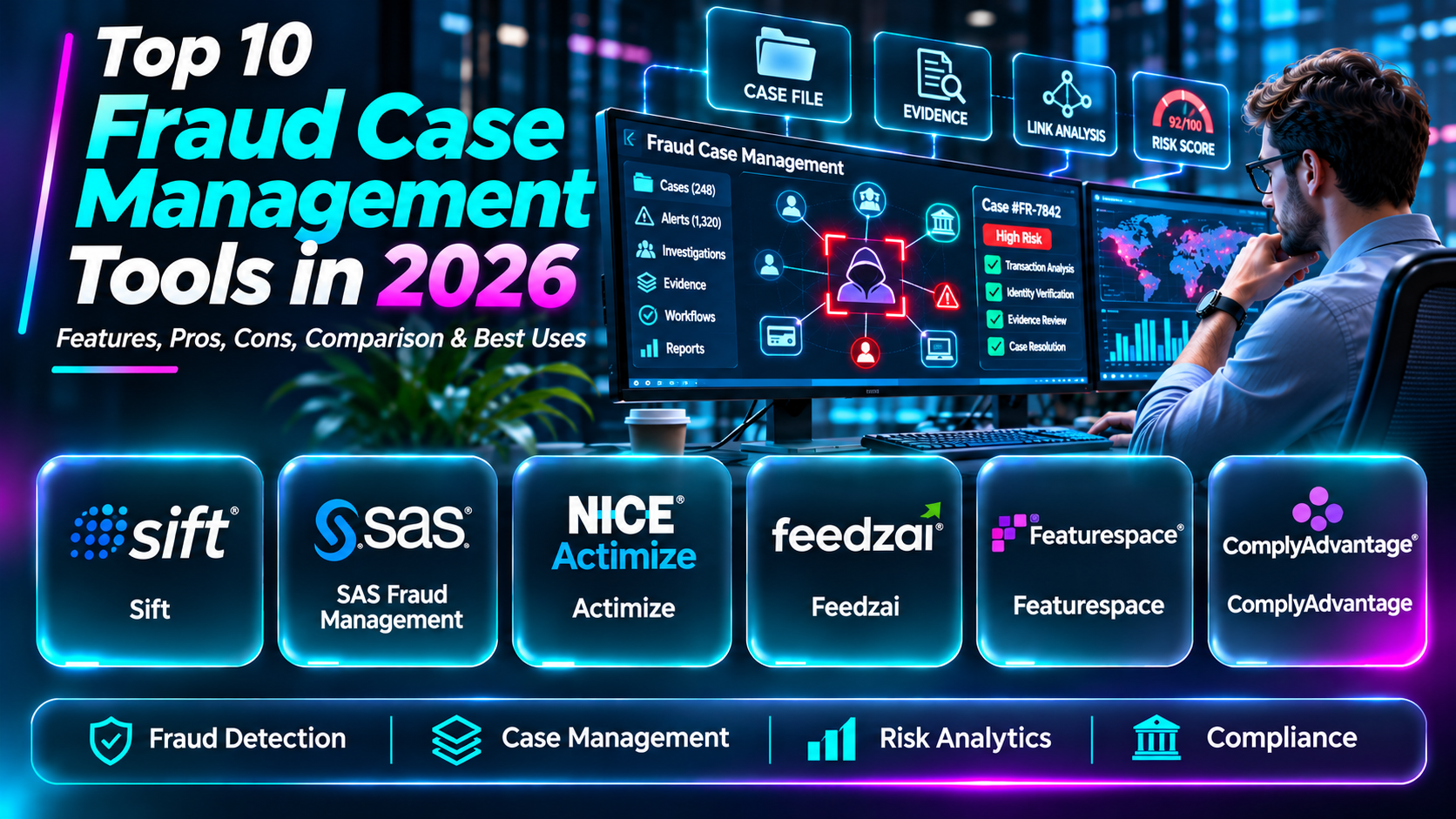
This guide examines ten fraud case management tools, including their features, benefits, limitations, and practical applications. It also provides comparison tables, recommendations for different users, a seven-step implementation example, and answers to common questions.
2. What Are Fraud Case Management Tools?
Fraud case management tools are software platforms that organize the investigation and resolution of suspected fraudulent activity. They help teams turn alerts, complaints, transaction anomalies, and other risk signals into documented cases.
These systems typically collect information from payment platforms, customer databases, fraud detection engines, and identity verification services. Analysts can then review evidence, assign tasks, record findings, escalate concerns, and close investigations through controlled workflows.
For example, a payment provider might detect several unusual transfers from a newly accessed account. A case management platform can combine the transaction records, device information, customer history, and analyst notes into one investigation.
The main benefits include faster case handling, clearer accountability, consistent decisions, and stronger audit trails. Actual results depend on the quality of detection signals, integration design, investigation procedures, and staff training.
Common applications of Fraud Case Management Tools include:
- Banking: Investigate suspicious transfers, account takeover, and payment fraud. Coordinate fraud specialists, customer service teams, and compliance officers.
- Financial technology: Review identity fraud, account misuse, and unusual payment patterns. Maintain structured records as transaction volumes increase.
- E-commerce: Investigate suspicious purchases, refund abuse, and chargeback disputes. Connect order histories with customer and payment information.
- Insurance: Examine potentially fraudulent claims and inconsistent supporting documents. Assign investigators and track evidence requests.
- Marketplaces: Investigate seller impersonation, account networks, and coordinated abuse. Link suspicious accounts and transactions.
- Telecommunications: Manage subscription fraud, account takeover, and unauthorized service activity. Support collaboration between security and customer operations.
- Cryptocurrency services: Investigate suspicious account behavior and potentially fraudulent transfers. Preserve transaction context and escalation histories.
- Corporate investigations: Review employee misconduct, procurement fraud, and internal reporting concerns. Apply access restrictions and evidence retention procedures.
3. Top 10 Fraud Case Management Tools in 2026
1. Unit21
Short Description
Unit21 provides a risk operations platform designed to help organizations manage fraud and anti-money laundering (AML) workflows. Its investigation capabilities are particularly relevant to financial technology companies, payment providers, and other digital businesses.
The platform emphasizes configurable monitoring, alert review, and case management. Teams can use it to organize investigations without developing every workflow component internally.
A notable characteristic is its focus on configurable rules and operational automation. Organizations can connect risk data and use workflows to prioritize and route investigations.
Unit21 can support collaboration between fraud analysts, risk managers, and compliance personnel. Its suitability depends on data integration requirements, investigation volume, and the features included in the selected agreement.
Key Features
- Case management: Consolidates related alerts and investigation information. Analysts can maintain case histories and record outcomes.
- Configurable workflows: Supports routing and escalation based on defined conditions. Teams can adapt processes to different fraud scenarios.
- Risk rules: Helps organizations define conditions for suspicious activity. Rule effectiveness depends on testing and maintenance.
- Alert prioritization: Organizes incoming alerts for analyst review. Prioritization criteria should reflect operational risk.
- Evidence records: Keeps investigation notes and supporting information together. Retention requirements should be configured appropriately.
- Team assignments: Supports ownership and collaboration across investigators. Managers can monitor responsibilities and progress.
- API integration: Connects with external systems through supported interfaces. Integration effort depends on data structures and existing architecture.
- Reporting: Helps teams examine investigation activity and outcomes. Organizations should confirm the reports available in their plan.
- AML coordination: Supports workflows involving financial crime compliance. Regulatory reporting capabilities require jurisdiction-specific validation.
Benefits
- Centralize fraud investigations.
- Reduce repetitive administrative work.
- Configure investigation workflows.
- Improve analyst accountability.
- Connect risk data sources.
- Standardize escalation procedures.
- Strengthen case documentation.
Pros
- Flexible configuration for digital businesses.
- Fraud and AML workflow coverage.
- Supports integration-led operations.
- Useful for growing risk teams.
- Structured investigation records.
- Workflow automation capabilities.
Cons
- Requires careful initial configuration.
- Integration work may be substantial.
- Enterprise costs require evaluation.
- Advanced features may vary by contract.
- Rules need ongoing maintenance.
Use Cases
- Payment fraud: Investigate suspicious transfers and payment patterns.
- Account takeover: Consolidate login and transaction evidence.
- Fintech onboarding: Review potentially fraudulent new accounts.
- AML investigations: Coordinate financial crime cases.
- Risk operations: Assign and escalate complex investigations.
- Audit preparation: Retrieve documented case decisions.
Best For
- Financial technology companies.
- Digital payment providers.
- Growing fraud teams.
- Risk operations departments.
- AML investigation teams.
- API-focused businesses.
2. NICE Actimize
Short Description
NICE Actimize develops financial crime and fraud management technology for regulated organizations. Its case management capabilities are particularly relevant to banks and large financial institutions.
The platform supports complex investigations involving multiple alerts, transactions, and customer relationships. It is designed for organizations that require structured governance and detailed investigation procedures.
Its enterprise financial crime ecosystem can connect detection, investigation, and operational workflows. Available capabilities depend on the specific NICE Actimize products and deployment configuration.
Large investigation teams can use its structured processes to coordinate case ownership and review. Implementation generally requires detailed planning, specialist resources, and governance alignment.
Key Features
- Enterprise case management: Organizes investigations across financial crime operations. Teams can document findings and resolution decisions.
- Alert consolidation: Brings relevant alerts into investigation workflows. Correlation depends on connected data and configured logic.
- Workflow orchestration: Supports structured assignments and escalation. Organizations can establish review and approval procedures.
- Customer context: Connects cases with relevant customer and transaction information. Data access must follow security policies.
- Investigation dashboards: Provides operational visibility into investigation activity. Dashboard availability depends on the product configuration.
- Audit trails: Records important investigation actions. Organizations should validate retention and evidentiary requirements.
- Fraud integration: Works within broader fraud prevention environments. Integration scope varies across deployments.
- Compliance support: Helps coordinate financial crime investigation processes. Regulatory obligations remain the institution’s responsibility.
- Enterprise controls: Supports governance-oriented operating models. Access policies require appropriate implementation.
Benefits
- Coordinate complex investigations.
- Standardize enterprise workflows.
- Improve case traceability.
- Consolidate financial crime information.
- Support management oversight.
- Strengthen investigation governance.
- Scale structured operations.
Pros
- Established financial crime focus.
- Suitable for large regulated institutions.
- Broad investigation ecosystem.
- Structured governance capabilities.
- Supports complex operational workflows.
- Integrates with enterprise risk processes.
Cons
- Implementation can be complex.
- Licensing may be costly.
- Specialist expertise may be needed.
- Configuration can require substantial effort.
- May exceed smaller teams’ needs.
Use Cases
- Bank fraud: Investigate suspicious account activity.
- Payment investigations: Review complex transaction patterns.
- Financial crime: Coordinate related fraud and AML cases.
- Escalations: Manage high-priority investigations.
- Audit review: Reconstruct documented decisions.
- Enterprise operations: Standardize investigations across departments.
Best For
- Large banks.
- Regulated financial institutions.
- Enterprise investigation teams.
- Financial crime departments.
- Organizations with complex workflows.
- Institutions requiring strong governance.
3. Feedzai
Short Description
Feedzai provides financial crime prevention technology with an emphasis on fraud detection and risk decisioning. Its platform is used in payment, banking, and digital financial service environments.
Fraud teams can use its risk intelligence to support investigations and operational decisions. Case handling capabilities should be evaluated alongside the detection products selected.
The platform combines data analysis, machine learning, and risk-oriented workflows. This approach can help analysts understand suspicious behavior across connected events.
Feedzai is especially relevant to organizations processing large volumes of digital transactions. Successful deployment depends on data quality, model governance, and integration with existing systems.
Key Features
- Risk analytics: Evaluates transaction and behavioral information. Results depend on available signals and model configuration.
- Fraud alerts: Identifies events requiring review. Alert policies should balance detection coverage and false positives.
- Investigation support: Provides context for suspicious activity. Teams should confirm case workflow functionality.
- Machine learning: Uses statistical and machine learning techniques for fraud analysis. Models require ongoing monitoring.
- Transaction context: Connects relevant payment attributes. This can help analysts understand suspicious patterns.
- Risk scoring: Produces indicators for decision workflows. Scores should not replace appropriate human review.
- Operational dashboards: Supports visibility into fraud activity. Reporting scope depends on the selected solution.
- Integration interfaces: Connects with financial technology infrastructure. Implementation may require specialist engineering.
- Decision management: Helps apply fraud policies to operational events. Governance controls remain essential.
Benefits
- Analyze transaction risk.
- Prioritize suspicious activity.
- Improve investigation context.
- Connect detection and operations.
- Support high-volume processing.
- Reduce fragmented risk analysis.
- Inform fraud decisions.
Pros
- Strong financial fraud focus.
- Advanced analytical capabilities.
- Relevant to payment environments.
- Supports data-driven decisions.
- Suitable for enterprise operations.
- Broad risk intelligence approach.
Cons
- Can require significant integration.
- Model oversight is necessary.
- Costs may be substantial.
- Specialized configuration may be needed.
- Case management scope requires validation.
Use Cases
- Card fraud: Investigate unusual card activity.
- Payment fraud: Review high-risk transfers.
- Account abuse: Analyze suspicious user behavior.
- Digital banking: Connect risk signals with investigations.
- Transaction review: Prioritize anomalous events.
- Fraud operations: Support analyst decision-making.
Best For
- Banks.
- Payment processors.
- Digital financial services.
- High-volume transaction teams.
- Fraud analytics departments.
- Enterprise risk operations.
4. SAS Fraud Management
Short Description
SAS Fraud Management is part of the SAS fraud analytics portfolio. It supports organizations that require analytical detection and investigation processes.
The solution is particularly relevant to financial institutions and enterprises managing complex fraud risks. Its value often depends on the organization’s analytical maturity and available data.
SAS emphasizes advanced analytics, fraud models, and operational decision support. These capabilities can complement structured investigation and case review procedures.
Organizations with established data teams may benefit from its analytical flexibility. Deployment, infrastructure, and workflow capabilities should be evaluated against the specific SAS offering.
Key Features
- Fraud analytics: Examines data for suspicious patterns. Analytical accuracy depends on data quality.
- Risk models: Supports model-based fraud detection. Models require validation and periodic review.
- Alert generation: Identifies activity for investigation. Teams should tune thresholds to operational capacity.
- Investigation context: Presents relevant fraud information. Available case views depend on configuration.
- Data integration: Uses information from connected systems. Complex environments may need extensive preparation.
- Decision support: Helps analysts assess suspicious activity. Human judgment remains important.
- Reporting: Supports analysis of fraud trends and operations. Reporting requirements should be confirmed during evaluation.
- Enterprise processing: Addresses substantial data volumes. Performance depends on deployment architecture.
- Governance support: Enables controlled analytical processes. Organizations remain responsible for appropriate oversight.
Benefits
- Analyze complex fraud patterns.
- Support evidence-based decisions.
- Integrate enterprise data.
- Improve risk prioritization.
- Monitor detection performance.
- Coordinate analytical investigations.
- Strengthen operational reporting.
Pros
- Strong analytical heritage.
- Suitable for complex environments.
- Supports advanced modeling.
- Enterprise-oriented capabilities.
- Useful for mature data teams.
- Broad fraud detection applications.
Cons
- Requires technical expertise.
- Implementation may take time.
- Infrastructure needs can be significant.
- Costs require detailed review.
- Workflow simplicity varies by configuration.
Use Cases
- Banking: Investigate unusual financial activity.
- Insurance: Analyze suspicious claims patterns.
- Payments: Review transaction anomalies.
- Enterprise fraud: Connect multiple data sources.
- Risk modeling: Evaluate detection strategies.
- Investigations: Provide analytical evidence to case teams.
Best For
- Large enterprises.
- Banks.
- Insurance organizations.
- Advanced analytics teams.
- Data-intensive fraud operations.
- Organizations with technical resources.
5. SEON
Short Description
SEON provides fraud prevention technology focused on digital identity signals, device intelligence, and online behavior. Its capabilities are relevant to organizations investigating account and transaction abuse.
The platform serves financial technology companies, online merchants, marketplaces, and other digital businesses. Investigation teams can use risk signals to evaluate suspicious accounts and activities.
SEON emphasizes information enrichment and fraud analysis within operational workflows. Its investigation usefulness depends on the available case management features and connected systems.
The platform can help smaller and growing teams establish more structured fraud review processes. Organizations should test its performance against their actual fraud patterns and customer populations.
Key Features
- Device intelligence: Analyzes device-related signals. Signal reliability can vary across environments.
- Digital footprint analysis: Enriches user risk assessments with available information. Privacy and data protection requirements must be respected.
- Fraud scoring: Helps prioritize suspicious activity. Scores require appropriate interpretation.
- Rules engine: Supports configurable fraud conditions. Rules should be tested before production use.
- Investigation interface: Presents relevant signals for review. Case workflow depth should be confirmed.
- Behavioral signals: Examines aspects of user activity. Available signals depend on integration.
- API access: Supports connection with digital platforms. Engineering effort varies.
- Operational review: Helps analysts investigate suspicious events. Teams should establish consistent resolution procedures.
- Reporting: Supports fraud performance analysis. Specific reporting options depend on product configuration.
Benefits
- Enrich fraud investigations.
- Identify suspicious digital behavior.
- Prioritize account reviews.
- Configure risk rules.
- Support faster triage.
- Connect digital risk signals.
- Improve analyst context.
Pros
- Strong digital fraud orientation.
- Useful device intelligence.
- Relevant to online businesses.
- Configurable fraud rules.
- Integration-friendly approach.
- Supports investigation enrichment.
Cons
- Not a universal enterprise case system.
- Data coverage varies by market.
- Signal interpretation needs care.
- Costs depend on usage.
- Complex investigations may need additional tools.
Use Cases
- Account creation: Review suspicious registrations.
- Account takeover: Examine unusual device activity.
- Online payments: Investigate high-risk transactions.
- Marketplaces: Analyze suspicious seller accounts.
- Gaming: Review bonus and promotion abuse.
- Digital services: Assess coordinated account misuse.
Best For
- Online businesses.
- Financial technology firms.
- Marketplaces.
- Gaming platforms.
- Digital fraud analysts.
- Teams needing device intelligence.
6. Sift
Short Description
Sift develops digital fraud prevention technology for online businesses. Its platform focuses on detecting and managing fraud across digital customer interactions.
The solution is relevant to e-commerce companies, marketplaces, and subscription services. These organizations often need to review suspicious orders, accounts, and payment activity.
Sift combines risk signals and machine learning with operational review capabilities. Teams should evaluate the investigation features available for their specific fraud workflows.
Its approach can help organizations connect customer behavior with fraud decisions. Effective deployment requires accurate event data and careful risk policy configuration.
Key Features
- Payment fraud detection: Evaluates suspicious purchase activity. Detection quality depends on submitted signals.
- Account protection: Supports identification of risky account behavior. Teams should define escalation criteria.
- Risk scoring: Helps distinguish higher-risk events. Scores should be validated against actual outcomes.
- Manual review: Supports analyst examination of suspicious activity. Available workflows depend on the product setup.
- Behavioral analysis: Uses digital activity patterns for fraud assessment. Coverage varies by implementation.
- Decision rules: Applies configurable fraud policies. Rule changes require monitoring.
- Event integration: Connects business activity with risk analysis. Event completeness affects results.
- Operational reporting: Helps evaluate fraud performance. Reporting needs should be tested.
- Trust signals: Uses available network and behavioral intelligence. Teams should assess suitability for their customer base.
Benefits
- Review suspicious orders.
- Analyze digital account risks.
- Improve fraud prioritization.
- Connect behavioral signals.
- Support payment decisions.
- Reduce manual data gathering.
- Monitor fraud trends.
Pros
- Strong e-commerce orientation.
- Relevant digital fraud signals.
- Supports operational review.
- Integrates with online platforms.
- Useful for account abuse.
- Suitable for transaction-focused teams.
Cons
- Less suited to complex bank investigations.
- Requires event integration.
- Costs depend on commercial terms.
- Models require monitoring.
- Some workflows need external systems.
Use Cases
- E-commerce: Investigate suspicious purchases.
- Marketplaces: Review seller and buyer abuse.
- Subscriptions: Examine account misuse.
- Payments: Evaluate unusual transactions.
- Promotions: Investigate incentive abuse.
- Account security: Review takeover indicators.
Best For
- Online retailers.
- Digital marketplaces.
- Subscription businesses.
- E-commerce fraud teams.
- Consumer platforms.
- Payment risk operations.
7. DataVisor
Short Description
DataVisor provides fraud and financial crime detection technology using machine learning and analytical techniques. It is relevant to organizations investigating complex and coordinated fraud activity.
The platform serves financial services, digital platforms, and enterprises with substantial transaction or account data. Its capabilities can help teams investigate patterns that are difficult to identify manually.
DataVisor emphasizes analytical detection, including approaches that examine unusual relationships and behavior. Organizations should assess how its case management functions connect with detection results.
The platform is most suitable where fraud patterns involve many accounts, transactions, or connected entities. Implementation requires appropriate data pipelines, investigation procedures, and model oversight.
Key Features
- Machine learning: Analyzes suspicious activity patterns. Performance depends on data and model governance.
- Anomaly detection: Identifies behavior that differs from expected patterns. Alerts require contextual review.
- Fraud network analysis: Helps examine connected suspicious entities. Relationship quality depends on source data.
- Case workflows: Supports investigation processes within the available solution. Teams should verify workflow coverage.
- Alert prioritization: Organizes events for analyst attention. Priorities should reflect actual business risk.
- Entity context: Connects relevant account and transaction information. Data matching needs validation.
- Operational analytics: Supports analysis of investigation and detection performance. Reporting varies by deployment.
- Data integration: Connects multiple fraud information sources. Integration complexity depends on architecture.
- Enterprise scalability: Supports demanding fraud environments. Performance should be tested using realistic workloads.
Benefits
- Detect coordinated fraud patterns.
- Investigate connected entities.
- Prioritize complex alerts.
- Combine fraud data sources.
- Support analytical investigations.
- Improve fraud visibility.
- Monitor evolving threats.
Pros
- Strong analytical approach.
- Useful for fraud networks.
- Relevant to large datasets.
- Supports complex detection.
- Enterprise-oriented capabilities.
- Suitable for sophisticated fraud operations.
Cons
- Requires good data integration.
- Analytical complexity can be high.
- Implementation may need specialists.
- Costs require vendor consultation.
- Case workflows should be tested carefully.
Use Cases
- Fraud rings: Investigate coordinated account networks.
- Banking: Review complex transaction activity.
- Marketplaces: Identify linked suspicious sellers.
- Digital payments: Analyze unusual payment clusters.
- Account fraud: Examine coordinated registrations.
- Risk analysis: Investigate emerging fraud patterns.
Best For
- Large digital platforms.
- Banks.
- Advanced fraud teams.
- Data-intensive businesses.
- Fraud network investigators.
- Enterprise risk departments.
8. Sardine
Short Description
Sardine provides fraud prevention and financial crime technology for digital financial services. Its offering combines risk intelligence with operational capabilities relevant to investigations.
The platform is particularly relevant to fintech companies, payment providers, and businesses handling complex digital transactions. These organizations often need to connect identity, device, and payment signals.
Sardine emphasizes integrated fraud and compliance risk information. Its case management and automation capabilities should be reviewed against the organization’s required workflows.
The platform can help teams investigate suspicious customer and transaction behavior. Successful implementation depends on data access, operational configuration, and appropriate human oversight.
Key Features
- Device intelligence: Provides signals about digital device activity. Teams should assess signal reliability.
- Payment risk analysis: Evaluates suspicious payment behavior. Available data affects detection quality.
- Identity risk: Supports assessment of potentially fraudulent identities. Verification scope depends on configuration.
- Investigation workflows: Helps organize risk reviews. Specific case capabilities require validation.
- Fraud alerts: Identifies suspicious activity for investigation. Teams should tune thresholds.
- Compliance coordination: Supports financial crime operations. Regulatory reporting obligations must be checked separately.
- API integration: Connects with digital financial systems. Engineering effort varies by environment.
- Risk intelligence: Combines relevant fraud indicators. Analysts should examine the underlying evidence.
- Operational automation: Supports selected repeatable activities. Automated decisions need appropriate controls.
Benefits
- Connect fraud and identity signals.
- Investigate payment anomalies.
- Improve risk context.
- Support fintech workflows.
- Automate routine reviews.
- Coordinate risk operations.
- Strengthen case consistency.
Pros
- Relevant to modern fintech operations.
- Combines multiple risk signals.
- Digital payment orientation.
- Supports operational integration.
- Useful for account fraud.
- Financial crime focus.
Cons
- Integration effort may be required.
- Enterprise costs need evaluation.
- Features vary by agreement.
- Automated decisions require oversight.
- Complex banking requirements need validation.
Use Cases
- Fintech fraud: Investigate suspicious financial activity.
- Payment processing: Review risky transactions.
- Account opening: Examine identity inconsistencies.
- Account takeover: Analyze device and behavioral evidence.
- Financial crime: Coordinate fraud and compliance investigations.
- Risk operations: Route suspicious cases for review.
Best For
- Fintech companies.
- Payment platforms.
- Digital banks.
- Financial crime teams.
- Identity risk operations.
- API-driven businesses.
9. Quantexa
Short Description
Quantexa provides decision intelligence technology focused on connecting data and understanding relationships. Its capabilities can support complex fraud investigations involving multiple entities.
The platform is particularly relevant to banks, insurers, and enterprises investigating organized fraud. It helps teams analyze connections that may be hidden across fragmented records.
Quantexa emphasizes entity resolution, network analysis, and contextual intelligence. These capabilities can complement case management processes, although organizations should verify the investigation workflow components required.
The platform is suitable for organizations with extensive data and sophisticated investigation needs. Deployment requires careful data integration, governance, and analytical design.
Key Features
- Entity resolution: Connects records that may refer to the same person or organization. Matching quality depends on source information.
- Network analysis: Examines relationships among connected entities. Analysts can investigate suspicious patterns.
- Contextual intelligence: Adds relationship information to risk assessments. This can improve investigation understanding.
- Data integration: Combines information from multiple sources. Data preparation may be extensive.
- Risk analysis: Supports identification of suspicious relationships. Findings require investigator validation.
- Investigation support: Provides connected context for case teams. Workflow capabilities should be evaluated separately.
- Visualization: Helps users explore relationships. Large networks may require specialist interpretation.
- Enterprise architecture: Supports complex organizational data environments. Deployment planning is important.
- Governance: Can operate within controlled enterprise processes. Security and access policies must be configured.
Benefits
- Connect fragmented records.
- Identify suspicious networks.
- Improve investigation context.
- Analyze entity relationships.
- Support complex fraud inquiries.
- Reduce isolated data review.
- Strengthen analytical decisions.
Pros
- Strong relationship analysis.
- Useful for organized fraud.
- Enterprise data orientation.
- Supports complex investigations.
- Helps reveal hidden connections.
- Relevant across several industries.
Cons
- Not a simple standalone case tracker.
- Requires substantial data preparation.
- Specialist skills may be necessary.
- Implementation can be complex.
- Enterprise costs require evaluation.
Use Cases
- Organized fraud: Investigate connected suspicious entities.
- Insurance: Examine claims networks.
- Banking: Analyze relationships across accounts.
- Corporate fraud: Investigate complex ownership structures.
- Financial crime: Connect related investigations.
- Enterprise intelligence: Enrich fraud case context.
Best For
- Large banks.
- Insurance enterprises.
- Organized fraud teams.
- Data intelligence departments.
- Complex investigation units.
- Organizations with fragmented data.
10. Case IQ
Short Description
Case IQ provides investigation and case management software for organizations handling internal and external misconduct concerns. Its focus differs from transaction-centered fraud detection platforms.
The solution is relevant to corporate investigation teams, ethics departments, human resources, and compliance professionals. These groups often manage complaints, evidence, interviews, and confidential findings.
Case IQ emphasizes structured case records, intake, workflow management, and investigation documentation. It is particularly useful when investigations involve people, policies, and organizational processes.
The platform can support collaboration across authorized investigation teams. Organizations should evaluate its suitability carefully if they require real-time payment fraud detection or financial transaction monitoring.
Key Features
- Case intake: Collects reported concerns through supported channels. Intake procedures should protect confidentiality.
- Investigation records: Organizes case details and supporting evidence. Consistent documentation improves review quality.
- Workflow management: Supports assignments and investigation stages. Teams can establish standardized procedures.
- Evidence tracking: Helps organize documents and investigation materials. Retention rules require configuration.
- Access controls: Restricts case visibility according to roles. Sensitive investigations require careful permission design.
- Reporting: Supports analysis of investigation trends. Reports should avoid exposing unnecessary personal information.
- Task management: Coordinates investigator responsibilities. Managers can monitor pending actions.
- Case history: Records important investigation activity. Audit requirements should be validated.
- Confidential investigations: Supports controlled handling of sensitive matters. Organizations remain responsible for legal compliance.
Benefits
- Standardize corporate investigations.
- Protect sensitive case information.
- Coordinate investigation tasks.
- Document findings consistently.
- Improve case accountability.
- Track evidence and actions.
- Support management reporting.
Pros
- Dedicated investigation management focus.
- Suitable for corporate misconduct cases.
- Structured case intake.
- Supports confidential workflows.
- Useful reporting capabilities.
- Less dependent on transaction analytics.
Cons
- Not primarily a payment fraud engine.
- Real-time fraud detection requires other tools.
- Financial crime features may be limited.
- Workflow setup requires planning.
- Licensing needs commercial evaluation.
Use Cases
- Employee fraud: Investigate suspected internal misconduct.
- Procurement fraud: Review suspicious purchasing behavior.
- Whistleblower reports: Manage confidential allegations.
- Corporate compliance: Track policy-related investigations.
- Evidence review: Coordinate interviews and documents.
- Audit support: Maintain investigation histories.
Best For
- Corporate investigation teams.
- Ethics departments.
- Human resources.
- Internal audit teams.
- Compliance departments.
- Organizations managing misconduct cases.
4. Comparison Table: Top 10 Fraud Case Management Tools
| Tool Name | Best For | Platform(s) | Standout Feature | Pricing |
|---|---|---|---|---|
| Unit21 | Fintech fraud operations | Cloud, web, API | Configurable investigation workflows | Custom quote |
| NICE Actimize | Large financial institutions | Enterprise, cloud or hosted options | Financial crime case management | Enterprise quote |
| Feedzai | Payment fraud teams | Enterprise platform, APIs | Transaction risk intelligence | Custom quote |
| SAS Fraud Management | Analytical fraud teams | Enterprise deployment options | Advanced fraud analytics | Enterprise quote |
| SEON | Digital fraud investigations | Cloud, web, API | Device and digital footprint signals | Commercial plans |
| Sift | E-commerce fraud | Cloud, web, API | Digital fraud risk analysis | Custom quote |
| DataVisor | Complex fraud networks | Enterprise cloud platform | Analytical fraud detection | Enterprise quote |
| Sardine | Fintech and payment risk | Cloud, web, API | Connected fraud and identity signals | Custom quote |
| Quantexa | Organized fraud investigations | Enterprise cloud or hybrid options | Entity resolution and network analysis | Enterprise quote |
| Case IQ | Corporate investigations | Cloud, web | Structured misconduct case workflows | Custom quote |
Note: Pricing, licensing, supported platforms, and available features can change. Check the official vendor websites for current plans, educational access, and regional availability.
The comparison includes both dedicated case management systems and broader fraud platforms with investigation-related capabilities. Buyers should verify whether the selected product includes the required case workflow, rather than assuming every detection product offers equivalent investigation functionality.
5. Which Fraud Case Management Tool Is Right for You?
The right platform depends on the fraud being investigated, the data available, and the organization’s operating model. A tool designed for card fraud may not be appropriate for employee misconduct or complex organized fraud networks.
Before purchasing, teams should map their existing investigation process and identify the most expensive delays. They should then test shortlisted tools with representative cases, realistic data, and the staff who will use them daily.
1. Small Fintech Startups
Small fintech teams often need practical workflows without extensive customization projects. They should prioritize integration simplicity, configurable rules, and clear case ownership.
Unit21 can be appropriate for teams establishing formal risk operations. Sardine may be relevant where device, identity, and payment signals are central.
Choose Unit21 if flexible investigation workflows are the primary requirement. Choose Sardine if integrated digital fraud intelligence is more important.
2. Large Banks
Large banks need controlled investigations, detailed records, and coordination across multiple departments. They must also consider operational resilience, access controls, and regulatory oversight.
NICE Actimize is relevant to enterprise financial crime workflows. SAS Fraud Management is worth evaluating when advanced analytics are a major requirement.
Choose NICE Actimize if enterprise case governance is the priority. Choose SAS if analytical fraud modeling is central to the operating strategy.
3. E-commerce Businesses
Online retailers need to review suspicious orders without unnecessarily rejecting legitimate customers. Their investigations frequently involve payments, accounts, devices, and purchase histories.
Sift focuses on digital commerce fraud and customer behavior. SEON provides additional digital identity and device-oriented risk signals.
Choose Sift if payment and account fraud are your main concerns. Choose SEON if device and digital footprint intelligence are especially important.
4. Payment Processors
Payment processors handle large transaction volumes and must make timely risk decisions. Investigation teams need relevant transaction context and effective alert prioritization.
Feedzai is suitable for evaluating sophisticated transaction risk analysis. Sardine may fit digital payment businesses seeking integrated identity and fraud intelligence.
Choose Feedzai if enterprise transaction analytics are the primary need. Choose Sardine if fintech-oriented fraud and identity workflows are more important.
5. Organized Fraud Investigation Teams
Organized fraud can involve networks of accounts, businesses, and transactions. Investigators need tools that reveal relationships beyond individual alerts.
Quantexa emphasizes entity resolution and connected data. DataVisor focuses on analytical detection of suspicious patterns and networks.
Choose Quantexa if relationship intelligence is the priority. Choose DataVisor if identifying coordinated anomalies across large datasets is more important.
6. Corporate Compliance Teams
Corporate investigations often involve complaints, interviews, documents, and confidential employee information. These requirements differ from real-time transaction monitoring.
Case IQ is designed for structured organizational investigations. NICE Actimize may be relevant when the organization primarily investigates financial crime within regulated operations.
Choose Case IQ if internal misconduct and corporate investigations dominate. Choose NICE Actimize if enterprise financial crime workflows are the main requirement.
7. Growing Digital Marketplaces
Marketplaces face seller impersonation, fake accounts, payment abuse, and coordinated fraud. They need consistent investigations while maintaining customer experience.
SEON can help enrich digital account investigations. Sift may be useful where transaction and account fraud are the primary concerns.
Choose SEON if digital identity signals drive your investigations. Choose Sift if transaction and account risk decisions are more central.
8. Enterprise Risk and Analytics Departments
Large organizations may need to combine data from many business systems. Their priority is often understanding complex patterns while preserving consistent investigation governance.
SAS Fraud Management offers advanced analytical capabilities. Quantexa can provide relationship context across fragmented records.
Choose SAS if predictive analytics and fraud modeling are central. Choose Quantexa if entity relationships and network investigations are the main challenge.
Best Fraud Case Management Tools for Different Users
| User Type | Recommended Software | Why? |
|---|---|---|
| Fintech startups | Unit21 | Configurable fraud operations workflows |
| Large banks | NICE Actimize | Enterprise financial crime case management |
| Payment processors | Feedzai | Transaction risk analytics |
| Analytical fraud teams | SAS Fraud Management | Advanced fraud modeling |
| Digital marketplaces | SEON | Device and digital risk signals |
| E-commerce retailers | Sift | Online payment and account fraud analysis |
| Fraud network investigators | DataVisor | Analytical detection of coordinated activity |
| Digital financial services | Sardine | Identity and payment risk intelligence |
| Organized fraud teams | Quantexa | Entity resolution and relationship analysis |
| Corporate compliance teams | Case IQ | Structured misconduct investigations |
6. Practical Example: Managing a Coordinated Payment Fraud Investigation
Consider a digital payment company experiencing a sudden increase in suspicious transfers. Several accounts appear unrelated at first, but investigators suspect that the activity may involve a coordinated fraud network.
The company currently receives alerts from transaction monitoring systems and customer support. Analysts must manually gather records, compare account details, and decide whether to restrict activity.
The company evaluates Unit21 for case workflows, Sardine for fraud intelligence, and Quantexa for relationship analysis. The following process illustrates how these capabilities could support an investigation, subject to the integrations and products deployed.
Step 1: Define Investigation Requirements
The team begins by identifying which events should create a fraud case. These may include unusual transfers, repeated failed authentication attempts, and customer reports of unauthorized activity.
Investigators also define the information required for every case. Mandatory fields should include the alert source, affected accounts, transaction references, priority, and assigned investigator.
Managers document service expectations for urgent and routine cases. They also establish escalation criteria for potential customer harm and significant financial exposure.
Action checklist:
- Fraud scenario and alert source
- Case priority and severity
- Required evidence fields
- Assignment rules
- Escalation conditions
Step 2: Connect Data Sources
The company connects transaction records, customer account information, and available device signals. Each integration should use secure access controls and reliable identifiers.
Engineers verify that incoming records contain accurate timestamps and transaction references. They also test how missing or delayed data affects case creation.
The team restricts sensitive information to authorized investigators. Data retention and access logging follow the organization’s legal and security requirements.
Action checklist:
- Transaction data integration
- Customer account identifiers
- Device and session information
- Timestamp validation
- Access permissions
Step 3: Generate and Prioritize Cases
Suspicious activity enters the investigation workflow through configured rules or connected detection systems. Cases receive priorities based on documented risk criteria.
The team avoids treating every automated alert as confirmed fraud. Investigators distinguish suspicious indicators from verified findings.
Supervisors monitor case volumes and investigate sudden changes in alert frequency. This helps identify poorly tuned rules and operational bottlenecks.
Action checklist:
- Alert-to-case mapping
- Risk prioritization rules
- Duplicate alert handling
- Analyst queue assignments
- False-positive monitoring
Step 4: Investigate Related Activity
Analysts review the affected accounts, payment histories, and available device information. They document which facts support or weaken the fraud hypothesis.
Where appropriate, relationship analysis can reveal shared identifiers or connected transactions. Investigators should verify whether these connections indicate wrongdoing or legitimate activity.
The case record captures the evidence reviewed and the analyst’s reasoning. Any unresolved uncertainty remains visible to subsequent reviewers.
Action checklist:
- Account activity timeline
- Transaction evidence
- Related entity analysis
- Supporting and contradictory evidence
- Investigation notes
Step 5: Escalate High-Risk Cases
Cases meeting predefined thresholds move to senior investigators or specialized teams. Escalation rules should account for potential financial loss and customer impact.
Authorized personnel decide whether protective actions are appropriate. These actions may include additional verification, temporary restrictions, or other measures permitted by policy.
The system records the reason for escalation and the person responsible for the decision. This helps preserve accountability when multiple departments are involved.
Action checklist:
- Escalation threshold
- Responsible reviewer
- Customer impact assessment
- Approved protective action
- Decision timestamp
Step 6: Document Outcomes
Investigators classify each case using a consistent outcome framework. Categories may include confirmed fraud, no fraud found, insufficient evidence, or further review required.
The team records the evidence supporting the conclusion. It also documents any customer communication, account action, or financial recovery process.
Supervisors review selected cases for quality and consistency. Where regulatory reporting may be required, specialists assess the applicable obligations.
Action checklist:
- Case outcome
- Evidence summary
- Reviewer approval
- Customer communication record
- Reporting assessment
Step 7: Improve the Fraud Program
The organization analyzes completed cases to identify recurring fraud patterns. It compares detection alerts with confirmed outcomes to understand false positives and missed risks.
Fraud specialists update rules and investigation procedures based on validated findings. Changes should be tested before broad deployment.
Managers also monitor investigation time, backlog size, escalation frequency, and case quality. These measures help determine whether the platform improves operations without harming legitimate customers.
Action checklist:
- Confirmed fraud trends
- False-positive analysis
- Case resolution time
- Rule change approvals
- Investigation quality reviews
This workflow demonstrates that effective fraud case management depends on more than software selection. Clear procedures, reliable data, trained investigators, and appropriate oversight are equally important.
7. Frequently Asked Questions (FAQs)
1. What is fraud case management software?
Fraud case management software organizes investigations into structured records. It connects alerts, evidence, analyst assignments, and resolution decisions.
The software can also support escalation, collaboration, and reporting. Available functions differ among dedicated case management systems and broader fraud platforms.
2. Can beginners use fraud case management tools?
Yes, some platforms provide configurable interfaces suitable for teams establishing formal fraud operations. However, users still need training in investigation procedures and evidence handling.
Beginners should start with clearly defined case categories and a limited workflow. More advanced automation can follow after the team develops consistent processes.
3. Are free fraud case management tools available?
Some organizations build basic case tracking workflows using general-purpose or open-source software. These approaches may reduce licensing costs but often require additional security and integration work.
Dedicated commercial fraud platforms usually use custom pricing or usage-based agreements. Buyers should compare total ownership costs rather than licensing fees alone.
4. Can fraud investigations be managed manually?
Yes, small teams can manage limited investigations using spreadsheets and shared records. Manual processes become harder to control as alert volumes and evidence requirements increase.
Common problems include duplicate work, inconsistent case notes, and unclear ownership. A structured platform becomes more valuable when investigations require frequent collaboration.
5. Are these tools suitable for professional fraud investigators?
Yes, many platforms are designed for specialized investigation teams. They can support evidence collection, case review, escalation, and operational reporting.
Professional suitability depends on the required investigation depth and industry. A corporate misconduct team may need different software from a bank fraud department.
6. Can insurance companies use fraud case management software?
Yes, insurers can use investigation workflows to examine suspicious claims. Relevant evidence may include claim histories, supporting documents, and relationships among claim participants.
Analytical platforms can help identify unusual claims patterns. Teams should confirm that the selected solution supports insurance-specific workflows.
7. Can fraud case management tools integrate with existing systems?
Many platforms provide APIs, connectors, or enterprise integration options. These may support connections to payment systems, customer databases, and fraud detection engines.
Integration complexity depends on the existing technology environment. Buyers should test data accuracy, access controls, and failure handling before deployment.
8. What do AML, API, and AI mean?
AML means anti-money laundering, which refers to controls intended to detect and prevent the misuse of financial systems for laundering illicit funds. API means application programming interface, which enables software systems to exchange information.
AI means artificial intelligence, a broad category of computing techniques used to perform tasks such as pattern recognition and classification. These technologies can support fraud investigations but do not eliminate the need for governance.
9. How does a fraud investigation workflow operate?
A typical workflow begins when suspicious activity creates an alert or report. The organization then assigns the case, reviews evidence, and determines whether escalation is necessary.
Investigators document findings before closing or transferring the case. Management reviews can help ensure consistent decisions and appropriate oversight.
10. How do fraud detection and case management differ?
Fraud detection identifies potentially suspicious events using rules, analytics, or other signals. Case management organizes the subsequent investigation and decision process.
Some products combine both functions. Others specialize in one area and connect to complementary systems.
11. Which tools are suitable for fraud analytics teams?
SAS Fraud Management and DataVisor are relevant where advanced analytical capabilities are important. Quantexa can be useful when investigators need to understand relationships across entities.
The best choice depends on the data available and the questions investigators must answer. Teams should evaluate analytical results using realistic cases.
12. Can fraud case management software support other industries?
Yes, fraud investigations occur in retail, telecommunications, insurance, marketplaces, and corporate operations. The required evidence and workflows vary by industry.
Organizations should avoid assuming that a financial crime platform automatically fits every fraud scenario. Industry-specific testing is essential.
13. What technical requirements should organizations consider?
Important requirements include data integration, access controls, availability, retention, and reporting. Organizations should also assess scalability and operational recovery procedures.
Cloud and enterprise deployment models have different operational implications. Security teams should review vendor controls and contractual responsibilities.
14. How should a company choose a fraud case management tool?
Start by documenting fraud scenarios, investigation volume, and required case workflows. Then shortlist platforms that support those requirements.
Run a pilot with representative alerts and actual investigators. Compare usability, evidence quality, integration effort, security, and total cost.
15. Is fraud case management the same as transaction monitoring?
No, transaction monitoring focuses on identifying potentially suspicious financial activity. Fraud case management focuses on investigating and resolving suspicious events.
The two functions often work together. A transaction monitoring alert may become the starting point for a formal fraud case.
16. Can these tools scale across large enterprises?
Many enterprise platforms are designed to support substantial data volumes and complex operating structures. Actual scalability depends on deployment architecture, licensing, integrations, and workflow design.
Organizations should test peak loads, access policies, reporting performance, and recovery procedures. They should also confirm that governance remains consistent across departments and regions.
8. Final Thoughts
Fraud case management tools help organizations turn suspicious activity into organized, accountable investigations. Their value comes from reliable evidence, clear responsibilities, timely decisions, and consistent oversight.
Unit21 offers configurable risk operations workflows, while NICE Actimize addresses complex enterprise financial crime investigations. Feedzai and SAS Fraud Management emphasize analytical capabilities that can strengthen fraud decision-making.
SEON and Sift are relevant to digital account and commerce fraud, while DataVisor focuses on complex suspicious patterns. Sardine combines digital fraud and identity risk signals for financial technology environments.
Quantexa helps investigators understand connected entities, while Case IQ is designed for structured corporate investigations. These products serve different requirements, so their positions in this comparison should not be interpreted as universal performance rankings.
The best choice depends on investigation volume, fraud scenarios, technical skills, governance requirements, and available budget. Organizations should test two or three suitable products with representative cases before committing to a long-term deployment.
