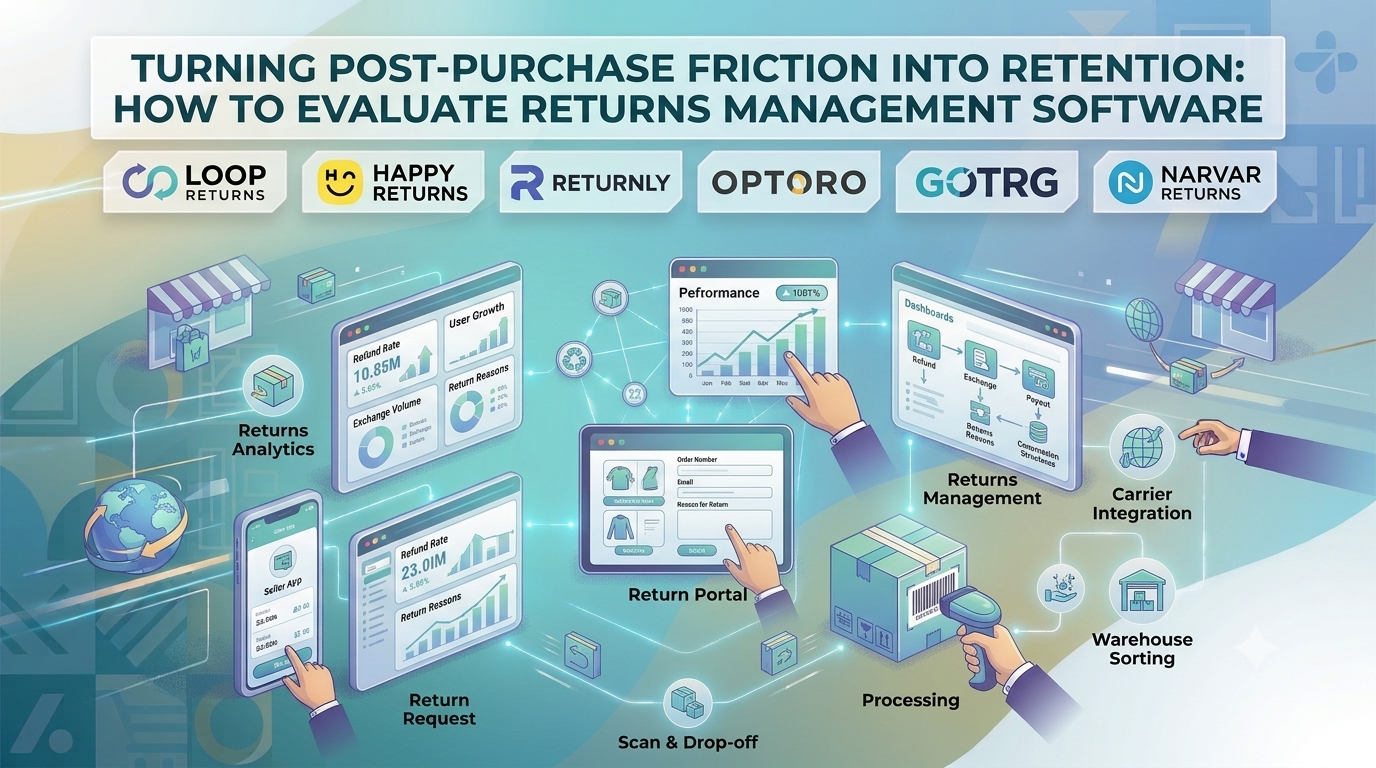
Returns are frequently treated as a necessary operational loss in modern commerce—especially in apparel, footwear, and consumer electronics, where return rates routinely reach 20 to 30 percent. When return operations rely on manual customer-service emails, hand-typed packing slips, and untracked warehouse return piles, costs escalate quickly: customer support inboxes are flooded with “Where is my refund?” tickets, returned inventory sits unprocessed for weeks before missing seasonal resale windows, and fraudulent returns drain profitability.
Returns management software transforms the reverse logistics journey—providing branded customer-facing return portals, encouraging exchanges and store-credit incentives over cash refunds, generating automated prepaid shipping labels, and routing reverse logistics workflows back to warehouse management systems (WMS). Evaluating returns software requires distinguishing between retention-focused exchange engines, omnichannel retail return and drop-off networks, and reverse logistics warehouse processing suites.
Five Core Capabilities That Separate Modern Returns Software From Simple Return Labels
Printing a generic return label inside an outbound box is outdated; modern returns management platforms deliver five strategic capabilities:
- Exchange-First Incentive Workflows: Encouraging shoppers to exchange an item for a different size, color, or alternative catalog product (often offering an extra $5–$10 store bonus credit) before requesting a cash refund—turning a potential revenue loss into a retained customer order.
- Branded Self-Service Return Portals: Providing customers with an intuitive self-service portal (requiring only order number and zip code) to select items, state return reasons, upload photos of damaged goods, and choose resolution preferences (exchange, store credit, original payment method).
- Automated Carrier Label Generation and Drop-Off Networks: Generating pre-populated USPS, UPS, FedEx, or international return labels instantly—while offering QR-code-based, box-free/label-free drop-off networks (such as Happy Returns, physical carrier stores, or retail partner locations).
- Custom Return Policy and Fraud Prevention Rules: Enforcing conditional return policies automatically—marking final-sale items as non-returnable, adjusting return windows by customer loyalty tier, and flagging high-risk returners who exploit return policies.
- Instant Exchanges and Reverse Logistics WMS Routing: Reserving replacement exchange items in inventory immediately before the returned item arrives back at the warehouse, while providing receiving staff with barcode-driven inspection apps to grade, restock, or liquidate goods quickly.
Leading Returns Management Software
Loop Returns
Loop Returns is a premier retention-first returns and exchange platform built natively for the Shopify Plus ecosystem. Renowned for its focus on revenue retention, Loop excels at guiding shoppers toward exchanges, size swaps, and bonus store credit through its Shop Now feature—allowing customers to spend their return credit across the brand’s entire catalog during the return flow. It includes deep automated policy rules, customizable return fees, and POS integration for in-store returns.
Fast-growing D2C lifestyle, apparel, and consumer brands running on Shopify Plus that prioritize retaining revenue and reducing refund rates favor Loop Returns. Its primary trade-off is tight optimization around the Shopify platform.
Happy Returns (by UPS)
Happy Returns is an industry leader in box-free, label-free physical return drop-off networks. Operating thousands of physical Return Bar locations (in retail stores across North America), Happy Returns allows shoppers to drop off unboxed items using a simple QR code on their phone, receiving immediate refunds or exchanges. The items are aggregated in reusable totes and shipped in bulk back to regional distribution hubs, reducing single-package reverse shipping costs and environmental waste.
Omnichannel retailers, footwear brands, and high-volume apparel sellers seeking a customer-friendly, box-free return experience that lowers reverse freight costs rely heavily on Happy Returns.
Returnly (by Affirm)
Returnly established itself as a pioneer in Instant Exchanges and risk-underwritten return credit. By granting shoppers upfront store credit the moment an item is dropped off with the carrier—underwriting the financial risk so merchants can ship replacement orders immediately without waiting for warehouse delivery—Returnly drives high customer satisfaction and repeat purchase velocity.
E-commerce brands where rapid exchange delivery and customer convenience drive retention favor Returnly.
Optoro and goTRG (Enterprise Reverse Logistics & Liquidation)
For enterprise retailers, department stores, and high-volume operations managing hundreds of thousands of returns:
- Optoro delivers an enterprise reverse-logistics platform that combines returns portals with smart warehouse disposition software—using machine learning to direct returned items to the most profitable channel (restock, secondary resale, liquidation, donation, or recycling).
- goTRG provides end-to-end reverse supply chain solutions, handling returns management, refurbishment, and secondary marketplace liquidation for enterprise retailers.
Narvar Returns
Part of the broad Narvar post-purchase customer experience platform, Narvar Returns provides enterprise-grade return tracking, branded web portals, multi-carrier label generation, and integration with physical drop-off networks across major retail platforms.
Returns Management Software Comparison
| Platform | Primary Architectural Strength | Exchange & Retention Mechanics | Drop-Off & Carrier Integration | Ecosystem Alignment | Best Fit |
| Loop Returns | Retention-first exchange workflows for Shopify | Exceptional (Shop Now in-portal catalog exchange & bonus credit) | Comprehensive (Automated carrier labels + Happy Returns integration) | Deep native Shopify & Shopify Plus ecosystem | D2C lifestyle & apparel brands on Shopify Plus seeking to retain revenue |
| Happy Returns | Box-free, label-free physical return drop-off network | High (In-portal exchanges, store credit & immediate refunds) | Industry-leading (Thousands of physical Return Bar drop-off locations) | E-commerce platforms, Shopify, BigCommerce & enterprise custom | Apparel & footwear brands wanting box-free drop-offs & bulk reverse freight |
| Returnly | Instant exchange credit & transaction speed | Very High (Instant credit granted at carrier drop-off scan) | Broad multi-carrier return label generation | Shopify, BigCommerce & major e-commerce platforms | Brands focused on fast exchange delivery and customer satisfaction |
| Optoro | Enterprise reverse supply chain & disposition | High (Customer-facing portal linked to warehouse disposition) | Multi-carrier domestic & international freight routing | Enterprise ERPs, WMS & custom enterprise retail architectures | Enterprise retailers needing warehouse returns processing & liquidation |
| Narvar Returns | Enterprise omnichannel post-purchase platform | High (Branded return experience integrated with package tracking) | Broad carrier networks + physical retail drop-off partnerships | Enterprise e-commerce (Salesforce, Adobe, Shopify Plus) | Multi-channel enterprise brands managing broad post-purchase journeys |
Common Returns Management Pitfalls to Avoid
- Making the Return Process Entirely Free Without Policy Guardrails: Offering unlimited, friction-free free returns with no restock fees or return windows encourages “wardrobing” (ordering five sizes to try at home and returning four). Use returns software to configure clear policy tiers: offer free returns on exchanges while deducting label processing fees on cash refunds.
- Isolating Reverse Logistics From Warehouse Operations: Generating a return label is easy; processing an uninspected return back into active warehouse inventory is where operations stall. Integrate returns software with your Warehouse Management System (WMS) so returned goods are graded, restocked, or liquidated quickly before missing seasonal windows.
- Failing to Capture Structured Return Reason Data: Treating returns as a black-box expense without capturing exact return reasons (e.g., “fits too small,” “color differs from website,” “damaged in transit”) blinds design and quality teams. Ingest return reason codes into product design and merchandising analytics.
Selecting the Right Returns Management Software
Match your returns management strategy to your e-commerce platform, physical footprint, and reverse-logistics model:
- For Shopify Plus Brands Prioritizing Revenue Retention and Exchanges: Standardize on Loop Returns to maximize in-portal exchange conversions.
- For Brands Prioritizing Box-Free, Eco-Friendly Return Drop-Offs: Deploy Happy Returns to leverage its Return Bar network and lower reverse freight expenses.
- For Multi-Channel Enterprise Retailers Needing Deep Warehouse Disposition: Implement Optoro to manage return routing, refurbishment, and secondary liquidation.
- For Enterprise Omnichannel Brands Managing Complete Post-Purchase Journeys: Deploy Narvar Returns.
