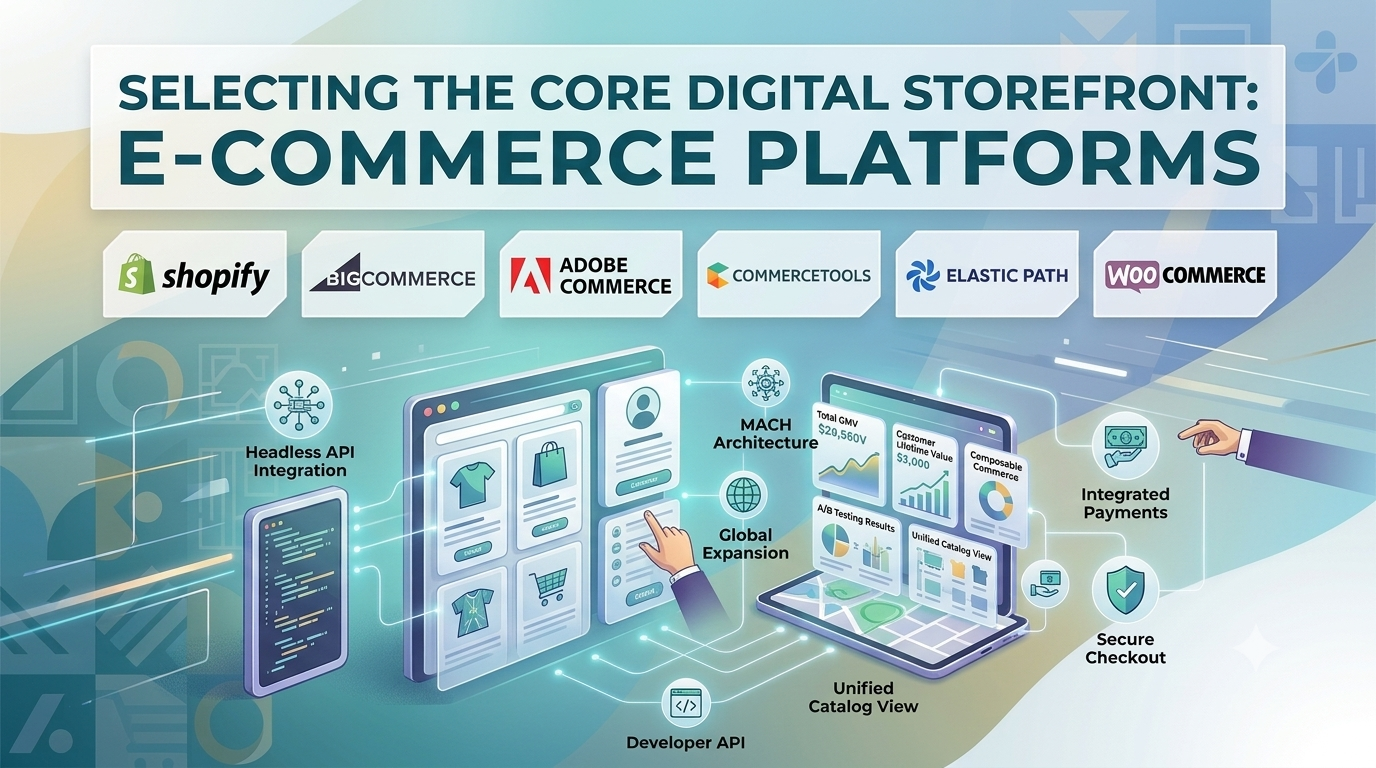
An e-commerce platform is the central nervous system of modern digital commerce. When a retail brand outgrows its early storefront software or builds on an architectural model poorly aligned with its operational scale, the business hits severe bottlenecks: checkout pages crash under high-traffic promotional drops, international multi-currency expansion requires months of custom development, and merchandising teams wait weeks for frontend engineering tickets just to publish a seasonal landing page.
E-commerce platforms provide the fundamental infrastructure for digital retail—managing catalog databases, customer accounts, shopping cart sessions, promotional rules, checkout transactions, and integration points for payment gateways, ERPs, and order management systems. Evaluating e-commerce software requires distinguishing between all-in-one hosted SaaS commerce platforms, headless and composable (MACH) commerce engines, and open-source self-hosted commerce frameworks.
Five Core Capabilities That Separate Enterprise E-Commerce Platforms From Basic Website Builders
Building a simple brochure website with buy buttons is entry-level; scalable e-commerce platforms deliver five foundational architectural controls:
- High-Concurrency Checkout and Infrastructure Resilience: Handling massive, bursty traffic spikes (such as holiday sales or limited-edition product drops) without checkout slowdowns, database timeouts, or inventory overselling.
- Unified B2C, B2B, and Multi-Storefront Architecture: Supporting multiple customer segments—consumer retail, wholesale B2B (with company accounts, custom price lists, and payment terms), and international localization (currencies, languages, regional tax rules)—from a single administrative back-end.
- Headless and Composable API Extensibility: Providing comprehensive GraphQL and REST APIs (aligned with MACH principles: Microservices, API-first, Cloud-native, Headless) that decouple back-end commerce logic from custom frontend digital interfaces (web, mobile apps, IoT, POS).
- Visual Merchandising and Content-Commerce Integration: Empowering marketing and merchandising teams to design responsive landing pages, schedule promotional banners, and curate product sorting rules visually without writing custom code.
- Ecosystem Breadth and Back-Office Continuity: Offering pre-built native connectors for enterprise ERPs (NetSuite, SAP), payment processors, tax automation engines, and order management systems (OMS) to ensure accurate fulfillment.
Leading E-Commerce Platforms
Shopify (and Shopify Plus)
Shopify is the global benchmark in hosted SaaS e-commerce, powering millions of businesses from early-stage direct-to-consumer (D2C) brands to enterprise retailers on Shopify Plus. Renowned for high checkout conversion, server infrastructure that effortlessly handles high-concurrency flash sales, an extensive App Store, and integrated B2B wholesale capabilities, Shopify provides a comprehensive commercial engine. Its evolution into headless commerce (via Hydrogen and Oxygen) allows brands to build custom web experiences on top of Shopify’s back-end checkout.
Brands seeking high checkout conversion, rapid time-to-market, reliable managed hosting, and an extensive third-party app ecosystem standardize on Shopify Plus. Considerations include transaction fees when not using Shopify Payments and architectural boundaries when building bespoke database logic outside the standard Shopify data schema.
BigCommerce (and BigCommerce Enterprise)
BigCommerce is an enterprise cloud commerce platform known for “open SaaS” flexibility, robust out-of-the-box B2B wholesale functionality, and multi-storefront governance. Unlike many hosted competitors, BigCommerce includes advanced capabilities natively—including custom product fields, multi-currency pricing, and multi-storefront management—without requiring dozens of paid third-party apps, while charging no proprietary platform transaction fees.
Mid-market to enterprise retailers, hybrid B2B/B2C businesses, and organizations adopting headless commerce on open cloud architectures favor BigCommerce Enterprise.
Adobe Commerce (formerly Magento)
Adobe Commerce is an established enterprise commerce platform built for deeply complex, highly customized global commerce ecosystems. Offering unmatched architectural flexibility (available as cloud-hosted or self-hosted open-source software), Adobe Commerce supports intricate multi-tier B2B accounts, complex product matrices, custom ERP integrations, and extensive international multi-brand portfolios. It integrates natively with Adobe Experience Cloud (Analytics, Target, Experience Manager).
Large enterprises, industrial distributors, and brands with highly bespoke business logic that require complete control over their database schemas, codebases, and hosting infrastructure rely on Adobe Commerce, accepting higher development costs and technical maintenance requirements.
Composable & Headless Commerce Leaders (commercetools, Elastic Path)
For digital-first enterprises, media conglomerates, and tech-forward retailers adopting modern composable commerce:
- commercetools is a market leader in pure-play MACH (Microservices, API-first, Cloud-native, Headless) commerce, delivering API endpoints for cart, catalog, and checkout designed to be assembled into custom digital touchpoints without monolithic constraints.
- Elastic Path provides composable commerce components and pre-built integrations (Composable Frontend, Commerce PXM) to help brands deploy modular commerce without engineering every component from scratch.
WooCommerce (Open-Source WordPress Commerce)
WooCommerce powers a massive share of digital stores by operating as an open-source commerce plugin built natively on WordPress. Offering complete code ownership, zero platform transaction fees, and millions of WordPress themes and plugins, WooCommerce is popular for content-driven brands, small businesses, and developers seeking full control on standard web hosting. Large-scale high-volume stores require careful database caching and hosting optimization to maintain performance.
E-Commerce Platforms Comparison
| Platform | Architectural Model | Checkout & Concurrency Scaling | B2B & Multi-Storefront Depth | Customization & Developer Overhead | Best Fit |
| Shopify / Shopify Plus | Managed SaaS (Monolithic + Headless Hydrogen) | Industry-leading (Handles massive flash-sale traffic spikes effortlessly) | Very High (Shopify Plus B2B + global multi-storefront expansion) | Low–Moderate (Liquid templating, apps + headless APIs) | High-growth D2C brands, retail scale-ups & enterprise consumer brands |
| BigCommerce | Open SaaS (Native multi-storefront & headless) | Very High (Reliable cloud infrastructure, zero transaction fees) | Very High (Native enterprise B2B features, price lists & customer tiers) | Moderate (Flexible open APIs, customizable templates) | Hybrid B2B/B2C brands, mid-market retailers & headless adopters |
| Adobe Commerce | Enterprise PaaS / Self-Hosted Open Source | High (Requires dedicated server tuning & scaling infrastructure) | Exceptional (Deep enterprise B2B workflows & multi-site governance) | High (Requires dedicated Magento/Adobe engineering teams) | Global multi-brand enterprises, distributors & complex bespoke operations |
| commercetools | Composable MACH (Pure API-first microservices) | Exceptional (Auto-scaling serverless cloud infrastructure) | Exceptional (Extensible custom data models & multi-channel APIs) | Very High (Requires dedicated software engineering squads) | Enterprise digital leaders building bespoke multi-touchpoint commerce |
| WooCommerce | Open-source self-hosted plugin (WordPress) | Moderate (Dependent on underlying hosting, PHP & database caching) | Moderate (Requires third-party B2B plugins and add-on extensions) | Moderate–High (Requires ongoing WordPress/plugin maintenance) | Content-driven brands, publishers & SMBs wanting complete code ownership |
Common E-Commerce Platform Implementation Pitfalls to Avoid
- Over-Engineering With Composable Architecture Too Early: Adopting a headless composable architecture (e.g., commercetools with custom microservices) when a standard hosted SaaS platform (Shopify Plus, BigCommerce) meets 95% of your requirements introduces hundreds of thousands of dollars in annual software development and maintenance costs without delivering proportional revenue.
- Underestimating Third-Party App Sprawl on Hosted SaaS: Building a complex store on hosted platforms by installing 45 third-party apps creates hidden vulnerabilities: page load speeds degrade, checkout code conflicts arise, and cumulative monthly subscription fees escalate. Standardize on platforms that offer core B2B, search, and variant capabilities natively.
- Migrating Without an SEO Redirection Strategy: Migrating a digital storefront to a new platform without mapping 301 redirects for every historical product, category, and blog URL causes search engine rankings to drop sharply post-launch. Maintain strict URL structures and metadata parity during migration.
Selecting the Right E-Commerce Platform
Align your e-commerce platform selection with your technical capabilities, business model, and operational scale:
- For High-Growth Consumer Brands Prioritizing Checkout Conversion and Speed: Standardize on Shopify Plus for managed hosting, ecosystem support, and rapid scalability.
- For Hybrid B2B/B2C Retailers Seeking Deep Built-In Features Without App Bloat: Choose BigCommerce Enterprise for native B2B capabilities, multi-storefront governance, and zero transaction fees.
- For Complex Global Enterprises Requiring Complete Codebase and Database Control: Deploy Adobe Commerce to accommodate bespoke business models and multi-brand catalogs.
- For Enterprise Technical Organizations Building Custom Omnichannel Experiences: Assemble a composable commerce stack centered on commercetools.
- For Content-Heavy Websites Anchored on WordPress: Deploy WooCommerce.
