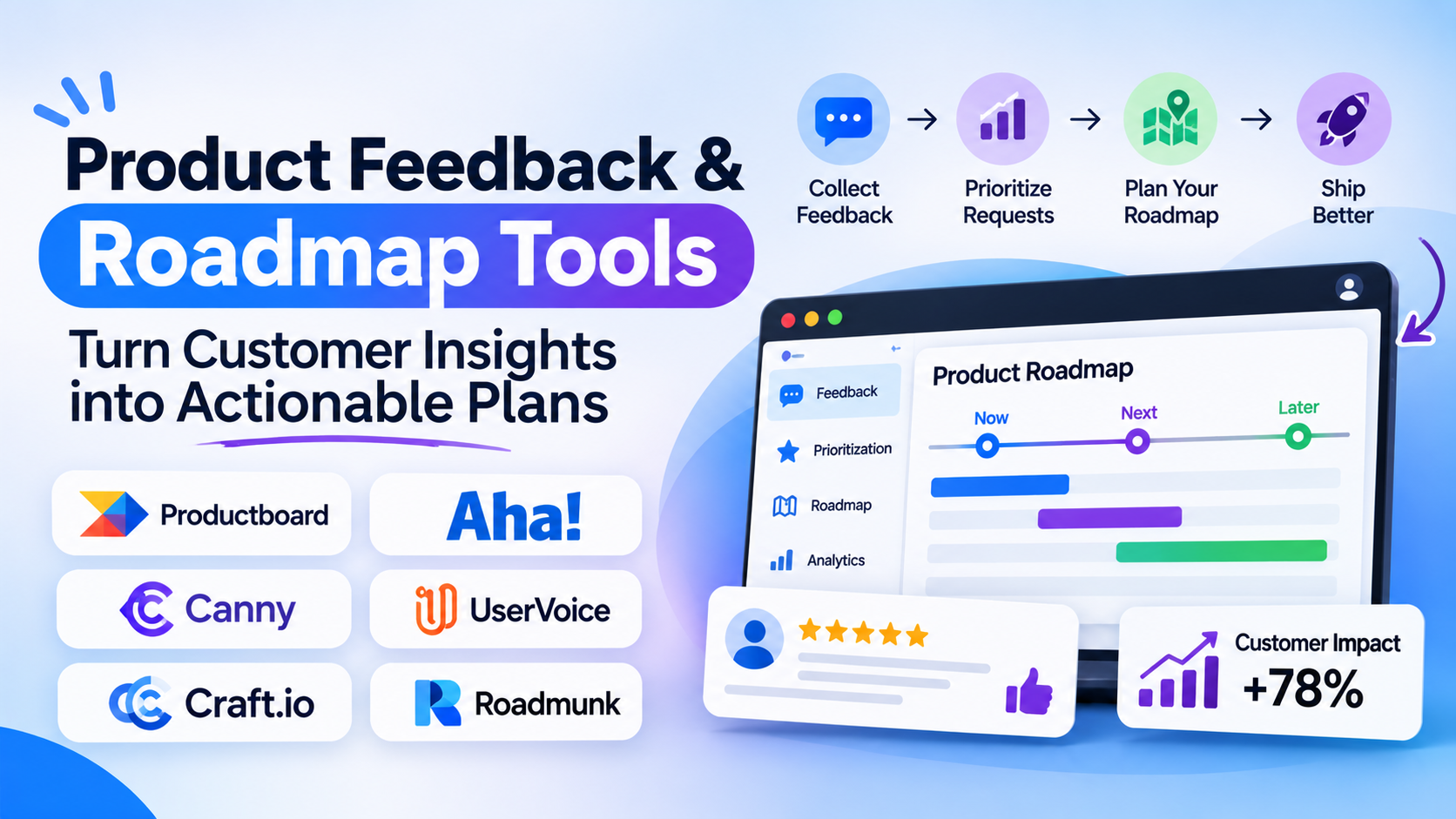
Product managers constantly battle competing demands: sales reps claim a single prospect will sign a seven-figure contract if one specific feature is built, customer support reports 80 users confused by the latest onboarding release, and an executive drops a pet project into sprint planning without user validation. When customer requests are scattered across Slack channels, Zendesk tickets, and sales notes, roadmaps default to whoever shouts the loudest—resulting in bloated products, frustrated customers, and wasted engineering capacity.
Product feedback and roadmap tools centralize qualitative customer input, aggregate feature requests by business impact, prioritize opportunities using structured scoring frameworks, and communicate transparent visual roadmaps to internal stakeholders and external users. Evaluating these tools requires distinguishing between comprehensive product management suites, public feature-request portals and changelog tools, and enterprise strategy-to-execution roadmapping engines.
Five Core Capabilities of Modern Product Feedback & Roadmap Platforms
A static presentation deck or spreadsheet roadmap is obsolete the moment engineering capacity changes; dedicated product platforms deliver five operational capabilities:
- Multi-Source Feedback Aggregation and CRM/Support Ingestion: Ingesting feedback automatically from Zendesk, Intercom, Slack, Salesforce, HubSpot, and email—consolidating fragmented customer requests into a centralized repository without manual copy-pasting.
- Customer Segmentation and Revenue-Weighted Prioritization: Connecting customer feedback directly to business data (ARR, customer tier, plan type) to calculate the real revenue impact of a feature request (e.g., “$1.2M in pipeline is waiting for Feature X, while Feature Y is requested primarily by free users”).
- Structured Opportunity Prioritization Frameworks: Applying objective scoring models—such as RICE (Reach, Impact, Confidence, Effort), ICE, or custom multi-variable formulas—to prioritize backlogs based on business strategy rather than emotional opinion.
- Dynamic, Tailored Visual Roadmaps (Timeline, Kanban, and Now-Next-Later): Publishing live visual roadmaps that adapt by audience: showing high-level strategic objectives (Now/Next/Later) to the executive board, commercial themes to sales teams, and release timelines to engineering squads.
- Closed-Loop Customer Communication and Public Changelogs: Automatically notifying every customer who requested a feature the moment it moves from “In Progress” to “Shipped”—paired with public or private changelogs that celebrate product velocity and reduce duplicate support inquiries.
Leading Product Feedback & Roadmap Platforms
Productboard
Productboard is the enterprise market leader in customer-centric product management. Built around its central Insights repository, Productboard aggregates feedback across email, Slack, Zendesk, and Salesforce, allowing product managers to highlight specific quotes, link them to feature components, and score opportunities based on prioritized customer segments and revenue impact. It connects strategy directly into delivery workflows via bi-directional integrations with Jira, Azure DevOps, and GitHub.
Mid-market to enterprise product organizations seeking a comprehensive platform that unites customer feedback ingestion, strategic scoring, and multi-audience roadmap presentations standardize heavily on Productboard.
Aha! (Aha! Roadmaps, Ideas, and Develop)
Aha! is the most established, comprehensive enterprise suite for product strategy, roadmapping, and idea management. Offering deep functional breadth across the product lifecycle, Aha! allows product leaders to define top-down strategic goals, manage multi-level release trains, run customer idea portals, and manage detailed engineering backlogs directly within Aha! Develop.
Enterprises with structured, mature product management frameworks and large multi-product portfolios favor Aha! for its deep methodology, customizable scorecards, and enterprise governance, accepting a steeper learning curve for new users.
Canny
Canny built its market presence by delivering a clean, user-friendly customer feedback and voting portal designed for high engagement and rapid setup. Featuring public or private feedback boards where customers can submit ideas, upvote feature requests, and leave comments, Canny auto-merges duplicate requests, syncs with Jira and Linear, and automates customer updates via built-in changelogs.
Startups, scale-ups, and modern B2B/B2C tech companies seeking transparent, customer-facing feedback boards and automated release announcements favor Canny.
UserVoice
UserVoice specializes in enterprise-scale product feedback management, with particular strength in capturing customer feedback directly from commercial customer-facing teams (Salesforce, Zendesk). By tying customer feedback directly to enterprise CRM revenue data, UserVoice helps enterprise product teams evaluate which feature requests correlate with high-value contracts and retained ARR.
Large enterprise B2B software companies needing sophisticated feedback governance, deep Salesforce account-value weighting, and customer communication workflows rely on UserVoice.
Craft.io and Roadmunk (Specialist Roadmapping Platforms)
- Craft.io acts as an end-to-end product management platform emphasizing structured prioritization frameworks (RICE, WSJF, MoSCoW), deep capacity planning, and portfolio governance for mature product teams.
- Roadmunk (by Tempo) specializes in visual, executive-ready roadmap creation—allowing product managers to pivot boardroom-quality roadmaps between swimlane, timeline, and idea-board views with native Jira synchronization.
Product Feedback & Roadmap Tools Comparison
| Platform | Primary Market Role | Feedback Ingestion & Revenue Weighting | Prioritization Framework Depth | Delivery & Issue Tracker Sync | Best Fit |
| Productboard | Enterprise customer-centric product management | Very High (Aggregates feedback + deep Salesforce/HubSpot revenue sync) | High (Custom scorecards, RICE & strategic drivers) | Deep bi-directional Jira, Azure DevOps & Linear sync | Mid-market & enterprise product teams scaling customer discovery |
| Aha! | Comprehensive enterprise product strategy suite | High (Aha! Ideas portals, in-app feedback & proxy voting) | Very High (Custom strategic scorecards, goals & initiatives) | Jira, Azure DevOps, Rally, GitHub & native Aha! Develop | Mature enterprise product organizations managing complex portfolios |
| Canny | Modern public/private customer feedback & voting | High (User voting portals, automated duplicate merging) | Moderate (Prioritization matrix based on user votes & ARR) | Direct Jira, Linear, ClickUp & GitHub integrations | Startups, scale-ups & modern SaaS teams wanting transparent feedback |
| UserVoice | Enterprise feedback intelligence for B2B | Very High (Deep CRM account integration & revenue weighting) | High (Data-driven feedback prioritization & search trends) | Strong bi-directional Jira & enterprise integrations | Enterprise B2B software companies managing high-value customer input |
| Craft.io | Structured product governance & spec planning | High (Feedback capture from email, Zendesk & Chrome extension) | Very High (Out-of-the-box RICE, WSJF, MoSCoW & custom formulas) | Tight bi-directional Jira & Azure DevOps integrations | Product teams prioritizing formal prioritization methodologies |
| Roadmunk | Executive visual roadmap presentation platform | Moderate (Idea backlog & feedback capture module) | Moderate (Value-vs-Effort prioritization scoring) | Bi-directional Jira & Azure DevOps roadmapping | PMs focused on creating boardroom-ready visual roadmaps |
Common Product Feedback and Roadmapping Pitfalls to Avoid
- Treating Feature Upvoting as an Absolute Strategic Priority: Relying blindly on public upvote counts biases roadmaps toward low-friction requests from free users while ignoring complex requirements needed by enterprise customers who rarely visit voting boards. Always weight requests against customer revenue tiers and strategic business goals.
- Publishing Fixed Calendar Timelines on Public Roadmaps: Promising external customers that Feature X will ship on “November 15” inevitably creates friction when engineering encounters unforeseen technical debt or security priorities. Publish theme-based Now / Next / Later roadmaps externally while keeping date-driven delivery timelines internal.
- Failing to Close the Loop When Features Ship: Collecting feedback from 150 customers and failing to notify them when the feature goes live wastes an opportunity to drive user adoption and reduce churn. Automate closed-loop release notifications directly from your roadmap tool.
Selecting the Right Product Feedback & Roadmap Tool
Match your platform choice to your organization’s scale, feedback channels, and product methodology:
- For Strategic Product Organizations Uniting Deep Feedback With Jira Delivery: Standardize on Productboard to aggregate feedback, calculate revenue-weighted priority, and manage roadmaps.
- For Enterprise Teams Requiring Full-Lifecycle Strategy, Goals, and Portfolio Governance: Deploy Aha! to align strategic business goals with multi-product roadmaps.
- For Startups and Scale-Ups Prioritizing Customer-Facing Voting Boards and Changelogs: Choose Canny for transparent community engagement and rapid setup.
- For Enterprise B2B Teams Prioritizing Direct Salesforce Revenue Attribution: Use UserVoice to evaluate feedback directly against pipeline and ARR impact.
- For Product Leaders Focused on Boardroom Visual Roadmaps: Utilize Roadmunk or Craft.io.
