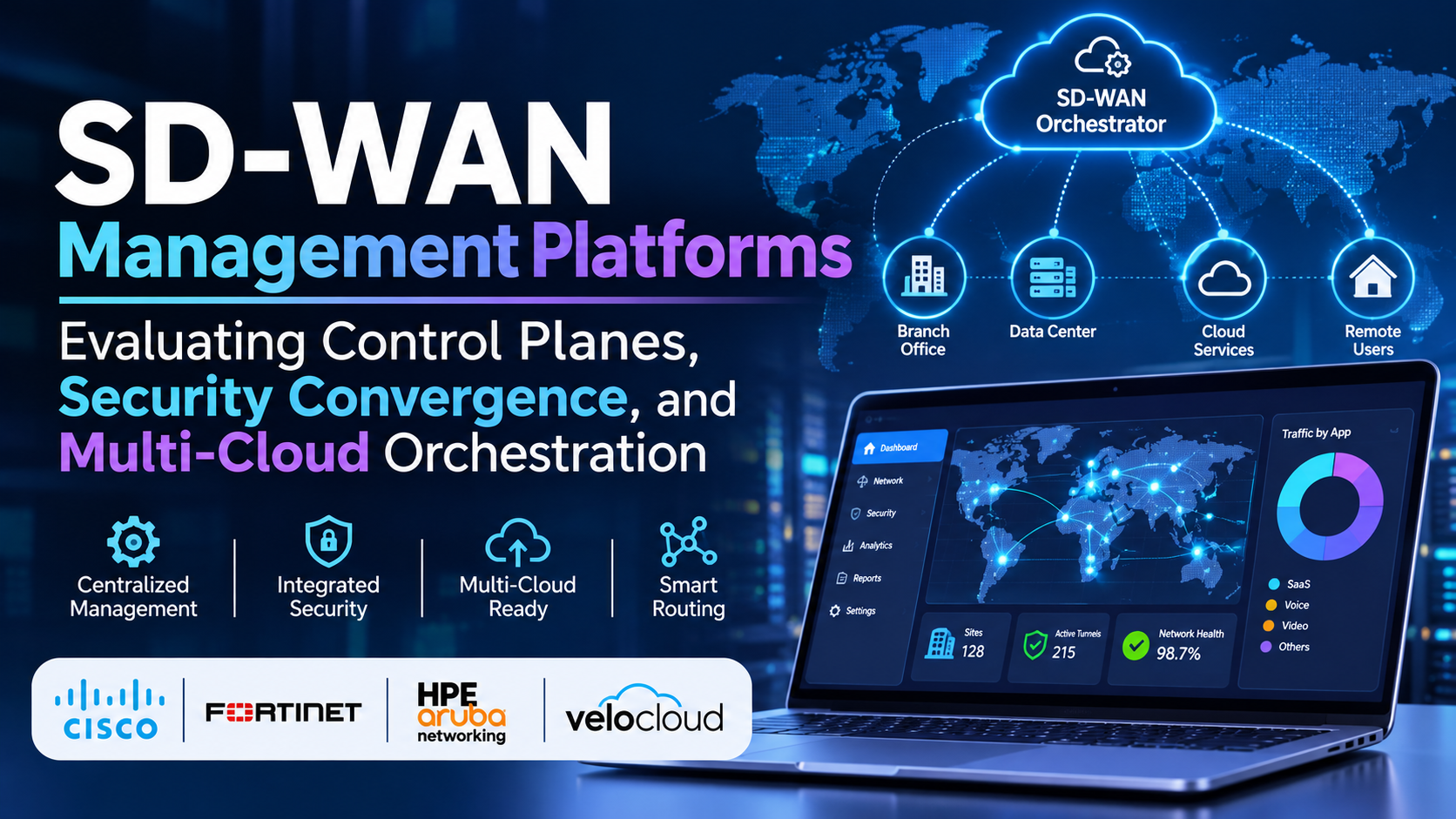
Migrating away from rigid MPLS circuits to software-defined wide area networking (SD-WAN) solves circuit cost and bandwidth bottlenecks, yet it often introduces an unexpected operational problem: control-plane sprawl. When branch routers, cloud virtual gateways, firewall policies, and SaaS traffic steering rules are managed across disconnected consoles, troubleshooting a degraded voice call or rolling out a global segmentation update becomes slower than managing legacy CLI routers.
An SD-WAN management platform—commonly called an orchestrator or controller—serves as the centralized brain of the wide area network. It separates the management and control planes from physical or virtual edge appliances, automating zero-touch provisioning (ZTP), application-aware path selection, IPsec tunnel mesh creation, and SLA enforcement. Because SD-WAN platforms differ sharply in how they handle routing complexity, built-in firewalling, and cloud SaaS integration, selecting the right orchestrator requires matching the platform’s architectural roots to your network team’s operating model.
Three Architectural Models Behind SD-WAN Orchestrators
Before comparing vendor dashboards, distinguish how different platforms evolved. Every major SD-WAN management plane reflects one of three engineering philosophies:
- Routing-First Overlay Architectures: Built for large, complex enterprise topologies requiring granular BGP/OSPF redistribution, multi-region hub-and-spoke hierarchies, and strict separation of control, data, and management planes. These platforms treat SD-WAN as a programmable routing fabric capable of scaling to thousands of sites.
- Security-Converged Edge Platforms: Built by next-generation firewall (NGFW) vendors that embed SD-WAN path steering directly inside their firewall operating systems. Here, the management console unifies application-aware WAN routing with intrusion prevention (IPS), URL filtering, and zero-trust network access (ZTNA) under a single policy rulebase.
- Cloud-Native and SASE-Integrated Orchestrators: Designed for distributed enterprises prioritizing rapid branch deployment, SaaS optimization, and minimal local hardware footprint. These platforms rely heavily on vendor-hosted cloud gateways or Points of Presence (PoPs) to optimize traffic toward Microsoft 365, Salesforce, and cloud IaaS regions without requiring complex routing expertise at every branch.
Leading SD-WAN Management Platforms Compared by Operational Fit
The platforms below represent established, actively maintained enterprise and mid-market SD-WAN orchestration systems, each anchored to distinct architectural strengths.
Cisco Catalyst SD-WAN Manager (formerly vManage)
is the centralized management plane for Cisco’s enterprise SD-WAN fabric (originating from Viptela and integrated across Cisco IOS-XE Catalyst edge routers). It works alongside the SD-WAN Controller (vSmart) and SD-WAN Validator (vBond) to separate policy distribution, device authentication, and packet forwarding.
- Where it excels: Deep routing sophistication and multi-topology control at global scale. Network architects can define granular centralized data policies, multi-VRF segmentation, and dynamic Overlay Management Protocol (OMP) route redistribution across thousands of branches, data centers, and cloud transit hubs (AWS, Azure, Google Cloud). Configuration groups and feature templates enforce consistent baselines across physical routers and virtual cloud edges.
- Operational trade-offs: Architectural power comes with a steeper learning curve. Understanding the interaction between OMP, centralized policies, localized policies, and template variables requires dedicated training. While Cisco hosts the management plane in its cloud by default, organizations with strict sovereignty mandates can deploy the control components on-premises, assuming the compute and high-availability maintenance burden themselves.
- Deployment and licensing: Cloud-hosted SaaS (recommended by Cisco) or self-hosted virtual appliances, licensed via tiered Cisco DNA / Catalyst SD-WAN subscriptions scaled by bandwidth and feature tier.
Fortinet FortiManager (Fortinet Secure SD-WAN)
provides centralized orchestration for Fortinet Secure SD-WAN, where SD-WAN link steering, forward error correction, and application identification run natively inside FortiGate next-generation firewalls on custom ASIC hardware.
- Where it excels: Consolidating branch security and WAN routing into a single appliance and console without separate SD-WAN licensing fees. From FortiManager, administrators define Performance SLAs (measuring latency, jitter, and packet loss via active probes), configure overlay IPsec templates, and bind SD-WAN traffic steering rules directly to NGFW security profiles and FortiGuard threat intelligence.
- Operational trade-offs: Because FortiManager manages full firewall security policies alongside SD-WAN overlays, policy databases and ADOM (Administrative Domain) hierarchies can feel dense for pure routing teams accustomed to lightweight cloud dashboards. Multi-cloud middle-mile optimization relies on deploying virtual FortiGate instances in cloud VPCs rather than a built-in global ISP backbone.
- Deployment and cost: Available as a virtual appliance, hardware appliance, or FortiManager Cloud SaaS; SD-WAN functionality is included natively in FortiOS without a separate SD-WAN license surcharge.
HPE Aruba EdgeConnect Orchestrator (formerly Silver Peak)
HPE Aruba EdgeConnect Orchestrator
manages the EdgeConnect SD-WAN platform using a business-intent overlay model. Instead of configuring per-tunnel routing rules manually, engineers group applications into Business Intent Overlays (BIOs) and assign transport priorities, bonding policies, and security zone rules across the fabric.
- Where it excels: Application performance over imperfect broadband and long-haul links. EdgeConnect combines dynamic path control with optional WAN optimization features (Unity Boost), including TCP acceleration, data deduplication, and packet-level forward error correction. Orchestrator automates full-mesh, hub-and-spoke, or regional tunnel topologies and integrates tightly with HPE Aruba ClearPass for identity-based segmentation and third-party SSE providers such as Zscaler and Netskope.
- Operational trade-offs: Organizations seeking a single-vendor hardware firewall and SD-WAN appliance may need to evaluate Aruba’s integrated zone-based firewall against dedicated NGFW alternatives depending on deep packet inspection requirements, while WAN optimization capabilities carry additional licensing costs.
- Deployment and cost: Cloud-hosted SaaS Orchestrator or on-premises virtual deployment, licensed by bandwidth tiers and optional WAN optimization add-ons.
Palo Alto Networks Prisma SD-WAN
Palo Alto Networks Prisma SD-WAN
(formerly CloudGenix) takes an application-defined, autonomous approach managed through the cloud-native Strata Cloud Manager console. Rather than relying solely on packet-level ping probes to judge link quality, Prisma SD-WAN evaluates Layer 7 application transaction health—such as voice MOS scores and SaaS response times—to trigger path failover.
- Where it excels: Enterprises standardizing on a single-vendor Secure Access Service Edge (SASE) architecture. Prisma SD-WAN integrates natively with Prisma Access, allowing branch ION appliances to steer internet-bound and SaaS traffic directly into Palo Alto’s cloud security enforcement points without manually building complex IPsec tunnels or BGP peerings per branch.
- Operational trade-offs: Management is strictly cloud-delivered, which eliminates on-premises controller maintenance but rules out air-gapped or sovereign on-premises controller deployments. Enterprises not adopting Prisma Access or Palo Alto’s broader ecosystem may pay a premium compared to hardware-integrated firewall/SD-WAN alternatives.
- Deployment and cost: Cloud-managed SaaS control plane paired with physical or virtual ION branch appliances, licensed by site bandwidth tiers.
Arista VeloCloud SD-WAN Orchestrator
(acquired from Broadcom/VMware) combines a multi-tenant cloud Orchestrator with distributed cloud Gateways and branch Edge appliances. Its Dynamic Multi-Path Optimization (DMPO) engine performs continuous per-packet link steering, jitter buffering, and forward error correction across broadband, LTE/5G, and MPLS circuits.
- Where it excels: Rapid zero-touch branch rollouts and cloud SaaS acceleration. Because VeloCloud maintains a global footprint of cloud-hosted Gateways positioned adjacent to major SaaS and IaaS providers, branch offices gain optimized, resilient access to cloud applications without backhauling traffic through a corporate data center. Its multi-tenant architecture also makes it a staple for managed service providers.
- Operational trade-offs: While VeloCloud Edges include stateful firewalling and segmentation, enterprises requiring deep intrusion prevention or advanced threat sandboxing typically chain traffic to third-party Security Service Edge (SSE) partners rather than relying solely on the edge appliance.
- Deployment and cost: Cloud-hosted SaaS Orchestrator (with on-premises options available for qualified deployments) licensed by bandwidth tier and feature edition.
Cisco Meraki Dashboard (Meraki SD-WAN)
embeds SD-WAN orchestration directly into its browser-based Meraki Dashboard alongside Meraki MX security appliances, switches, and wireless access points.
- Where it excels: Lean IT teams managing retail stores, clinics, or distributed branch offices where operational simplicity outweighs intricate BGP routing knobs. Meraki’s Auto VPN establishes full-mesh or hub-and-spoke encrypted tunnels in a few clicks, automatically handling dynamic public IP addresses behind NAT and applying Layer 7 traffic shaping and dynamic path selection.
- Operational trade-offs: Meraki abstracts away low-level routing protocols and CLI access by design. Large enterprises with complex multi-VRF core routing, intricate route redistribution policies, or strict requirements for on-premises management servers will find Meraki overly constrained compared to Cisco Catalyst SD-WAN or HPE Aruba EdgeConnect.
- Deployment and cost: Exclusively cloud-managed SaaS console paired with Meraki MX hardware or virtual MX (vMX) cloud appliances, governed by mandatory per-device subscription licensing.
Juniper Mist WAN Assurance (Session Smart SD-WAN)
pairs Juniper’s cloud-native Mist AI management console with Session Smart Routers (SSR, formerly 128 Technology) and SRX gateways. Unlike traditional SD-WAN platforms that encapsulate traffic inside static IPsec or GRE tunnels, Session Smart Routing uses Secure Vector Routing (SVR) to route sessions natively without tunnel header overhead.
- Where it excels: Eliminating IPsec tunnel encapsulation overhead on bandwidth-constrained satellite, cellular, or high-throughput links while automating Day 2 troubleshooting. Mist AI continuously monitors Service Level Expectations (SLEs) across WAN links, applications, and LAN/WLAN clients, surfacing root-cause anomalies and natural-language diagnostics through its Marvis virtual assistant.
- Operational trade-offs: Juniper’s tunnel-free SVR architecture operates differently from conventional IPsec-based SD-WAN fabrics, requiring network engineers to adapt mental models around session state and peering. Full value is realized when pairing WAN Assurance with Juniper Mist wireless and switching for end-to-end client-to-cloud visibility.
- Deployment and cost: Cloud-hosted SaaS management console paired with physical or virtual Session Smart Routers or SRX appliances, licensed via subscription tiers.
Comparing SD-WAN Management Platforms
| Platform | Architectural Heritage | Management Hosting | Security Convergence | Multi-Cloud & SaaS Approach | Best Organizational Fit |
| Cisco Catalyst SD-WAN Manager | Routing-first enterprise overlay | Cloud SaaS or On-Premises | Integrated IOS-XE firewall + Cisco Umbrella/SSE | Cloud OnRamp for IaaS/SaaS transit hubs | Large enterprises with complex BGP/VRF topologies |
| Fortinet FortiManager | NGFW + SD-WAN converged appliance | On-Premises VM/Hardware or Cloud SaaS | Full built-in NGFW, IPS, ZTNA & FortiGuard | Virtual FortiGate appliances in cloud VPCs | Security-driven teams consolidating branch hardware |
| HPE Aruba EdgeConnect Orchestrator | Business-intent overlay + WAN optimization | Cloud SaaS or On-Premises VM | Zone-based firewall + SSE ecosystem integrations | Cloud hub orchestration + optional TCP acceleration | Enterprises needing link conditioning and granular app SLAs |
| Palo Alto Prisma SD-WAN | Autonomous Layer 7 app-defined fabric | Cloud SaaS only | Native single-vendor SASE with Prisma Access | Direct cloud-delivered enforcement via Prisma PoPs | Organizations standardizing on Palo Alto SASE |
| Arista VeloCloud Orchestrator | Cloud-gateway multi-path overlay | Cloud SaaS (On-Premises available) | Stateful edge firewall + third-party SSE chaining | Global network of vendor-hosted Cloud Gateways | Distributed branches with heavy SaaS usage and MSPs |
| Cisco Meraki Dashboard | Cloud-first unified branch IT | Cloud SaaS only | Integrated MX firewall, IPS & content filtering | Auto VPN to vMX instances in major clouds | Lean IT teams prioritizing fast deployment over routing depth |
| Juniper Mist WAN Assurance | Tunnel-free Session Smart + AI ops | Cloud SaaS only | Session-aware firewalling + SRX security options | Direct SVR peering without IPsec tunnel overhead | Organizations seeking AI-driven diagnostics and low overhead |
Four Operational Details to Verify Before Signing a Contract
Vendor demonstrations routinely showcase zero-touch onboarding and clean world maps, but real operational friction surfaces months later during steady-state administration. Verify four technical realities during a pilot:
- Licensing Behavior Upon Subscription Expiration: Ask explicitly what happens if a management subscription lapses or is delayed during procurement renewal. Some cloud-managed platforms (such as Meraki) enforce strict grace periods after which traffic forwarding stops, whereas others allow existing edge configurations to continue passing traffic while locking out dashboard changes and telemetry updates.
- Control-Plane Resiliency During Orchestrator Outages: Confirm that branch edge appliances maintain local routing state, existing IPsec tunnels, and dynamic failover rules if connectivity to the cloud orchestrator is interrupted. Management plane unavailability should never cause data plane downtime.
- API Completeness and Infrastructure-as-Code Support: If your network team manages changes through Terraform, Ansible, or CI/CD pipelines, verify whether the orchestrator exposes a documented REST API with official Terraform providers—and confirm that API-driven changes do not conflict with GUI templates.
- Brownfield Coexistence and Migration Path: Rarely can an enterprise cut over hundreds of sites in a single weekend. Test how cleanly the platform handles BGP route leaking, dynamic path preference, and asymmetric routing between newly migrated SD-WAN branches and legacy MPLS sites during a phased rollout.
Selecting the Right Platform for Your Network Team
The decisive factor in SD-WAN management is matching platform complexity to your team’s daily operational reality. If your priority is rapid branch rollouts with minimal routing overhead, cloud-first dashboards like Cisco Meraki or Arista VeloCloud remove substantial administrative friction. If your mandate is retiring standalone branch firewalls alongside legacy routers, Fortinet FortiManager or Palo Alto Prisma SD-WAN eliminate multi-vendor policy duplication—provided your team is comfortable managing security and routing inside one governance model. For global enterprises running intricate multi-VRF routing, custom BGP policies, and hybrid cloud backbones, Cisco Catalyst SD-WAN Manager or HPE Aruba EdgeConnect Orchestrator provide the architectural control required without forcing workarounds.
