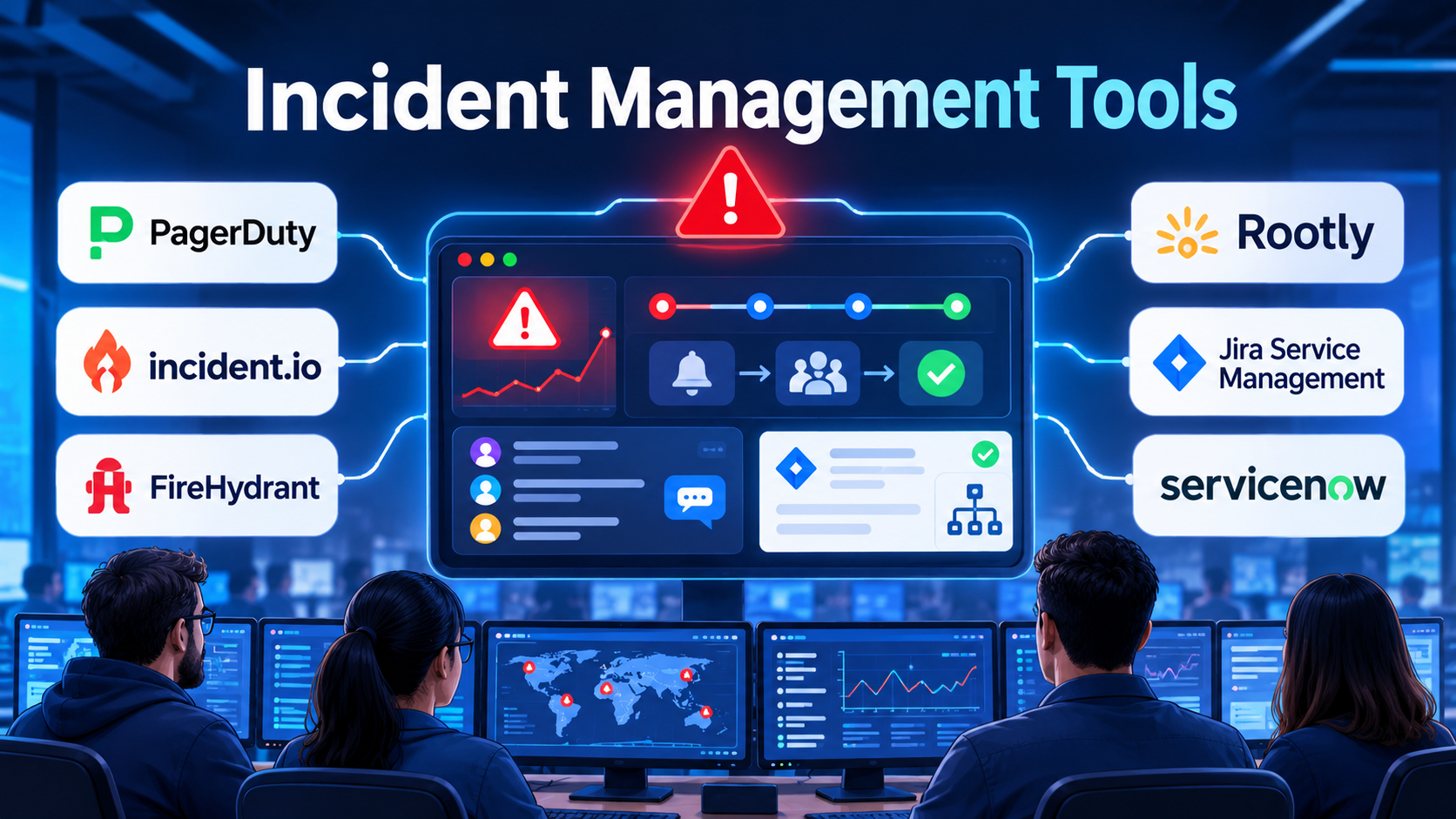
When a payment processing service degrades at 3:00 AM, the difference between a five-minute recovery and a two-hour outage rarely comes down to who received an email first. Outages drag on when alert storms page five teams simultaneously, on-call rotation schedules are out of date, responders waste twenty minutes hunting for runbooks, or post-incident action items vanish into chat history without follow-through.
Incident management tools solve these coordination bottlenecks, yet the market divides into three distinct operational layers. On-call alerting and escalation engines ensure the right engineer wakes up via mobile push, SMS, or voice call with alert deduplication. ChatOps incident response platforms orchestrate live Slack or Microsoft Teams war rooms, role assignments (Incident Commander, Communications Lead), status-page updates, and automated postmortems. Enterprise IT Service Management (ITSM) suites bind incident tickets to CMDB asset inventories, SLA timers, and formal ITIL change controls. Choosing the wrong platform either buries agile engineering teams in ticket bureaucracy or leaves enterprise operations without auditable compliance trails.
Three Distinct Operational Layers in Incident Response
Before comparing specific products, engineering, SRE, and IT operations teams should separate the three primary functions that incident management software performs.
1. On-Call Scheduling and Alert Routing Engines
Platforms such as PagerDuty, Opsgenie, Grafana OnCall, and Splunk On-Call ingest webhooks from monitoring tools (Prometheus, Datadog, CloudWatch, Sentry), deduplicate noisy bursts, match alerts against multi-tier on-call schedules, and escalate across mobile push, SMS, and phone calls until someone acknowledges ownership.
- Core strength: High-reliability multi-channel paging that bypasses mobile “Do Not Disturb” settings, paired with flexible rotation overrides and escalation policies.
- Primary limitation: Focuses primarily on getting a responder’s attention rather than coordinating complex multi-team war rooms or drafting customer status updates.
2. ChatOps Incident Response and Postmortem Orchestrators
Modern incident platforms like incident.io, FireHydrant, and Rootly operate directly inside Slack and Microsoft Teams. With a single slash command (/inc), they spin up a dedicated incident channel, assign structured Incident Command System (ICS) roles, invite relevant service owners automatically, track timelines, update external status pages, and generate pre-populated postmortem documents once resolved.
- Core strength: Eliminates manual coordination overhead during high-stress outages because responders already live inside chat.
- Primary trade-off: Most effective for organizations that actively coordinate live engineering incidents in Slack or Microsoft Teams rather than traditional ticket queues.
3. Enterprise ITSM and Service Desk Platforms
Suites such as ServiceNow IT Service Management and Jira Service Management treat incidents as formal service-desk records linked to configuration items (CIs), change requests, problem records, and customer support SLAs.
- Core strength: Enforces rigorous audit trails, cross-departmental governance, and ITIL process alignment across corporate IT and enterprise operations.
- Primary trade-off: Heavier administrative configuration and slower form-based workflows compared to chat-native SRE incident tools.
Notable Incident Management Tools Across Workflows
PagerDuty — Enterprise On-Call Reliability and Event Intelligence
PagerDuty established the modern on-call alerting category and remains the benchmark for high-reliability notification delivery across voice, SMS, mobile push, and email. Beyond core on-call rotations and multi-level escalation policies, PagerDuty offers Event Intelligence (grouping related alerts via machine learning and topology rules to suppress noise) and Runbook Automation (formerly Rundeck) to trigger diagnostic scripts or restarts automatically when known alerts fire.
PagerDuty integrates with hundreds of observability, ticketing, and chat platforms. Its primary consideration is pricing structure: advanced AIOps event grouping, automated runbooks, and stakeholder status dashboards sit in higher enterprise tiers, making total per-user spend climb quickly as teams scale.
incident.io — Slack- and Teams-Native Incident Coordination
Built specifically around modern ChatOps workflows, incident.io turns Slack (and Microsoft Teams) into a structured command center without forcing responders to leave chat to update external web forms. When an incident is declared, incident.io creates a dedicated channel, prompts for severity and summary, assigns roles (Lead, Communications, Scribe), schedules automated status-update reminders, and synchronizes timelines directly to Confluence, Notion, or Google Docs for post-incident reviews.
incident.io has expanded to include native On-Call scheduling and Status Pages, allowing engineering organizations to consolidate alerting, war-room orchestration, and customer communication under one vendor. Teams that do not organize engineering collaboration around Slack or Microsoft Teams will extract less value from its chat-first ergonomics.
FireHydrant and Rootly — Automated SRE Runbooks and Reliability Workflows
Both FireHydrant and Rootly compete closely in the modern SRE incident response space, combining Slack/Teams automation with configurable workflow rules, service catalogs, and postmortem tracking:
- FireHydrant emphasizes service-catalog ownership (linking incidents to specific microservices, environments, and runbooks) alongside native on-call alerting (Signals) and retrospective analytics.
- Rootly stands out for its granular no-code workflow automation—allowing SRE teams to trigger custom actions (such as creating Jira follow-up tickets, spinning up Zoom/Google Meet bridges, or posting to Statuspage) based on severity changes, elapsed duration, or custom incident fields.
Jira Service Management — Unified DevOps and ITIL Incident Workflows
Maintained by Atlassian, Jira Service Management bridges software engineering and enterprise IT operations—particularly following Atlassian’s integration of Opsgenie capabilities directly into the Jira Service Management platform.
Teams gain on-call schedules, alert routing, incident war rooms, change-risk assessment (linking incidents directly to recent Bitbucket or GitHub deployments), and asset management inside the broader Jira ecosystem. For organizations already standardized on Jira Software and Confluence, consolidating incident tracking there avoids duplicating user licenses and keeps post-incident remediation tasks in the exact same backlog developers already work from.
ServiceNow IT Service Management — Large-Enterprise Governance and CMDB Integration
For global enterprises, financial institutions, and regulated infrastructure operators, ServiceNow ITSM serves as the authoritative system of record for incident, problem, and change management. Its defining strength is deep integration with a Configuration Management Database (CMDB)—allowing operations teams to trace an infrastructure alert to affected business services, upstream dependencies, and recent approved change tickets.
ServiceNow requires dedicated platform administrators and structured implementation projects, making it ideal for large corporate IT and compliance-driven organizations rather than lean product-engineering squads seeking fast self-service setup.
Grafana OnCall and GoAlert — Open-Source On-Call Alerting Alternatives
For engineering teams that want self-hosted control or tight alignment with open-source observability stacks without paying per-seat SaaS on-call fees:
- Grafana OnCall (available both as an open-source self-hosted project and inside Grafana Cloud) integrates natively with Prometheus Alertmanager, Grafana Alerting, and Loki—supporting escalation chains, Slack/Telegram/phone notifications, and calendar-based rotation syncing.
- GoAlert (open-source, originally developed by Target) provides self-hosted on-call scheduling, escalation policies, and SMS/voice alerting via Twilio for organizations preferring lightweight, self-managed infrastructure.
Comparison of Incident Management Tools
| Tool / Platform | Primary Focus | Core Interface & Workflow | On-Call Paging Built In | Standout Strength | Primary Trade-Off |
| PagerDuty | On-call alerting & AIOps event grouping | Web console + mobile app + chat integrations | Yes (industry benchmark) | Ultra-reliable multi-channel paging, noise suppression, and runbook automation | Higher enterprise add-on costs for AIOps and automation features |
| incident.io | ChatOps incident response & on-call | Slack & Microsoft Teams native + web UI | Yes | Fast, low-friction incident coordination, status pages, and automated postmortems | Heavily centered on Slack/Teams engineering workflows |
| FireHydrant / Rootly | Automated SRE incident workflows | Slack/Teams + web workflow engine | Yes (FireHydrant Signals / Rootly On-Call) | Deep custom automation rules, service-catalog ownership, and retrospective tracking | Requires disciplined service-catalog and workflow maintenance |
| Jira Service Management | Unified DevOps & ITIL incident tracking | Jira web UI + integrated Opsgenie alerting | Yes (Opsgenie engine) | Connects on-call alerts, incident tickets, deployments, and Jira backlogs natively | Form- and ticket-centric UX feels heavier than pure ChatOps tools |
| ServiceNow ITSM | Enterprise IT governance & CMDB | Enterprise web portal & workflows | Via integrations / Notify | Deep CMDB dependency mapping, SLAs, and regulatory audit compliance | Complex administration and enterprise licensing footprint |
| Grafana OnCall | Open-source & cloud-native on-call routing | Grafana UI + Prometheus Alertmanager | Yes (via Twilio/providers) | Zero-license open-source option tightly coupled to Prometheus and Grafana | Fewer high-level ChatOps war-room and stakeholder governance features |
Four Operational Failures That Undermine Incident Tools
1. Alert Fatigue from Unfiltered Monitoring Webhooks
Wiring every warning-level Prometheus or Datadog alert straight to a phone-call escalation policy guarantees responder burnout within weeks. Route only actionable, customer-impacting symptoms (such as SLO burn-rate alerts or checkout error spikes) to synchronous paging, while sending informational warnings to asynchronous Slack channels or ticket queues.
2. Missing Out-of-Band Communication Fallback
If your entire incident response workflow depends exclusively on Slack slash commands, what happens during a major Slack outage? Maintain a documented out-of-band fallback—such as direct web UI access to your alerting tool, backup conference bridges, and standalone status-page credentials—so responders are never locked out by a single vendor dependency.
3. Single-Point-of-Failure Escalation Schedules
An escalation policy that pages one primary engineer and then stops leaves critical alerts unacknowledged if a phone dies or loses cellular signal. Every production escalation chain should include a secondary backup engineer (escalating within 5–10 minutes) followed by an engineering manager or team lead fallback.
4. Postmortems Without Tracked Remediation
Generating a polished postmortem document automatically after an incident delivers zero reliability improvement if follow-up action items sit unscheduled. Ensure your incident tool syncs post-incident tasks directly into your engineering issue tracker (Jira, Linear, or GitHub Issues) with explicit owners and due dates reviewed during weekly reliability meetings.
Choosing the Right Incident Management Stack
- For product engineering teams living in Slack or Microsoft Teams: incident.io, FireHydrant, or Rootly drastically cuts coordination friction during live outages while automating postmortem documentation.
- For organizations prioritizing battle-tested global on-call alerting and noise reduction across complex monitoring tools: PagerDuty remains the most mature standalone alerting and event-intelligence engine.
- For Atlassian-standardized organizations unifying IT operations and software development: Jira Service Management consolidates on-call scheduling, incident tracking, deployment correlation, and remediation backlogs in one suite.
- For large regulated enterprises requiring strict ITIL change governance and CMDB traceability: ServiceNow ITSM (often paired with PagerDuty for engineering on-call paging) satisfies complex audit and service-desk requirements.
- For cloud-native teams seeking an open-source, self-hosted on-call engine: Grafana OnCall pairs cleanly with Prometheus Alertmanager without per-seat commercial SaaS licensing.
