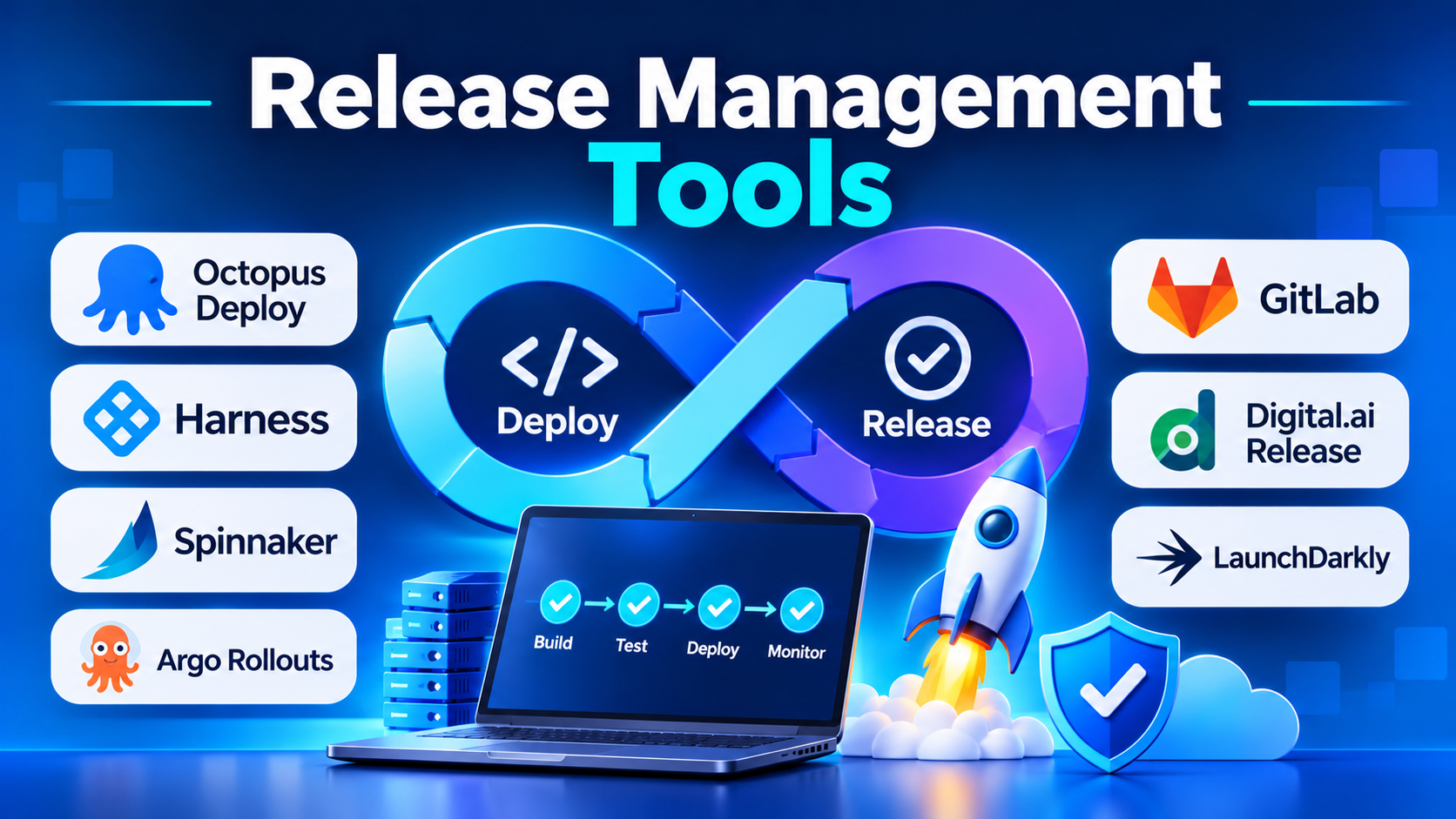
Compiling a container image in CI takes minutes; getting that release safely through staging, compliance sign-offs, canary traffic shifting, database schema migrations, and coordinated microservice dependencies is where delivery pipelines stall. When organizations scale past a handful of services, ad-hoc deployment scripts and manual release spreadsheets break down—resulting in blocked release trains, untracked production changes, and high-stress rollbacks.
Release management tools exist to govern the path from verified build artifact to production runtime. However, the category covers fundamentally different operational philosophies. Some platforms act as multi-environment deployment orchestrators that push packages across hybrid cloud and on-premises targets, others specialize in continuous verification and progressive delivery (automating canary analysis using observability metrics), and enterprise suites focus on ITSM change governance, release calendars, and cross-team dependency coordination. Selecting the right platform requires identifying whether your primary bottleneck is deployment execution, automated risk verification, or organizational governance.
Three Distinct Approaches to Release Management
Before comparing specific software products, engineering and operations leaders should separate the three operational layers that release management platforms address:
1. Application Deployment and Environment Orchestrators
Tools such as Octopus Deploy and Azure Pipelines (Release/Environments) model explicit deployment lifecycles—promoting immutable artifacts sequentially across Development, QA, Staging, and Production environments while managing environment-specific variables, tenant configurations, and approval gates.
- Core strength: Clear visual dashboards showing exactly which version is deployed to each environment or customer tenant, paired with repeatable rollback mechanics.
- Primary trade-off: Follows an imperative “push” model that requires managing deployment targets, agents, or cloud credentials inside the orchestrator.
2. Progressive Delivery and Continuous Verification Platforms
Platforms like Harness CD, Spinnaker, and Argo Rollouts focus on reducing the blast radius of production releases. Rather than deploying a new version to 100% of users simultaneously, they automate canary deployments, blue-green cutovers, and traffic splitting—continuously querying APM and logging tools (Prometheus, Datadog, New Relic) to roll back automatically if error rates or latency spike.
- Core strength: Replaces manual post-deploy war rooms with automated, metric-driven rollout verification.
- Primary trade-off: Requires mature observability instrumentation and health-check baselines before automated rollback rules can operate reliably.
3. Enterprise Release Orchestration and Value Stream Governance
Enterprise suites such as Digital.ai Release (formerly XL Release) and ServiceNow DevOps Change Velocity sit above individual CI/CD runners to coordinate complex, multi-application release trains across regulated enterprises—automating ServiceNow change-request tickets, enforcing blackout windows, and tracking audit evidence across dozens of teams.
- Core strength: Bridges engineering pipelines with enterprise ITIL/ITSM compliance and cross-program dependency tracking.
- Primary trade-off: Heavy administrative setup and licensing cost; unnecessary overhead for autonomous product teams practicing continuous deployment.
Notable Release Management Tools Across Architectures
Octopus Deploy — Multi-Environment and Multi-Tenant Deployment Automation
Octopus Deploy is purpose-built for the deployment and release layer that begins after a CI server finishes building and testing an artifact. It models deployment processes visually—combining environment promotion lifecycles, manual approval steps, dynamic variable scoping, and integrated runbooks for operational maintenance tasks.
Its defining capability is first-class multi-tenant deployment support: software vendors and enterprises deploying separate instances of an application across hundreds of customer tenants or regional data centers can manage tenant-specific variables and phased rollout rings without duplicating pipelines. Octopus supports Kubernetes, cloud PaaS, and traditional Windows/Linux virtual machines via lightweight Tentacle agents or SSH, though organizations looking strictly for declarative GitOps Kubernetes sync may prefer Kubernetes-native controllers.
Harness Continuous Delivery — AI-Assisted Verification and Enterprise Governance
Harness CD separates continuous delivery from continuous integration with a strong emphasis on Automated Continuous Verification and enterprise policy-as-code. During canary or blue-green deployments, Harness connects directly to observability platforms (such as Prometheus, Datadog, Splunk, and Dynatrace) to compare baseline and canary telemetry, automatically halting and rolling back releases when anomalies appear.
It also embeds Open Policy Agent (OPA) governance gates, role-based access control, and native freeze windows, making it attractive for regulated enterprises standardizing deployments across Kubernetes, AWS ECS, serverless, and traditional VM workloads. Its commercial pricing model (typically metered by active services or developer seats) and broad enterprise feature set make it heavier than small startups usually require.
Spinnaker — Multi-Cloud Immutable Infrastructure Delivery
Originally created at Netflix and maintained under the Continuous Delivery Foundation, Spinnaker is an open-source, multi-cloud continuous delivery platform designed around immutable infrastructure patterns (baking machine images or deploying Kubernetes manifests) and sophisticated deployment pipelines.
Spinnaker’s strength lies in native cloud-provider abstractions across AWS, Google Cloud, Azure, and Kubernetes—supporting complex multi-region traffic management, automated canary analysis (via Kayenta), and execution windows out of the box. The primary barrier to adoption is operational complexity: Spinnaker consists of multiple interdependent microservices that demand dedicated platform engineering resources and substantial cluster memory to host and upgrade reliably.
Argo Rollouts — Kubernetes-Native Progressive Delivery Controller
While Argo CD handles declarative GitOps synchronization, Argo Rollouts extends Kubernetes with a Rollout custom resource that replaces standard Kubernetes Deployment objects to unlock advanced progressive delivery.
Argo Rollouts integrates directly with ingress controllers and service meshes (such as NGINX, Istio, Traefik, and AWS ALB) to shift traffic incrementally (for example, 5% -> 25% -> 50% -> 100%) while running automated AnalysisRun queries against Prometheus, Datadog, or custom webhooks. Because it runs as a lightweight, open-source Kubernetes controller without external SaaS dependencies, it is a top choice for Kubernetes-standardized teams—though it applies strictly to Kubernetes workloads.
GitLab Release Governance and Environments
For organizations standardized on GitLab, release management capabilities are built directly into the single-application workflow—linking Git tags, release notes, deployment approvals, protected environments, deploy freeze periods, and DORA metrics (deployment frequency, lead time for changes, change failure rate) to merge requests and CI pipelines.
Using GitLab Environments alongside Deployment Approvals allows teams to enforce separation of duties without procuring a separate release-orchestration tool, though organizations orchestrating releases across heterogeneous source-control systems and legacy mainframes will need a standalone platform.
Digital.ai Release — Enterprise Release Train and Compliance Orchestration
Digital.ai Release targets large enterprises coordinating interdependent releases spanning cloud microservices, ERP suites, and legacy mainframe systems. Rather than replacing low-level deployment tools, it orchestrates across them—connecting Jenkins, GitHub Actions, Jira, ServiceNow, and SonarQube into unified release templates with automated audit trails, risk scoring, and dependency visualization.
It is best suited for banks, insurers, and large telecommunications organizations governed by strict change-advisory-board (CAB) audits, whereas agile cloud-native engineering teams generally favor self-service pipeline governance.
LaunchDarkly (and Feature Management Platforms) — Decoupling Deployment from Release
Modern release engineering increasingly separates deploying code to production (an infrastructure event) from releasing features to users (a business event). Feature management platforms like LaunchDarkly—alongside open-source alternatives such as Unleash and Flagsmith—allow teams to ship dark code continuously and control exposure via percentage rollouts, user-segment targeting, and instant kill switches without redeploying binaries or rolling back database migrations.
Comparison of Release Management Tools
| Tool / Platform | Primary Focus | Target Environments | Progressive Delivery | Standout Strength | Primary Trade-Off |
| Octopus Deploy | Multi-environment & multi-tenant deployment | Kubernetes, Cloud VMs, Windows/Linux servers | Blue-green & rolling patterns | Unmatched multi-tenant deployment modeling and clear environment matrix visibility | Imperative push architecture; less focused on GitOps pull reconciliation |
| Harness CD | Enterprise CD & automated verification | Kubernetes, ECS, Serverless, VMs | Canary, blue-green, rolling with metric analysis | Automated telemetry-based rollback verification and OPA policy governance | Enterprise subscription cost and broader configuration footprint |
| Spinnaker | Multi-cloud immutable infrastructure CD | AWS, GCP, Azure, Kubernetes | Automated canary (Kayenta), red/black | Deep native multi-cloud abstractions and mature multi-region pipeline controls | High self-hosted operational and infrastructure maintenance overhead |
| Argo Rollouts | Kubernetes progressive delivery controller | Kubernetes clusters | Canary, blue-green, traffic mirroring | Lightweight open-source Kubernetes CRD with ingress/service-mesh traffic shifting | Strictly limited to Kubernetes environments |
| GitLab Environments | Unified SCM/CI/CD release governance | Cloud, Kubernetes, hybrid runners | Incremental rollouts & feature flags | Native traceability from issue to MR, security scan, approval gate, and DORA metrics | Tied closely to GitLab repositories and pipelines |
| Digital.ai Release | Enterprise release train & ITSM orchestration | Hybrid cloud, mainframe, multi-tool estates | Coordinates external CD tools | End-to-end compliance audit trails, dependency mapping, and ServiceNow integration | Heavy enterprise governance focus; excessive for autonomous product squads |
| LaunchDarkly / Unleash | Runtime feature-flag release control | Application runtimes (SDKs across languages) | Percentage rings, user targeting, kill switches | Instant feature rollback without code redeployment | Requires disciplined flag-cleanup hygiene to avoid conditional code debt |
Five Operational Capabilities Worth Verifying Before Adoption
1. Separation of Duties and Environment Approval Gates
In regulated environments, the developer who authors a pull request cannot be the sole person approving its promotion to production. Verify that the release tool enforces cryptographic or identity-backed approval gates tied to SSO groups—and automatically invalidates approvals if the underlying artifact digest changes.
2. Automated Rollback Speed and Database Compatibility
Rolling back an application container in thirty seconds fails if the release already executed a destructive database column drop. Evaluate how the platform coordinates schema migration steps (such as Liquibase or Flyway jobs) before traffic cutover, and whether rollbacks redeploy the exact previous immutable artifact rather than rebuilding from source.
3. Deployment Freeze Windows and Emergency Overrides
Enterprise operations require scheduled freeze periods during peak revenue events or compliance audits—paired with audited “break-glass” override workflows for critical security hotfixes. Check whether blackout windows can be enforced centrally via policy rather than manually configured per pipeline.
4. Native DORA Metrics and Audit Trail Export
Rather than building custom spreadsheets to measure release health, verify whether the platform natively tracks deployment frequency, lead time, mean time to recovery (MTTR), and change failure rate—and exports tamper-evident deployment logs for SOC 2 or ISO 27001 audits.
5. Drift Detection vs. Imperative Execution
If your target infrastructure runs on Kubernetes, determine whether an imperative deployment runner or a declarative GitOps controller (such as Argo CD paired with Argo Rollouts) provides cleaner recovery when manual hotfixes or cluster failures cause live state to diverge from intended release versions.
Matching the Tool to Your Delivery Bottleneck
- For teams deploying across hybrid Windows/Linux servers, cloud VMs, and multi-tenant customer environments: Octopus Deploy provides the clearest environment visibility and tenant-scoped variable management.
- For Kubernetes-standardized organizations wanting progressive canary rollouts without commercial lock-in: Pair Argo CD with Argo Rollouts and Prometheus metrics to automate traffic shifting and metric-driven rollbacks.
- For enterprises seeking turnkey automated canary verification and policy governance across cloud and container workloads: Harness CD minimizes the engineering effort required to connect observability telemetry to automated rollback decisions.
- For large regulated organizations coordinating multi-team release trains and ITSM change tickets: Digital.ai Release (or ServiceNow DevOps workflows) centralizes cross-program dependencies and compliance evidence.
- For any engineering team looking to shrink release risk immediately: Combine your deployment orchestrator with a feature management platform (LaunchDarkly or self-hosted Unleash) so user-facing feature exposure can be toggled in milliseconds independently of infrastructure deployments.
