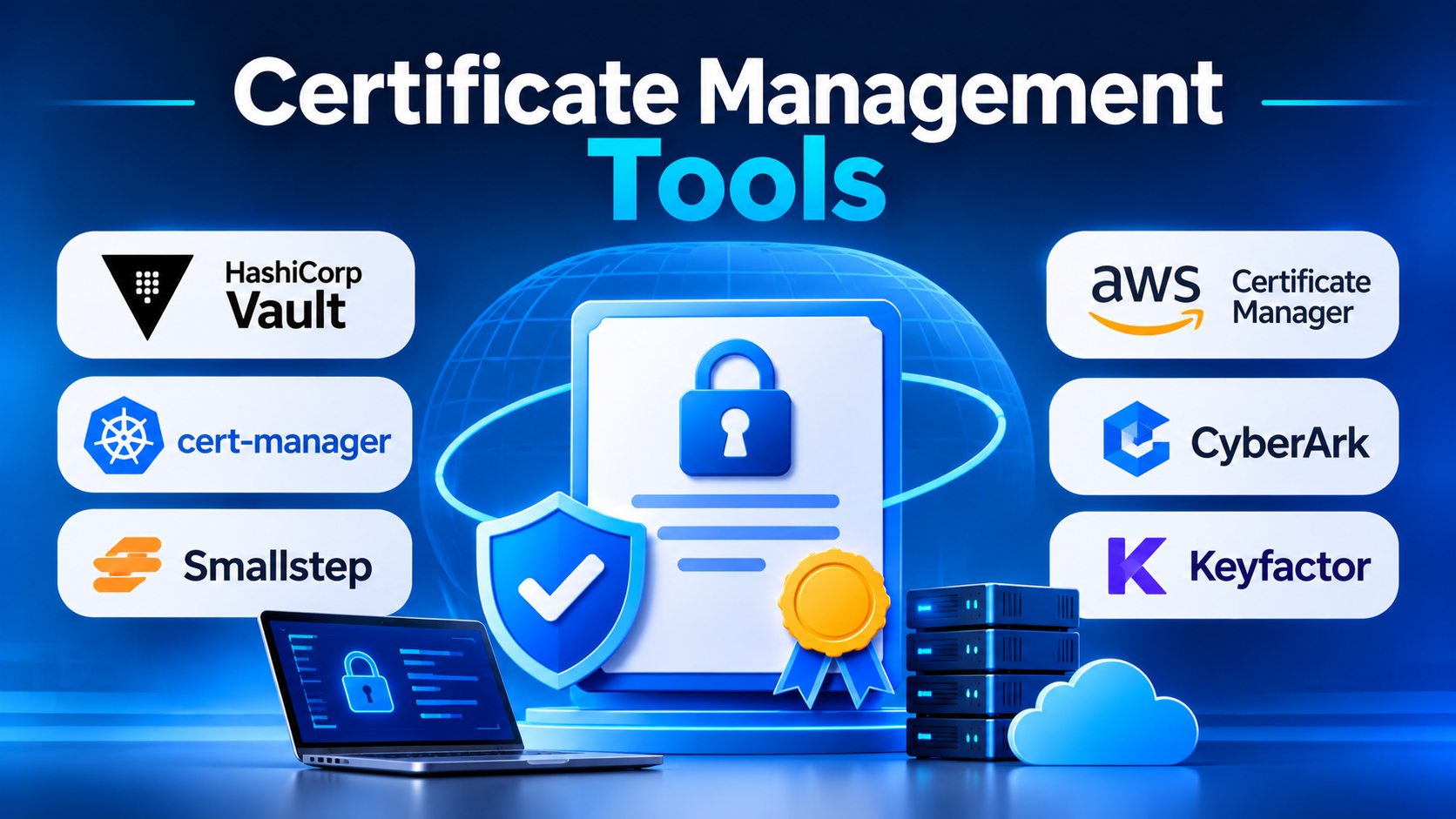
An expired TLS certificate on a public ingress controller or an unrenewed mutual TLS (mTLS) leaf certificate inside a service mesh rarely fails gracefully—it halts API traffic, triggers browser security warnings, and causes cascading authentication failures across microservices. As public Certificate Authorities tighten maximum certificate validity windows and cloud-native environments adopt zero-trust mutual authentication, manual spreadsheet tracking and annual ticket-based renewals no longer scale.
Certificate management tools address this operational risk, yet the category spans three distinct layers of infrastructure: ACME-based public TLS automation, cloud-native Kubernetes certificate controllers, and enterprise Certificate Lifecycle Management (CLM) platforms that discover, inventory, and govern cryptographic identities across hybrid estates. Selecting the right tooling requires distinguishing between issuing certificates, automating renewal hooks, and maintaining centralized visibility over every key and certificate running in production.
Three Distinct Layers in Certificate Lifecycle Management
Before comparing products, infrastructure and security teams should separate the three operational problems certificate tools solve:
1. Public Domain TLS Automation (ACME Protocol)
Tools built around the Automated Certificate Management Environment (ACME) protocol—such as Certbot and Caddy—automate domain validation (HTTP-01 or DNS-01 challenges), certificate issuance, and renewal against public Certificate Authorities like Let’s Encrypt, ZeroSSL, and Google Trust Services.
- Core strength: Eliminates human intervention for public-facing web servers, reverse proxies, and load balancers.
- Primary limitation: Focuses on individual host or proxy configurations rather than organization-wide inventory discovery, internal private PKI hierarchies, or enterprise compliance auditing.
2. Cloud-Native Kubernetes and Workload PKI Controllers
In containerized environments where pods and services spin up and terminate continuously, tools like cert-manager and SPIRE automate X.509 certificate issuance directly inside clusters—bridging Kubernetes workloads to both public ACME issuers and private internal Certificate Authorities (such as HashiCorp Vault, AWS Private CA, or step-ca).
- Core strength: Declarative, GitOps-friendly certificate management with automatic
Secretrotation and workload attestation. - Primary limitation: Scoped to Kubernetes and cloud-native workloads; traditional appliances, mainframes, and legacy Windows/Linux servers outside the cluster still require external management.
3. Enterprise Certificate Lifecycle Management (CLM) and Discovery Suites
Commercial enterprise platforms—such as Venafi (CyberArk), Keyfactor, and DigiCert Trust Lifecycle Manager—provide centralized discovery across networks and cloud accounts, policy enforcement (key algorithms, minimum bit lengths, approved CAs), automated provisioning onto load balancers (F5, Citrix, NGINX), and audit reporting.
- Core strength: Prevents “shadow certificates” across complex, heterogeneous enterprises and prepares organizations for cryptographic agility (such as migrating to post-quantum algorithms).
- Primary limitation: Carries substantial commercial licensing costs and requires dedicated PKI administration to configure connectors across legacy infrastructure.
Notable Certificate Management Tools Across Architectures
cert-manager — The Standard for Kubernetes Certificate Automation
Hosted under the Cloud Native Computing Foundation (CNCF), cert-manager extends Kubernetes with Custom Resource Definitions (Certificate, Issuer, ClusterIssuer) that treat X.509 certificates as declarative infrastructure resources.
cert-manager natively requests certificates from ACME providers (such as Let’s Encrypt), HashiCorp Vault, Venafi, AWS Private CA, and self-signed internal issuers, storing the resulting key pairs inside Kubernetes Secret objects and renewing them automatically before expiration. Paired with its companion project trust-manager, teams can also distribute internal root CA bundles cleanly across cluster namespaces. Because cert-manager operates strictly within Kubernetes, organizations must pair it with host-level agents or enterprise CLM suites to cover non-Kubernetes servers and hardware appliances.
Smallstep (step-ca and step CLI) — Open-Source Internal PKI and Short-Lived Certificates
Smallstep solves a pervasive operational headache: running an internal Private Certificate Authority without the fragility of raw OpenSSL scripts or the administrative weight of legacy Microsoft AD CS deployments.
Its open-source step-ca server provides an online, automated Certificate Authority supporting ACME, OIDC single sign-on, and cloud instance identity attestation (AWS, GCP, Azure) to mint short-lived TLS and SSH certificates (often valid for hours rather than months). By issuing short-lived certificates, teams reduce reliance on complex Certificate Revocation Lists (CRLs) and OCSP responders. Commercial Smallstep tiers add centralized device inventory, fleet management, and high-availability hosted CA infrastructure.
HashiCorp Vault PKI Secrets Engine — Dynamic X.509 Issuance for Hybrid Infrastructure
For engineering organizations already operating HashiCorp Vault for secrets management, its built-in PKI Secrets Engine generates dynamic, short-lived X.509 certificates on demand via REST API.
Rather than storing long-lived private keys on disk, applications authenticate to Vault using Kubernetes service accounts or cloud IAM roles and receive freshly generated leaf certificates directly in memory. Vault can operate as a self-contained root/intermediate CA or act as an intermediary broker signing requests against an external enterprise root. Teams not already running Vault should weigh the operational overhead of maintaining a high-availability Vault cluster if certificate issuance is their only requirement.
CyberArk Certificate Manager (formerly Venafi) — Enterprise Discovery and Machine Identity Governance
Venafi—now integrated into CyberArk’s identity security portfolio—pioneered enterprise Machine Identity Management across Fortune 500 networks, financial institutions, and regulated infrastructure.
Its strength lies in deep network and cloud discovery (scanning subnets, load balancers, cloud accounts, and container registries to locate unknown or expiring certificates), cryptographic policy governance (blocking weak SHA-1/RSA-1024 keys or unauthorized public CAs), and automated remediation workflows across F5 BIG-IP, Apache, IIS, Kubernetes, and mainframe environments. Its enterprise scope and commercial pricing make it purpose-built for large organizations with thousands of certificates, whereas smaller cloud-native teams typically find lightweight ACME and Kubernetes tooling sufficient.
Keyfactor Command — Scalable Private PKI and IoT/Device Certificate Operations
Keyfactor Command combines enterprise Certificate Lifecycle Management with deep expertise in high-volume private PKI—spanning enterprise IT servers, DevOps pipelines, and connected IoT or operational technology (OT) devices.
Keyfactor integrates tightly with Microsoft Active Directory Certificate Services (AD CS), EJBCA (which Keyfactor maintains as a widely deployed open-source enterprise CA), and major cloud CAs. It excels in organizations managing massive fleets of internal certificates across hybrid Windows/Linux estates and embedded hardware. Like Venafi, Keyfactor requires structured enterprise deployment and commercial licensing.
AWS Certificate Manager (ACM) and Cloud-Native CA Services
For workloads hosted on major public clouds, managed certificate services eliminate renewal maintenance at the load-balancer and CDN edge:
- AWS Certificate Manager (ACM) provisions and automatically renews public and private TLS certificates attached directly to Elastic Load Balancers (ALB/NLB), Amazon CloudFront, and API Gateway at zero additional cost for public certificates—though ACM public private keys cannot be exported for use on external servers outside AWS.
- Google Cloud Certificate Manager and Azure Key Vault Certificates offer equivalent managed lifecycle automation within GCP and Azure load-balancing and ingress layers.
Certbot and Caddy — Host-Level Public ACME Automation
For single-server deployments, virtual machines, and edge reverse proxies outside Kubernetes:
- Certbot (maintained by the Electronic Frontier Foundation) remains the standard CLI client for automating Let’s Encrypt issuance and renewal on NGINX, Apache, and Linux hosts via cron or systemd timers.
- Caddy embeds ACME certificate provisioning directly into the web server and reverse proxy binary itself—automatically obtaining, renewing, and stapling OCSP responses for HTTPS domains out of the box with zero external cron jobs.
Comparison of Certificate Management Tools
| Tool / Platform | Primary Domain | Supported Issuers & CAs | Deployment Model | Standout Strength | Primary Trade-Off |
| cert-manager | Kubernetes workloads & ingress | Let’s Encrypt (ACME), Vault, Venafi, AWS Private CA | Open-source Kubernetes controller | Declarative CRD-based renewal and native ingress/service-mesh integration | Covers Kubernetes clusters only; requires separate tooling for VMs/appliances |
Smallstep (step-ca) | Internal PKI, SSH, & workload identity | Self-hosted internal CA (ACME, OIDC, Cloud IAM) | Open-source CLI/server + commercial SaaS | Fast, developer-friendly internal PKI for short-lived mTLS and SSH certificates | Commercial tier required for enterprise fleet inventory and hosted HA |
| HashiCorp Vault PKI | Dynamic X.509 for hybrid workloads | Internal root/intermediate CA or external CA signing | Self-hosted (OSS/BSL) or HCP Cloud | Generates short-lived certificates on demand without storing private keys on disk | High operational overhead if deployed solely for certificate management |
| CyberArk (Venafi) | Enterprise CLM & discovery | DigiCert, Sectigo, Entrust, AD CS, Vault, Cloud CAs | Enterprise SaaS or self-hosted | Deep network discovery, cryptographic policy gates, and load-balancer automation | Enterprise licensing cost and implementation complexity |
| Keyfactor Command / EJBCA | Enterprise CLM & high-scale private PKI | EJBCA, Microsoft AD CS, DigiCert, Cloud CAs | Self-hosted, cloud, or SaaS | Strong hybrid Windows/Linux PKI orchestration and high-volume device/IoT issuance | Heavyweight enterprise governance footprint |
| AWS Certificate Manager (ACM) | Cloud edge & load-balancer TLS | Amazon Trust Services & AWS Private CA | Managed AWS cloud service | Zero-maintenance public TLS renewal for ALB, CloudFront, and API Gateway | Public certificate private keys cannot be exported outside AWS services |
| Certbot / Caddy | Host-level web servers & reverse proxies | Let’s Encrypt and ACME-compatible CAs | Open-source Linux/cross-platform binaries | Simple, zero-cost public HTTPS automation for standalone servers | Lacks centralized multi-team inventory, audit reporting, and private PKI governance |
Four Technical Decisions That Prevent Certificate Outages
1. Short-Lived Certificates vs. Complex Revocation Infrastructure
Traditional Certificate Revocation Lists (CRLs) and OCSP stapling frequently suffer from caching delays, network reachability failures, and client-side soft-fail behavior. Modern cloud-native architectures increasingly favor short-lived certificates (valid for 24 hours to 7 days) issued automatically via ACME or SPIFFE/SPIRE—making revocation largely unnecessary because compromised credentials expire naturally within hours.
2. DNS-01 vs. HTTP-01 ACME Challenge Boundaries
When automating public TLS certificates, HTTP-01 challenges are simple to configure on public web servers but fail for wildcard certificates (*.example.com) and internal services blocked from public internet ingress. DNS-01 challenges solve both problems by proving domain ownership via TXT records, though they require granting your certificate controller scoped API credentials to your DNS provider (such as Route 53, Cloudflare, or Cloud DNS).
3. Application Hot-Reloading After Renewal
Renewing a certificate file on disk or updating a Kubernetes Secret does not protect production traffic if the running web server, JVM keystore, or gRPC process keeps serving the expired certificate cached in memory. Always verify how your runtime reloads updated PEM or PKCS#12 files—using sidecar reloaders (such as Stakater Reloader in Kubernetes), SIGHUP signals, or dynamic TLS GetCertificate callbacks.
4. Preparing for Cryptographic Agility
Between shortening public TLS validity periods and upcoming transitions toward post-quantum cryptography (PQC) algorithms, hardcoding key sizes, cipher suites, or CA endpoints inside application code creates brittle technical debt. Centralizing issuance behind an abstraction layer—such as cert-manager or an enterprise CLM policy engine—allows security teams to update key algorithms or switch Certificate Authorities across hundreds of services without modifying application binaries.
Selecting the Right Certificate Management Approach
- For standalone web servers and edge proxies: Use Caddy for built-in zero-config HTTPS or Certbot when managing existing NGINX and Apache fleets.
- For Kubernetes-native applications and ingress controllers: Standardize on cert-manager backed by Let’s Encrypt for public endpoints and Smallstep
step-caor HashiCorp Vault PKI for internal service-to-service mTLS. - For AWS, GCP, or Azure edge infrastructure: Leverage native managed services (AWS Certificate Manager, Google Cloud Certificate Manager, or Azure Key Vault) wherever traffic terminates on cloud-managed load balancers or CDNs.
- For large hybrid enterprises struggling with unknown certificate sprawl across legacy servers, F5 load balancers, and Windows AD CS: Invest in an enterprise CLM platform such as CyberArk Certificate Manager (Venafi) or Keyfactor Command to establish continuous discovery, policy enforcement, and automated renewal workflows.
