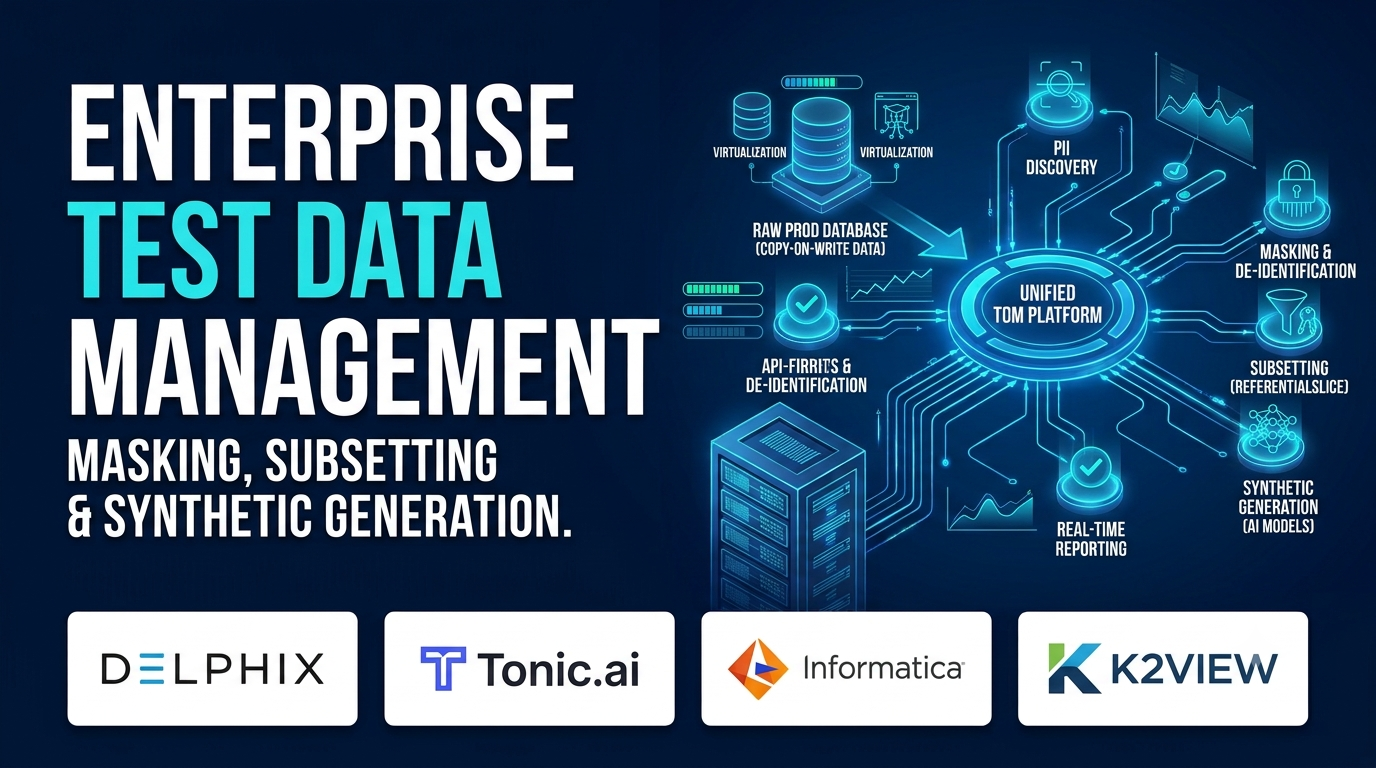
Staging environments break in two predictable ways: either engineers copy raw production databases into non-production tiers—creating severe privacy and compliance exposure—or they rely on hand-crafted mock records that miss real-world edge cases, null distributions, and relational constraints. Test Data Management (TDM) tools exist to resolve that tension by delivering realistic, referentially intact datasets to development, QA, and CI/CD pipelines without exposing sensitive customer records.
However, the TDM market is not a uniform category of interchangeable platforms. Tools built around database virtualization and copy-on-write cloning solve fundamentally different bottlenecks than platforms designed for statistical synthetic data generation or lightweight CI database seeding. Choosing the wrong architecture leads to multi-terabyte storage bloat, broken foreign-key relationships across microservices, or brittle masking scripts that fail whenever a schema evolves.
Three Competing Architectures in Test Data Management
Before comparing specific products, engineering and data governance teams must decide which underlying data-provisioning mechanism fits their infrastructure and regulatory boundaries.
1. Subsetting and Static Data Masking
This traditional enterprise model extracts a smaller, referentially intact slice of a production database (subsetting) and irreversibly replaces personally identifiable information (PII) with realistic substitutes (static masking). Deterministic masking ensures that if “Customer A” becomes “Customer X” in the billing database, the same transformation occurs in the CRM and order-fulfillment databases—preserving cross-system joins without retaining real identities.
- Best suited for: Monolithic relational databases, legacy ERP systems, and compliance-heavy industries where test cases depend on authentic historical edge cases.
- Primary trade-off: Requires strict schema awareness; every time a developer adds a column containing sensitive data, masking rules must be updated before the next refresh.
2. Database Virtualization and Copy-on-Write Provisioning
Rather than physically duplicating multi-terabyte databases for every QA team, virtualization platforms ingest a single masked “golden copy” and expose lightweight, isolated virtual databases (VDBs) via storage-level pointers. When a tester modifies records in their branch, only the changed data blocks are written to disk.
- Best suited for: Large enterprise databases where full restores take hours or days and storage infrastructure costs dominate.
- Primary trade-off: Introduces infrastructure dependencies around storage pools and virtualized mounts, which can be heavier than needed for cloud-native microservices.
3. Synthetic Data Generation
Synthetic TDM tools bypass production data entirely—or learn only its statistical distributions—to generate brand-new datasets from scratch using rule-based generators, schema constraints, or machine learning models. Because no real customer records enter the pipeline, synthetic datasets inherently avoid GDPR, HIPAA, and CCPA re-identification risks.
- Best suited for: Greenfield applications lacking production history, strict zero-production-access environments, and automated CI pipelines requiring deterministic, fast-booting test fixtures.
- Primary trade-off: Rule-based generators can miss subtle production anomalies unless carefully configured, while AI-trained tabular models require significant compute and validation to prevent overfitting or memorizing outliers.
Notable Test Data Management Platforms by Primary Approach
Because organizations rarely use a single database engine across every team, evaluating TDM tools requires matching each platform’s core strength to your dominant data architecture.
Delphix (Perforce) — Enterprise Data Virtualization and Masking
Delphix combines automated PII discovery and deterministic masking with copy-on-write database virtualization. After syncing with production sources (such as Oracle, SQL Server, PostgreSQL, or SAP), Delphix masks sensitive fields and lets developers provision, bookmark, rewind, or branch full-sized virtual databases in minutes through APIs or self-service portals. Its primary differentiator is operational speed on massive legacy estates where traditional ETL-based cloning bottlenecks release cycles. However, its enterprise licensing model and infrastructure footprint are generally excessive for small teams running lightweight cloud databases.
Tonic.ai — Developer-Focused De-Identification and Subsetting
Tonic.ai targets modern cloud data stacks—including PostgreSQL, MySQL, Snowflake, Databricks, and MongoDB—with a strong emphasis on developer workflow integration and automated privacy preservation. It combines schema-aware subsetting, referential integrity enforcement across multiple databases, and differential privacy techniques for synthetic generation. Teams benefit from built-in schema change alerts that flag unmasked columns before pipelines run. While Tonic.ai handles complex relational and semi-structured schemas well, organizations operating mainframes or deeply customized legacy ERP suites will find narrower native connector coverage than traditional enterprise incumbents.
Informatica Test Data Management — Governance-Heavy Enterprise Suites
Designed for large organizations already invested in the Informatica data governance ecosystem, Informatica TDM provides policy-driven data discovery, persistent data masking, subsetting, and rule-based data generation. Its strength lies in centralized compliance auditing, role-based access controls, and support for heterogeneous mainframe and relational environments. The trade-off is administrative complexity: initial deployment, rule configuration, and ongoing maintenance typically require dedicated data engineering or governance specialists rather than self-service application developers.
K2view — Entity-Based Micro-Database Provisioning
K2view takes a distinct architectural approach by organizing test data around individual business entities—such as a single customer, policy, or account—rather than entire database tables. It extracts all records related to a specific entity across fragmented source systems, masks them on the fly, and stores each entity in its own encrypted micro-database. Testers can query and provision exact combinations of customer profiles (for example, “100 multi-currency accounts with overdue balances”) on demand. This entity-centric model excels in complex, distributed enterprise architectures, though it requires upfront data modeling to map how business entities span underlying tables.
MOSTLY AI — Statistical Synthetic Tabular Data
MOSTLY AI specializes in generating privacy-safe synthetic tabular data trained on real production datasets using generative models. Rather than relying solely on regex replacement or static dictionaries, it learns multi-column correlations, time-series behaviors, and statistical distributions while applying privacy mechanisms to prevent individual record memorization. It is particularly useful when QA or data science teams need realistic behavioral patterns without touching masked production rows. However, because it relies on model training rather than direct block-level cloning, it is less suited for instantaneous terabyte-scale operational database refreshes.
Synthesized — Automated Test Data for CI/CD Pipelines
Synthesized focuses on integrating synthetic data generation and subsetting directly into automated CI/CD workflows through declarative YAML configurations and SDKs. It analyzes database schemas to infer constraints, relationships, and distributions, generating compact, referentially valid test datasets during build runs. Engineering teams adopting shift-left testing practices use it to spin up ephemeral test databases per pull request without waiting on centralized DBA provisioning.
Open-Source and Developer-Native Alternatives
Not every engineering organization requires a commercial TDM platform. Several open-source tools address specific slices of the test data lifecycle:
- Snaplet (and PostgreSQL-native seeding tools) / Faker ecosystems: Libraries like Faker (available across Python, JavaScript, Java, and Go) remain the standard for unit and integration tests where developers programmatically construct isolated object graphs.
- Neosync: An open-source, developer-first data anonymization and synthetic data orchestration platform built for cloud databases like PostgreSQL and MySQL, offering deterministic transformations and Kubernetes-friendly deployment.
- pg_anonymizer (PostgreSQL Anonymizer): An extension that embeds declarative masking rules directly inside PostgreSQL DDL syntax, allowing teams to dump anonymized datasets natively without introducing external middleware.
Comparison of Test Data Management Tools
| Tool | Primary Architecture | Target Data Environments | Key Differentiator | Operational Consideration |
| Delphix | Virtualization + static masking | Enterprise RDBMS, ERP (Oracle, SQL Server, SAP) | Near-instant copy-on-write VDB branching and time-travel rewind | Heavy enterprise footprint and licensing model |
| Tonic.ai | De-identification, subsetting, synthetic | Cloud RDBMS, warehouses, NoSQL (Postgres, Snowflake, MongoDB) | Cross-database referential integrity with automated schema-drift alerts | Less focused on legacy mainframe/ERP ecosystems |
| Informatica TDM | Policy-driven masking + subsetting | Heterogeneous enterprise, mainframe, RDBMS | Deep governance, compliance auditing, and centralized policy enforcement | Steep learning curve; requires dedicated administration |
| K2view | Entity-based micro-databases | Distributed multi-system enterprise stacks | Provisions specific business-entity cohorts across fragmented databases | Requires upfront entity-to-table mapping |
| MOSTLY AI | AI-driven synthetic generation | Tabular databases, data warehouses, CSV/Parquet | Preserves complex multi-table statistical correlations with zero real PII | Model training overhead; not a drop-in VDB cloner |
| Synthesized | Declarative synthetic + subsetting | Cloud databases, CI/CD pipelines | YAML-driven ephemeral database seeding for pull-request workflows | Best suited for automated dev/QA pipelines over legacy ops |
| Neosync | Open-source anonymization + synthetic | Cloud-native SQL (PostgreSQL, MySQL) | Self-hostable, developer-centric API and deterministic masking | Narrower connector breadth than commercial suites |
Five Technical Pitfalls That Break TDM Implementations
Cross-Database Referential Drift
Modern applications rarely store all state in one database. A user ID in PostgreSQL might correspond to a document key in MongoDB, a customer token in a payment gateway, and an analytics record in Snowflake. If a TDM tool masks each datastore independently using non-deterministic rules, distributed integration tests immediately fail on broken joins. Always verify that your chosen tool supports deterministic hashing or keyed salt algorithms across every datastore in your architecture.
Unstructured Text and JSON Blobs
Standard PII scanners easily catch columns named email, ssn, or phone_number. They frequently miss sensitive data embedded inside free-text notes columns, application logs, or nested JSON payloads. Before selecting a masking engine, test its ability to parse JSON paths and run named-entity recognition (NER) or custom regex patterns inside unstructured fields.
Trigger, Sequence, and Constraint Collisions
Subsetting a relational database is straightforward until foreign-key cascades, auto-increment sequences, database triggers, or circular references interfere with insertion order. Some tools disable constraints during loading and re-enable them afterward—which can hide subtle data-integrity bugs until application code executes.
Over-Subsetting Edge Cases
Aggressive subsetting (for example, extracting 1% of production rows) dramatically reduces storage and refresh times, but random sampling often strips out rare failure conditions—such as expired tax rules, multi-currency rounding edge cases, or legacy account tiers. Effective subsetting requires stratified or query-driven filtering so rare business states remain represented in compact datasets.
Treating TDM as a One-Time Setup
Database schemas change weekly in continuous delivery environments. A TDM pipeline without automated schema-drift detection silently leaves newly added PII columns unmasked—turning a compliant staging environment into an unmonitored data breach vector.
How to Scope a Practical Evaluation
Rather than running broad vendor demonstrations on generic sample schemas, validate candidate TDM tools against a controlled internal proof-of-concept using your messiest production schema:
- Select a multi-table slice with real constraints: Include self-referencing foreign keys, composite keys, JSON columns, and at least two distinct database engines that share a common business identifier.
- Test a deliberate schema change: Add a new column containing synthetic sensitive data mid-pilot to observe whether the tool blocks propagation, alerts owners, or quietly passes raw values through.
- Measure end-to-end refresh latency in CI: Time the complete cycle—from extraction and masking/generation to database readiness inside an automated pipeline—rather than looking solely at raw row-generation throughput.
- Verify auditability for compliance teams: Confirm that the platform produces immutable logs proving which masking rules ran on which datasets, as security and audit teams increasingly require verifiable evidence that non-production environments contain zero live PII.
If your primary bottleneck is storage cost and slow restores on multi-terabyte relational databases, virtualization-first platforms like Delphix or entity-based tools like K2view deliver the highest operational impact. If your engineering teams are building cloud-native applications and need fast, automated, privacy-safe fixtures inside CI/CD pipelines, developer-oriented platforms such as Tonic.ai, Synthesized, or open-source Neosync align far better with modern delivery workflows.
Anchor Texts: Test Data Management Tools Data masking vs synthetic data Database virtualization for QA Subsetting relational databases Referential integrity in test data CI/CD test data provisioning Open-source data anonymization PII discovery and masking
Tags: Test Data Management, Data Masking, Synthetic Data, Database Virtualization, Software Testing, Quality Assurance, DevOps, CI/CD, Data Privacy, GDPR Compliance, Database Administration, Software Engineering
SEO Headline: Test Data Management Tools: Selecting Between Masking, Subsetting, and Synthetic Generation
