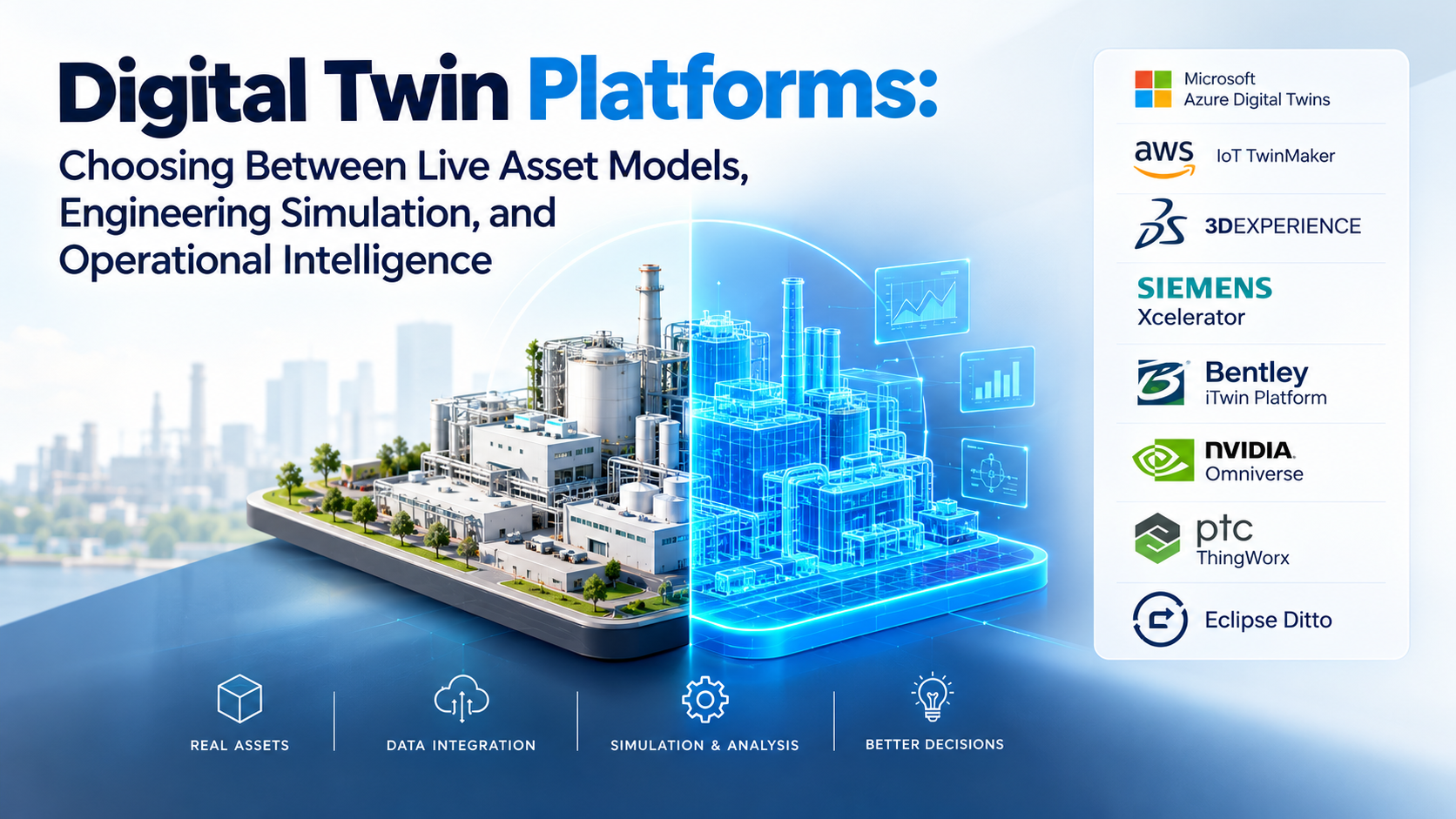
A common point of failure in enterprise digital twin initiatives is confusing a geometric render with an operational system. Organizations routinely commission photorealistic three-dimensional models of production facilities or logistics hubs, connect a handful of temperature sensors, and declare the creation of a digital twin. Within months, these projects stall as static dashboard novelties. The geometry looks convincing, but the model cannot run predictive physics, resolve semantic data conflicts between disparate operational systems, or execute automated control loops back into the physical environment.
A functional digital twin is not primarily a visual asset; it is a live relational system. It combines an evolving operational data model with continuous sensory feedback, domain-specific physics or behavioral logic, and bidirectional integration with enterprise business software.
Selecting a digital twin platform requires moving past marketing presentations featuring spatial computing and focusing on architectural fundamentals: how the software normalizes industrial telemetry, binds spatial assets to enterprise record-keeping, executes simulation solvers at scale, and manages the lifecycle of physical assets as their physical configurations change.
The Four Architectural Layers of a Functional Digital Twin
Every production-grade digital twin platform operates across four interdependent layers. System failure or operational gridlock typically occurs when buyers select a vendor specializing in only one tier while underestimating the technical complexity of the remaining three.
1. Ingestion, Protocol Normalization, and Edge Brokerage
Physical operations run on legacy fieldbuses and industrial operational technology (OT) protocols: Modbus, Profinet, BACnet, and OPC Unified Architecture (OPC UA). These standards transmit raw, time-stamped register values lacking business or spatial context.
- The Core Task: Edge gateways and ingestion engines must normalize these data streams into standard transport payloads (typically MQTT or HTTPS) and route them without dropping packets or introducing latency that would invalidate closed-loop control.
- Failure Modes: If the ingestion layer cannot manage intermittent network drops through localized edge queuing, the twin loses operational synchronization, corrupting downstream predictive algorithms.
2. Semantic Modeling and Asset Graphs
Sensor data without relational context is noise. A vibration readout of 4.2 millimeters per second is meaningless unless the system understands which specific bearing generated it, which pump housing contains that bearing, which fluid line depends on that pump, and which enterprise asset management (EAM) work order governed its last scheduled overhaul.
- The Core Task: The semantic layer structures physical assets into an interconnected knowledge graph using ontologies like the Digital Twins Definition Language (DTDL) or RealEstateCore.
- Failure Modes: When an ontology is too rigid, adding a new sensor subtype requires updating the database schema enterprise-wide, creating developmental bottlenecks.
3. Computation, Simulation, and Behavioral Analytics
This layer supplies the analytical intelligence of the twin. Rather than simply displaying past or current telemetry, it runs computational models to answer “what happens if” scenarios.
- The Core Task: Executing continuous finite element analysis (FEA), computational fluid dynamics (CFD), discrete-event factory simulations, or trained machine-learning degradation models.
- Failure Modes: Computational latency. If an engineering simulation takes twelve hours to compute transient thermal stresses, it cannot serve an operational twin that requires real-time anomaly intervention.
4. Presentation, Spatial Context, and Actuation
The interface exposes insights to engineers, facility managers, and business operators through two-dimensional analytics dashboards, spatial browser interfaces, or immersive virtual platforms. Crucially, in advanced implementations, this layer handles reverse actuation: pushing parameter adjustments directly back to Programmable Logic Controllers (PLCs) or Building Management Systems (BMS).
Primary Digital Twin Platforms Compared
The software landscape spans industrial automation conglomerates, enterprise cloud providers, spatial gaming engine developers, and specialized simulation suites.
| Platform / Ecosystem | Primary Domain Focus | Data & Modeling Architecture | Deployment Footprint | Core Operational Advantage | Primary Operational Bottleneck |
| Siemens Industrial Operations X (Insights Hub & Tecnomatix) | Heavy manufacturing, automotive, discrete automation assembly | Hybrid relational and industrial time-series models; native PLM links | Edge-to-cloud (Managed SaaS, Private Cloud, On-Premises) | Deepest out-of-the-box integration with native factory PLCs, automation hardware, and Teamcenter PLM | Steep administrative learning curve; heavily favors Siemens-native field hardware |
| GE Vernova Asset Performance Management (APM) | Power generation, utilities, oil and gas, heavy rotating machinery | Structured asset reliability graphs tied directly to historical failure records | Cloud-native SaaS or private enterprise hosting | Unrivaled reliability-centered maintenance (RCM) algorithms and domain failure-mode libraries | Limited native spatial/3D modeling capabilities; focused almost exclusively on maintenance economics |
| PTC ThingWorx & Kepware | Industrial IoT, machinery manufacturing, field-service monitoring | Model-driven ontology framework with industrial connectivity drivers | Flexible: on-premises servers, hybrid, or public cloud infrastructure | Industry-standard edge connectivity through native Kepware industrial communication drivers | Complex UI styling; high configuration overhead when deploying advanced physics-based simulations |
| Bentley Systems (iTwin Platform) | Infrastructure engineering, civil utilities, transportation networks | Open-source semantic layer (iModel.js) running against geographic coordinate systems | Hybrid cloud platform built around web-standard rendering | Native handling of complex, multi-format engineering CAD and BIM files with timeline version tracking | Specialized for built infrastructure; less suited to high-frequency discrete manufacturing control |
| NVIDIA Omniverse | Photorealistic industrial simulation, autonomous robotics validation, factory flow | Universal Scene Description (OpenUSD) semantic framework with live physics | On-premises workstation clusters and accelerated cloud GPU infrastructure | Physically accurate real-time ray-traced simulation and multi-user spatial collaboration | Demands massive GPU computing resources; requires external data pipelines for industrial time-series management |
| Open-Source Stacks (Eclipse Ditto with Apache Kafka & InfluxDB) | Custom developer-centric IoT platforms, smart-city experimental pilots | Decentralized JSON-based digital twin models with publish-subscribe messaging | Fully containerized microservices (Kubernetes, Linux edge hosts) | Complete freedom from vendor licensing; no software lock-in; lightweight operational footprint | Zero vendor liability; requires internal software teams to build user interfaces, physics engines, and semantic layers |
Detailed Platform Analysis
Siemens Industrial Operations X: The Factory-Floor Benchmark
Siemens delivers what is arguably the most operationally integrated digital twin environment for manufacturing and automation. Built on the convergence of its Teamcenter Product Lifecycle Management (PLM) stack, simulation tools, and industrial IoT infrastructure, Siemens approaches digital twins from the perspective of product design through machine execution.
The fundamental advantage of the Siemens portfolio is continuity. A machine can be designed in CAD, validated dynamically in simulation, programmed via virtual PLC commissioning, and then connected to the physical machine running on a factory floor. The operational telemetry feeds directly back into the original design models to evaluate component wear against calculated structural engineering tolerances.
However, operating inside the Siemens ecosystem requires institutional discipline and substantial capital. While the platform supports open standards like OPC UA, teams extracting data from heterogeneous or competing factory-floor controller architectures face significant configuration overhead compared to facilities utilizing standardized Siemens automation hardware.
GE Vernova APM: Reliability Over Aesthetics
GE Vernova approaches digital twins strictly through asset health, thermodynamics, and failure-mode avoidance. This platform explicitly prioritizes statistical reliability and operational risk over 3D visualization.
The engine relies on decades of codified physical operating history from heavy industrial hardware: turbines, compressors, boilers, and transformers. Its algorithms continually map sensory indicators—such as oil analysis, acoustic emissions, and temperature deltas—against empirical failure curves. It generates actionable insights: calculating remaining useful life (RUL), calculating the financial cost of operating an asset at reduced capacity versus shutting down, and automating work orders within enterprise ERP platforms.
Organizations that require visual plant navigators or spatial assembly layout planning will find GE Vernova APM ill-suited to those workflows. It functions as an analytical engine for risk reduction and operational maintenance, not as a visual operations platform.
PTC ThingWorx: Flexible Industrial Connectivity
PTC positions ThingWorx as an extensible model-driven development platform for industrial IoT. Its greatest operational asset is native integration with Kepware, an industrial communication suite that supports hundreds of legacy and modern industrial communication drivers.
Because industrial environments rarely feature homogenous equipment, ThingWorx excels at bridging the gap between machines built across different decades and modern enterprise cloud networks. The platform enables developers to define “Things” that inherit properties, data shapes, and operational alerts, simplifying the process of building custom operational mashup dashboards.
The platform’s limitation lies in computational depth. While it connects seamlessly to PTC’s Windchill PLM and CAD software, running complex, high-frequency multiphysics simulations requires external computational integrations. It is fundamentally an operational monitoring and workflow platform rather than a continuous simulation solver.
Bentley Systems iTwin: The Built Infrastructure Workhorse
Bentley Systems focuses on large-scale infrastructure assets: bridges, rail systems, water processing plants, and commercial campuses. The iTwin Platform is engineered specifically to resolve the long-standing industry challenge of handling massive, fragmented Architecture, Engineering, and Construction (AEC) data files.
Rather than trying to load giant, static Building Information Modeling (BIM) files that freeze client browsers, iTwin extracts design data into an open-source, relational database structure (iModel.js). Its core capability is timeline visualization: the platform tracks every engineering change order across design, construction, and operation, allowing operators to scrub backwards and forwards through time to evaluate physical alterations alongside current telemetry.
The trade-off is domain specialization. The iTwin Platform is purpose-built around geospatial coordinates, point clouds, and structural modeling standards. It lacks the microsecond-level polling and discrete automation logic required to run a high-speed packaging line or an electronics manufacturing surface-mount cell.
NVIDIA Omniverse: Physically Accurate Spatial Simulation
NVIDIA Omniverse approaches the digital twin domain from real-time spatial computing, accelerated computer graphics, and robotics validation. Utilizing Pixar’s Universal Scene Description (OpenUSD) as its structural data model, Omniverse acts as an aggregation and collaboration hub for diverse 3D design applications.
Its primary differentiator is native integration with physically accurate physics simulation engines (such as NVIDIA PhysX and specialized ray-tracing renderers). Rather than merely displaying an animation of an automated guided vehicle (AGV) navigating a warehouse, Omniverse simulates the accurate friction coefficients of the concrete floor, the optical response of the robot’s LiDAR sensors under varying lighting conditions, and the aerodynamic resistance of overhead cooling ducts.
The friction point for Omniverse is enterprise IT integration. The platform requires extensive workstation- and datacenter-grade GPU processing power. Furthermore, Omniverse is not an asset management platform or an industrial historian out of the box; it relies entirely on external databases, edge brokers, and enterprise software to supply operational business and sensor context.
Open-Source Architectures: Full Autonomy for Custom Pipelines
For engineering teams possessing strong software development capabilities, deploying an open-source stack anchored by Eclipse Ditto, Apache Kafka, and specialized time-series databases represents a viable alternative to proprietary licensing structures.
Eclipse Ditto provides the conceptual framework for handling digital twins: it maintains the centralized state representation of physical hardware, arbitrates access control, and mirrors state changes between the edge and enterprise software layers via standardized JSON payloads. When coupled with Apache Kafka for scalable message streaming and InfluxDB or TimescaleDB for time-series analytics, this architecture delivers a flexible, vendor-neutral backend.
The fundamental liability is the total absence of commercial indemnification, specialized user interfaces, and out-of-the-box analytical models. The implementing organization must build, secure, and maintain every interface, connector, and simulation loop, making this path viable only for organizations with dedicated software engineering divisions.
Evaluating the Hidden Costs of Digital Twin Implementations
Software licensing accounts for only a minority of the capital consumed by a digital twin program. Operational budgets routinely overrun across several critical areas:
+------------------------------------------------------------------------+
|                  Enterprise Digital Twin Cost Drivers                  |
+------------------------------------------------------------------------+
| [35%] Semantic Normalization, Ontology Mapping, and Data Cleansing    |
| [25%] Edge Hardware, Sensor Instrumentation, and Network Retrofits    |
| [25%] Custom API Development and Legacy ERP/MES/SCADA Integration      |
| [15%] Base Software Licensing, Cloud Ingestion, and Compute Tiers     |
+------------------------------------------------------------------------+
1. Data Cleansing and Semantic Normalization
Enterprise operational technology systems are rarely configured with standardized naming conventions. One facility may label an exhaust valve VLV-EXH-01, while an adjacent plant labels an identical asset EX_VALVE_UNIT1. Manually auditing, translating, and mapping thousands of disparate asset tags into a unified semantic ontology often consumes more engineering hours than deploying the digital twin software itself.
2. Brownfield Edge Instrumentation and Network Upgrades
Connecting older operational assets to modern digital twin software requires retrofitting vibration probes, current clamps, temperature transducers, and secure industrial edge gateways. Furthermore, routing this data securely out of the operational plant without compromising the security of the supervisory control and data acquisition (SCADA) network requires re-architecting industrial network segmentation (such as ISA/IEC 62443 compliance frameworks).
3. Continuous Cloud Compute and Time-Series Ingestion
Digital twins generate vast volumes of telemetry. Ingesting millions of high-frequency data points per minute into a public cloud environment escalates monthly operational expenditures. Without robust edge-filtering policies—where edge gateways calculate averages and process anomalies locally, transmitting only variances to the centralized system—cloud storage and database read/write costs can quickly undermine project return on investment.
Strategic Selection Criteria
Selecting the correct platform requires determining whether your operational bottleneck is mechanical, computational, civil, or business-process-oriented:
- For Discrete Manufacturing and Machine Tooling: If your primary challenge is optimizing machine setups, automating PLC code generation, and tracking product manufacturing across an automated line, choose Siemens Industrial Operations X.
- For Heavy Industrial Asset Reliability and Maintenance: If your objective is preventing catastrophic mechanical failure across large rotating machinery, turbines, and chemical infrastructure without requiring complex 3D models, deploy GE Vernova APM.
- For Complex Industrial Heterogeneity and Field Service: If you must extract telemetry across dozens of incompatible legacy PLC brands to build operational dashboards and remote monitoring workflows, PTC ThingWorx provides the most adaptable industrial connectivity.
- For Civil Infrastructure, Campuses, and Built Assets: If your digital twin centers on spatial coordination, civil engineering changes over time, and geographic information system (GIS) layers, Bentley Systems iTwin provides the best-suited data architecture.
- For Advanced Robotics Validation and Factory Physics Simulation: If your engineering workflow involves testing computer vision models, simulating autonomous transport fleets, or conducting high-fidelity spatial planning, deploy NVIDIA Omniverse alongside your existing enterprise data lakes.
- For Scalable, Highly Customized Internal Software Products: If you have an established software engineering organization and must avoid recurring software seat licensing fees across thousands of distributed connected devices, build on the Eclipse Ditto open-source framework.
Conducting a Meaningful Proof of Value
Organizations should avoid evaluating digital twin software through pre-recorded vendor demonstrations that showcase static 3D graphics and clean synthetic telemetry. Production environments are defined by noisy data, missing timestamps, legacy network limits, and shifting physical configurations.
To validate a platform, construct a pilot program around an individual, high-friction operational subsystem:
- Select a brownfield machine cell that features mixed controller generations and a documented history of unscheduled downtime.
- Ingest live operational telemetry through an industrial gateway, map the raw data to the platform’s semantic ontology, and connect the model to your maintenance work order database.
- Validate whether the platform detects an induced anomalous operating state and correctly computes the downstream impact on throughput or component degradation.
The platform that ingests raw field data, maps system dependencies, and delivers verifiable predictive insight with the least custom scripting and integration friction is the platform capable of scaling from an isolated pilot into an enterprise-grade operational asset.
