Vector search finds paragraphs that look similar to a question, but it struggles when answering requires connecting facts scattered across fifty different documents—such as tracing indirect corporate ownership chains, mapping component dependencies across engineering post-mortems, or identifying every supplier exposed to a single regional disruption.
Knowledge graph construction tools bridge that gap by extracting structured entities (nodes), typed relationships (edges), and provenance metadata from unstructured documents, databases, and logs. With the rise of LLM-powered extraction and GraphRAG architectures, teams no longer spend months writing brittle regular expressions—yet turning raw LLM output into a clean, deduplicated, queryable knowledge graph still requires careful architectural choices.
Five Core Capabilities of Modern Knowledge Graph Construction
Building a knowledge graph that holds up in production requires solving five technical challenges beyond simple triple extraction (Subject -> Predicate -> Object):
- Ontology and Schema Enforcement: Unconstrained LLM extraction produces chaotic, overlapping predicates (
works_at,employed_by,is_staff_at). Production construction pipelines enforce typed Pydantic or OWL/SHACL schemas so extracted nodes and edges conform to a consistent domain model. - Entity Resolution and Deduplication: Recognizing that “IBM”, “International Business Machines”, and “IBM Corp.” refer to the same canonical node—combining embedding similarity, lexical fuzzy matching, and LLM disambiguation before committing edges to the graph.
- Source Provenance and Temporal Validity: Every node and edge must retain back-references to the exact source document, page, and timestamp—and track validity windows (
valid_from,valid_to) when facts evolve over time. - Community Summarization and Hybrid Graph-Vector Indexing: Supporting both exact multi-hop Cypher/SPARQL traversals (“find all vendors two hops from Supplier X”) and global thematic synthesis via hierarchical community detection (the Leiden algorithm pattern popularized by Microsoft GraphRAG).
- Incremental Updates Without Full Rebuilds: Re-running LLM extraction across an entire 100,000-document corpus every time ten files change is prohibitively expensive. Mature tools support incremental delta ingestion and localized community re-summarization.
Leading Knowledge Graph Construction Tools
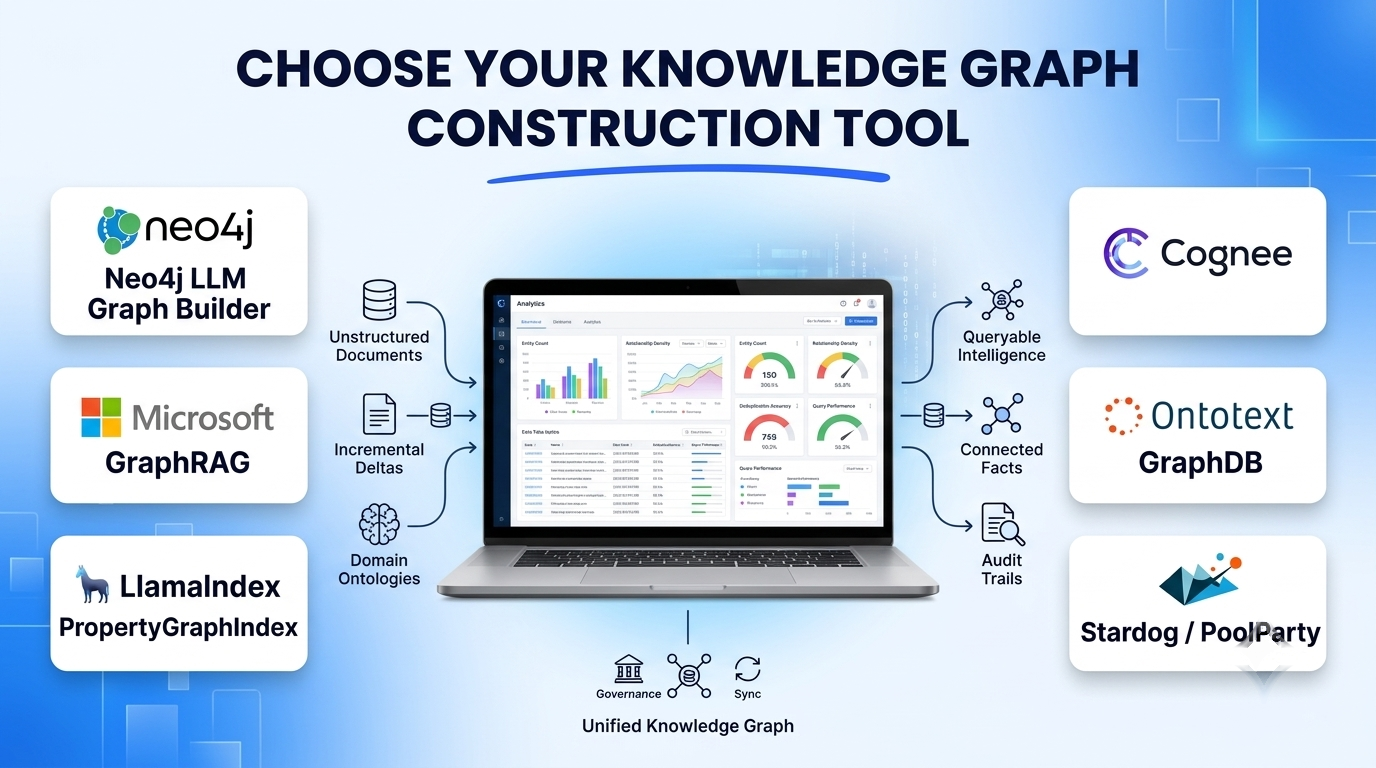
Neo4j LLM Knowledge Graph Builder (and Neo4j GraphRAG Python Package)
Neo4j pairs the industry’s most widely deployed native property graph database with dedicated LLM construction tooling. The Neo4j LLM Knowledge Graph Builder provides an open-source web interface and API pipeline that ingests PDFs, web pages, and documents, extracts entities and relationships guided by user-defined or auto-suggested schemas, performs entity deduplication, and writes directly into Neo4j alongside vector embeddings. For programmatic engineering pipelines, the official neo4j-graphrag Python package offers modular entity extractors, schema validators, and hybrid graph-plus-vector retrievers.
Organizations already running Neo4j—or teams needing a mature, ACID-compliant graph database with Cypher querying, visual graph exploration, and strong enterprise governance—gain an end-to-end construction and querying stack.
Microsoft GraphRAG (and Fast/Lazy GraphRAG Variants)
Microsoft Research’s open-source GraphRAG framework introduced a distinct architectural pattern for global corpus sensemaking: extracting entities and relationships via LLMs, clustering them into hierarchical communities using the Leiden algorithm, and pre-generating LLM summaries for each community. At query time, the system answers broad corpus-wide questions (“what are the top recurring systemic risks across all 2,000 audit reports?”) that standard vector RAG misses completely.
Research teams, intelligence analysts, and enterprises performing corpus-wide thematic synthesis benefit from GraphRAG’s hierarchical summaries. Its major trade-off is indexing cost and latency: full LLM community summarization across massive document sets consumes substantial tokens, motivating lighter incremental derivatives like LightRAG and nano-graphrag.
LlamaIndex PropertyGraphIndex
Inside the LlamaIndex ecosystem, PropertyGraphIndex provides a composable, Python-native abstraction for constructing and querying labeled property graphs. Developers can combine multiple extractors in parallel—such as strict schema-guided LLM extractors, implicit metadata extractors, and free-form triple extractors—and persist the resulting graph into Neo4j, Memgraph, FalkorDB, Amazon Neptune, or Kuzu while querying simultaneously via vector similarity and graph traversal.
Python teams already building on LlamaIndex who want to blend property-graph traversal with existing vector retrieval pipelines gain seamless interoperability without rewriting ingestion code.
Cognee
Cognee is an open-source, self-hostable AI memory and knowledge graph engine that unifies relational storage, vector embeddings, and ontology-driven graph construction into a declarative pipeline (add → cognify → search). Supporting temporal graph modes, custom domain ontologies, and feedback-driven edge re-weighting, Cognee bridges static document knowledge graphs with dynamic conversational agent memory.
Engineering teams wanting a lightweight, self-hosted Python pipeline that turns both static documents and live agent interactions into a queryable knowledge graph favor Cognee.
Enterprise Semantic & RDF/OWL Platforms (PoolParty, Ontotext GraphDB, Stardog)
For regulated life sciences, pharmaceuticals, finance, and government agencies where strict W3C standards (RDF, OWL, SKOS, SHACL) and deterministic taxonomy governance are mandatory, enterprise semantic platforms like PoolParty, Ontotext GraphDB, and Stardog combine curated corporate thesauri and NLP entity linking with LLM-assisted taxonomy expansion and SPARQL reasoning.
Knowledge Graph Construction Tools Comparison
| Tool / Platform | Graph Data Model | Schema & Entity Resolution | Storage Backends | Key Strength | Primary Limitation |
| Neo4j LLM Graph Builder | Labeled Property Graph (Cypher) | Schema-guided extraction + embedding deduplication | Neo4j (AuraDB & Self-Hosted) | Visual builder + mature production graph database & hybrid search | Tied to Neo4j database ecosystem |
| Microsoft GraphRAG | Property graph + hierarchical Leiden communities | LLM entity/relation extraction + community summaries | Parquet / Arrow files + vector stores | Unmatched global corpus sensemaking across broad questions | High upfront LLM token cost during indexing |
| LlamaIndex PropertyGraphIndex | Labeled Property Graph | Multi-extractor pipelines (strict schema + free-form) | Neo4j, FalkorDB, Memgraph, Neptune, Kuzu | Composable Python extractors & multi-backend portability | Requires Python engineering to configure custom resolution |
| Cognee | Unified relational + vector + ontology graph | Custom Pydantic ontologies + temporal edge tracking | Plug-and-play (Postgres, Neo4j, Kuzu, Qdrant) | Combines static document graphs with dynamic agent memory | Younger ecosystem than enterprise graph databases |
| Ontotext / Stardog / PoolParty | W3C Semantic Graph (RDF / OWL / SPARQL) | Formal taxonomies, SHACL validation & inference rules | Enterprise RDF triple stores | Strict regulatory compliance, reasoning & taxonomy governance | Steeper semantic-web learning curve & enterprise licensing |
Practical Pitfalls in LLM-Driven Graph Construction
- Skipping Ontology Constraints on Large Corpora: Allowing an LLM to invent arbitrary relationship labels across 50,000 documents creates a “hairball graph” with thousands of near-duplicate edge types that break deterministic queries. Always constrain extraction to 10–25 well-defined entity and relationship types.
- Underestimating Entity Resolution Complexity: Two distinct customers named “Acme Logistics” in different states should not be merged blindly, while “Alphabet Inc.” and “Google” must be linked cleanly. Combine blocking keys (tax IDs, domains, locations) with embedding thresholds before merging nodes.
- Using a Knowledge Graph When Hybrid Vector Search Suffices: If 95% of user questions are answered within single documents without multi-hop cross-document joins, maintaining a knowledge graph adds indexing cost and schema complexity without proportional accuracy gains.
Selecting the Right Knowledge Graph Construction Tool
Match your construction pipeline to your query patterns and governance standards:
- For Production Property Graphs With Visual & Programmatic Workflows: Start with Neo4j LLM Knowledge Graph Builder and the
neo4j-graphragSDK for balanced schema enforcement, deduplication, and Cypher querying. - For Global Summarization Over Large Unstructured Archives: Evaluate Microsoft GraphRAG (or LightRAG for lower indexing cost) when users ask broad thematic synthesis questions.
- For Composable Python Pipelines Across Multiple Graph Databases: Use LlamaIndex PropertyGraphIndex or Cognee to keep storage backends swappable.
- For Regulated Taxonomies and Formal Logical Reasoning: Choose Stardog, Ontotext GraphDB, or PoolParty when W3C RDF/OWL standards are required.
