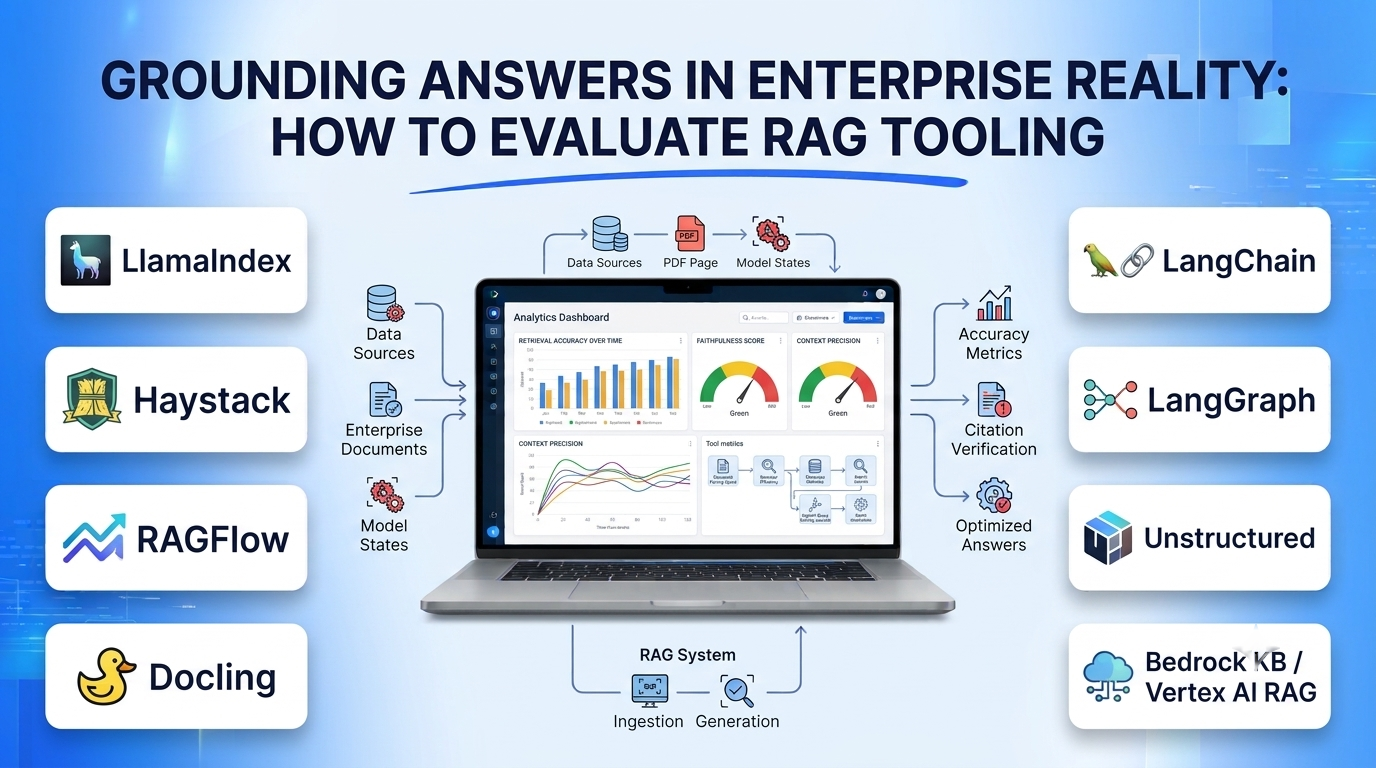
Wiring a vector database to a language model takes thirty lines of Python in a tutorial; getting that system to answer complex policy, financial, or technical questions accurately across ten thousand messy PDFs, multi-page spreadsheets, and Confluence pages is where most prototypes stall. When retrieval fails, even the strongest frontier LLM hallucinates confidently over incomplete or poorly chunked context.
Modern RAG tooling has evolved far beyond simple cosine-similarity vector lookups. Production architectures combine layout-aware document parsers, hybrid lexical-plus-dense retrievers, cross-encoder rerankers, and agentic query routers. Evaluating RAG tools requires distinguishing modular orchestration frameworks, turnkey self-hosted RAG engines, layout-aware document ingestion parsers, and managed cloud retrieval pipelines.
Five Core Capabilities That Separate Production RAG From Naive Vector Search
Before comparing frameworks or engines, engineering teams should evaluate five technical layers that govern retrieval precision and answer trustworthiness:
- Layout-Aware Document Parsing and Table Extraction: Naive PDF text extractors flatten multi-column layouts, destroy financial tables, and strip section headers—leaving embeddings with corrupted sentences. Production ingestion tools preserve document hierarchy, OCR scanned pages, and convert tables into structured Markdown or HTML before chunking.
- Semantic and Hierarchical Chunking: Fixed 500-token splits sever definitions from their exceptions. Advanced RAG pipelines use structure-aware chunking, parent-child document indexing (searching small granular chunks while feeding the surrounding parent section to the LLM), and contextual enrichment.
- Hybrid Retrieval and Cross-Encoder Reranking: Dense vector embeddings capture conceptual similarity (“car” ↔ “automobile”) but frequently miss exact SKU codes, error strings, or legal clause numbers. Production retrieval combines dense vectors with BM25 lexical search via Reciprocal Rank Fusion (RRF), followed by a cross-encoder reranker (such as Cohere Rerank or BGE-Reranker) to score the top candidates before generation.
- Citation Grounding and Hallucination Verification: Enterprise users rarely trust an unattributed summary. Strong RAG engines attach clickable chunk-level citations and verify that every factual claim in the response is entailed by retrieved source passages.
- Document-Level Access Control (ACL) Enforcement: If a junior employee queries a shared corporate RAG index, retrieval must strictly filter chunks against the user’s underlying SharePoint, Google Drive, or Confluence permissions before any context reaches the LLM.
Leading RAG Tooling Across Architectural Layers
LlamaIndex (and LlamaParse)
LlamaIndex is the most comprehensive data-centric framework in the open-source RAG ecosystem, offering hundreds of data connectors, specialized indexing abstractions (vector, summary, tree, and property-graph indexes), and built-in retrieval/generation evaluators (hit rate, MRR, faithfulness, context relevancy). Alongside the open-source framework, LlamaParse serves as its dedicated cloud parsing and extraction engine—handling complex nested tables, embedded charts, and multi-column PDFs cleanly.
Engineering teams building custom retrieval pipelines over heterogeneous enterprise documents and complex PDFs gain deep indexing flexibility from LlamaIndex. Because its abstractions span multiple layers, teams with simple linear retrieval needs should avoid over-engineering complex index hierarchies early on.
Haystack (by deepset)
Haystack is an open-source Python framework built around explicit, strongly typed directed pipelines with loops, branches, and conditional routing. Every component—embedders, hybrid retrievers, rerankers, prompt builders, and evaluators—declares explicit input/output types that are validated before execution and serializable to YAML, with Hayhooks serving pipelines directly as REST APIs or MCP endpoints.
Enterprise search and NLP teams that value inspectable pipeline topology, built-in statistical ranking metrics (NDCG, MAP, MRR, recall), and clean production deployment favor Haystack.
RAGFlow
Unlike code-first libraries, RAGFlow is a turnkey, open-source, self-hosted RAG engine complete with a web interface, visual chunk inspection, and API endpoints. Its standout capability is DeepDoc, a built-in document understanding module combining layout analysis, OCR, and table structure recognition across Word files, slide decks, spreadsheets, scans, and PDFs—paired with template-based chunking that lets domain experts inspect and manually refine chunks visually before indexing.
Organizations wanting a ready-to-deploy internal knowledge engine with strong document parsing and traceable inline citations—without building a custom frontend and ingestion pipeline from scratch—frequently adopt RAGFlow. Self-hosting requires dedicated compute resources (at least 16 GB RAM and Elasticsearch or Infinity as the backing search engine).
LangChain and LangGraph (Agentic RAG)
While traditional 2-step RAG always executes retrieval before generation, complex queries often require query decomposition, multi-hop retrieval across separate knowledge bases, and self-correction when initial chunks look irrelevant. LangChain provides the standardized retriever, text-splitter, and vector-store building blocks, while LangGraph orchestrates Agentic RAG loops with durable checkpointing, conditional retrieval retries, and human-in-the-loop verification.
Specialized Document Ingestion & Parsing Tools (Unstructured, Docling, Marker)
Because retrieval accuracy is capped by ingestion quality, many teams pair their vector database with a dedicated open-source document parser:
- Docling (by IBM Research, donated to the Linux Foundation) converts PDFs, DOCX, PPTX, and images into structured JSON and Markdown with high-accuracy table and reading-order extraction running locally.
- Unstructured provides modular partitioning and chunking pipelines across dozens of enterprise file formats, available both as an open-source library and a managed serverless ingestion API.
Managed Enterprise RAG Platforms (Amazon Bedrock Knowledge Bases, Vertex AI RAG Engine, Cohere Compass)
Cloud-native enterprises seeking zero-infrastructure maintenance often use managed RAG pipelines such as Amazon Bedrock Knowledge Bases or Google Vertex AI RAG Engine—which automate document chunking, managed vector storage, hybrid search, citation attribution, and cloud IAM governance behind a single API.
RAG Tooling Comparison
| Tool / Platform | Architectural Role | Document Parsing & Chunking | Retrieval & Ranking Strategy | Deployment & Licensing | Best Fit |
| LlamaIndex + LlamaParse | Data-centric RAG framework + commercial parser | Advanced table/layout parsing (LlamaParse) + hierarchical nodes | Vector, hybrid, property graph & reranker integrations | Open-source framework (MIT) + Managed Parse SaaS | Teams building custom RAG over complex PDFs & diverse data sources |
| Haystack | Modular typed pipeline framework | Modular converters, cleaners & hierarchical splitters | Dense, sparse (BM25), hybrid fusion & cross-encoder rerankers | Open-source (Apache 2.0) + Hayhooks API/MCP server | Engineering teams needing inspectable pipelines & ranking metrics |
| RAGFlow | Turnkey self-hosted RAG engine & UI | Built-in DeepDoc OCR, table recognition & visual chunk editor | Multi-recall hybrid retrieval + fused reranking + citations | Open-source (Apache 2.0) self-hosted (Docker) | Organizations wanting an out-of-the-box visual RAG portal |
| LangChain / LangGraph | Agentic & stateful RAG orchestration | Broad loader & splitter ecosystem | Corrective RAG, query routing & multi-hop agent loops | Open-source (MIT) + LangSmith commercial | Complex multi-step reasoning & self-correcting retrieval workflows |
| Docling / Unstructured | Document ingestion & layout parsing engines | Deep layout, OCR & structured Markdown/JSON export | Upstream ingestion layer for any vector/search engine | Open-source local execution + Unstructured Cloud | Teams fixing poor PDF/table extraction before indexing |
| Bedrock KB / Vertex AI RAG | Managed cloud RAG services | Automated managed chunking & multimodal parsing | Managed hybrid search, reranking & citation metadata | Managed AWS / Google Cloud infrastructure | Enterprises prioritizing zero ops & native cloud IAM compliance |
Common RAG Failure Modes and How to Avoid Them
- Tuning Prompts Before Measuring Retrieval Recall: When a RAG system gives vague or incorrect answers, 80% of the time the right chunk was never in the top-$k$ retrieved results. Always measure Retrieval Recall@k and Context Precision independently before tweaking generation prompts.
- Skipping Reranking in High-Precision Domains: Retrieving the top 50 candidates via fast hybrid search and compressing them down to the top 5 using a cross-encoder reranker consistently delivers one of the largest accuracy gains per dollar in RAG pipelines.
- Ignoring Incremental Sync and Stale Deletions: Uploading documents once is easy; keeping a vector index synchronized when source files are edited, renamed, or deleted in SharePoint or Google Drive requires tracking content hashes and deletion tombstones so obsolete policies stop surfacing.
Selecting the Right RAG Tooling
Match your tooling choice to your team’s engineering bandwidth and document complexity:
- For Turnkey Internal Knowledge Search With Visual Chunk Control: Deploy RAGFlow so teams get DeepDoc parsing, visual chunk debugging, and cited answers out of the box.
- For Custom Python Engineering Over Messy Enterprise PDFs: Pair Docling or LlamaParse for layout-accurate Markdown extraction with LlamaIndex or Haystack for hybrid retrieval and reranking.
- For Multi-Hop Agentic Research and Self-Correcting Queries: Orchestrate retrieval tools inside LangGraph so the agent can rewrite failed queries and synthesize across multiple sources.
