Introduction
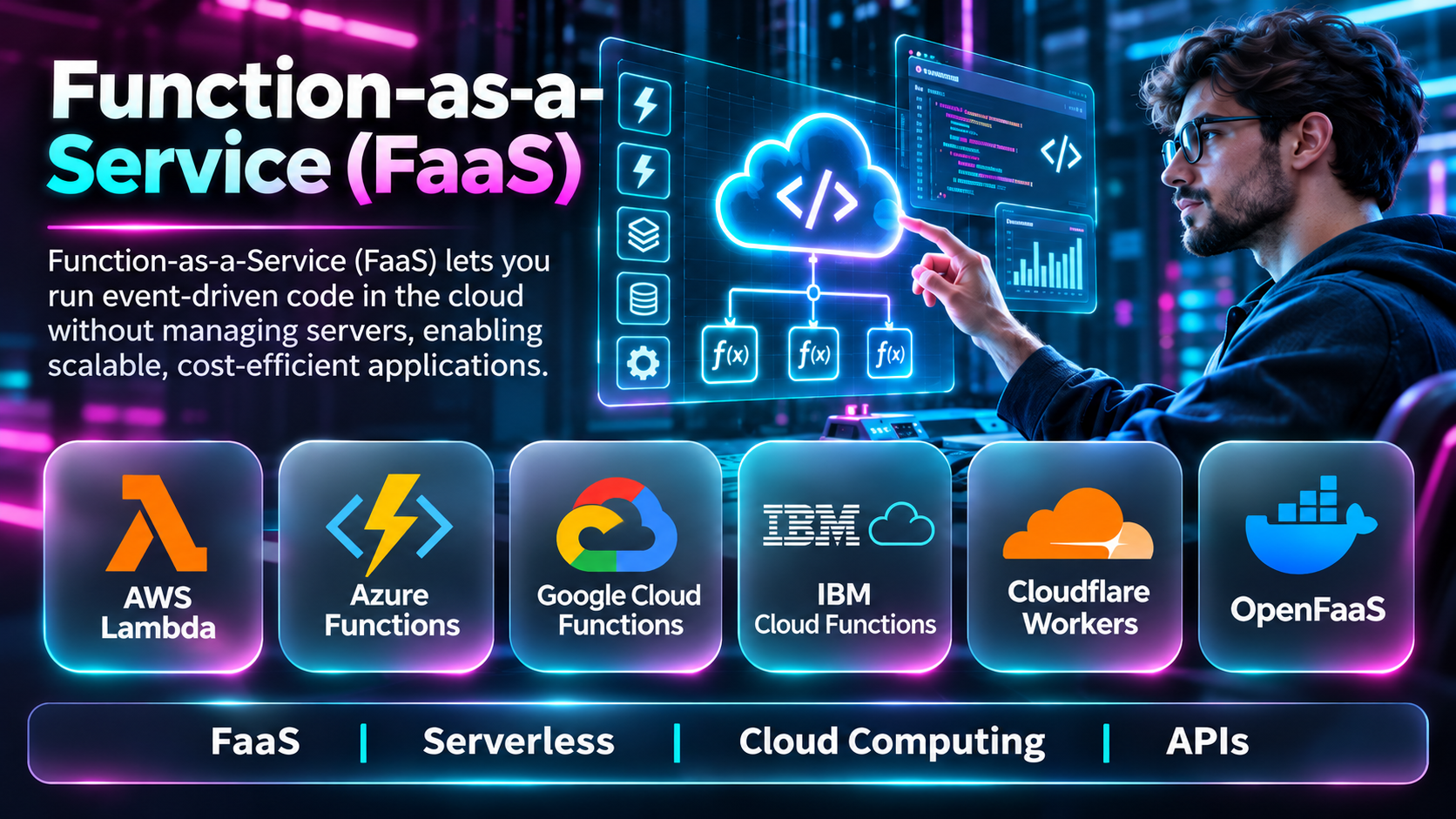
Function-as-a-Service (FaaS) platforms let developers run individual pieces of application code without managing the servers that execute them.
A function might validate a payment notification, resize an uploaded image, process a message, or respond to an API request. Instead of keeping an application server running continuously, the function executes when an event or request triggers it.
This model can simplify infrastructure operations, particularly for intermittent workloads and event-driven applications. It also allows teams to separate application responsibilities into independently deployable components.
However, FaaS is not automatically the right solution for every application. Function execution limits, cold starts, state management, networking, security, and observability can complicate production systems.
Managed cloud platforms provide convenient integrations, while open-source FaaS frameworks offer more deployment control. Choosing between them requires an understanding of both application requirements and operational capabilities.
This guide compares ten FaaS platforms and explains their features, benefits, limitations, and practical uses.
What Is Function-as-a-Service (FaaS)?
Function-as-a-Service is a cloud execution model in which developers deploy individual functions that run when triggered.
The platform manages the underlying execution infrastructure, including resource allocation and aspects of scaling.
A typical FaaS architecture includes a function, an event source, execution permissions, supporting services, and monitoring.
How FaaS Works
- A developer writes a function.
- The function is packaged and deployed.
- A request or event invokes the function.
- The platform allocates execution resources.
- The function processes its input.
- Results are returned or stored.
- Logs and metrics capture execution behavior.
FaaS vs. Serverless Computing
FaaS is a specific form of serverless computing.
Serverless is a broader category that may also include managed databases, container execution, messaging, and backend services.
Common FaaS Applications
- HTTP APIs and webhooks
- File processing
- Scheduled automation
- Queue consumers
- Database event handling
- Data transformation
- Notification processing
- IoT events
- Lightweight AI orchestration
- Integration workflows
Top 10 Function-as-a-Service Platforms
1. AWS Lambda
Short Description
AWS Lambda is one of the most established managed FaaS services. It executes functions in response to HTTP requests, cloud events, queue messages, schedules, and other supported triggers.
It is especially useful for organizations already using AWS services such as Amazon S3, DynamoDB, EventBridge, SQS, and API Gateway.
For example, an e-commerce platform can invoke Lambda when a new order enters a queue, validate the order, update records, and trigger downstream notifications.
Lambda offers substantial flexibility in runtime packaging, concurrency configuration, and cloud integrations. Nevertheless, teams need to manage permissions, execution limits, retries, and dependencies carefully.
Key Features
- Event source integrations: Connects functions with supported AWS events.
- Automatic scaling: Adjusts execution capacity to incoming requests.
- Multiple runtimes: Supports several development languages.
- Container packaging: Enables container-image-based functions.
- Concurrency configuration: Controls simultaneous executions.
- IAM permissions: Restricts access to AWS resources.
- Versioning: Supports controlled releases.
- Monitoring: Integrates with CloudWatch metrics and logs.
- Provisioned concurrency: Supports reduced initialization latency for suitable workloads.
Benefits
Lambda provides a mature FaaS environment with extensive AWS integration and automated execution infrastructure.
Pros
- Broad event ecosystem
- Managed scaling
- Mature developer tooling
- Flexible packaging
- Granular access controls
- Strong AWS compatibility
Cons
- AWS dependence
- Execution duration limits
- Cold-start behavior
- Complex permission design
- Potentially difficult distributed debugging
Use Cases
Order processing, file transformation, API endpoints, scheduled jobs, and event-driven integrations.
Best For: AWS teams building production event-driven applications.
2. Azure Functions
Short Description
Azure Functions provides event-driven function execution within Microsoft’s cloud ecosystem.
It supports HTTP endpoints, timers, message queues, storage events, and other integrations. Its binding system can reduce repetitive integration code for supported services.
Organizations using Azure Active Directory-related identity services, Azure Storage, Service Bus, and Event Grid may find it particularly convenient.
Azure Functions also offers Durable Functions for orchestrating stateful workflows that extend beyond a single function invocation.
The platform requires careful selection of hosting plans and execution configurations, especially when predictable latency or enterprise networking is important.
Key Features
- Triggers: Starts functions from supported events.
- Bindings: Connects functions with external services.
- Durable Functions: Coordinates stateful workflows.
- Language support: Supports multiple runtimes.
- Hosting choices: Offers different scaling and resource models.
- Azure integration: Connects with native services.
- Identity controls: Supports managed identities.
- Monitoring integration: Works with Azure observability tools.
- Deployment pipelines: Supports automated releases.
Benefits
Azure Functions combines managed execution with enterprise integration and workflow capabilities.
Pros
- Microsoft ecosystem alignment
- Durable orchestration
- Useful triggers and bindings
- Multiple hosting configurations
- Enterprise identity integration
- Strong development tools
Cons
- Hosting model complexity
- Configuration overhead
- Cold starts on some plans
- Azure-specific integrations
- Cost comparisons require care
Use Cases
Business automation, HTTP APIs, enterprise messaging, scheduled tasks, and workflow coordination.
Best For: Organizations developing within Microsoft Azure.
3. Google Cloud Run Functions
Short Description
Google Cloud Run functions provides managed function deployment and execution within Google Cloud’s serverless environment.
It supports HTTP-triggered and event-driven workloads, allowing developers to create application logic without managing underlying servers.
Google Cloud integrations make it useful for responding to storage events, messages, and application requests.
Its relationship with Cloud Run infrastructure provides a modern foundation for function execution.
Developers still need to evaluate trigger configuration, runtime support, permissions, concurrency, and service limits.
Key Features
- HTTP invocation: Executes functions from requests.
- Event-driven triggers: Supports relevant cloud events.
- Managed infrastructure: Reduces server administration.
- Google Cloud integration: Connects with native services.
- Runtime support: Accommodates supported languages.
- Scaling: Adjusts execution resources.
- IAM security: Controls invocation and resource access.
- Logging: Captures operational information.
- Deployment tooling: Supports automated releases.
Benefits
Cloud Run functions provides a managed FaaS option for Google Cloud applications.
Pros
- Google Cloud integration
- Managed execution
- Event-driven capabilities
- Developer-friendly deployment
- Monitoring integration
- Suitable for backend automation
Cons
- Cloud ecosystem dependence
- Trigger configuration complexity
- Execution constraints
- Startup latency considerations
- Service-specific operational requirements
Use Cases
Cloud event handling, APIs, data processing, and automated workflows.
Best For: Google Cloud development teams.
4. Cloudflare Workers
Short Description
Cloudflare Workers provides serverless execution through a distributed network, making it particularly useful for HTTP request processing and edge applications.
Developers can implement authentication logic, request transformations, routing decisions, and lightweight APIs.
For globally distributed applications, processing suitable requests near network entry points can reduce unnecessary trips to centralized infrastructure.
Workers also connects with Cloudflare’s storage and application services.
However, its execution environment differs from conventional server runtimes, so compatibility and resource requirements must be assessed.
Key Features
- Edge execution: Runs logic across distributed infrastructure.
- HTTP handling: Processes requests and responses.
- JavaScript compatibility: Supports relevant web development tooling.
- Routing integration: Associates functions with configured routes.
- Storage services: Integrates with supported Cloudflare products.
- Deployment tooling: Supports automated publishing.
- Environment configuration: Manages application settings.
- Operational logging: Supports debugging and monitoring.
Benefits
Workers supports globally distributed application logic without conventional server management.
Pros
- Distributed execution
- Strong web integration
- Rapid deployment
- Low infrastructure overhead
- Useful edge capabilities
- Cloudflare ecosystem
Cons
- Runtime compatibility differences
- Resource restrictions
- Platform-specific APIs
- Not ideal for all compute-intensive tasks
- Architectural learning curve
Use Cases
API gateways, personalization, redirects, request validation, and edge applications.
Best For: Web developers building distributed request-processing functions.
5. OpenFaaS
Short Description
OpenFaaS is an open-source framework for deploying functions and related workloads using container infrastructure.
It appeals to teams that want greater control over their FaaS environment rather than relying entirely on a managed cloud service.
Organizations can deploy OpenFaaS in suitable Kubernetes environments and integrate it with existing operational practices.
Container-based packaging supports flexible dependencies and application runtimes.
However, the organization remains responsible for substantial infrastructure operations, including cluster reliability, security, scaling configuration, and monitoring.
Key Features
- Container-based functions: Packages workloads using containers.
- Kubernetes integration: Supports suitable cluster deployments.
- Function templates: Simplifies project creation.
- HTTP invocation: Exposes function endpoints.
- Autoscaling capabilities: Supports workload scaling.
- CLI tooling: Manages development and deployment.
- Metrics integration: Supports operational visibility.
- Custom runtimes: Allows flexible function packaging.
Benefits
OpenFaaS provides deployment control and flexibility for teams operating their own infrastructure.
Pros
- Open-source foundation
- Container flexibility
- Infrastructure control
- Kubernetes compatibility
- Custom runtime support
- Suitable for private environments
Cons
- Self-hosted operations
- Kubernetes expertise
- Security maintenance
- Scaling configuration
- Support and feature differences by offering
Use Cases
Private-cloud functions, internal automation, Kubernetes workloads, and custom execution environments.
Best For: Platform teams seeking self-managed FaaS.
6. Knative
Short Description
Knative is an open-source Kubernetes-based platform for serverless workloads and event-driven applications.
It provides components for serving applications and connecting event producers with consumers.
Knative is particularly relevant to organizations that already operate Kubernetes and want serverless-style deployment and scaling capabilities within their clusters.
Rather than offering a fully managed cloud service by itself, Knative provides infrastructure building blocks that platform teams can configure and operate.
This flexibility is valuable, but it also introduces networking, cluster management, and operational complexity.
Key Features
- Kubernetes integration: Builds on existing clusters.
- Knative Serving: Supports managed application deployment.
- Autoscaling: Adjusts workload instances.
- Scale-to-zero: Supports idle workload reduction.
- Revision management: Tracks application deployments.
- Traffic splitting: Supports gradual releases.
- Eventing components: Connects event sources and consumers.
- Container support: Runs compatible container workloads.
Benefits
Knative helps Kubernetes teams create internal serverless platforms while retaining infrastructure control.
Pros
- Open-source
- Kubernetes-native
- Flexible container workloads
- Event-driven architecture
- Revision controls
- Infrastructure ownership
Cons
- Kubernetes operational burden
- Networking complexity
- Cluster maintenance
- Steeper learning curve
- Requires platform engineering resources
Use Cases
Internal developer platforms, event-driven services, Kubernetes automation, and container-based functions.
Best For: Organizations with mature Kubernetes operations.
7. Apache OpenWhisk
Short Description
Apache OpenWhisk is an open-source serverless computing platform designed for event-driven function execution.
It supports actions that execute application code and triggers that initiate workflows.
OpenWhisk can be used to build automation systems, backend processing, and event-oriented applications.
Its open-source nature allows organizations to deploy and customize the platform within their own environments.
However, operating OpenWhisk requires infrastructure expertise, and organizations should assess ecosystem activity, deployment complexity, and long-term maintenance needs.
Key Features
- Actions: Encapsulates executable function logic.
- Triggers: Responds to defined events.
- Rules: Connects triggers with actions.
- Sequences: Chains actions into workflows.
- Multiple runtimes: Supports suitable programming environments.
- API integration: Exposes function endpoints.
- Open-source deployment: Enables self-managed environments.
- Extensibility: Supports custom integration patterns.
Benefits
OpenWhisk offers an open-source execution model for event-driven applications.
Pros
- Open-source
- Event-oriented architecture
- Workflow sequencing
- Runtime flexibility
- Deployment control
- Customizable integrations
Cons
- Self-hosting complexity
- Infrastructure maintenance
- Operational learning curve
- Smaller managed ecosystem
- Requires careful scaling design
Use Cases
Event automation, internal functions, integration processing, and custom serverless platforms.
Best For: Teams researching or operating open-source FaaS infrastructure.
8. Oracle Cloud Infrastructure Functions
Short Description
OCI Functions provides managed function execution for applications deployed in Oracle Cloud Infrastructure.
It uses container-oriented packaging and supports event-driven workloads.
Enterprises using Oracle databases and other OCI services can employ Functions for integration, automation, and API processing.
The service can reduce the need to provision dedicated application servers for short-running tasks.
Its main consideration is ecosystem fit: organizations should examine OCI service integration, execution constraints, and deployment processes.
Key Features
- Managed execution: Runs functions without direct server administration.
- Container packaging: Supports container-based deployment.
- Event triggers: Responds to supported OCI events.
- API invocation: Enables HTTP-driven workflows.
- OCI integration: Connects with Oracle services.
- Identity management: Controls permissions.
- Logging: Supports troubleshooting.
- Deployment tooling: Supports release automation.
Benefits
OCI Functions extends event-driven compute to Oracle Cloud environments.
Pros
- Oracle ecosystem integration
- Managed operations
- Container-based deployment
- Event processing
- Enterprise cloud alignment
- Automation support
Cons
- OCI-specific knowledge
- Smaller integration ecosystem
- Runtime constraints
- Portability planning
- Deployment configuration requirements
Use Cases
Oracle cloud automation, event handling, API processing, and system integration.
Best For: OCI-based enterprises.
9. DigitalOcean Functions
Short Description
DigitalOcean Functions offers managed execution for on-demand functions.
It is useful for developers who want serverless capabilities without designing an extensive infrastructure platform.
Functions can support lightweight APIs, webhook processing, scheduled operations, and other backend tasks.
Its relationship with DigitalOcean’s cloud ecosystem makes it an option for smaller development teams already using the provider.
However, teams should verify language support, execution constraints, integration capabilities, and workload suitability.
Key Features
- On-demand functions: Executes code when invoked.
- Managed infrastructure: Reduces server operations.
- HTTP endpoints: Supports API-oriented tasks.
- Deployment tooling: Enables function releases.
- Supported runtimes: Runs selected languages.
- Cloud integration: Works with relevant platform services.
- Execution scaling: Handles varying invocation demand.
- Operational visibility: Provides execution information.
Benefits
DigitalOcean Functions offers a simpler path to managed function execution for modest workloads.
Pros
- Accessible developer experience
- Minimal server management
- Lightweight backend support
- Cloud ecosystem integration
- Straightforward deployment
- Suitable for small projects
Cons
- Limited specialized integrations
- Execution restrictions
- Smaller ecosystem
- Less enterprise functionality
- Portability considerations
Use Cases
Webhooks, backend utilities, API endpoints, and small automation workflows.
Best For: Independent developers and small teams.
10. Alibaba Cloud Function Compute
Short Description
Alibaba Cloud Function Compute is a managed FaaS platform supporting event-driven applications and HTTP workloads.
It is integrated with Alibaba Cloud services and can execute functions without requiring teams to maintain dedicated servers.
Organizations can use it to process cloud events, implement APIs, transform data, and automate operational tasks.
Its suitability depends on the organization’s cloud strategy, geographic requirements, and service integration needs.
Developers should also evaluate execution limits, regional capabilities, and cost behavior under realistic workloads.
Key Features
- Event-driven functions: Executes code from supported triggers.
- Managed scaling: Adjusts execution resources.
- HTTP invocation: Supports API workloads.
- Runtime options: Supports applicable programming environments.
- Alibaba integrations: Connects with native services.
- Resource configuration: Supports execution tuning.
- Monitoring: Exposes logs and metrics.
- Deployment automation: Supports application releases.
Benefits
Function Compute provides managed FaaS capabilities for Alibaba Cloud applications.
Pros
- Native cloud integration
- Managed infrastructure
- Event-driven processing
- HTTP support
- Scalable execution
- Regional cloud options
Cons
- Alibaba ecosystem dependence
- Regional capability differences
- Service-specific configuration
- Migration complexity
- Cost planning requirements
Use Cases
Event processing, APIs, data transformation, and cloud automation.
Best For: Organizations using Alibaba Cloud.
Function-as-a-Service Platforms Comparison Table
| Platform | Deployment Model | Main Strength | Best For |
|---|---|---|---|
| AWS Lambda | Managed AWS | Extensive event integrations | AWS developers |
| Azure Functions | Managed Azure | Enterprise workflows | Azure teams |
| Cloud Run functions | Managed Google Cloud | Google Cloud events | GCP developers |
| Cloudflare Workers | Distributed managed | Edge request processing | Web APIs |
| OpenFaaS | Self-hosted | Container flexibility | Platform teams |
| Knative | Kubernetes-based | Internal serverless platform | Kubernetes teams |
| Apache OpenWhisk | Self-hosted | Event-driven actions | Open-source deployments |
| OCI Functions | Managed OCI | Oracle integration | OCI enterprises |
| DigitalOcean Functions | Managed cloud | Simple deployment | Small teams |
| Alibaba Function Compute | Managed Alibaba Cloud | Native cloud events | Alibaba Cloud users |
How to Choose the Best FaaS Platform
1. Identify Trigger Requirements
List the events that must invoke functions, including HTTP requests, queues, database changes, and schedules.
2. Review Execution Limits
Evaluate memory, runtime duration, payload size, and concurrency.
3. Compare Runtime Support
Confirm compatibility with the team’s programming languages and dependencies.
4. Evaluate Integration Capabilities
Native cloud integrations can simplify development but may increase vendor dependence.
5. Consider Deployment Control
Managed services reduce operations. Self-hosted frameworks offer more infrastructure control.
6. Test Cold-Start Behavior
Measure startup latency under realistic traffic conditions.
7. Design Failure Handling
Plan retries, idempotency, dead-letter queues, and error recovery.
8. Review Security
Protect function endpoints, credentials, secrets, and downstream permissions.
9. Evaluate Observability
Ensure that logs, metrics, and traces support incident investigation.
10. Estimate Total Cost
Include invocations, execution duration, memory, networking, supporting services, and operational labor.
Best FaaS Platforms by User Type
| User Type | Recommended Platform | Reason |
|---|---|---|
| AWS backend developer | AWS Lambda | AWS event ecosystem |
| Microsoft enterprise developer | Azure Functions | Azure integrations |
| Google Cloud engineer | Cloud Run functions | Native Google Cloud execution |
| Edge API developer | Cloudflare Workers | Distributed HTTP handling |
| Self-hosted platform engineer | OpenFaaS | Container-based functions |
| Kubernetes platform team | Knative | Kubernetes-native serverless |
| Open-source infrastructure team | Apache OpenWhisk | Custom event-driven platform |
| Oracle cloud developer | OCI Functions | OCI compatibility |
| Independent developer | DigitalOcean Functions | Simpler managed execution |
| Alibaba Cloud developer | Function Compute | Native integrations |
Practical Example: Building an Event-Driven Order Notification System
An online store needs to send order confirmation messages after successful purchases.
Step 1: Define the Event
Create an event when an order is confirmed.
Step 2: Select a FaaS Platform
Choose a service compatible with the existing cloud infrastructure.
Step 3: Implement the Function
Write code that validates the event and prepares a notification.
Step 4: Configure the Trigger
Connect the function to an event bus or message queue.
Step 5: Add Idempotency
Ensure duplicate events do not create duplicate notifications.
Step 6: Secure Credentials
Store messaging service credentials in an appropriate secrets system.
Step 7: Handle Failures
Implement retry policies and dead-letter processing.
Step 8: Add Monitoring
Track successful invocations, failures, retries, and processing latency.
Step 9: Test Traffic Spikes
Simulate high order volume.
Step 10: Review Costs
Measure function usage and supporting messaging expenses.
Step 11: Deploy Gradually
Release the function to a limited environment before full production.
Step 12: Improve Reliability
Review failure patterns and adjust execution configuration.
Common Challenges With FaaS
Cold starts: Initialization can increase request latency.
Stateless execution: Persistent state usually requires external storage.
Duplicate events: Retry behavior can cause repeated processing.
Timeouts: Long-running work may exceed execution limits.
Vendor lock-in: Cloud-specific triggers can complicate migration.
Observability: Distributed functions require consistent tracing and logs.
Concurrency: High invocation volume can overload downstream services.
Security: Overly broad permissions increase risk.
Frequently Asked Questions
1. What is FaaS?
FaaS is a cloud execution model that runs functions in response to requests or events.
2. How is FaaS different from serverless?
FaaS is one category within the broader serverless computing model.
3. Does FaaS eliminate servers?
No. It shifts much of server management to the platform provider or infrastructure operator.
4. What triggers a FaaS function?
HTTP requests, messages, schedules, cloud events, and other supported triggers.
5. Is AWS Lambda a FaaS platform?
Yes. AWS Lambda is a managed function execution service.
6. Is Azure Functions serverless?
Yes. It provides managed function execution through supported hosting models.
7. What is a cold start?
It is the initialization required when a function execution environment is not already ready.
8. Can FaaS support APIs?
Yes. Functions can implement HTTP endpoints and backend application logic.
9. Can functions run continuously?
Most FaaS environments have execution limits and are not intended for indefinite processing.
10. What is function concurrency?
It is the number of function executions running simultaneously.
11. What is an event trigger?
It is a condition or message that initiates function execution.
12. What is idempotency?
It means repeated processing of the same operation does not produce unintended additional effects.
13. Can FaaS access databases?
Yes, with appropriate network access, permissions, and connection management.
14. Is FaaS appropriate for microservices?
Yes, particularly for independently triggered components.
15. What is OpenFaaS?
OpenFaaS is an open-source framework for deploying functions using container infrastructure.
16. What is Knative?
Knative provides Kubernetes-based components for serverless workloads and event processing.
17. What is Apache OpenWhisk?
It is an open-source platform for event-driven function execution.
18. Can FaaS run on private infrastructure?
Yes, using suitable self-hosted frameworks.
19. What is the benefit of managed FaaS?
It reduces direct responsibility for execution infrastructure.
20. What are the disadvantages of self-hosted FaaS?
Teams must operate the underlying platform, scaling, networking, and security.
21. How is FaaS priced?
Managed services commonly charge based on execution-related usage, though models vary.
22. Can FaaS process uploaded files?
Yes. Storage events can trigger file-processing functions.
23. Can FaaS support scheduled tasks?
Yes, where the platform provides schedule-based triggers.
24. Is FaaS suitable for real-time applications?
It can be, provided latency and execution behavior meet the requirements.
25. What is a dead-letter queue?
It stores messages or events that could not be processed successfully.
26. Why are retries important?
They help recover from temporary failures, but must be designed to avoid duplicate side effects.
27. How do teams secure functions?
They use least-privilege permissions, authenticated endpoints, secrets management, and monitoring.
28. Can FaaS be used for AI applications?
Yes, for suitable inference requests, event processing, and orchestration tasks.
29. How do teams test FaaS?
Through unit, integration, load, security, and failure-recovery testing.
30. What is the best FaaS platform?
It depends on trigger support, cloud integrations, execution requirements, operational control, and cost.
Final Thoughts
Function-as-a-Service platforms help developers build event-driven systems without maintaining dedicated servers for every task.
AWS Lambda, Azure Functions, and Google Cloud Run functions offer managed execution within major cloud ecosystems. Cloudflare Workers provides distributed web-oriented execution.
OpenFaaS, Knative, and Apache OpenWhisk provide alternatives for teams seeking greater infrastructure control. OCI Functions, DigitalOcean Functions, and Alibaba Cloud Function Compute serve additional cloud environments.
The best FaaS platform is the one that matches the application’s execution model, integration requirements, reliability targets, and operational capabilities.
Successful FaaS adoption also depends on disciplined event design, secure permissions, idempotent processing, meaningful observability, and careful cost management.
