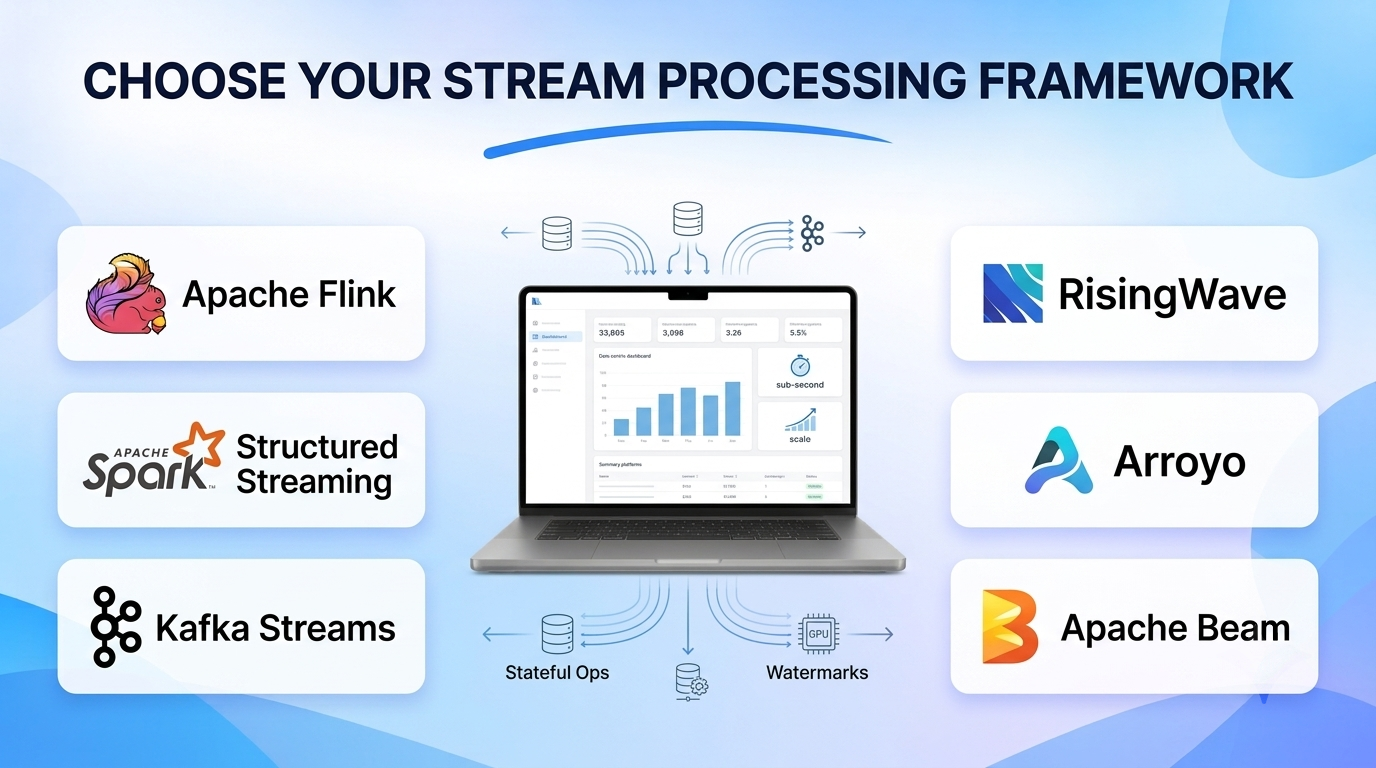
Moving events from point A to point B with a streaming broker solves only half of a real-time data architecture. The harder engineering problem begins when applications must enrich, join, deduplicate, and aggregate unbounded data streams as events arrive—especially when mobile clients send out-of-order packets minutes late or nodes crash mid-calculation.
Choosing a stream processing framework requires balancing latency against operational complexity. Some teams need sub-second stateful windowing with strict exactly-once guarantees, while others simply want SQL transformations running incrementally over cloud object storage without managing a dedicated cluster of stateful compute nodes.
What Distinguishes Stream Processing From Simple Event Consumption
Writing a stateless consumer loop that reads JSON messages from Kafka and inserts rows into a database is straightforward. Stream processing frameworks become necessary when pipelines require:
- Stateful Operations: Maintaining running counts, session states, or sliding-window aggregations across millions of keys in fault-tolerant local storage.
- Event-Time Semantics and Watermarks: Handling records based on when an action actually occurred rather than when a server received the packet, using watermarks to decide when late-arriving data should still update a window.
- Distributed Checkpointing and Exactly-Once Processing: Snapshotting operator state periodically so that if a worker crashes, the pipeline recovers without double-counting transactions or dropping events.
Major Stream Processing Frameworks and Architectural Approaches
Apache Flink
Apache Flink is the industry benchmark for true event-at-a-time, stateful stream processing. Rather than grouping incoming records into small timed batches, Flink processes each event immediately as it arrives, maintaining large state locally in RocksDB and taking asynchronous distributed snapshots (based on the Chandy-Lamport algorithm) to guarantee exactly-once state consistency. It supports DataStream APIs in Java and Python alongside a mature Flink SQL engine.
Organizations running complex event-driven applications—such as real-time fraud scoring, dynamic pricing, multi-stream temporal joins, and high-throughput CDC pipelines—rely on Flink when millisecond latency and sophisticated watermark handling are non-negotiable. The primary cost is operational expertise: tuning RocksDB memory, managing state backends, and debugging backpressure on self-hosted clusters require seasoned distributed-systems engineers, though managed offerings from Confluent, Ververica, and AWS ease deployment.
Apache Spark Structured Streaming
Spark Structured Streaming extends Apache Spark’s unified analytics engine to continuous data streams using a micro-batch execution model by default (alongside an experimental low-latency continuous processing mode). By treating an unbounded stream as an endlessly appending table, Spark lets engineers reuse the exact same DataFrame and SQL code across historical batch backfills and live streaming pipelines.
Data engineering teams already standardized on Apache Spark or Databricks for batch lakehouse processing adopt Structured Streaming to avoid maintaining two separate compute engines. Its architectural trade-off is latency and complex streaming joins: micro-batch scheduling typically yields latencies ranging from hundreds of milliseconds to several seconds, and multi-way stream-to-stream outer joins offer fewer state-control primitives than Flink.
Kafka Streams
Kafka Streams is not a standalone cluster framework—it is a lightweight Java/Scala client library embedded directly inside standard microservice applications. Because it relies entirely on Apache Kafka topics for partitioning, fault tolerance, and internal changelog state stores (backed by local RocksDB instances), teams deploy Kafka Streams apps using standard Kubernetes deployments, Docker containers, or virtual machines without standing up a separate JobManager/TaskManager cluster.
Software engineering teams building event-driven microservices in Java or Kotlin that read from Kafka and write back to Kafka gain massive operational simplicity from Kafka Streams. Its boundaries are clear: it works exclusively with Kafka as its messaging backbone, offers no native Python authoring API, and is less suited for heavy analytical multi-source joins across external databases.
RisingWave
RisingWave reimagines stream processing as a cloud-native, PostgreSQL-compatible streaming database. Rather than writing procedural Java or Scala state-management code, engineers express continuous transformations, windowed aggregations, and multi-way streaming joins as declarative SQL materialized views. RisingWave decouples compute from storage by persisting internal state directly to object storage (such as S3) with tiered caching, simplifying scaling and failure recovery.
Analytics engineers and backend teams who prefer standard Postgres SQL over JVM stream-processing code—and want downstream applications to query live materialized views directly—find RisingWave substantially easier to operate than self-managed Flink. As a newer entrant compared to decade-old Apache projects, buyers should verify connector breadth and custom UDF requirements for specialized workloads.
Arroyo
Arroyo is an open-source, Rust-based distributed stream processing engine designed for high throughput, low memory overhead, and serverless-friendly cloud execution. Supporting SQL and Rust pipelines with native Kafka, Kinesis, Iceberg, and Parquet integrations, Arroyo avoids JVM garbage-collection pauses while offering a clean web UI for inspecting pipeline topologies, watermarks, and throughput metrics.
Platform teams seeking high-performance SQL stream processing without Java runtime tuning—particularly those streaming directly into Apache Iceberg data lakes—benefit from Arroyo’s modern architecture. Its ecosystem of community connectors and third-party enterprise integrations remains smaller than Flink’s or Spark’s.
Bytewax
Bytewax brings stateful stream processing natively into the Python ecosystem by wrapping a Rust-powered Timely Dataflow execution engine behind a Pythonic dataflow API. Data scientists and ML engineers can write stateful windowing, enrichment, and sessionization pipelines using standard Python libraries (NumPy, pandas, PyTorch, Hugging Face) without rewriting feature-engineering logic into Java or Scala.
Machine learning teams building real-time feature pipelines, LLM document-ingestion streams, and Python-centric anomaly detectors adopt Bytewax to keep transformation logic in one language. For massive multi-terabyte state management across hundreds of nodes, JVM-based Flink still offers deeper enterprise tooling.
Apache Beam
Apache Beam provides a unified programming model (SDKs in Java, Python, and Go) that abstracts away the underlying execution engine. Developers write a single batch-or-streaming pipeline definition and execute it across portable runners including Google Cloud Dataflow, Apache Flink, and Apache Spark.
Organizations running on Google Cloud Dataflow—or enterprises determined to avoid locking pipeline code to a single execution runtime—use Beam for portability and unified batch/streaming semantics. In practice, debugging runner-specific performance bottlenecks often still requires understanding the underlying engine (such as Dataflow or Flink), and abstraction layers can lag behind the newest native features of a specific runner.
Stream Processing Framework Comparison
| Framework | Execution Model | Primary Language / Interface | State Management | Best Fit | Key Trade-Off |
| Apache Flink | True event-at-a-time streaming | Java, Scala, Python, Flink SQL | Local RocksDB + distributed checkpoints | Complex stateful apps, low latency, and heavy CDC/ETL | High operational and tuning complexity self-hosted |
| Spark Structured Streaming | Micro-batch (default) over unified engine | SQL, Python, Scala, Java | HDFS/S3 state store checkpoints | Teams unifying batch and streaming on Spark/Databricks | Higher baseline latency (hundreds of ms to seconds) |
| Kafka Streams | Embedded client library (no separate cluster) | Java, Scala | Local RocksDB + Kafka changelog topics | Kafka-centric microservices needing stateful transformations | Kafka-only input/output; JVM-only API |
| RisingWave | Cloud-native streaming database | PostgreSQL-compatible SQL | Disaggregated state persisted in object storage | SQL-first teams maintaining live materialized views | Smaller plugin ecosystem than legacy JVM frameworks |
| Arroyo | Rust-native distributed streaming engine | SQL and Rust | Object-storage checkpoints with low-footprint state | High-efficiency SQL streaming and Iceberg lake ingestion | Newer ecosystem with fewer legacy enterprise connectors |
| Bytewax | Rust Timely Dataflow core with Python API | Python | Local/distributed state backends in Python workers | Real-time ML feature engineering and Python data teams | Smaller horizontal scale footprint than mature Flink clusters |
| Apache Beam | Portable abstraction layer across runners | Java, Python, Go | Delegated to chosen runner (e.g., Dataflow, Flink) | Google Cloud Dataflow users and multi-runner portability | Abstraction overhead when tuning engine-specific edge cases |
Four Architectural Questions Before Selecting a Framework
- What Is Your True Latency Budget? If downstream consumers require responses in under 50 milliseconds, micro-batch architectures will struggle; choose event-at-a-time engines like Flink, Kafka Streams, or Arroyo. If five-to-thirty-second freshness satisfies business needs, micro-batch streaming or incremental SQL tables dramatically reduce operational risk.
- Where Does State Live During Recovery? Large windowed joins can accumulate hundreds of gigabytes of state. Verify whether recovery requires reloading massive state snapshots over the network or if disaggregated object-storage caching accelerates restarts.
- Who Will Debug Production Backpressure? A framework written in Java/Scala creates an ownership gap if your team consists entirely of Python data scientists or SQL analytics engineers.
- How Will You Handle Historical Backfills? Processing real-time streams is only half the lifecycle; sooner or later a business rule changes and you must reprocess six months of historical events from object storage without duplicating downstream records.
Matching the Framework to Your Team
If your engineering organization needs millisecond latency, complex multi-stream joins, and battle-tested stateful recovery at massive scale, Apache Flink remains the strongest technical foundation. When your team already runs Apache Spark for batch pipelines and can tolerate second-level latency, Structured Streaming avoids operating a second distributed compute engine. For backend Java services transforming Kafka topics in place, Kafka Streams eliminates cluster management entirely, while RisingWave and Bytewax give SQL-first analysts and Python ML engineers direct, modern paths into real-time stream processing without JVM complexity.
