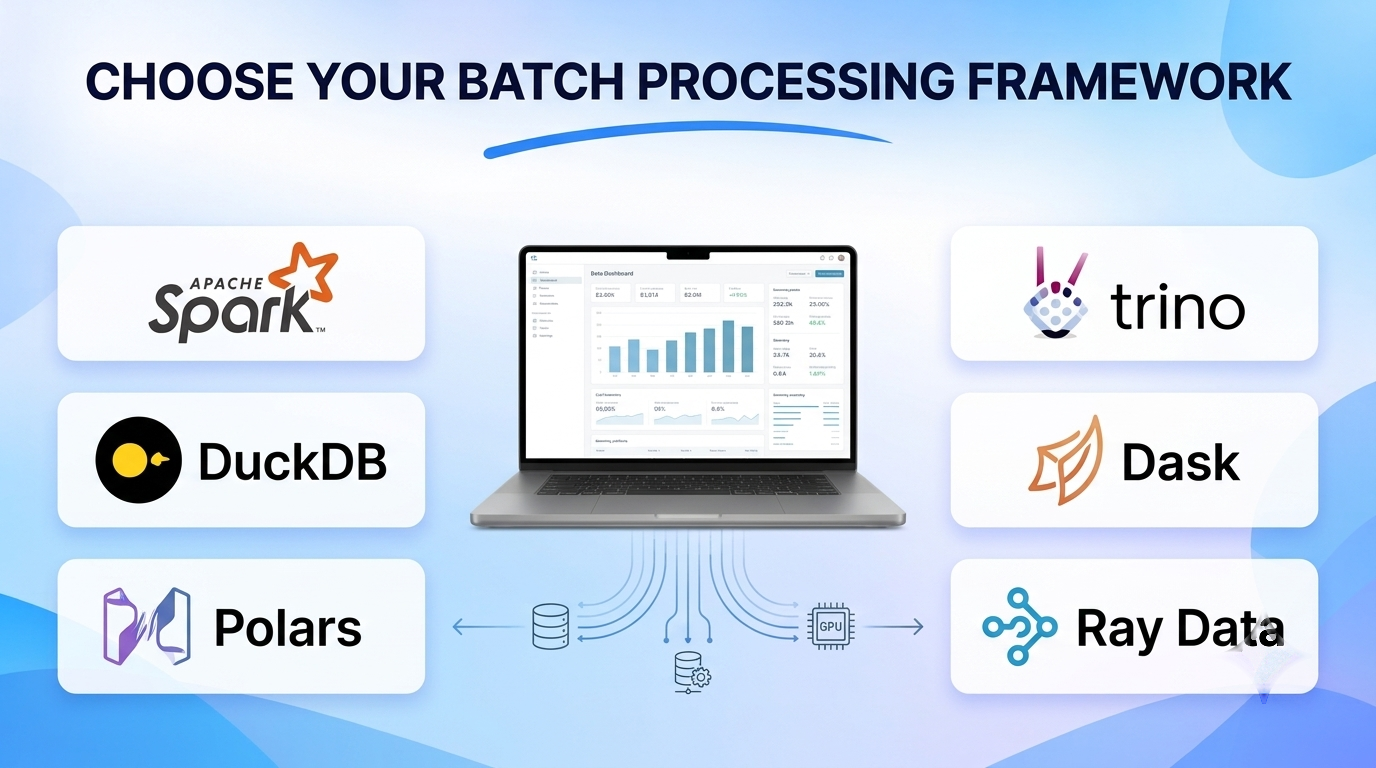
Every data engineering team eventually hits the memory ceiling of single-machine processing. A Python script using pandas runs cleanly on ten gigabytes of daily logs, slows to a crawl at fifty gigabytes, and crashes with out-of-memory errors once historical backfills reach terabytes.
Batch processing frameworks solve large-scale, bounded data transformation by distributing computation, memory management, shuffle operations, and fault recovery across clusters—or by executing vectorized single-node queries so efficiently that a single large cloud instance handles workloads that once required a dozen servers. Choosing well today means deciding whether your workload genuinely requires distributed cluster orchestration or can run faster and cheaper on modern single-node columnar engines.
The Modern Shift: Distributed Clusters vs. Scale-Up Vectorized Engines
For over a decade, large-scale batch processing meant spinning up distributed JVM clusters (Hadoop MapReduce, followed by Apache Spark). While distributed compute remains indispensable for multi-terabyte joins, machine learning feature generation, and petabyte-scale data lakes, two developments have reshaped batch architecture:
- Modern Cloud Hardware: Cloud virtual machines now offer hundreds of gigabytes of RAM and fast NVMe storage at modest hourly rates, allowing single-node vectorized engines (such as DuckDB and Polars) to process datasets up to several hundred gigabytes faster than distributed clusters that spend minutes coordinating network shuffles.
- Open Table Formats: Apache Iceberg, Delta Lake, and Apache Hudi bring ACID transactions, schema evolution, and partition pruning directly to cloud object storage, allowing multiple batch engines to read and write the exact same data lake tables without vendor lock-in.
Major Batch Processing Frameworks and Engines
Apache Spark
Apache Spark remains the dominant general-purpose distributed batch processing engine across enterprise data engineering. Executing transformations as directed acyclic graphs (DAGs) in memory with resilient distributed datasets (RDDs) and the Catalyst query optimizer, Spark handles petabyte-scale ETL, complex multi-table joins, unstructured file parsing, and distributed machine learning across Python (PySpark), SQL, Scala, and Java.
Enterprises processing multi-terabyte daily workloads across cloud object storage—whether through Databricks, Amazon EMR, Google Cloud Dataproc, or self-managed Kubernetes—rely on Spark for its maturity, fault tolerance, and deep ecosystem integration. Its operational trade-off is cluster overhead: JVM startup latency, shuffle tuning, executor memory skew, and idle cluster costs make Spark heavy for small-to-medium datasets under a few hundred gigabytes.
DuckDB
DuckDB is an open-source, in-process analytical database management system often described as “SQLite for analytics.” Running directly inside an existing Python, R, Node.js, or CLI process with zero external server infrastructure, DuckDB uses a vectorized columnar execution engine to query Parquet, CSV, JSON, and Apache Iceberg files directly on local disk or S3 at remarkable speed.
Data engineers, analysts, and automated CI/CD or serverless pipelines processing datasets from megabytes up to several hundred gigabytes frequently replace multi-node Spark jobs with DuckDB—cutting compute costs and eliminating cluster startup latency. Because DuckDB executes on a single machine, datasets that exceed available RAM and local disk spill capacity require scaling up instance size or transitioning to a distributed engine.
Polars
Polars is a high-performance DataFrame library written in Rust with native Python and Rust APIs, built on the Apache Arrow columnar memory format. Featuring a lazy query optimizer that performs predicate pushdown, projection pushdown, and automatic multithreaded parallelization across all available CPU cores, Polars processes large tabular datasets substantially faster and with far lower memory overhead than legacy single-threaded pandas code.
Data scientists and Python engineers looking to scale tabular data transformations on single machines without adopting SQL-only engines or JVM cluster infrastructure gain immediate productivity from Polars. Like DuckDB, Polars is designed primarily for single-node scale-up execution rather than distributed multi-node cluster shuffles.
Trino (and Presto)
Trino is an open-source, distributed MPP SQL query engine engineered for fast interactive and batch analytical queries across heterogeneous data sources. Rather than owning its own proprietary storage layer, Trino queries data where it lives—federating joins across Apache Iceberg, Hive, Delta Lake, PostgreSQL, MySQL, and object storage simultaneously through pluggable connectors.
Organizations running large open data lakehouses on AWS S3 or GCS—especially those wanting to run large SQL batch transformations (via dbt-trino) alongside ad-hoc analyst queries on a single shared engine—deploy Trino to avoid data duplication. Because Trino optimizes for in-memory pipelined execution rather than disk-spilling batch stages by default (unless fault-tolerant execution mode is configured), massive long-running ETL shuffles require careful memory configuration.
Dask
Dask scales familiar Python data science libraries—including pandas, NumPy, and scikit-learn—across multi-core workstations and distributed clusters. By breaking large arrays and DataFrames into parallel task graphs scheduled dynamically across Python workers, Dask allows Python teams to scale existing scientific and tabular code without rewriting algorithms into Scala or SQL.
Research institutions, financial modeling teams, and Python-heavy data science groups working with multi-dimensional arrays (via xarray) or custom parallel Python workflows value Dask’s native integration with the PyData stack. For pure SQL-style relational joins and aggregations at petabyte scale, Spark’s Catalyst optimizer generally outperforms Dask’s task scheduler.
Ray (Ray Data)
Ray is an open-source distributed compute framework built primarily for AI and machine learning workloads, with Ray Data providing scalable batch data processing specifically tailored for ML training and batch inference pipelines. Ray Data streams batches of unstructured and multimodal data—images, audio, video, embeddings, and Parquet tables—across heterogeneous CPU and GPU clusters efficiently.
AI engineering teams running large-scale batch inference, embedding generation, or distributed model training pipelines choose Ray Data because traditional SQL/DataFrame engines handle GPU resource scheduling and unstructured media poorly. For standard business intelligence warehouse transformations, SQL-based engines remain simpler and more economical.
Apache Flink (Batch Execution Mode)
While best known for stream processing, Apache Flink provides a unified batch execution mode over the exact same DataStream and Table/SQL APIs. When configured for bounded inputs, Flink swaps streaming checkpoints for sort-merge shuffles and blocking data exchanges, allowing teams to run historical batch backfills using the identical pipeline code deployed for real-time streams.
Engineering teams standardized on Flink for real-time pipelines adopt Flink batch mode to eliminate code duplication between live processing and historical reprocessing. For standalone batch-only organizations without streaming requirements, Spark or Trino offers a broader batch ecosystem.
Batch Processing Framework Comparison
| Framework | Execution Architecture | Primary Interface | Sweet Spot Data Scale | Best Fit | Key Trade-Off |
| Apache Spark | Distributed JVM cluster (DAG + Catalyst optimizer) | PySpark, SQL, Scala, Java | Hundreds of GBs to petabytes | Enterprise lakehouse ETL and multi-terabyte joins | Cluster startup overhead and JVM memory/shuffle tuning |
| DuckDB | Single-node in-process vectorized columnar engine | SQL, Python, R, CLI | Megabytes to hundreds of GBs | Fast serverless/single-node Parquet and lakehouse ETL | Bounded by single-machine RAM and local disk spill |
| Polars | Single-node multithreaded Rust DataFrame engine | Python, Rust | Megabytes to ~100+ GBs | High-speed Python DataFrame pipelines replacing pandas | Single-node execution; not for distributed multi-node shuffles |
| Trino | Distributed MPP federated SQL engine | ANSI SQL | Terabytes to petabytes | Lakehouse SQL batch transforms and federated queries | Memory tuning needed for heavy multi-stage ETL shuffles |
| Dask | Distributed Python task-graph scheduler | Python (pandas/NumPy APIs) | Tens of GBs to multi-terabytes | Scaling scientific Python and multi-dimensional arrays | Less optimized for complex relational SQL joins than Spark |
| Ray Data | Distributed CPU/GPU streaming batch engine | Python | Terabytes of multimodal/ML data | Batch ML inference, preprocessing, and GPU pipelines | Overkill for standard tabular BI warehouse transformations |
| Apache Flink (Batch) | Unified bounded execution on streaming runtime | Java, Python, Flink SQL | Terabytes | Reprocessing historical backfills with existing Flink code | Less mature batch ecosystem than Spark for ad-hoc ETL |
Common Batch Architecture Mistakes
- Defaulting to Distributed Clusters for Sub-100GB Jobs: Spinning up a 10-node Spark cluster to transform 30 gigabytes of Parquet files wastes money on cluster initialization, network serialization, and idle driver overhead. Benchmarking single-node DuckDB or Polars on a single compute instance often completes the same job in seconds at a fraction of the cost.
- Ignoring Small-File Compaction: Batch jobs writing thousands of tiny Parquet files into object storage cripple downstream query performance. Always pair batch writers with periodic compaction (such as Iceberg
rewrite_data_filesor DeltaOPTIMIZE). - Skipping Idempotency Design: Batch jobs fail due to transient cloud spot-instance interruptions or API timeouts. Ensure every batch pipeline overwrites target partitions atomically rather than blindly appending duplicate rows on retry.
Choosing the Right Batch Engine
Start by sizing your actual working dataset rather than hypothetical future scale. If your daily transformations operate on datasets under a few hundred gigabytes, DuckDB (for SQL workflows) or Polars (for Python DataFrame pipelines) delivers extraordinary speed with zero cluster administration. Once data volumes reach multiple terabytes or require distributed multi-table shuffles across cloud object storage, Apache Spark and Trino provide proven horizontal scale over open table formats. Finally, reserve Ray Data for GPU-intensive ML batch inference and multimodal AI pipelines where traditional tabular engines hit architectural limits.
