Running five local stdio MCP servers on an individual engineer’s laptop works well during experimentation. Deploying MCP across a 500-person engineering or enterprise organization breaks down immediately without a centralized control plane.
When every employee configures their own local servers and pastes static personal access tokens into plaintext JSON files, security teams lose visibility into what data agents access, compliance teams lack audit trails, and AI agents choke on bloated context windows filled with hundreds of uncurated tools. MCP Gateways and Remote MCP Management platforms solve this by inserting an enterprise proxy and governance layer between MCP clients and upstream MCP servers—centralizing authentication, role-based access control (RBAC), dynamic tool filtering, observability, and remote server hosting.
Core Capabilities That Define an Enterprise MCP Gateway
Just as API gateways (Kong, Apigee, AWS API Gateway) became mandatory for microservice architectures, MCP gateways provide six specialized capabilities tailored to stateful JSON-RPC agent traffic:
- Identity Federation and Zero-Secret Token Brokering: Instead of distributing long-lived API keys to developer laptops, the gateway integrates with corporate Identity Providers (Okta, Microsoft Entra ID, Google Workspace) via OAuth 2.1 and Enterprise-Managed Authorization (ID-JAG token exchange). Users authenticate once via SSO, and the gateway brokers short-lived, user-scoped tokens to downstream SaaS and database MCP servers.
- Virtual Server Aggregation and Dynamic Tool Filtering: Connecting an agent to 15 upstream MCP servers can expose 150+ tools—degrading LLM reasoning accuracy and spiking token costs. An MCP gateway aggregates multiple backend servers into clean, role-specific virtual MCP endpoints (e.g.,
/mcp/support-agentexposing only 8 read-only CRM and Jira tools) or uses semantic tool routing to surface only relevant tools per prompt. - Granular RBAC and Policy-as-Code Guardrails: Enforcing policies at the individual tool and parameter level—such as allowing junior analysts to call
postgres_queryonly against anonymized views, blockingdrop_tableordelete_issueglobally, or requiring human-in-the-loop approval workflows for high-risk mutations. - Protocol Translation (
stdio-to-Streamable HTTP) and Lifecycle Hosting: Many useful open-source MCP servers still ship only as localstdioNode/Python packages. Remote MCP management platforms containerize, isolate, and host these servers centrally, exposing them securely over Streamable HTTP so workstations never execute unvetted local binaries. - Payload Inspection, PII Redaction, and Threat Detection: Inspecting JSON-RPC requests and responses in transit to mask sensitive PII/PCI fields before they reach external LLM providers, while scanning tool manifests and outputs for tool-poisoning and prompt-injection payloads.
- End-to-End Audit Logging and Telemetry: Recording immutable, identity-attributed audit logs (
whoinvokedwhichtool onwhatserver withwhicharguments and latency) exported directly to SIEM platforms and OpenTelemetry collectors.
Leading MCP Gateways and Remote MCP Management Platforms
The MCP governance market has rapidly evolved across four distinct architectural categories:
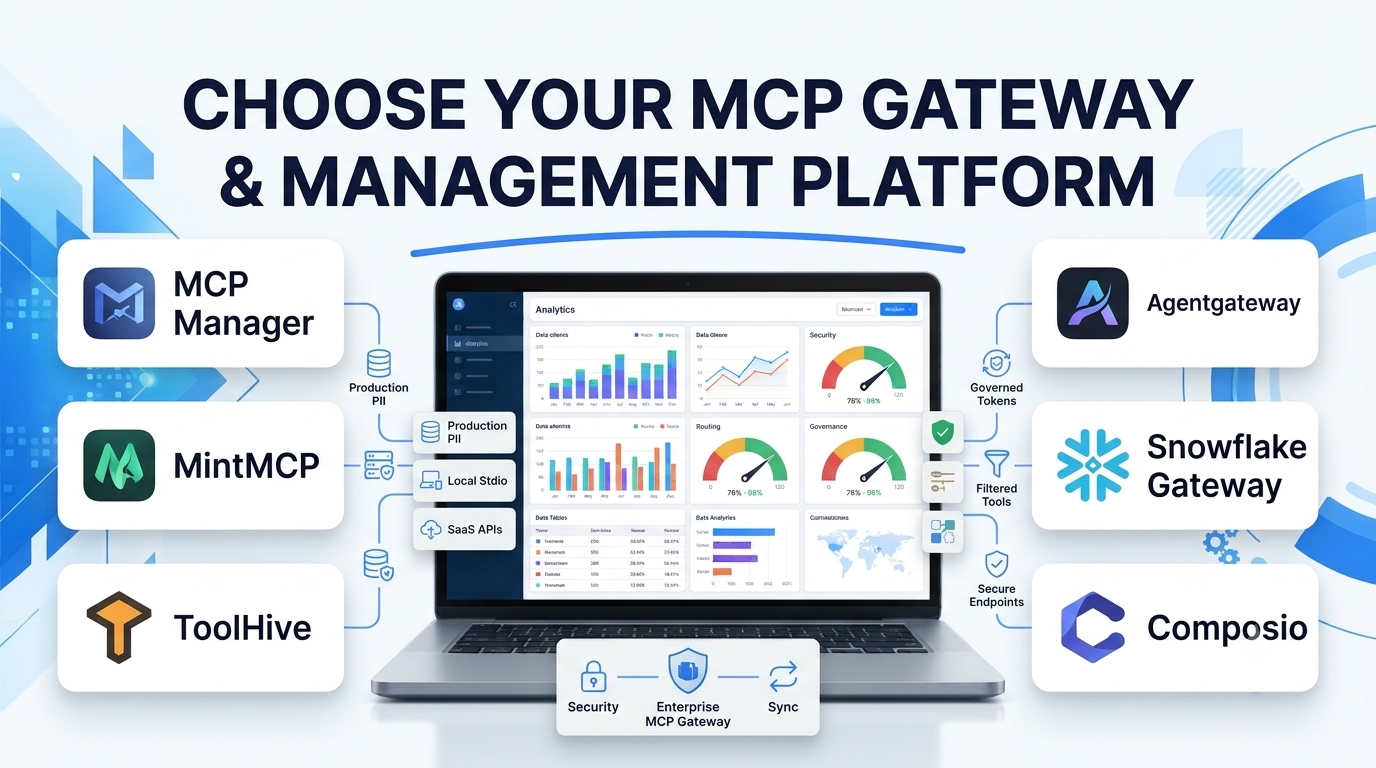
Dedicated Enterprise MCP Gateways (MCP Manager, MintMCP, ToolHive, Lunar.dev)
Purpose-built MCP governance platforms focus exclusively on solving multi-server aggregation, security policy enforcement, and managed hosting:
- MCP Manager provides a centralized enterprise control plane featuring role-based server/tool filtering, identity-bound RBAC, cross-server session state management, PII masking, and full audit logging across internal and third-party MCP servers.
- MintMCP specializes in turning local
stdioand remote MCP servers into managed, SOC 2-governed virtual MCP endpoints—handling container hosting, OAuth credential injection, and one-click distribution to employee clients like Claude Desktop and Cursor. - ToolHive (by Stacklok) focuses on secure container-isolated execution of MCP servers with cryptographic provenance verification, secret management, and fine-grained network/filesystem boundaries for developer teams.
- Lunar.dev (MCPX) acts as an open-source, self-hosted MCP proxy and gateway emphasizing traffic control, rate limiting, token-budget enforcement, and observability across agent tool calls.
Cloud & Data Platform Managed MCP Gateways (Snowflake, AWS, Google Cloud, Cloudflare)
Major infrastructure providers increasingly embed native MCP gateway capabilities directly into their cloud security perimeters:
- Snowflake Managed MCP Server / Gateway enables enterprises to expose Snowflake Cortex Analyst, Cortex Search, and custom SQL tools over a single governed MCP endpoint—enforcing Snowflake RBAC, OAuth, and zero-secret identity pass-through so agents strictly respect warehouse data governance.
- Amazon Bedrock AgentCore Gateway converts existing AWS Lambda functions, OpenAPI services, and upstream MCP servers into unified, IAM-governed MCP endpoints with built-in semantic tool search (so agents query thousands of enterprise tools without overflowing context windows) and Cognito/OAuth federation.
- Cloudflare Workers & AI Gateway allows engineering teams to deploy globally distributed, OAuth-authenticated remote MCP servers at the edge with built-in DDoS protection, rate limiting, and zero-trust Access policies.
Traditional API & AI Gateways Adding MCP Proxying (Kong, Litellm, Envoy / Agentgateway)
Organizations that already standardize traffic governance on API gateways or LLM proxies can extend existing infrastructure rather than introducing a separate vendor:
- Agentgateway (an open-source, Rust-based data plane built on Envoy/Linux Foundation) is engineered specifically for agentic protocols—supporting MCP and Agent2Agent (A2A) traffic, multiplexing
stdioand Streamable HTTP backends, enforcing JWT/OAuth RBAC, and emitting OpenTelemetry traces. - Kong AI Gateway and LiteLLM Proxy integrate MCP server registry and tool-routing capabilities alongside LLM model routing, allowing platform teams to manage model quotas and MCP tool permissions through a single gateway control plane.
Integration & iPaaS Remote MCP Hubs (Workato, Zapier, Composio)
For enterprise operations teams connecting hundreds of commercial SaaS applications without writing custom wrapper servers, platforms like Composio, Workato, and Zapier provide hosted, multi-tenant remote MCP endpoints with pre-built OAuth token refresh, managed connectors for 250+ SaaS tools, and per-user session isolation.
MCP Gateways & Management Platforms Comparison
| Platform / Category | Deployment Model | Core Architectural Strength | Auth & Identity Governance | Tool Filtering & Context Control | Best Fit |
| MCP Manager / MintMCP | Managed SaaS or Private VPC | Purpose-built MCP governance, hosting & virtual endpoints | Enterprise SSO/IdP + OAuth 2.1 + zero-secret brokering | Role-based tool filtering & PII redaction | Enterprises scaling MCP across engineering & business teams |
| Agentgateway / Lunar.dev | Open-source self-hosted (Rust / containers) | High-performance proxy, stdio multiplexing & rate limiting | JWT / OAuth 2.1 + policy rules | Virtual server routing & quota caps | Platform engineering teams wanting open-source infra control |
| Snowflake / Bedrock AgentCore | Managed Cloud (Snowflake / AWS) | Native cloud/data-warehouse governance & semantic tool discovery | Native IAM, Snowflake RBAC & OAuth federation | Semantic tool search across large catalogs | Organizations running core data & agents on AWS or Snowflake |
| Kong / LiteLLM | Self-hosted or Enterprise Cloud | Unified LLM model + MCP tool gateway in one control plane | API keys, JWT, OAuth & enterprise RBAC | Model + tool routing & unified telemetry | Teams already using Kong or LiteLLM for LLM traffic |
| Composio / Workato | Managed SaaS iPaaS | 250+ pre-built SaaS MCP connectors with managed OAuth refresh | Per-user delegated SaaS OAuth vaults | App- and action-scoped virtual toolkits | Teams needing instant, maintenance-free SaaS integrations |
Architectural Pitfalls When Rolling Out an MCP Gateway
Deploying a gateway solves shadow-IT sprawl, but three design mistakes can undermine adoption:
- Routing Low-Latency Local Filesystem Calls Through a Remote Proxy: Not every MCP server belongs behind a centralized cloud gateway. Local workspace tools—such as local Git diffs, filesystem edits, or local test runners inside VS Code—must stay local via
stdiofor sub-millisecond latency and workstation privacy. Use the gateway for shared SaaS, internal APIs, and production databases. - Exposing Unfiltered Pass-Through Proxies: Simply putting a reverse proxy in front of ten MCP servers without curating tool schemas leaves agents overwhelmed by 100+ overlapping tools. Always group tools into task-specific virtual endpoints or enable semantic tool filtering.
- Ignoring Downstream Token Scope Translation: Authenticating a user at the gateway with SSO is only half the job; the gateway must exchange that corporate identity for tightly scoped downstream OAuth tokens (via RFC 8693 Token Exchange or ID-JAG) rather than falling back to a single shared god-mode service account.
Selecting the Right MCP Governance Strategy
Scale your MCP management architecture incrementally as adoption grows:
- For Small Engineering Teams (Under 25 Builders): Start with version-pinned official remote servers, local
stdioworkspace tools, and a shared.mcp.jsonbaseline—no heavy gateway required yet. - For Platform Teams Standardizing Multi-Team Engineering: Deploy an open-source proxy like Agentgateway or ToolHive to centralize authentication, containerize
stdioservers, and export OpenTelemetry audit logs. - For Regulated Enterprises Rolling Out MCP Organization-Wide: Adopt a dedicated governance platform like MCP Manager or MintMCP (or Bedrock AgentCore / Snowflake within your primary cloud) to enforce IdP-driven access policies, PII masking, and curated virtual tool endpoints.
