Stateless language models treat every API call like the first day on the job. Dumping an entire multi-week conversation history into a million-token context window looks tempting in a prototype, but in production it drives up per-turn latency, multiplies token spend, and degrades recall as stale or contradictory facts bury current instructions.
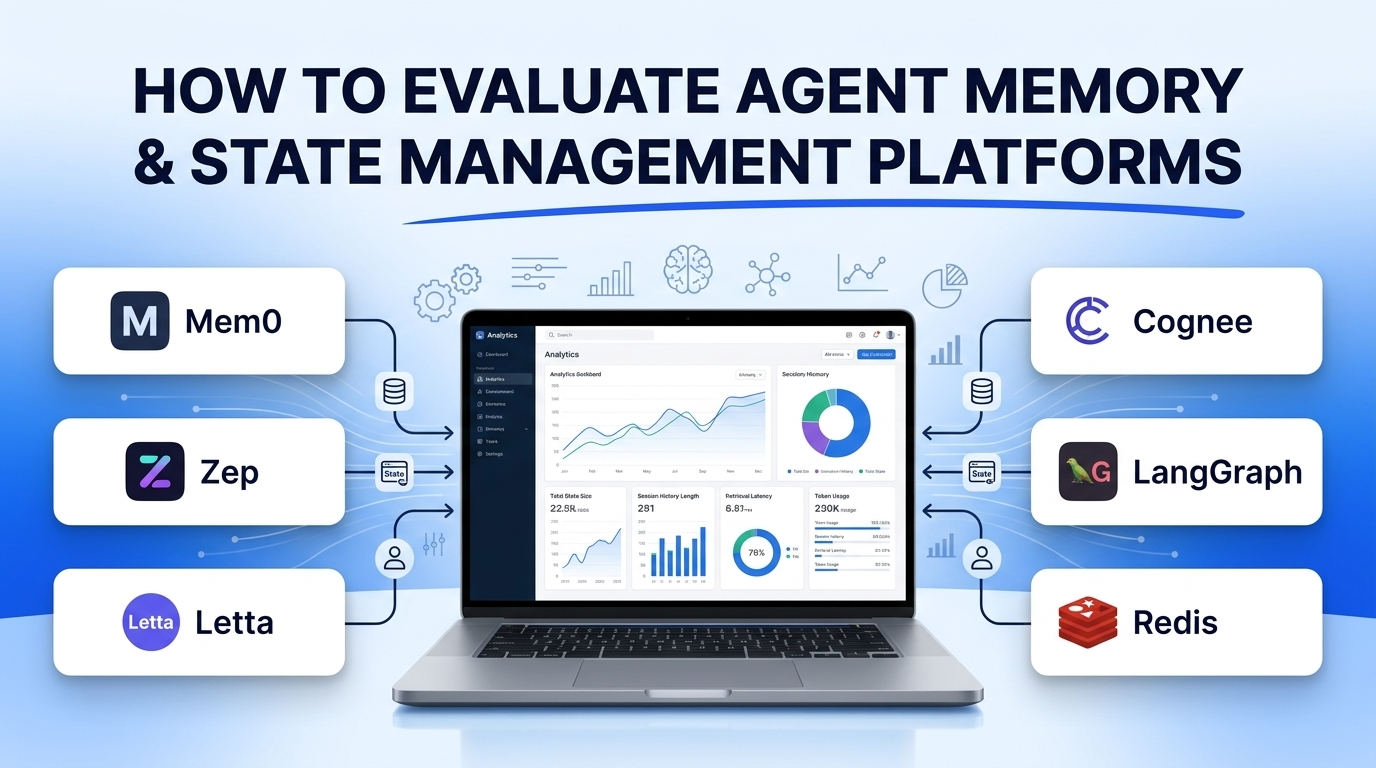
Agent memory and state management platforms sit between the model and raw conversation logs—distilling interactions into structured facts, temporal relationships, or editable context blocks, and retrieving only what is relevant for the current turn. Evaluating these platforms requires separating pipeline-extracted memory layers, temporal knowledge graphs, agent-managed context repositories, and durable execution state stores, as each makes fundamentally different assumptions about who decides what gets remembered and how contradictions get resolved.
Core Architectural Decisions in Agent Memory
Before comparing vendors, engineering teams need to evaluate four structural mechanisms that govern accuracy, latency, and auditability:
- Extraction Ownership (Pipeline-Driven vs. Agent-Controlled): In pipeline-driven memory systems, an asynchronous background LLM pass inspects conversation turns and extracts distilled facts automatically. In agent-controlled architectures (such as the MemGPT paradigm), the agent itself invokes explicit memory tools (
core_memory_replace, file edits) to curate what stays in its active prompt. - Temporal Invalidation vs. In-Place Overwrites: Real-world facts change—a customer upgrades from a Starter plan to Enterprise, moves cities, or revokes a preference. Vector-only stores that simply append new embeddings leave conflicting facts competing during similarity search. Temporal graph architectures attach
valid_atandinvalid_attimestamps to entity edges so the system distinguishes current state from historical audit trails. - Multi-Signal Retrieval (Vector + BM25 + Graph Traversal): Pure semantic similarity struggles with exact identifiers, dates, and multi-hop entity relationships (“which projects belong to the client who renewed last quarter?”). Production platforms combine dense vector embeddings with lexical keyword search (BM25) and graph relationship traversal.
- Multi-Tenant Scope Isolation: Enterprise agents must partition memory cleanly across user, session, agent, and organization boundaries—ensuring a shared corporate knowledge base never leaks private user preferences across tenants.
Leading Agent Memory & State Management Platforms
Mem0
Mem0 operates as an additive, multi-signal memory layer designed for rapid integration into existing agent pipelines. Available as an Apache 2.0 open-source library and a managed cloud platform, Mem0 extracts concise factual statements and entity links from conversation turns, reconciles duplicates or updates against existing memories within the same user or agent scope, and retrieves compact context bundles using vector, keyword, and optional graph signals.
Product teams building personalized assistants, customer support bots, and consumer AI apps benefit from Mem0’s low-friction API (add and search calls) and substantial token reduction compared to raw transcript stuffing. Its primary trade-off is temporal auditability: because Mem0 optimizes for current state reconciliation, reconstructing point-in-time historical states requires logging memory mutation events externally.
Zep (and Graphiti)
Zep differentiates itself through Graphiti, an open-source temporal knowledge graph engine built specifically for dynamic, evolving facts. Rather than storing flat text snippets, Zep models interactions as timestamped entity-relationship edges that record both when a fact occurred in the real world and when the system ingested it. When new information contradicts an earlier fact, Zep invalidates the superseded edge without deleting it, enabling sub-second hybrid retrieval (vector, BM25, and graph traversal) without requiring an LLM call at query time.
Enterprise agents operating in longitudinal domains—such as financial advisory, healthcare care-coordination, CRM account management, or compliance auditing—gain deterministic point-in-time recall and relationship traversal. Teams with simple preference-lookup use cases may find graph schema modeling heavier than necessary.
Letta (formerly MemGPT)
Originating from UC Berkeley’s MemGPT research, Letta treats the LLM’s context window like operating system RAM backed by external disk storage. Instead of relying on an external black-box extraction pipeline, Letta equips agents with structured in-context memory blocks and Git-backed filesystem repositories (MemFS) that the agent actively reads, edits, organizes, and versions via tool calls.
Developers building autonomous, long-running agents that must self-curate working memory and maintain auditable Git diffs of every memory revision favor Letta. Because memory management is executed by the agent itself, adopting Letta works best when using its agent runtime rather than bolting it onto an unrelated orchestration loop.
Cognee
Cognee unifies relational databases, vector stores, and ontology-driven knowledge graphs into a self-hostable memory pipeline. Through structured ingestion (cognify) and temporal graph modes, Cognee maps unstructured documents alongside conversational history into typed nodes and edges, allowing teams to shape domain ontologies and re-weight graph relevance from user feedback.
Engineering teams running self-hosted infrastructure that need to fuse static enterprise documentation with dynamic conversational memory inside one graph benefit from Cognee’s flexible storage backend.
Durable Execution & Checkpointer State Stores (LangGraph Checkpointers, Redis Agent Memory, Temporal)
Long-term semantic memory (remembering user facts across weeks) is distinct from short-term execution state (preserving exact graph variables, pending tool outputs, and human-in-the-loop pause states across server restarts).
- LangGraph Checkpointers (backed by PostgreSQL or Redis) serialize full graph state at every super-step, enabling deterministic time-travel debugging, fault recovery, and multi-day human approval pauses.
- Redis (Agent Memory Server & LangCache) provides sub-millisecond working-memory session storage, semantic caching, and hybrid vector search for high-concurrency production agents.
Agent Memory Platforms Comparison
| Platform | Core Data Model | Who Curates Memory | Contradiction & Temporal Handling | Hosting & Licensing | Best Fit |
|---|---|---|---|---|---|
| Mem0 | Vector-first distilled facts + entity/graph layer | Automated background LLM extraction pipeline | Reconciles and updates toward current state | Open-source (Apache 2.0) + Managed Cloud | Fast personalization & token reduction in conversational apps |
| Zep (Graphiti) | Temporal knowledge graph (timestamped edges) | Automated graph ingestion engine | Invalidates superseded edges with timestamps; preserves history | Graphiti OSS (Apache 2.0) + Zep Cloud / BYOC | Longitudinal enterprise agents needing historical & relational recall |
| Letta | Pinned context blocks + Git-backed memory files | The agent itself via memory-editing tool calls | Agent rewrites blocks/files with Git commit diffs | Open-source (Apache 2.0) + Managed Platform | Autonomous agents requiring self-managed context & audit diffs |
| Cognee | Unified relational, vector & ontology graph | Configurable ingestion & feedback pipelines | Temporal edge windows or in-place graph updates | Open-source self-hosted stack | Self-hosted teams blending document RAG with agent memory |
| Redis / Postgres Checkpointers | Key-value, JSON state snapshots & vector indexes | Deterministic application/framework runtime | Explicit state versioning & TTL policies | Open-source + Managed Cloud | High-throughput session state, caching & workflow checkpointing |
Common Memory Architecture Pitfalls
- Confusing Chat Logs With Memory: Storing every raw assistant greeting and tool stack trace in a vector store pollutes retrieval with noise. Always distill interactions into atomic facts or structured state transitions before indexing.
- Write-Path Latency Bottlenecks: Running synchronous LLM extraction and graph entity resolution before returning a response adds 800ms to 2 seconds per turn. Execute memory extraction asynchronously in a background worker after streaming the assistant’s reply to the user.
- Unbounded Memory Accumulation (“Memory Poisoning”): If an agent hallucinates a false assumption during turn four and writes it to long-term memory, that error becomes permanent ground truth in turn fifty. Provide user-facing memory inspection controls, confidence thresholds, and time-to-live (TTL) decay rules.
Selecting the Right Agent Memory Platform
Separate short-term workflow state from long-term user knowledge before choosing a tool:
- For Workflow Pause, Resume, and Fault Recovery: Use PostgreSQL or Redis checkpointers paired with your orchestration runtime rather than a semantic memory store.
- For Rapid User Personalization With Minimal Boilerplate: Start with Mem0 to extract and retrieve concise user preferences with low integration overhead.
- For Complex Enterprise Entities and Evolving Facts Over Time: Choose Zep when your agent must track changing account states, multi-entity relationships, and point-in-time history.
- For Self-Directed Autonomous Agents: Adopt Letta when the agent itself needs full programmatic authority over its working context and Git-versioned memory files.
