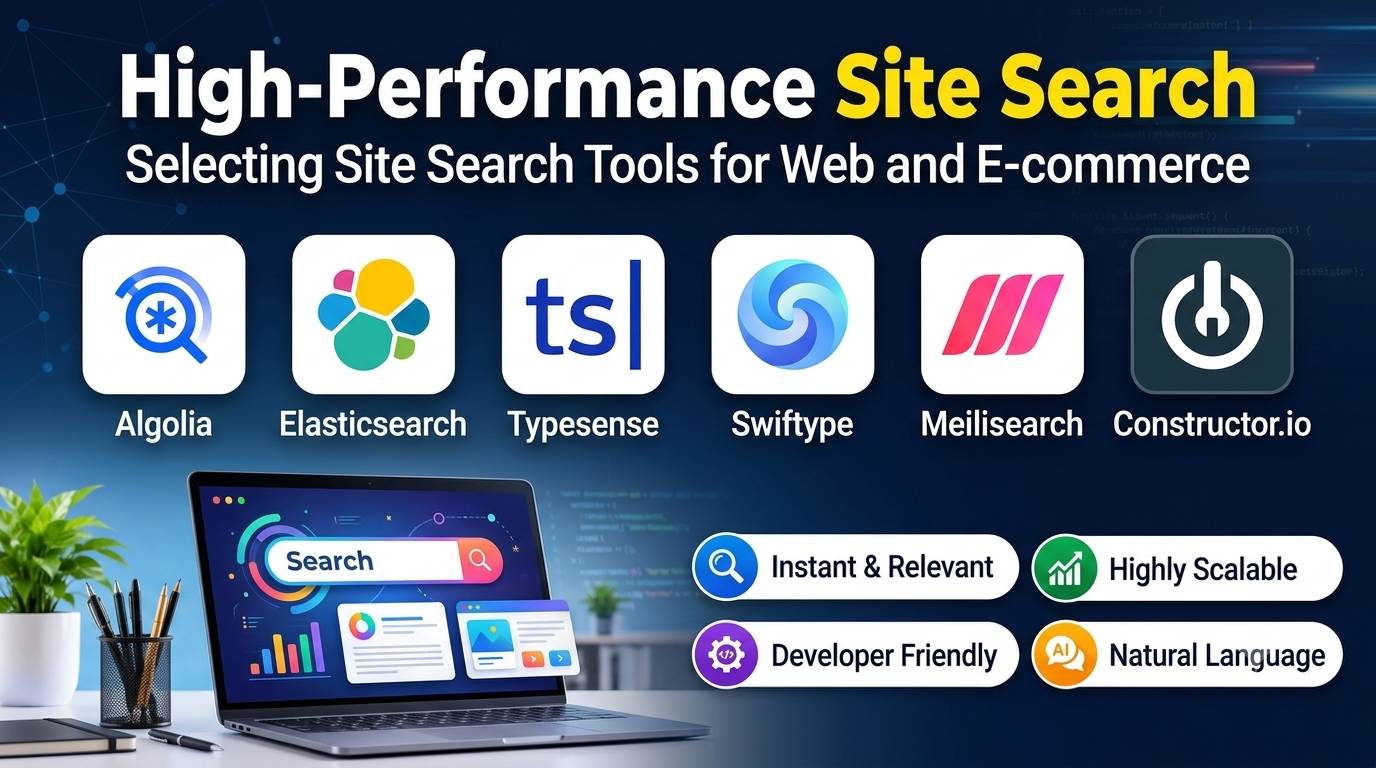
When a visitor lands on a website and enters a query into the search bar, conversion rates hang in the balance. Native database queries using basic LIKE statements quickly crumble under the weight of typographic errors, synonym variations, faceted filters, and high concurrent traffic. Visitors expect instant autocomplete suggestions, contextual typo tolerance, and results ordered by relevance rather than simple string matching.
Evaluating site search tools requires looking past surface-level widget designs and examining indexing architecture, latency budgets, analytics capabilities, and content ingestion pipelines. This guide breaks down six leading site search platforms, analyzing their technical strengths, integration models, and architectural trade-offs for modern web applications and ecommerce storefronts.
Core Evaluation Criteria for Site Search Infrastructure
Deploying an external site search service or embedded engine involves balancing query performance against maintenance overhead and merchandising control.
- Indexing Speed and Update Frequency: How rapidly product catalogs or content repositories reflect inventory changes, price updates, or new article publications via webhooks or API pushes.
- Relevance Tuning and NLP Capabilities: Support for custom synonyms, semantic vector search, natural language understanding (NLU), and machine learning models that automatically optimize ranking based on click-through and conversion data.
- Faceted Navigation and Filtering: The ability to handle complex multi-select facets (price ranges, categories, sizes) with sub-millisecond response times under heavy concurrent loads.
- Frontend SDKs and Integration Footprint: Availability of robust JavaScript libraries, headless APIs, and pre-built UI components that minimize custom frontend engineering effort.
Leading Site Search Platforms Compared
Different digital properties—ranging from high-volume ecommerce catalogs to expansive content publishing platforms—demand distinct architectural approaches.
Algolia
- Primary Focus: High-performance, API-first hosted search and discovery infrastructure optimized for instant results.
- Deployment Model: Cloud-managed SaaS.
- Technical Strengths: Unmatched query latency through distributed edge infrastructure, robust instant search front-end libraries, advanced typo-tolerance algorithms, and powerful analytics dashboard for tracking zero-result queries.
- Considerations: Costs scale directly with record counts and search operations volume, which can become expensive for massive, infrequently accessed content archives.
Elasticsearch / Elastic App Search
- Primary Focus: Scalable, highly customizable search and analytics built on distributed Lucene architecture.
- Deployment Model: Self-hosted or Elastic Cloud (SaaS).
- Technical Strengths: Complete control over mapping, analyzers, and custom scoring scripts. App Search layers simplified APIs over core Elasticsearch to ease implementation without sacrificing underlying engine power.
- Considerations: Requires dedicated DevOps oversight and cluster management to maintain stability and performance under heavy query spikes.
Typesense
- Primary Focus: Open-source, typo-tolerant search engine written from scratch in C++ for low memory footprints.
- Deployment Model: Self-hosted open-source or managed cloud (Typesense Cloud).
- Technical Strengths: Extremely fast indexing and querying, built-in semantic vector search, geolocation filtering, and straightforward configuration designed to be a developer-friendly alternative to heavier search clusters.
- Considerations: Smaller community and ecosystem compared to older giants like Elasticsearch, requiring reliance on core documentation for highly specialized custom plugins.
Swiftype (Elastic App Search)
- Primary Focus: Crawler-based and API-driven site search for marketing websites, blogs, and documentation portals.
- Deployment Model: Cloud SaaS.
- Technical Strengths: Out-of-the-box web crawlers that automatically index HTML pages without custom API pipelines, intuitive drag-and-drop result curation, and straightforward analytics.
- Considerations: Less optimized for complex, highly dynamic ecommerce product databases with real-time inventory updates compared to dedicated merchandising platforms.
Meilisearch
- Primary Focus: Lightning-fast, open-source search engine tailored for developer experience and immediate relevance.
- Deployment Model: Self-hosted or Meilisearch Cloud.
- Technical Strengths: Zero-configuration defaults that work exceptionally well out of the box, intuitive RESTful API, excellent handling of typos, and support for multi-tenant search filtering.
- Considerations: Entire index must fit comfortably within RAM for maximum performance speed, requiring careful capacity planning for massive datasets.
Constructor.io
- Primary Focus: AI-driven e-commerce discovery, search, and product recommendation platform.
- Deployment Model: Cloud SaaS.
- Technical Strengths: Leverages advanced machine learning models trained specifically on user behavior to maximize conversion rates, automated personalization, and sophisticated merchandising controls.
- Considerations: Highly specialized for transactional e-commerce workflows; over-engineered for standard content publishing sites or basic documentation portals.
Comparative Technical Overview
| Platform | Primary Architecture | Core Ranking Approach | Best Suited For | Deployment Model |
| Algolia | SaaS distributed edge | Custom scoring, lexical & vector | High-traffic e-commerce, instant apps | Cloud SaaS |
| Elasticsearch | Distributed Lucene cluster | BM25, script scoring, vectors | Custom enterprise applications, logs & search | Self-hosted / Managed Cloud |
| Typesense | C++ in-memory engine | Typo-tolerance, faceted search | Fast developer setups, mid-scale apps | Self-hosted / Managed Cloud |
| Swiftype | Cloud crawler & API | Lexical relevance, curation | Marketing sites, documentation portals | Cloud SaaS |
| Meilisearch | Rust-based search engine | Typo-tolerance, default ranking | Modern web apps, indie developers | Self-hosted / Cloud |
| Constructor.io | Machine learning SaaS | Behavioral AI, personalization | Large-scale retail and e-commerce | Cloud SaaS |
Integration and Performance Optimization Considerations
Implementing site search successfully involves addressing data synchronization and query latency constraints.
- Index Synchronization: Real-time databases must push changes to search indices without introducing race conditions. Implement event-driven webhooks or background worker queues to handle incremental updates when records are created, modified, or deleted.
- Debouncing and Caching: Frontend search interfaces should debounce user keystrokes (typically 150-300ms) to prevent hammering the search API with incomplete queries, while edge caching handles repeated popular searches.
- Synonym Management: Maintain domain-specific synonym dictionaries to bridge the gap between internal product terminology and colloquial visitor phrasing.
Summary and Selection Framework
Selecting the right site search tool depends on infrastructure preferences, budget constraints, and specific use-case dynamics.
- Choose Algolia when development velocity and absolute minimum query latency are paramount for high-volume consumer applications.
- Choose Typesense or Meilisearch when seeking high-performance open-source engines that avoid complex Java cluster management.
- Choose Elasticsearch when deep customization, custom scoring algorithms, and multi-tenant data governance are mandatory requirements.
- Choose Constructor.io when optimizing conversion rates and automated product recommendations for large retail catalogs.
Evaluate your catalog size, query volume, and engineering capacity before committing to a search provider.
