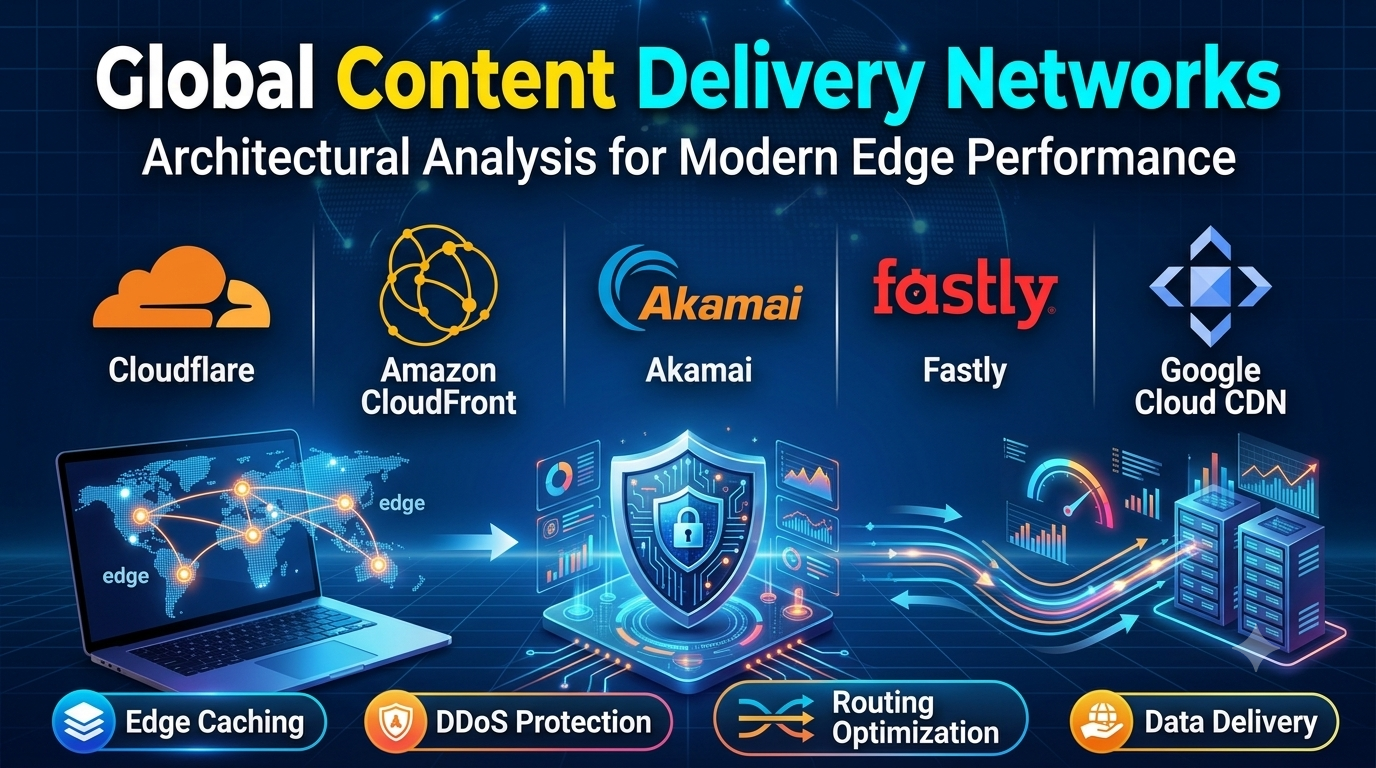
When web applications scale to serve a global user base, relying on a single origin server introduces prohibitive latency, high bandwidth bottlenecks, and single points of failure. Physical distance dictates network round-trip time (RTT); a user in Tokyo accessing an origin server hosted in Frankfurt will experience inevitable transport delays governed by the speed of light through fiber optics.
Content Delivery Networks (CDNs) solve this by distributing cached static assets and dynamic content closer to the end user across globally dispersed Points of Presence (PoPs). Selecting a CDN requires evaluating edge compute capabilities, cache invalidation speed, security integrations, and traffic pricing structures. This guide examines leading content delivery networks, analyzing their architectural models, performance trade-offs, and enterprise integration patterns.
Core Evaluation Criteria for CDN Architecture
Deploying or migrating a CDN involves balancing global reach against operational complexity and cost control.
- Edge Compute and Programmability: The ability to execute lightweight JavaScript or WebAssembly (Wasm) workers directly at the edge to handle authentication, request manipulation, and edge rendering.
- Cache Invalidation and Purge Latency: The speed at which updated assets (HTML, images, scripts) propagate across global PoPs after an origin purge request.
- Security and DDoS Mitigation: Built-in Web Application Firewall (WAF), rate-limiting rules, bot management, and volumetric Layer 3/4/7 DDoS protection.
- Origin Shielding: The capacity to shield origin servers by aggregating cache requests through an intermediate caching layer, drastically reducing origin load during traffic spikes.
Leading Content Delivery Networks Compared
Different application architectures—ranging from static edge-rendered sites to high-throughput video streaming platforms—demand distinct CDN capabilities.
Cloudflare
- Primary Focus: Edge security, serverless compute (Workers), and global content delivery.
- Deployment Model: Global Anycast network.
- Technical Strengths: Unmatched DDoS mitigation, highly programmable edge workers running on V8 isolates with near-zero cold starts, robust DNS management, and built-in Zero Trust security products.
- Considerations: Complex caching rules and custom cache keys often require configuring Page Rules or Cache Rules, which can become intricate across large multi-tenant domains.
Amazon CloudFront
- Primary Focus: Deep AWS integration, secure media streaming, and enterprise application acceleration.
- Deployment Model: AWS Edge Locations and Regional Edge Caches.
- Technical Strengths: Native, high-speed integration with S3, EC2, Lambda@Edge, and AWS Shield. Excellent support for signed URLs/cookies for protected media distribution and complex lambda-based request transformation.
- Considerations: Egress data transfer pricing structures and configuration management via AWS IAM can introduce steep learning curves and unexpected operational costs.
Akamai Edge Delivery
- Primary Focus: Enterprise-grade media streaming, massive scale security, and deep web performance optimization.
- Deployment Model: Massive proprietary global distributed platform.
- Technical Strengths: Industry leader in handling massive traffic spikes for live global events and broadcast-quality video streaming. Advanced protocol optimization, sophisticated origin shield topologies, and enterprise-level reliability.
- Considerations: Premium pricing model and proprietary configuration interfaces that typically require dedicated professional services or certified administrators to manage effectively.
Fastly
- Primary Focus: Real-time content delivery, instant cache purging, and edge compute (Compute@Edge).
- Deployment Model: Anycast edge network built on Varnish configuration language (VCL).
- Technical Strengths: Industry-leading sub-second cache purge propagation globally, highly flexible VCL-based request routing, and secure WebAssembly-powered edge compute environments.
- Considerations: Steeper initial learning curve for configuring custom VCL logic compared to simpler toggle-based CDN management panels.
Google Cloud CDN
- Primary Focus: Google Cloud Platform (GCP) native acceleration and global load balancing.
- Deployment Model: Google global fiber network and edge points of presence.
- Technical Strengths: Leverages Google’s private backbone network for reduced latency, native integration with Cloud Load Balancing, built-in Cloud Armor security, and seamless support for signed certificates.
- Considerations: Primarily optimized for architectures hosted within Google Cloud Platform, making multi-cloud setups more complex to orchestrate.
Comparative Technical Overview
| Platform | Primary Edge Compute | Cache Invalidation Speed | Core Security Features | Best Suited For |
| Cloudflare | Cloudflare Workers (V8) | Instant (Global) | WAF, Bot Mgmt, DDoS | General web apps, serverless architectures, security-first posture |
| Amazon CloudFront | Lambda@Edge / CloudFront Functions | Fast | AWS Shield, WAF | AWS-centric stacks, media distribution, enterprise applications |
| Akamai | EdgeWorkers | Fast | Enterprise WAF, Bot Manager | High-scale video streaming, global media, enterprise web |
| Fastly | Compute@Edge (Wasm) / VCL | Sub-second | Next-Gen WAF, DDoS | Real-time content updates, API acceleration, programmatic routing |
| Google Cloud CDN | Integration with GCP services | Fast | Cloud Armor, IAM | GCP-native infrastructure, global load balancing |
Integration and Traffic Management Considerations
Implementing a CDN successfully requires careful planning around DNS routing, SSL/TLS termination, and cache hit ratios.
- Anycast Routing: Ensure the CDN provider utilizes a robust Anycast network to automatically route user requests to the geographically nearest available PoP, minimizing network latency.
- Cache Hit Ratio (CHR) Optimization: Analyze cache-control headers, vary headers, and cookie forwarding rules. Unnecessary cookie forwarding can fragment cache entries and overwhelm origin servers.
- Failover and Multi-CDN Strategies: For mission-critical web applications requiring absolute 100% uptime, consider multi-CDN architectures paired with intelligent DNS traffic steering to route around regional outages.
Summary and Selection Framework
Selecting the right content delivery network depends heavily on infrastructure topology, budget, and performance requirements.
- Choose Cloudflare when looking for an all-in-one edge security and serverless compute platform with extensive out-of-the-box DDoS protection.
- Choose Amazon CloudFront or Google Cloud CDN when infrastructure is tightly coupled within AWS or GCP to minimize egress data transfer fees.
- Choose Fastly when applications demand instantaneous cache purging and programmable edge routing for dynamic content.
- Choose Akamai for large-scale broadcast streaming, live events, and enterprise workloads requiring battle-tested reliability.
Evaluate traffic distribution patterns, origin server location, and caching complexity before committing to a global edge provider.
