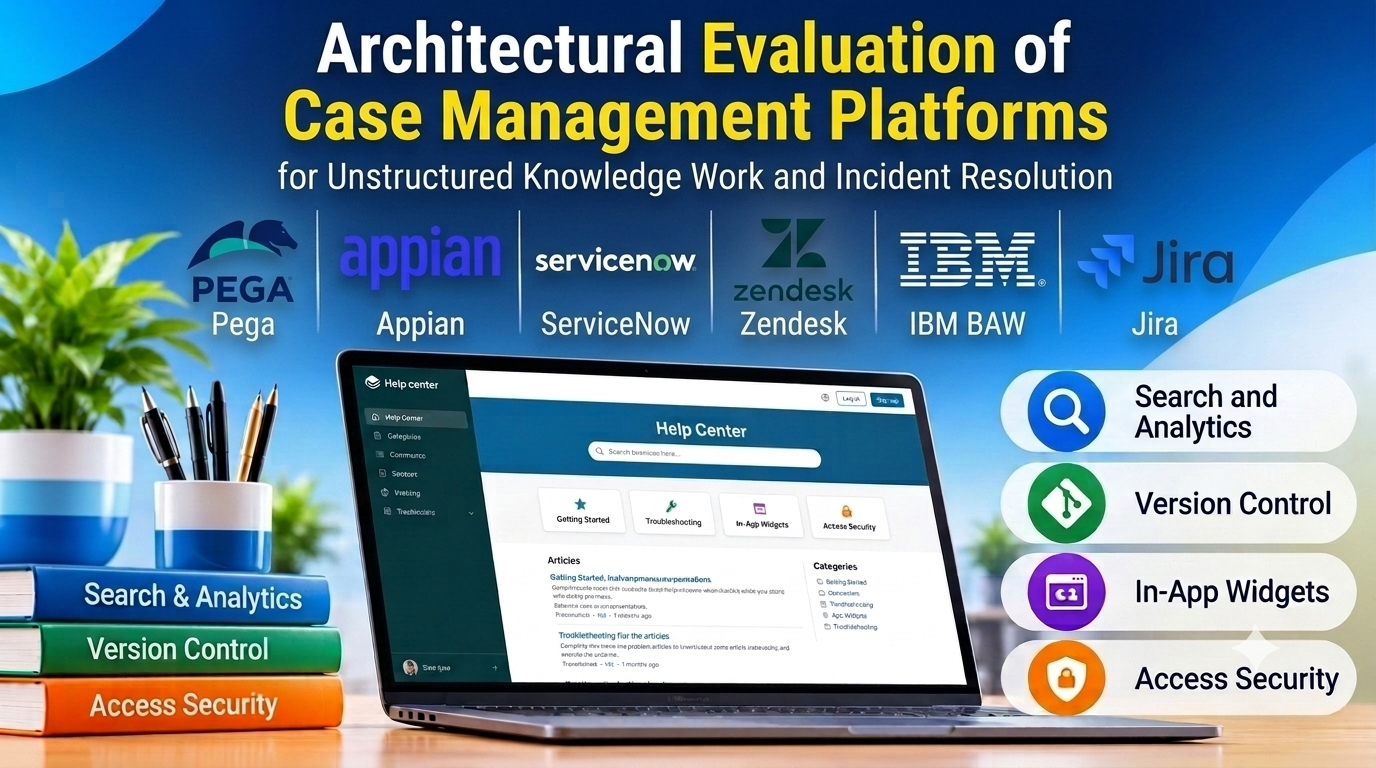
Traditional business process management (BPM) tools excel at handling highly structured, predictable workflows where every step follows a strict linear sequence (such as loan approvals or automated invoicing). However, a vast portion of enterprise knowledge work—including customer service dispute resolution, insurance claims investigation, legal case preparation, healthcare patient care coordination, and cybersecurity incident response—is fundamentally unpredictable. These scenarios require handling unstructured data, ad-hoc task collaboration, evolving documents, and decisions dictated by emerging case facts rather than rigid process diagrams.
Adaptive Case Management (ACM) platforms bridge this gap, providing knowledge workers with a dynamic workspace to collect documents, communicate with stakeholders, track audit histories, and resolve complex cases. Selecting a case management platform requires looking past basic ticketing boards and evaluating document collaboration security, search and indexing capabilities, audit trail immutability, and integration flexibility. This guide examines leading case management platforms, analyzing their architectural strengths, data handling models, and enterprise deployment trade-offs.
Core Evaluation Criteria for Case Management Architecture
Selecting an enterprise case management solution involves balancing structured workflow guidance with the flexibility required for unpredictable knowledge work.
- Dynamic Workflow and Ad-Hoc Tasking: The ability for caseworkers to add tasks, reorder steps, and spawn sub-cases dynamically as new information emerges during an investigation.
- Document Management and Content Repository: Robust handling of unstructured files (PDFs, emails, legal contracts, scanned images) with version control, optical character recognition (OCR), and secure metadata tagging.
- Auditability and Compliance Immutability: Tamper-evident audit logs that record every document view, status change, and user action to satisfy strict legal and regulatory compliance requirements.
- Collaboration and Secure Stakeholder Access: Role-based access controls (RBAC) and external portals allowing internal agents, external legal counsel, or customers to collaborate securely within a single case file.
Leading Case Management Platforms Compared
Different industry requirements—ranging from legal compliance and healthcare administration to customer service and IT incident tracking—demand distinct platform architectures. Below is an examination of six prominent case management systems.
Pega Customer Service and Enterprise Case Management
- Primary Focus: End-to-end enterprise case management, customer service operations, and AI-driven decisioning.
- Deployment Model: Pega Cloud SaaS or customer-managed environments.
- Technical Strengths: Market-leading case lifecycle management framework, advanced predictive analytics, robust integration with legacy databases, and seamless routing of complex multi-departmental cases.
- Considerations: Substantial enterprise licensing costs and complex administrative overhead require dedicated Pega certified architects for successful deployment.
Appian Case Management
- Primary Focus: Low-code application delivery combining data virtualization, workflow orchestration, and dynamic case management.
- Deployment Model: Appian Cloud or private enterprise cloud.
- Technical Strengths: Unified data fabric that connects disparate data silos without migration, rapid visual application design, and robust security governance.
- Considerations: Proprietary low-code architecture can create a steep learning curve for traditional software development teams.
ServiceNow Customer Service Management (CSM) / Security Operations
- Primary Focus: IT service management, security incident response, and enterprise request fulfillment.
- Deployment Model: ServiceNow Cloud SaaS.
- Technical Strengths: Massive enterprise adoption, exceptional IT asset and workflow integrations, robust SLA tracking, and powerful automated incident routing capabilities.
- Considerations: Heavily optimized for IT and HR service workflows; customizing it for specialized legal or clinical case management can require extensive platform configuration.
Zendesk / Freshdesk (Enterprise Tier)
- Primary Focus: Customer support ticketing, omnichannel help desk management, and lightweight case tracking.
- Deployment Model: Cloud SaaS.
- Technical Strengths: Rapid deployment, intuitive agent workspaces, extensive third-party app marketplaces, and strong live chat and email integration out of the box.
- Considerations: Designed primarily for customer support ticketing rather than complex, long-running investigative cases involving heavy document management and multi-party compliance.
IBM Business Automation Workflow (BAW)
- Primary Focus: Heavyweight enterprise case management and workflow automation for regulated financial and government institutions.
- Deployment Model: Containerized Red Hat OpenShift deployment.
- Technical Strengths: Unmatched capability for handling complex, highly regulated case files requiring stringent audit trails, document imaging, and enterprise content management (ECM) integration.
- Considerations: Complex infrastructure footprint requiring specialized Red Hat OpenShift and IBM administration expertise.
Jira Service Management (Atlassian)
- Primary Focus: Agile IT service desks, developer-centric incident tracking, and internal request management.
- Deployment Model: Cloud SaaS or Data Center (Self-hosted).
- Technical Strengths: Deep integration with Jira Software and developer code repositories, flexible custom issue types, robust queuing workflows, and approachable pricing for technical teams.
- Considerations: Geared predominantly toward technical operations and engineering workflows rather than business-facing compliance or legal case investigations.
Comparative Technical Overview
| Platform | Primary Use Case | Deployment Model | Key Differentiator | Best Suited For |
| Pega | Complex enterprise case management | Pega Cloud or Self-hosted | Advanced AI decisioning & case lifecycles | Large enterprises managing complex operational investigations |
| Appian | Low-code case management apps | Appian Cloud / Private Cloud | Data fabric & rapid low-code building | Organizations building custom case solutions fast |
| ServiceNow | IT service & incident management | ServiceNow Cloud | Massive IT workflow ecosystem | IT, security, and enterprise service operations |
| Zendesk | Customer support ticketing | Cloud SaaS | Omnichannel support & rapid setup | Customer support teams managing high-volume inquiries |
| IBM BAW | Regulated enterprise cases | Red Hat OpenShift | Rigorous audit compliance & ECM integration | Government and financial institutions with strict security mandates |
| Jira Service Management | Technical service desks | Cloud SaaS or Self-hosted | Deep integration with developer tools | Technology teams aligning IT support with engineering |
Implementation and Compliance Considerations
Deploying a case management platform successfully requires evaluating data privacy laws, document retention policies, and user adoption hurdles.
- Data Privacy and PII Protection: Case files frequently contain sensitive Personally Identifiable Information (PII) or confidential health and financial records. Ensure the platform supports field-level encryption, masking, and regional data residency compliance (GDPR, HIPAA).
- Document Version Control and Bloat: Unstructured document attachments can bloat database storage rapidly. Implement automated document retention policies and archive closed cases to maintain system search performance.
- User Experience and Caseworker Adoption: Caseworkers spend their entire day inside the case management interface. If the UI is cluttered or requires excessive navigation clicks, productivity will plummet. Prioritize platforms with intuitive, unified case workspaces.
Summary and Selection Framework
Choosing the right case management platform depends heavily on your industry, case complexity, and existing software ecosystem.
- Choose Pega or IBM BAW when managing complex, highly regulated enterprise investigations that demand advanced case lifecycle orchestration and stringent compliance auditing.
- Choose Appian when your organization requires a custom, data-driven case management application built rapidly via low-code architecture.
- Choose ServiceNow when your primary focus is IT service management, cybersecurity incident response, or operational request fulfillment.
- Choose Zendesk when handling customer support inquiries and service tickets that do not require complex investigative document workflows.
Evaluate your document management volume, regulatory compliance mandates, and user workflow complexity before committing to a case management platform.
