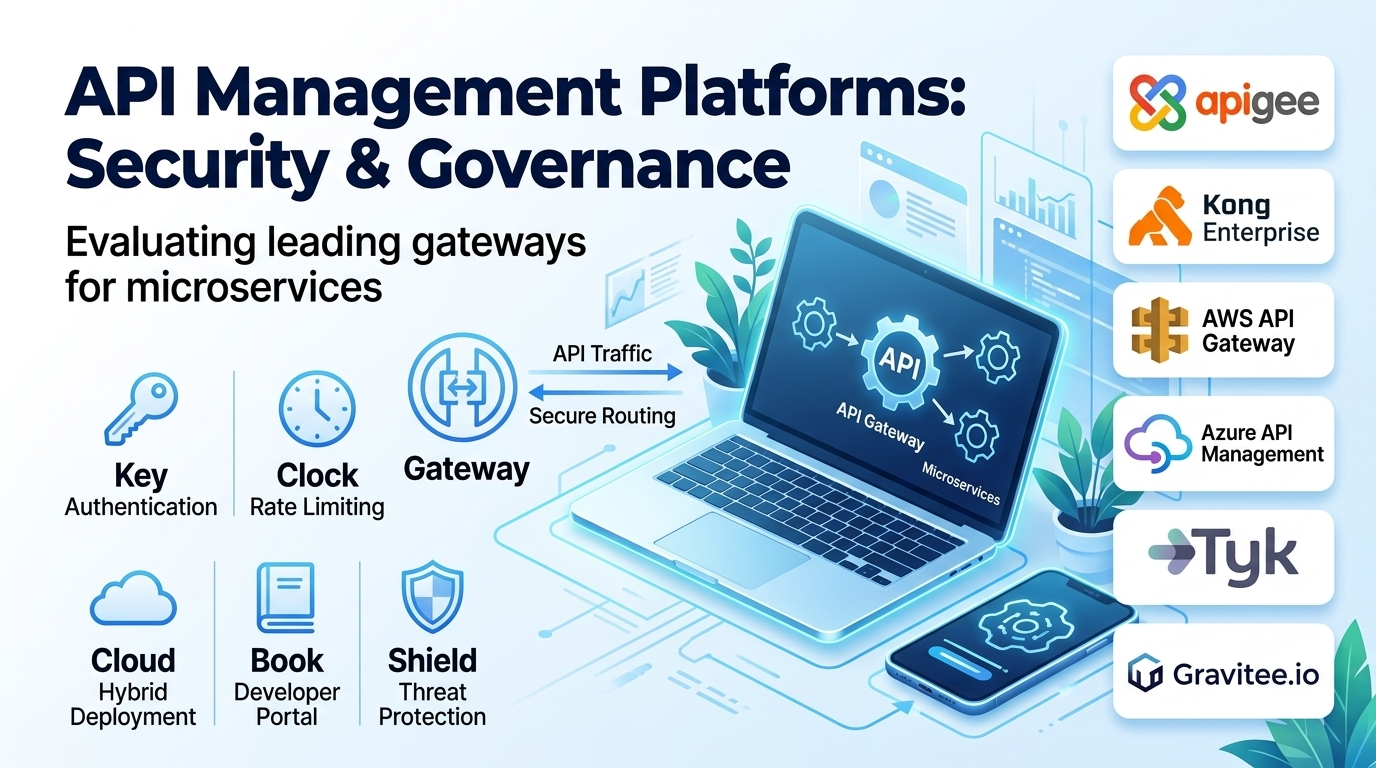
Modern software engineering relies heavily on distributed microservices architectures where application logic is exposed, consumed, and integrated via Application Programming Interfaces (APIs). As organizations scale from a handful of internal endpoints to thousands of public-facing APIs, managing traffic routing, rate limiting, security authentication, and developer documentation becomes unmanageable without dedicated infrastructure.
Choosing an API management platform requires looking past basic proxy routing and evaluating gateway latency, multi-cloud deployment flexibility, developer portal customization, and zero-trust security enforcement. This guide examines leading API management platforms, analyzing their architectural strengths, proxy models, and enterprise deployment trade-offs.
Core Evaluation Criteria for API Management Architecture
Selecting an API management solution involves balancing traffic handling performance against gateway security and developer portal usability.
- Gateway Proxy Performance and Latency: The speed and resource efficiency with which the API gateway inspects, transforms, and routes incoming requests to backend microservices without introducing noticeable latency.
- Security and Policy Enforcement: Native support for OAuth 2.0, OpenID Connect (OIDC), JSON Web Token (JWT) validation, IP whitelisting, and Web Application Firewall (WAF) integration.
- Deployment Topology and Hybrid Cloud: The ability to deploy gateway instances across distributed environments, including edge proxies, Kubernetes clusters (via Ingress controllers), on-premises data centers, and multi-cloud regions.
- Developer Portal and Documentation: The quality of automated API documentation generation (OpenAPI/Swagger), developer self-service registration, and interactive testing consoles.
Leading API Management Platforms Compared
Different enterprise scales, infrastructure topologies (Kubernetes versus legacy virtual machines), and developer workflows demand distinct API management architectures. Below is an examination of six prominent platforms.
Apigee (Google Cloud)
- Primary Focus: Enterprise-grade API management, security governance, and multi-cloud monetization.
- Deployment Model: Hybrid deployment (Cloud management plane with local runtime gateways).
- Technical Strengths: Outstanding enterprise security enforcement, robust traffic analytics, advanced quota and monetization rules, and seamless native integration with Google Cloud services.
- Considerations: High licensing costs and complex architecture make it excessive for small-to-mid-sized engineering teams.
Kong Enterprise
- Primary Focus: Cloud-native API gateway, high-performance proxy routing, and microservices governance.
- Deployment Model: Containerized (Docker/Kubernetes) and multi-cloud infrastructure.
- Technical Strengths: Built on NGINX/Kong Gateway core, offering blazing-fast request throughput, minimal latency, extensive plugin ecosystem, and seamless GitOps configuration workflows.
- Considerations: Advanced enterprise features, developer portal customization, and support require the paid Enterprise tier.
AWS API Gateway
- Primary Focus: Serverless and cloud-native API creation and management within the Amazon Web Services ecosystem.
- Deployment Model: Fully managed AWS cloud service.
- Technical Strengths: Zero infrastructure management, automatic scaling to handle massive request volumes, seamless integration with AWS Lambda, DynamoDB, and IAM security policies.
- Considerations: Vendor lock-in to the AWS cloud ecosystem can complicate multi-cloud portability or hybrid on-premises deployments.
Azure API Management
- Primary Focus: Enterprise API governance and integration across Microsoft Azure and hybrid environments.
- Deployment Model: Cloud SaaS and self-hosted gateway containers.
- Technical Strengths: Deep integration with Microsoft Entra ID (Azure AD), robust developer portal out-of-the-box, comprehensive analytics, and seamless VNet connectivity.
- Considerations: Management plane is tied to Azure infrastructure, though runtime gateways can be hosted externally.
Gravitee.io
- Primary Focus: Open-source API management, event-driven APIs (Kafka, WebSockets), and access management.
- Deployment Model: Open-source core with enterprise commercial extensions (Self-hosted or Cloud).
- Technical Strengths: Excellent support for modern event-driven architectures (AsyncAPI), intuitive admin console, strong open-source foundation, and flexible data store options.
- Considerations: Smaller community ecosystem and enterprise partner network compared to legacy giants like Apigee or Kong.
Tyk
- Primary Focus: Lightweight, open-source API gateway and developer portal focused on developer experience and speed.
- Deployment Model: Self-hosted (Docker/Kubernetes) or Cloud-managed.
- Technical Strengths: Highly performant Go-based proxy, rapid deployment cycle, robust GraphQL security features, and flexible multi-tenant management.
- Considerations: Enterprise-grade analytics and advanced developer portal features require upgrading to paid commercial editions.
Comparative Technical Overview
| Platform | Primary Architecture | Core Deployment Model | Extensibility | Best Suited For |
| Apigee | Enterprise policy engine | Hybrid cloud runtime | JavaScript, Java, Python policies | Large enterprises requiring strict governance |
| Kong | NGINX-based Go/Lua proxy | Kubernetes / Container native | Lua, Go, and Python plugins | Cloud-native engineering teams on Kubernetes |
| AWS API Gateway | Fully managed serverless | AWS Managed Cloud | Lambda authorizers & integrations | Teams building serverless applications on AWS |
| Azure API Management | Managed proxy & portal | Azure Cloud + Self-hosted gateway | Policies in XML & C# integration | Enterprises standardized on the Microsoft stack |
| Gravitee.io | Event-driven API gateway | Self-hosted or Cloud | Custom plugins & event brokers | Organizations adopting event-driven microservices |
| Tyk | Go-based lightweight proxy | Self-hosted containers or Cloud | Middleware extensions in Go/JS | Agile teams wanting fast, lightweight API routing |
Implementation and Security Considerations
Deploying an API management platform successfully requires establishing strict security boundaries and operational safeguards.
- Gateway Latency and Bottlenecks: Because every API request passes through the gateway proxy, ensure your gateway infrastructure is properly load-balanced and scaled to prevent it from becoming a single point of failure or latency bottleneck.
- Rate Limiting and DDoS Protection: Configure granular rate-limiting policies and quota restrictions per consumer or API key to protect downstream microservices from traffic surges and abuse.
- API Versioning and Breaking Changes: Establish clear lifecycle management policies. Never introduce breaking changes to existing API endpoints without maintaining versioned URI paths or header-based routing (e.g.,
/v1/vs/v2/).
Summary and Selection Framework
Choosing the right API management platform depends heavily on your cloud infrastructure, performance requirements, and architectural style.
- Choose Apigee or Azure API Management when operating in a large enterprise environment that demands comprehensive governance, strict security policies, and robust out-of-the-box developer portals.
- Choose Kong or Tyk when engineering teams operate cloud-native Kubernetes clusters and require a high-performance, lightweight proxy with GitOps configuration workflows.
- Choose AWS API Gateway when building fully serverless applications anchored entirely within the Amazon Web Services ecosystem.
- Choose Gravitee.io when your architecture relies heavily on modern event-driven messaging protocols such as Kafka and WebSockets alongside traditional REST APIs.
Evaluate your cloud hosting strategy, traffic volume, and security compliance mandates before committing to an API management platform architecture.
