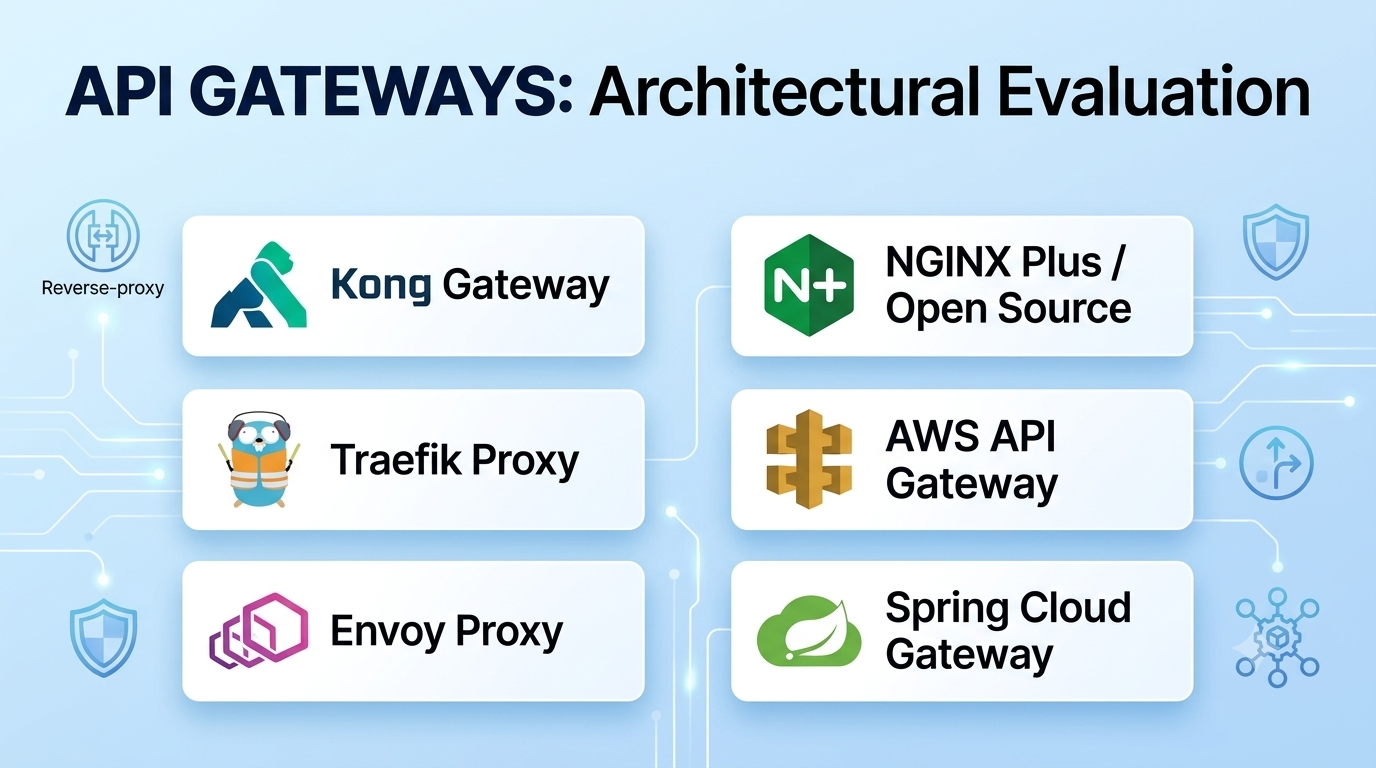
In a distributed microservices architecture, client applications—ranging from single-page web apps to native mobile clients—rarely communicate directly with internal backend services. Exposing dozens or hundreds of independent microservices directly to the public internet creates severe security vulnerabilities, complex client-side integration logic, and excessive cross-origin resource sharing (CORS) overhead. API gateways solve this architectural challenge by serving as the single reverse-proxy entry point for all incoming traffic, handling request routing, protocol translation, SSL termination, and security policy enforcement.
Selecting an API gateway requires evaluating proxy latency under heavy throughput, load-balancing algorithms, Kubernetes Ingress integration, and distributed tracing capabilities. This guide examines leading API gateways, analyzing their architectural foundations, proxy performance models, and enterprise deployment trade-offs.
Core Evaluation Criteria for API Gateway Architecture
Selecting an API gateway involves balancing high-throughput packet routing performance against security extensibility and operational simplicity.
- Proxy Performance and Resource Efficiency: The speed at which the gateway inspects, modifies, and proxies incoming network traffic without introducing memory bloat or request latency.
- Routing and Protocol Translation: The flexibility to route traffic based on HTTP headers, URL paths, or query parameters, alongside support for protocol translation (such as transforming incoming HTTP/REST requests into gRPC or asynchronous messaging).
- Security Enforcement at the Edge: Built-in capabilities for rate limiting, JWT validation, IP filtering, and protecting backend services from denial-of-service (DoS) attacks.
- Cloud-Native and Kubernetes Integration: Native support for operating as a Kubernetes Ingress controller, synchronizing routes dynamically with container deployments via Custom Resource Definitions (CRDs).
Leading API Gateways Compared
Different infrastructure environments, performance thresholds, and operational models demand distinct gateway architectures. Below is an examination of six prominent API gateways.
Kong Gateway
- Primary Focus: High-performance, cloud-native API gateway built on an NGINX core with a Lua plugin ecosystem.
- Deployment Model: Containerized (Docker/Kubernetes) or hybrid cloud.
- Technical Strengths: Unmatched request throughput with minimal latency, extensive plugin library for authentication and rate-limiting, and robust Kubernetes Ingress controller integration.
- Considerations: Advanced enterprise management, custom plugin development in Lua or Go, and centralized analytics require the paid Enterprise subscription.
Traefik Proxy
- Primary Focus: Modern, cloud-native application proxy and Kubernetes Ingress controller with automatic configuration discovery.
- Deployment Model: Containerized Docker and Kubernetes environments.
- Technical Strengths: Zero-configuration automatic discovery of backend services via Docker and Kubernetes labels, excellent dashboard visualization, and native Let’s Encrypt SSL certificate management.
- Considerations: While exceptional for dynamic container routing, it is less tailored for heavy enterprise API monetization, developer portals, and complex monetization workflows compared to dedicated API management suites.
Envoy Proxy
- Primary Focus: High-performance C++ edge and service mesh proxy designed for large cloud-native architectures.
- Deployment Model: Service mesh sidecar or edge gateway.
- Technical Strengths: Industry standard for modern service meshes (Istio), exceptionally low memory footprint, robust load-balancing algorithms, and comprehensive distributed tracing and observability.
- Considerations: Steep learning curve and complex configuration via dynamic xDS APIs; rarely operated raw without a control plane.
NGINX Plus / Open Source
- Primary Focus: High-performance web server, reverse proxy, and load balancer.
- Deployment Model: Virtual machine or bare-metal server infrastructure.
- Technical Strengths: Battle-tested reliability across decades of web traffic, exceptional raw performance, robust SSL termination, and flexible stream/TCP load balancing.
- Considerations: Requires manual configuration file editing or commercial control planes to achieve dynamic API gateway routing capabilities.
AWS API Gateway (HTTP and REST APIs)
- Primary Focus: Fully managed cloud API routing and serverless integration within Amazon Web Services.
- Deployment Model: Fully managed AWS cloud service.
- Technical Strengths: Zero infrastructure management, automatic scaling, native integration with AWS Lambda, DynamoDB, and IAM security mechanisms.
- Considerations: Tied strictly to the AWS cloud ecosystem, introducing platform lock-in and potential data egress costs for multi-cloud deployments.
Spring Cloud Gateway
- Primary Focus: Java-centric API routing and microservices gateway for Spring Boot applications.
- Deployment Model: Java Virtual Machine (JVM) application runtime.
- Technical Strengths: Seamless integration with Java microservices ecosystems, reactive non-blocking architecture built on Spring WebFlux, and dynamic routing based on Java predicates.
- Considerations: Requires a Java runtime environment, making it less optimal for polyglot infrastructure teams operating in non-JVM environments.
Comparative Technical Overview
| Platform | Core Language / Engine | Primary Deployment Target | Key Differentiator | Best Suited For |
| Kong | C / NGINX / Lua | Kubernetes & Containers | Massive plugin library & high throughput | Cloud-native microservices environments |
| Traefik | Go | Docker & Kubernetes | Automatic service discovery via labels | Dynamic containerized microservices |
| Envoy | C++ | Service Mesh & Edge | Deep observability & Istio integration | Enterprise Kubernetes service meshes |
| NGINX | C | Bare-metal & Virtual Machines | Battle-tested reverse proxy stability | Traditional server and proxy workloads |
| AWS API Gateway | Managed AWS Infrastructure | AWS Cloud | Serverless integration & zero ops | Teams building serverless applications on AWS |
| Spring Cloud Gateway | Java (Spring Boot) | JVM Runtime Environments | Native Java ecosystem integration | Enterprises standardized on the Spring Boot stack |
Implementation and Operational Considerations
Deploying an API gateway into production requires careful planning around network topology, high availability, and observability.
- High Availability and Load Balancing: An API gateway represents a single point of failure for incoming traffic. Always deploy gateways behind redundant load balancers across multiple availability zones or server instances.
- Observability and Tracing: Ensure the gateway injects correlation IDs (such as W3C Trace Context headers) into incoming requests so debugging tools can trace transactions seamlessly across downstream microservices.
- Security Boundary Separation: Separate your external edge gateway (handling public internet traffic and client authentication) from internal service-to-service routing proxies to maintain defense-in-depth principles.
Summary and Selection Framework
Choosing the right API gateway depends heavily on your hosting infrastructure, technology stack, and operational requirements.
- Choose Kong or Traefik when operating in dynamic Kubernetes and containerized cloud environments that demand automated service discovery and high throughput.
- Choose Envoy when implementing a service mesh architecture or requiring deep observability at enterprise scale.
- Choose AWS API Gateway when building cloud-native serverless applications exclusively within Amazon Web Services.
- Choose Spring Cloud Gateway when your engineering organization is built entirely around Java Spring Boot microservices.
Evaluate your infrastructure topology, performance constraints, and operational expertise before committing to an API gateway platform.
