Single-turn input/output assertions cannot test an autonomous agent. A customer support, voice, or operations agent does not just answer one static prompt—it negotiates across eight conversational turns with an impatient user, asks clarifying questions, calls backend APIs in variable sequences, recovers when an external tool returns an error, and enforces strict refund or compliance policies along the way.
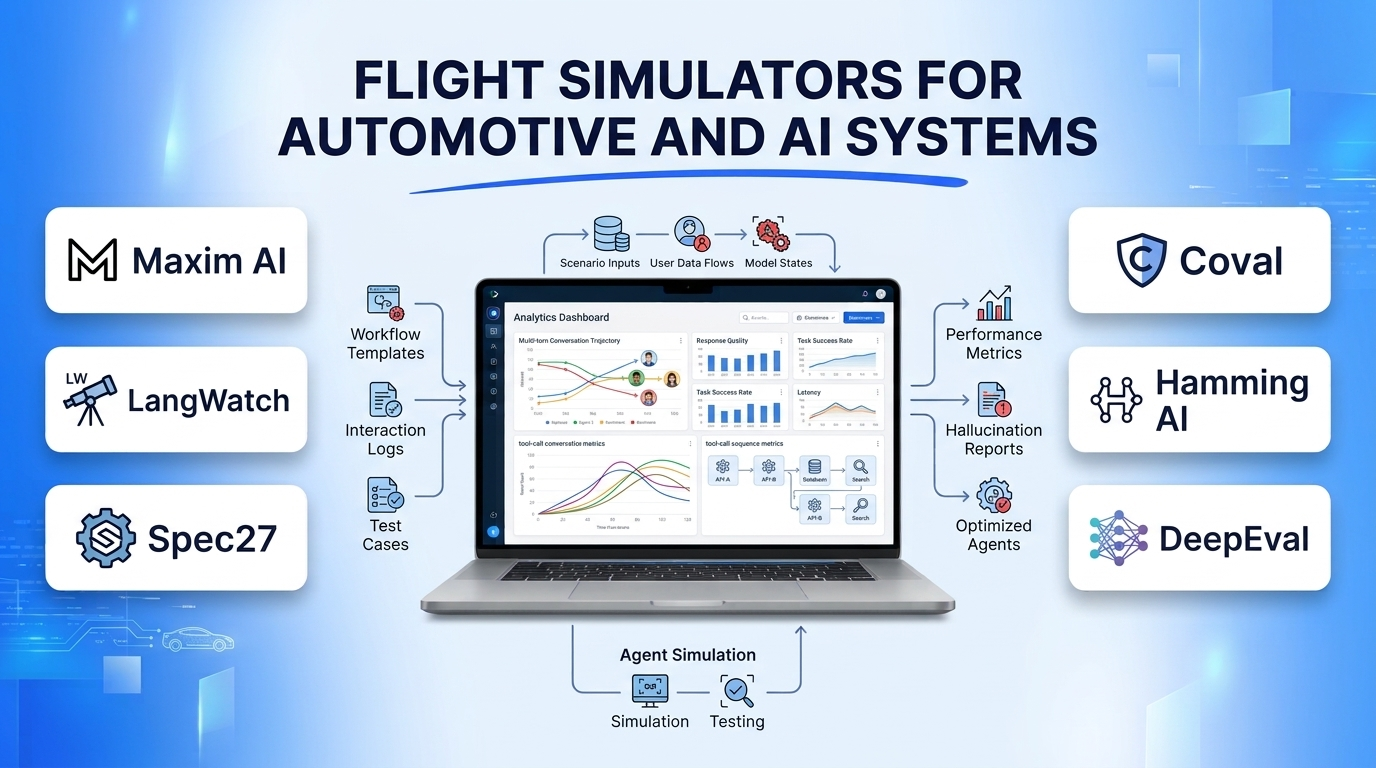
Agent workflow simulation and testing tools act like flight simulators for AI systems. Instead of testing static text pairs, they pair your live agent with LLM-powered synthetic user personas and mocked or sandboxed tool environments, running hundreds of dynamic multi-turn conversations in parallel and grading the full execution trajectory against behavioral criteria.
Five Core Capabilities of Agent Simulation Platforms
Evaluating a simulation and multi-turn testing platform requires looking beyond simple batch dataset runners to inspect how realistically it models dynamic environments:
- Persona-Driven Synthetic User Simulators: Static multi-turn scripts break the moment an agent phrases a clarifying question slightly differently. True simulation tools use configurable user-simulator LLMs driven by a goal, background context, and behavioral persona (e.g., confused first-time buyer, frustrated VIP customer, adversarial social engineer) that adapt dynamically to every agent reply.
- Trajectory-Level and Tool-Call Verification: Judging only the final message misses silent failures—such as an agent claiming “I have canceled your subscription” without ever invoking
cancel_subscription(), or callingissue_refund()twice. Evaluators must inspect the underlying trace spans to verify exact tool invocations, argument payloads, and call ordering. - Deterministic Tool Mocking and Fault Injection: Testing an agent against live Stripe or production ERP APIs is slow, expensive, and risky. Mature simulation frameworks let teams mock external tool responses—including injecting simulated
503 Service Unavailabletimeouts, rate limits, or conflicting database records—to verify graceful agent recovery. - Step-Level Replay and Root-Cause Branching: When a 12-turn simulated conversation fails at turn 9, engineers should be able to fork and replay the simulation directly from turn 8 after tweaking a prompt or tool schema, rather than re-running from turn 1.
- CI/CD Automation and Production-Trace-to-Scenario Conversion: Turning real production failures into reproducible multi-turn simulation scenarios that run automatically in
pytest,vitest, or GitHub Actions before every release.
Leading Agent Workflow Simulation & Testing Platforms
Maxim AI
Maxim AI provides an end-to-end simulation, evaluation, and observability platform built specifically for cross-functional teams shipping multi-turn conversational and workflow agents. Teams define test scenarios paired with user personas (politeness, domain knowledge, emotional state), conversation turn caps, and expected tool trajectories, then run simulations directly against live agent API endpoints. Maxim logs every request, response, and tool span, supports step-level simulation replay for root-cause debugging, and includes a no-code UI so product managers and QA reviewers can configure scenarios alongside engineers.
Organizations where product managers, QA specialists, and engineers collaborate closely on customer-facing support, booking, or operational agents benefit from Maxim’s unified simulation-to-production workflow.
LangWatch (and Open-Source Scenario)
LangWatch focuses heavily on automated multi-turn agent simulation both through its managed platform and Scenario, its open-source (Apache 2.0) agent testing framework available in Python, TypeScript, and Go. Designed to run inside native test runners (pytest or vitest) against any agent framework, Scenario pairs a simulated user LLM with an automated judge that evaluates every turn against plain-English behavioral criteria and verifies actual tool calls from execution traces.
Engineering teams wanting an open-source, code-native simulation library that plugs directly into existing CI pipelines without vendor lock-in frequently adopt Scenario and LangWatch.
Spec27
Spec27 approaches agent testing from behavioral specification and robustness verification rather than passive trace logging. Teams define explicit behavioral rules and policy boundaries that an agent must uphold, and Spec27 systematically tests multi-turn conversations, input paraphrasing variations, and adversarial pressure to verify whether defined agent behaviors hold across edge cases—even when internal agent instrumentation is limited.
Teams needing rigorous pre-release behavioral assurance and policy-boundary stress testing across black-box or complex multi-agent systems favor Spec27.
Coval and Hamming AI (Voice & Multimodal Conversational Agent Simulation)
Text-based simulators miss latency jitter, interruption handling (barge-in), background noise, and transcription errors that break voice agents in production. Coval and Hamming AI specialize in automated simulation and testing for voice and conversational AI agents—generating thousands of synthetic phone calls across accents, noisy environments, and impatient caller personas while measuring end-to-end voice latency, turn-taking naturalness, and task completion.
LangSmith and Braintrust (Multi-Turn Trajectory Evaluation)
Teams already standardized on LangSmith or Braintrust can run multi-turn conversational evaluations and trajectory comparisons inside their existing workflows:
- LangSmith supports multi-turn conversation evaluators, pairwise experiment comparisons, and failure clustering (
LangSmith Engine) that groups production trace failures and generates candidate evaluation tests. - Braintrust offers automated test-case generation (
Loop), dataset-driven trajectory scoring, and pull-request regression diffs across prompt and model versions.
DeepEval (Conversational & Trajectory Unit Testing)
In addition to single-turn RAG metrics, DeepEval provides conversational test cases (ConversationalTestCase) and tool-correctness metrics (ToolCorrectnessMetric) that validate multi-turn dialogue coherence and exact tool-call sequences inside standard Python pytest suites.
Agent Simulation & Testing Tools Comparison
| Platform | Primary Testing Strength | User Simulation & Environment Modeling | Trajectory & Tool Inspection | CI/CD & Ecosystem Fit | Best Fit |
| Maxim AI | Large-scale persona simulation & lifecycle QA | Configurable user personas, turn caps & live endpoint runs | Full span tracing + step-level simulation replay | CI/CD webhooks + no-code UI for PM/QA teams | Cross-functional teams shipping complex customer/ops agents |
LangWatch (Scenario) | Open-source multi-turn simulation in native test runners | Goal-driven simulated users with temperature variation | Verifies behavioral criteria against actual tool traces | Apache 2.0 SDK (pytest / vitest in Python, TS, Go) | Engineering teams wanting OSS simulation inside CI pipelines |
| Spec27 | Behavioral specification & adversarial robustness | Multi-turn variance & policy-boundary stress testing | Evaluates rule adherence even without deep instrumentation | Automated pre-release behavioral suites | Teams verifying strict policy compliance under adversarial pressure |
| Coval / Hamming AI | Voice & phone agent simulation | Synthetic audio callers, accents, barge-in & latency stress | Measures voice turn-taking, ASR errors & workflow completion | Automated voice CI/CD & production monitoring | Teams deploying customer-facing voice AI agents |
| LangSmith / Braintrust | Trace-to-dataset multi-turn regression suites | Dataset replay, synthetic test generation & multi-turn judges | Native graph/span trajectory diffs & failure clustering | Tight integration with LangGraph / CI pull requests | Teams already standardized on LangSmith or Braintrust tracing |
| DeepEval | Code-native trajectory & conversation assertions | Multi-turn dialogue test cases & tool-sequence checks | Evaluates tool selection, parameters & call ordering | Native Python pytest integration | Python developers adding agent trajectory gates to unit tests |
Practical Pitfalls in Agent Simulation Testing
- Letting the Simulated User Become Too Helpful: Left unconstrained, an LLM playing a simulated customer will neatly volunteer every required order number, email address, and policy exception in turn one—hiding the exact ambiguity failures real users trigger. Explicitly instruct user simulators to withhold details unless asked and to push back when policies feel unclear.
- Evaluating Only Final Text Replies Instead of Side Effects: An agent can write a polite apology while still erroneously executing a database write tool. Always assert on side effects and tool-call traces, not just conversational prose.
- Running Full 500-Scenario Simulations on Every Single Commit: Multi-turn simulations multiply LLM token usage by 10× to 20× per scenario. Run a fast 25-scenario smoke suite on every pull request, and execute the full 300+ scenario persona matrix nightly or before major model upgrades.
Selecting the Right Agent Simulation & Testing Tool
Match your simulation tooling to your agent’s modality and who authors the test scenarios:
- For Open-Source, Code-Native CI/CD Simulation: Use LangWatch’s
Scenario(or DeepEval for deterministic trajectory assertions) directly insidepytestorvitest. - For Cross-Functional Collaboration With Non-Engineer QA and PMs: Adopt Maxim AI so product and operations leads can author persona scenarios and inspect step-by-step replays alongside engineering.
- For Policy-Critical Behavioral Robustness: Add Spec27 to stress-test whether agents hold strict policy boundaries under phrasing shifts and adversarial turns.
- For Voice and Telephony Agents: Use Coval or Hamming AI to test audio latency, interruptions, and spoken edge cases before putting an agent on a live phone line.
