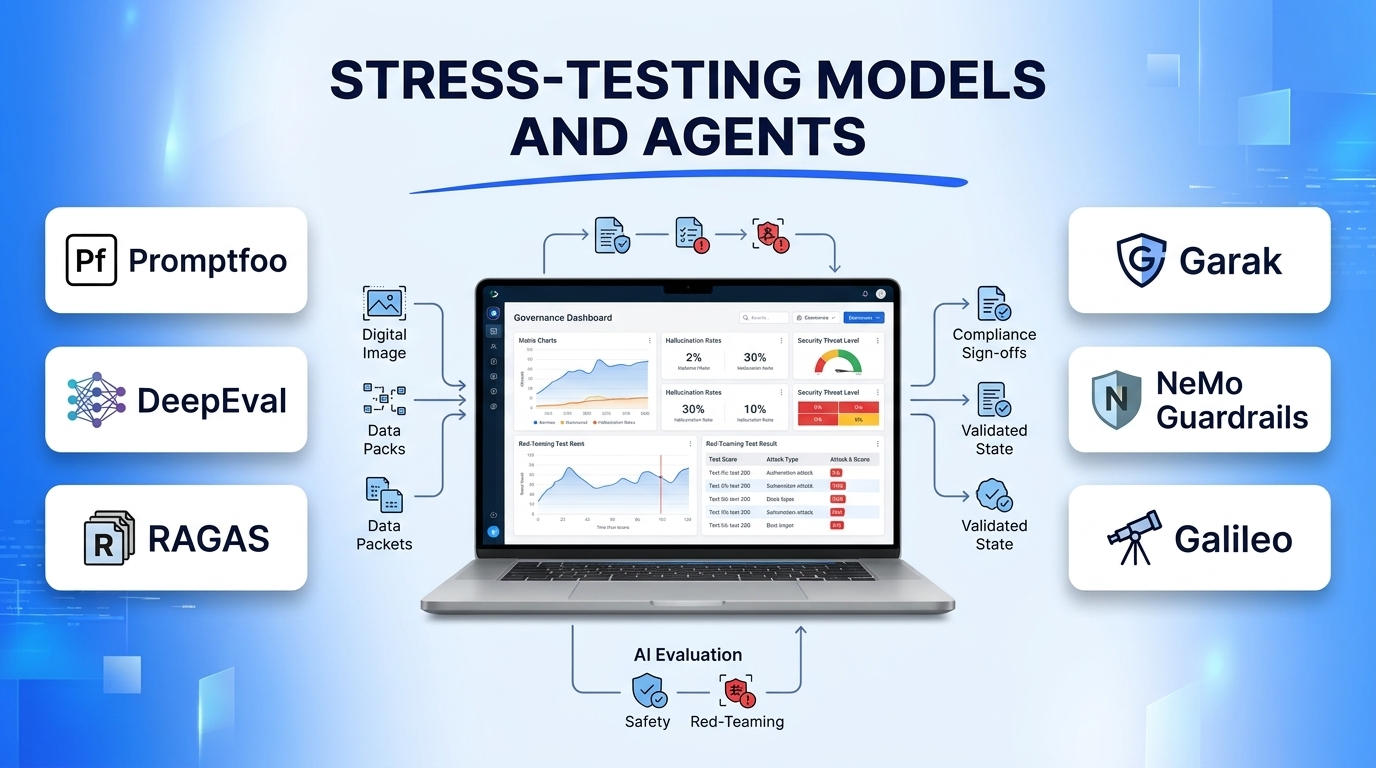
A generative AI application that passes 95% of happy-path unit tests can still leak system prompts, hallucinate non-existent refund policies, execute an indirect prompt injection hidden inside a retrieved PDF, or output biased recommendations under adversarial phrasing.
Unlike deterministic software where a single input always yields one expected output, LLM and agent systems require two complementary layers of protection: pre-deployment evaluation and red-teaming suites that stress-test prompts, RAG pipelines, and tool-calling agents in CI/CD, and real-time runtime guardrails that inspect inputs and outputs inline to block unsafe behavior in production.
Five Core Capabilities of AI Safety & Evaluation Stacks
When assembling an evaluation and safety stack, teams should separate offline quality/security testing from inline production filtering:
- Automated Adversarial Red-Teaming: Generating systematic attack suites—covering direct jailbreaks, indirect prompt injection via retrieved documents or web pages, PII/credential extraction, and unauthorized tool invocation—rather than relying on manual ad-hoc probing.
- RAG-Specific Faithfulness and Context Metrics: Measuring whether generated answers are strictly grounded in retrieved context chunks (faithfulness/hallucination rate) separately from whether the retriever fetched the right documents (context precision and recall).
- Agent Trajectory and Tool-Call Correctness: Evaluating not just the final text reply, but whether an agent invoked the right MCP or API tools, passed valid schema arguments, respected permission boundaries, and took an efficient path to completion.
- CI/CD Regression Gates With Deterministic + Judge Scoring: Running declarative test suites in GitHub Actions or GitLab CI that combine fast deterministic assertions (JSON schema, regex, toxicity classifiers) with calibrated LLM-as-a-judge rubrics—blocking pull requests when quality or safety scores drop.
- Sub-100ms Inline Production Guardrails: Lightweight, specialized safety models and deterministic scanners deployed on the live request/response path to intercept prompt injections, PII leaks, and off-topic abuse without adding multi-second latency.
Leading AI Safety & Evaluation Tools
Promptfoo
Promptfoo is the leading open-source (MIT-licensed), CLI-first framework for LLM evaluation and automated red-teaming. Configured via declarative YAML files checked into Git, Promptfoo compares prompts and models side by side across latency, cost, and accuracy while offering a comprehensive red-teaming engine with over 40 adversarial vulnerability plugins—including indirect prompt injection, jailbreaks, PII exposure, and security testing for agents calling MCP servers and tools.
Engineering and security teams wanting declarative, pull-request-reviewable red-teaming and model comparison gates in CI/CD rely heavily on Promptfoo.
DeepEval (by Confident AI)
DeepEval is an open-source, Python-native LLM evaluation framework designed to feel like pytest for AI systems. Offering over 14 research-backed metrics (including hallucination, answer relevancy, faithfulness, contextual recall, bias, toxicity, and agent tool-call correctness), DeepEval integrates directly into standard Python CI/CD pipelines and pairs with Confident AI for hosted dataset management and regression tracking.
Python-first engineering teams that want unit-test-style metric assertions inside their existing pytest workflows gravitate toward DeepEval.
RAGAS
RAGAS is a specialized open-source evaluation framework purpose-built for Retrieval-Augmented Generation (RAG) pipelines. Rather than generic text scoring, RAGAS decomposes RAG quality into distinct retrieval and generation metrics—context precision, context recall, faithfulness, and answer relevance—and includes synthetic test-set generation tools that build question-answer pairs directly from your enterprise document corpus.
Teams whose primary AI architecture centers on enterprise knowledge retrieval and document Q&A frequently pair RAGAS with a broader testing or observability tool.
NVIDIA Garak and Microsoft PyRIT (Offensive Red-Teaming Frameworks)
For dedicated AI security engineers conducting deep offensive vulnerability assessments, two open-source red-teaming toolkits stand out:
- NVIDIA Garak acts like an
nmapvulnerability scanner for LLMs—probing models and endpoints across dozens of structured attack modules including encoding bypasses, hallucination triggers, data leakage, and toxicity. - Microsoft PyRIT (Python Risk Identification Tool) provides an extensible automation framework for security red teams to orchestrate multi-turn adversarial attack strategies, score model responses, and uncover systemic safety weaknesses across text and multimodal systems.
Lakera Guard, NVIDIA NeMo Guardrails, and Guardrails AI (Runtime Guardrails)
Pre-release testing catches known failure patterns, while runtime guardrails protect live production traffic:
- Lakera Guard provides a ultra-low-latency commercial API purpose-built to detect prompt injections, jailbreaks, and PII leakage in real time before user inputs or retrieved web/RAG documents reach your model.
- NVIDIA NeMo Guardrails is an open-source programmable toolkit that lets developers define conversational rails (topical boundaries, fact-checking rails, and safe tool-execution rails) using Colang around LLM applications.
- Guardrails AI combines an open-source Python validation framework with a hub of composable input/output validators (PII detection, competitor mentions, toxic language, structured JSON enforcement) that automatically re-prompt or filter non-compliant outputs.
Patronus AI and Galileo (Enterprise Safety & Hallucination Platforms)
Patronus AI and Galileo target regulated enterprises needing high-precision automated evaluators and real-time protection. Galileo pairs specialized small language models (Luna-2) for low-cost, low-latency hallucination and error detection with Protect inline production guardrails, while Patronus AI provides fine-tuned evaluator models (such as Lynx for hallucination detection) and automated adversarial testing suites.
AI Safety & Evaluation Tools Comparison
| Tool | Primary Role | Core Strength | CI/CD vs. Runtime Focus | Licensing & Deployment | Best Fit |
| Promptfoo | Evaluation & automated red-teaming | Declarative YAML tests, multi-model matrix & 40+ attack plugins (incl. MCP) | Pre-deployment CI/CD & security audits | Open-source (MIT) CLI + Enterprise Cloud | Engineering & AppSec teams running automated red-teaming in CI |
| DeepEval | Python LLM & agent unit-testing framework | pytest-native assertions, 14+ metrics & agent trajectory checks | Pre-deployment Python CI/CD | Open-source (Apache 2.0) + Confident AI Cloud | Python-native teams wanting unit-test-style metric gates |
| RAGAS | RAG-specific quality evaluation | Retrieval precision/recall + generation faithfulness & synthetic datasets | Offline & sampled RAG evaluation | Open-source (Apache 2.0) | Teams optimizing complex enterprise RAG pipelines |
| Garak / PyRIT | Offensive LLM vulnerability scanners | Deep adversarial probing, multi-turn attacks & encoding bypasses | Security red-teaming & penetration testing | Open-source (NVIDIA / Microsoft) | Security teams auditing models and endpoints for vulnerabilities |
| Lakera Guard / NeMo Guardrails | Inline runtime safety & topical guardrails | Real-time prompt-injection blocking (Lakera) / programmable rails (NeMo) | Live production runtime filtering | Commercial API (Lakera) / OSS (NeMo) | Production apps exposed to untrusted user or web inputs |
| Galileo / Patronus AI | Enterprise evaluation & hallucination guardrails | Specialized evaluator SLMs, real-time blocking & audit reporting | Both pre-release eval & runtime protection | Commercial SaaS + Enterprise VPC | Regulated enterprises needing low-latency hallucination guardrails |
Evaluation Traps That Create False Confidence
- Relying on Generic Benchmark Scores Instead of Domain Failure Datasets: High scores on public benchmarks do not protect a banking or healthcare agent from domain-specific traps. Build custom test sets around your application’s highest-consequence failure modes—such as unauthorized refunds, fabricated citations, or cross-tenant data leakage.
- Using the Same Model Family as Both Generator and Judge: An LLM judge exhibits self-preference bias toward outputs written in its own stylistic patterns. Calibrate LLM-as-a-judge rubrics against human-labeled golden examples and pair them with deterministic code checks.
- Ignoring Judge Token Costs on Large Suites: Running a frontier reasoning model as an evaluator across 10,000 daily traces quickly rivals production inference spend. Use deterministic code assertions first, and route routine LLM-judge checks to smaller, calibrated models.
Selecting the Right AI Safety & Evaluation Stack
Most production teams combine two complementary tools rather than relying on a single vendor:
- For Pre-Release Red-Teaming and Model Benchmarking: Start with Promptfoo to run declarative security scans and multi-model comparisons in CI/CD.
- For Python
pytestPipelines and RAG Diagnostics: Pair DeepEval (for CI metric gates) with RAGAS (for isolating retrieval vs. generation failures). - For Live Production Protection Against Untrusted Inputs: Place Lakera Guard or NVIDIA NeMo Guardrails inline in front of customer-facing agents and RAG ingestion pipelines.
