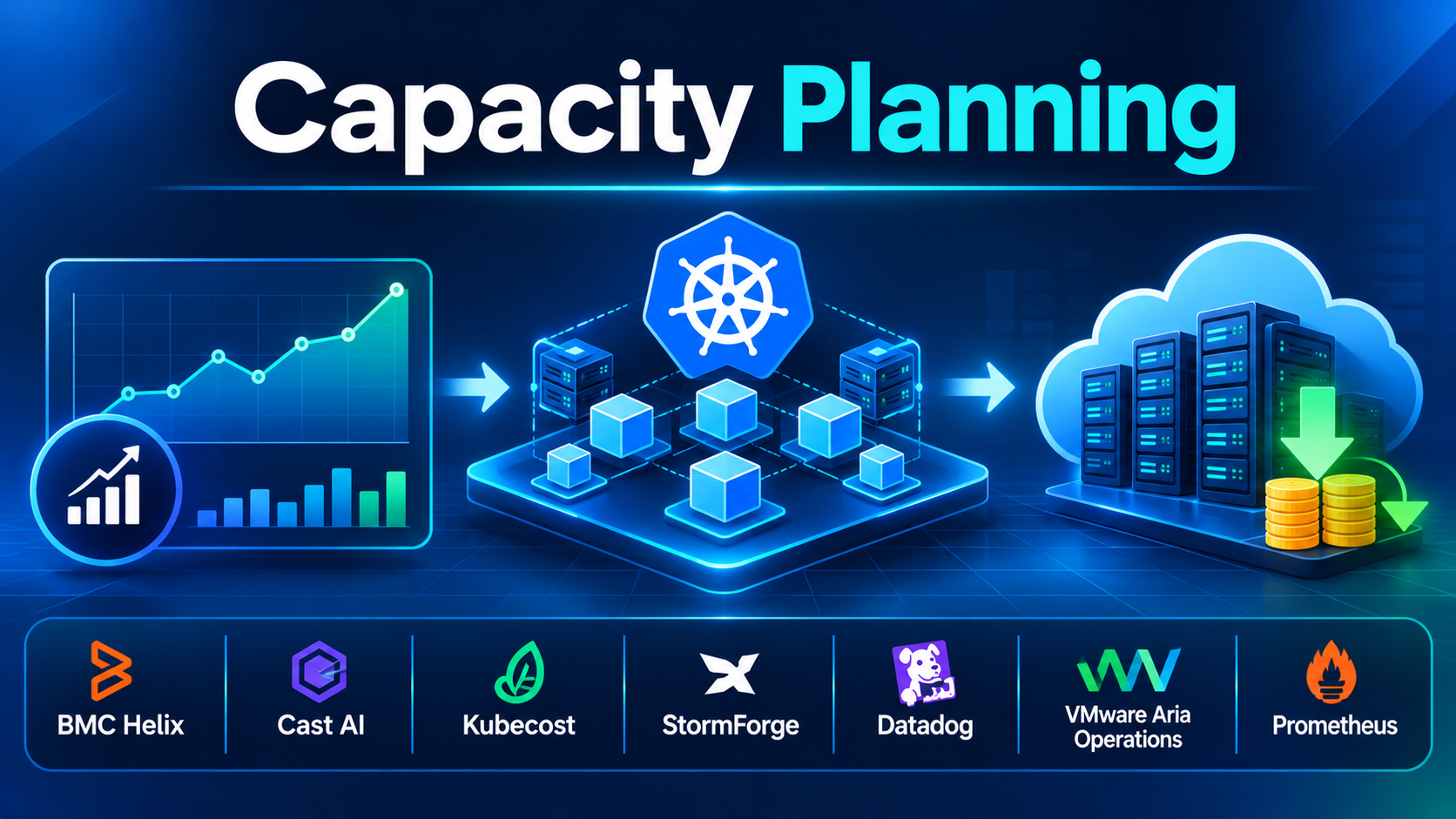
Provisioning infrastructure for peak traffic all year wastes millions in idle cloud compute, yet under-provisioning a database cluster or Kubernetes node pool before a seasonal traffic surge guarantees cascading timeouts when demand spikes. Historically, capacity planning meant exporting last quarter’s CPU graphs into a spreadsheet and adding an arbitrary 30% buffer—an approach that collapses in elastic cloud environments where microservices autoscale dynamically, reserved instances require multi-year commitments, and AI/GPU workloads face strict hardware allocation limits.
Capacity planning tools help engineering, FinOps, and IT operations teams forecast resource exhaustion, right-size compute and storage footprints, and model “what-if” growth scenarios before bottlenecks hit production. However, the category spans distinct operational domains: hybrid data-center and enterprise IT capacity suites, Kubernetes-native resource rightsizing and autoscaling engines, cloud FinOps and commitment-planning platforms, and observability-embedded forecasting tools. Selecting the right platform requires aligning its forecasting horizon, workload telemetry sources, and automated execution boundaries with your infrastructure architecture.
Four Distinct Approaches to Infrastructure Capacity Planning
Before comparing individual software products, platform engineering, SRE, and FinOps teams should separate the four operational problems capacity planning tools solve.
1. Enterprise Hybrid Data Center and VM Capacity Modeling
Suites such as BMC Helix Continuous Optimization and VMware Aria Operations analyze historical utilization across on-premises hypervisors, storage arrays, mainframes, and multi-cloud virtual machines—using queuing theory and seasonal trend modeling to forecast exactly when physical hosts, storage pools, or licenses will saturate.
- Core strength: Essential for capital-expenditure hardware procurement, data-center consolidation, and private-cloud VM density optimization.
- Primary trade-off: Heavy enterprise implementation footprint; less agile for ephemeral container microservices that scale by the second.
2. Kubernetes Workload Rightsizing and Cluster Autoscaling
Cloud-native platforms like Cast AI, Kubecost, StormForge, and open-source Kubernetes Vertical Pod Autoscaler (VPA) / Karpenter inspect real-time container CPU and memory requests versus actual usage—eliminating the widespread problem of developers over-requesting pod resources “just to be safe.”
- Core strength: Reclaims stranded cluster capacity automatically and selects optimal spot or on-demand node instance types in real time.
- Primary trade-off: Focused primarily on Kubernetes compute and memory optimization rather than long-term business-demand forecasting or non-containerized legacy systems.
3. Cloud FinOps and Commitment Capacity Planners
Platforms such as CloudHealth (Broadcom), Apptio Cloudability, and ProsperOps bridge engineering capacity with financial procurement—analyzing steady-state compute baselines to recommend or autonomously manage AWS Reserved Instances, Savings Plans, and Committed Use Discounts.
- Core strength: Prevents over-committing to multi-year cloud contracts before architectural migrations or workload optimizations take effect.
- Primary trade-off: Optimizes financial unit economics rather than application-level latency bottlenecks or thread-pool saturation.
4. Telemetry-Driven Forecasting in Observability and Open-Source Stacks
Tools like Datadog Watchdog / Cloud Cost Management, Prometheus (predict_linear), and Tamland (GitLab’s open-source capacity forecasting framework built on Prophet) apply time-series forecasting directly to application and infrastructure metrics—alerting SREs weeks in advance when disk growth, connection-pool exhaustion, or memory leaks approach saturation thresholds.
Notable Capacity Planning Tools Across Workflows
BMC Helix Continuous Optimization — Enterprise Hybrid Capacity and Scenario Modeling
BMC Helix Continuous Optimization (formerly TrueSight Capacity Optimization) is a flagship enterprise capacity planning suite built for large hybrid IT estates spanning on-premises VMware/bare-metal servers, storage systems, databases, and public cloud accounts.
Its standout capability is predictive “what-if” simulation: capacity planners can model the exact infrastructure impact of onboarding a new business application, migrating workloads from on-premises data centers to AWS or Azure, or handling projected seasonal transaction growth before purchasing hardware. Its enterprise depth and commercial licensing suit large regulated organizations with dedicated capacity management teams, whereas lean cloud-native startups typically find lighter FinOps or Kubernetes-specific tools faster to deploy.
Cast AI — Autonomous Kubernetes Node Provisioning and Rightsizing
Built specifically for Kubernetes clusters running on AWS EKS, Google GKE, and Microsoft AKS, Cast AI analyzes live pod resource requests, actual container utilization, and cloud instance pricing continuously—automatically rightsizing workloads, bin-packing pods onto tighter node footprints, and rebalancing between spot and on-demand instances.
Rather than merely generating static PDF recommendations that engineers never implement, Cast AI operates as an active control plane that modifies cluster node pools automatically within administrator-defined guardrails. Teams running non-Kubernetes VM fleets or traditional bare-metal data centers will need a broader hybrid capacity suite.
Kubecost (IBM) — Kubernetes Resource Allocation, Cost Visibility, and Capacity Insights
Kubecost (available in an open-source core edition built on OpenCost as well as commercial enterprise tiers) provides granular visibility into Kubernetes CPU, memory, GPU, and persistent-volume allocation broken down by namespace, deployment, label, or team.
Kubecost surfaces over-provisioned container requests, idle cluster capacity, and node-sizing recommendations directly from Prometheus metrics without shipping sensitive telemetry outside your cluster. Its open-source foundation makes it an accessible starting point for Kubernetes platform teams, while enterprise tiers add multi-cluster federation, automated rightsizing actions, and cloud-bill reconciliation.
StormForge — Machine-Learning Kubernetes Resource Optimization
StormForge focuses on solving Kubernetes resource-request configuration at scale—using machine learning to analyze historical container telemetry and automatically adjust CPU and memory requests and limits safely without triggering OOMKilled crashes or CPU throttling.
Unlike tools focused solely on node bin-packing, StormForge targets the application-level container specification layer, integrating into GitOps pull-request workflows or running autonomous in-place pod updates. Its scope is specialized around Kubernetes workload efficiency rather than enterprise hardware procurement or multi-cloud financial commitment management.
Datadog (Cloud Cost Management & Forecasting) — Unified Telemetry and Spend Correlation
For engineering organizations already using Datadog for infrastructure monitoring and APM, combining Datadog’s Forecast Monitors with Cloud Cost Management connects technical saturation metrics directly to cloud billing drivers.
SREs can forecast disk, memory, or database connection exhaustion using seasonal regression algorithms while mapping AWS, Azure, and GCP spend back to specific Kubernetes namespaces and APM services. Organizations not already standardized on Datadog should weigh the cost of full telemetry ingestion if they only need standalone capacity reporting.
VMware Aria Operations (formerly vRealize Operations) — Private Cloud and vSphere Capacity Management
For enterprises operating substantial on-premises VMware vSphere and private-cloud infrastructure, VMware Aria Operations provides native capacity analytics—calculating remaining cluster time, VM right-sizing opportunities, host consolidation ratios, and hardware procurement forecasts directly from hypervisor telemetry.
It remains deeply integrated with VMware SDDC stacks, though organizations actively migrating away from on-premises hypervisors toward cloud-native Kubernetes architectures often pair or replace it with cloud-agnostic platforms.
Tamland and Prometheus (predict_linear) — Open-Source SRE Saturation Forecasting
Engineering teams standardized on Prometheus and Grafana have two practical open-source mechanisms for proactive capacity planning:
- Prometheus
predict_linear()functions allow SREs to write alerting rules that project linear growth over a trailing window (for example, alerting when a persistent volume will hit 100% capacity within four days at current write rates). - Tamland (originally developed and open-sourced by GitLab’s infrastructure team) builds automated capacity forecasting reports on top of Prometheus metrics and Meta’s Prophet time-series library—generating regular saturation forecasts across database CPU, Redis memory, disk IOPS, and sidekiq queue capacity without commercial SaaS licensing.
Comparison of Capacity Planning Tools
| Tool / Platform | Primary Domain | Forecasting & Optimization Mechanism | Deployment Model | Standout Strength | Primary Trade-Off |
| BMC Helix Continuous Optimization | Enterprise hybrid data center & cloud | Queuing theory, seasonal modeling, & what-if simulations | Enterprise SaaS or On-Premises | Deep multi-tier hardware, VM, and cloud migration capacity modeling | Heavy enterprise implementation and licensing footprint |
| Cast AI | Kubernetes clusters (EKS, GKE, AKS) | Real-time workload rightsizing & automated node bin-packing | SaaS control plane + cluster agent | Hands-free autonomous cluster scaling and spot/on-demand optimization | Scoped exclusively to Kubernetes environments |
| Kubecost / OpenCost | Kubernetes cost & resource allocation | Prometheus-based utilization vs. request analysis | Open-Source / Self-Hosted + Enterprise SaaS | Granular namespace/team capacity and cost visibility inside the cluster | Automated execution and multi-cluster governance require commercial tiers |
| StormForge | Kubernetes container resource tuning | ML-driven CPU/memory request & limit optimization | SaaS + Kubernetes agent | Prevents both over-provisioning and OOM throttling via GitOps or live updates | Focused on container sizing rather than cloud commitment or VM planning |
| Datadog Forecasting & Cost | Full-stack cloud & APM telemetry | Seasonal metric forecasting + cloud billing correlation | Managed Cloud SaaS | Links application saturation trends directly to cloud infrastructure spend | Best value only when already standardized on Datadog observability |
| VMware Aria Operations | On-premises vSphere & private cloud | Hypervisor capacity, VM density, & consolidation modeling | Self-Hosted / VMware Cloud | Native visibility into ESXi host saturation and private-cloud hardware planning | Primarily centered on VMware virtualization estates |
| Tamland / Prometheus | Open-source SRE saturation forecasting | Time-series regression (Prophet / predict_linear) | Open-Source Self-Hosted | Zero licensing cost; automates long-horizon saturation reports from Prometheus | Requires platform engineering setup and maintenance |
Four Practices That Keep Capacity Plans Accurate
1. Plan Around Saturation Bottlenecks, Not Average CPU
A cluster running at 35% average CPU can still collapse during a traffic spike if a single-threaded Redis instance, PostgreSQL connection pool, or NAT gateway bandwidth limit saturates at 80%. Identify your architecture’s true limiting resources (IOPS, connection limits, GPU memory, API rate quotas) and track saturation percentiles (p95/p99) rather than fleet averages.
2. Right-Size Workloads Before Buying Reserved Capacity
Committing to one- or three-year cloud Reserved Instances or Savings Plans based on bloated, unoptimized Kubernetes resource requests locks in unnecessary spend. Always run a workload rightsizing pass—trimming idle memory and CPU buffers—before calculating baseline commitment purchases.
3. Pair Historical Forecasting with Load-Test Validation
Time-series forecasting models extrapolate past organic growth accurately, but they cannot predict step-function changes caused by a new product launch, a viral marketing campaign, or a major enterprise customer onboarding. Validate major architectural capacity assumptions with periodic load and stress tests (using k6, Locust, or Gatling) to measure true throughput ceilings.
4. Establish Automated Reclamation Policies for Idle Environments
Staging clusters, abandoned feature-branch preview environments, and unattached cloud block volumes routinely consume 20% to 35% of non-production capacity. Enforce TTL (time-to-live) expiration policies and scheduled off-hours scale-downs before provisioning additional cluster capacity.
Choosing the Right Capacity Planning Tool
- For Kubernetes-centric platform and FinOps teams seeking immediate compute savings: Cast AI (for autonomous node and workload optimization) or Kubecost / OpenCost (for transparent, self-hosted resource allocation visibility) delivers the fastest operational return.
- For large enterprises managing hybrid on-premises data centers, VMware clusters, and complex cloud migrations: BMC Helix Continuous Optimization (or VMware Aria Operations for vSphere-heavy estates) provides rigorous scenario modeling and hardware procurement forecasting.
- For SRE teams standardized on Prometheus and Grafana wanting proactive saturation alerts: Combine Prometheus
predict_linearrules with Tamland to catch slow-burn resource exhaustion weeks before outages occur. - For cloud-native engineering teams already using Datadog: Leverage Datadog Forecast Monitors alongside Cloud Cost Management to unify technical capacity planning and FinOps accountability in one platform.
