Every engineering team ships code continuously, yet most customers still discover major features by accident—or learn about breaking API changes only after an integration fails in production. When release communication breaks down, the culprit is rarely a lack of writing effort; it is the disconnect between raw version-control commits (fix(auth): handle nil token refresh) and the structured, audience-specific narratives that users, support teams, and enterprise buyers actually need.
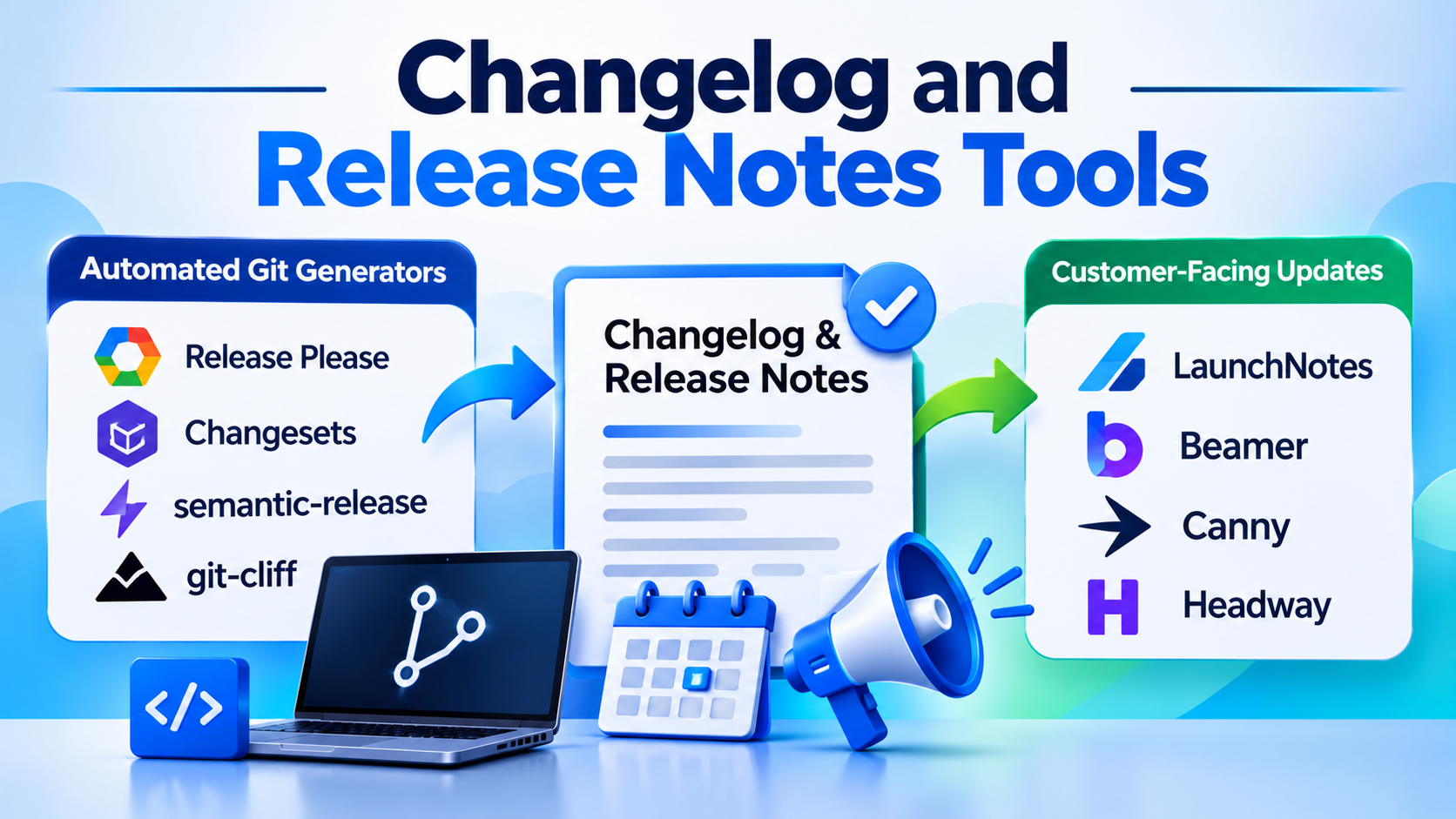
Changelog and release notes tools bridge that gap, but the category splits into two fundamentally different software architectures. Automated Git-to-Markdown generators parse Conventional Commits and pull request labels to bump semantic versions and generate CHANGELOG.md files inside CI pipelines. Customer-facing product update platforms, by contrast, provide hosted changelog portals, in-app notification widgets, email digests, and feedback loops designed for SaaS product managers and customer success teams. Choosing the wrong model leaves either developers manually copy-pasting release notes into marketing pages or end users staring at raw commit hashes.
Two Distinct Layers in Release Communication
Before comparing individual tools, engineering and product organizations should determine which audience they are primarily serving.
1. Developer-Centric Automated Changelog Generators
CLI tools and CI plugins—such as semantic-release, Release Please, git-cliff, and Changesets—operate directly inside your Git repository. They inspect structured commit messages, pull request metadata, or intent files to calculate the next Semantic Versioning (SemVer) tag, generate release notes in Markdown, and publish GitHub or GitLab Releases automatically.
- Core strength: Eliminates manual version bumping and guarantees that open-source libraries, SDKs, and internal APIs maintain accurate, reproducible version histories.
- Primary trade-off: Output reflects technical code changes rather than customer value; raw commit lists rarely make sense to non-technical SaaS end users without editorial rewriting.
2. Customer-Facing Changelog and Product Update Platforms
SaaS platforms—such as Beamer, LaunchNotes, Headway, and Canny—focus on distributing curated release announcements to end users, account managers, and enterprise stakeholders. They pair hosted public or authenticated changelog pages with embeddable in-app widgets (“What’s New” badges), user segmentation, and subscriber notifications.
- Core strength: Delivers high visibility inside your application UI, tracks reader engagement, and closes the feedback loop when shipped features resolve customer feature requests.
- Primary trade-off: Requires human curation (or AI-assisted drafting from Jira/Linear tickets) rather than fully hands-off Git commit generation.
Notable Changelog and Release Notes Tools Across Workflows
Release Please (Google) — Pull-Request-Driven SemVer and Changelog Automation
Maintained by Google, Release Please automates CHANGELOG.md updates, version bumps, and GitHub Releases using Conventional Commits (feat:, fix:, feat!:). Rather than tagging a release immediately on every push to main, Release Please opens and continuously updates a dedicated Release Pull Request that accumulates pending changes.
When maintainers merge that Release PR, Release Please tags the commit, updates CHANGELOG.md, and publishes the GitHub Release. It supports single repositories as well as complex polyglot monorepos with independent package versioning. Its main requirement is strict commit-message hygiene across contributors, though squash-merging pull requests with Conventional Commit titles makes enforcement straightforward.
Changesets — Multi-Package Monorepo Release Coordination
Created primarily for JavaScript and TypeScript monorepos (and widely adopted by projects using pnpm, Turborepo, and Nx), Changesets decouples release notes from raw Git commit history. Instead of parsing every commit message, developers run a CLI command (npx changeset) when opening a pull request to write a brief human-readable summary and declare whether the change is a major, minor, or patch bump for affected packages.
Changesets aggregates those markdown snippets at release time into clean, user-friendly changelogs and automatically bumps internal workspace dependencies. For teams managing multi-package SDKs or design systems, Changesets produces far cleaner release notes than raw commit parsers, at the cost of requiring contributors to include a changeset file with each feature PR.
semantic-release — Fully Automated CI/CD Version Publishing
semantic-release removes human intervention from package publishing entirely. Running at the end of a CI pipeline, it analyzes commit messages since the last tag, determines the semantic version increment, generates release notes, creates the Git tag, publishes artifacts to registries (such as npm, PyPI, or Docker), and posts comments on resolved GitHub/Jira issues.
It is best suited for mature libraries and automated microservice pipelines with high test coverage where every merge to main is immediately releasable. Teams that prefer staging multiple features into scheduled release candidates or manually reviewing release wording before publication often favor Release Please or Changesets instead.
git-cliff — High-Speed Rust Changelog Generation with Custom Templates
Written in Rust, git-cliff is a standalone CLI generator that parses Git history using regex rules and Conventional Commits to render changelogs through customizable Tera (Jinja2-style) templates.
Because it has zero runtime dependencies and executes in milliseconds, git-cliff integrates easily into any language ecosystem (Rust, Go, Python, C++, Java) without requiring a Node.js toolchain. It excels when engineering teams want complete control over Markdown formatting, commit grouping, and issue-tracker link generation inside a fast single binary.
LaunchNotes — Enterprise Product Communication and Stakeholder Alignment
On the customer-facing side, LaunchNotes is built for B2B SaaS organizations that need to coordinate release communication across multiple audiences—external customers, internal sales/support teams, and beta cohorts—from a single source of truth.
LaunchNotes connects directly to Jira, Linear, GitHub, and Slack, allowing product managers to draft announcements once and publish tailored views to a public changelog portal, an in-app embed widget, email digests, or private Slack channels. It also supports subscriber filtering by product area and collects structured sentiment feedback on each release. Its commercial subscription pricing is geared toward scaling B2B product organizations rather than solo indie developers.
Beamer — In-App Notification Feeds and User Engagement
Beamer focuses heavily on driving feature adoption directly inside web and mobile applications through an embeddable sidebar or popover changelog widget. Product teams categorize updates (New, Improvement, Fix), segment announcements by user role, plan tier, or behavior, and trigger push notifications or NPS micro-surveys alongside release posts.
For SaaS products where users rarely visit an external /changelog URL, Beamer’s in-app visibility significantly increases awareness of newly shipped capabilities. Teams looking primarily for developer-centric Git/CI automation or deep enterprise ticket traceability will find it more marketing- and product-oriented.
Headway and Canny — Lightweight Portals vs. Feedback-Loop Integration
For smaller SaaS teams and developer tools, two distinct SaaS models round out the landscape:
- Headway offers a minimalist, fast-to-configure hosted changelog page and lightweight JavaScript widget designed purely for publishing clean, chronological product updates with minimal administrative overhead.
- Canny integrates changelog publishing directly with its customer feature-request voting board—automatically notifying every user who upvoted or commented on a requested feature the moment its status moves to
Complete.
Comparison of Changelog and Release Notes Tools
| Tool / Platform | Primary Audience | Workflow Trigger | Deployment / Hosting | Standout Strength | Primary Trade-Off |
| Release Please | Open-source & internal developers | Conventional Commits in GitHub PRs | GitHub Action / CLI | Accumulates pending notes in an automated Release PR before tagging | Requires Conventional Commit discipline across merges |
| Changesets | Monorepo & SDK maintainers | Developer-authored intent files per PR | Open-source CLI / CI | Clean human-written notes and coordinated multi-package SemVer bumps | Adds a manual CLI step during pull-request authoring |
semantic-release | Library & automated CD teams | CI build completion on release branches | Open-source Node.js CLI | End-to-end hands-free SemVer tagging, changelog creation, and registry publish | Less flexible when teams want manual editorial review before release |
git-cliff | Polyglot engineering teams | Git commit history & tags | Single Rust CLI binary | Ultra-fast execution and fully customizable Tera Markdown templates | Generates local files only; does not orchestrate package publishing |
| LaunchNotes | B2B SaaS product & GTM teams | Jira/Linear/GitHub sync + editorial workflow | Commercial SaaS portal & widget | Multi-audience segmentation (customers vs. internal teams) and subscriber alerts | Enterprise SaaS pricing; requires product-manager curation |
| Beamer | Product growth & customer success teams | Manual or API-triggered announcements | Commercial SaaS widget & portal | High-visibility in-app notification feed with user segmentation and reactions | Focused on UI engagement rather than Git/CI release engineering |
| Canny Changelog | SaaS teams managing user feedback loops | Feature-board status transitions | Commercial SaaS (part of Canny suite) | Automatically closes the loop with users who requested shipped features | Best value only when adopting Canny for feature-request tracking |
Four Practices That Keep Release Notes Useful
1. Maintain Two Channels When Audiences Differ
Do not force one artifact to serve both API consumers and non-technical end users. Keep an automated CHANGELOG.md and GitHub Releases page generated by Release Please, Changesets, or git-cliff for engineers integrating against your code, while summarizing customer-impacting milestones in a curated product portal or in-app feed.
2. Highlight Breaking Changes and Migration Steps First
Developers reading technical release notes scan immediately for what will break their build or require configuration changes. Configure your changelog template so BREAKING CHANGE entries, deprecations, and upgrade commands appear at the top of every release entry rather than buried beneath dozens of minor dependency bumps.
3. Filter Out Internal Noise
Commit histories filled with chore: update eslint, ci: fix cache key, and refactor: rename helper bury meaningful improvements. Configure changelog rules to exclude chore, ci, test, and style commits from published release notes—or use Changesets so only intentional user-facing changes generate changelog entries.
4. Pair Release Notes with Permalinks and RSS/Webhook Feeds
Enterprise customers and platform teams automate dependency monitoring by subscribing to RSS feeds, Atom feeds, or webhook notifications for critical vendors. Ensure your release notes platform exposes stable permalinks per release version alongside machine-readable RSS or JSON feeds.
Choosing the Right Changelog Workflow
- For open-source libraries, CLI tools, and internal microservices: Adopt Release Please or
git-cliffpaired with Conventional Commits to automateCHANGELOG.mdgeneration and semantic version tagging inside CI. - For multi-package TypeScript/JavaScript monorepos and SDKs: Use Changesets so contributors write concise, human-readable summaries alongside their pull requests while automating cross-package version bumps.
- For early-stage SaaS products needing a clean public update feed: Start with Headway or Canny (if you also want integrated feature-request voting) to publish updates with minimal setup.
- For scaling B2B SaaS organizations coordinating product launches across customers, support, and sales: Standardize on LaunchNotes or Beamer to deliver segmented in-app notifications, email digests, and internal release briefings from a unified hub.
