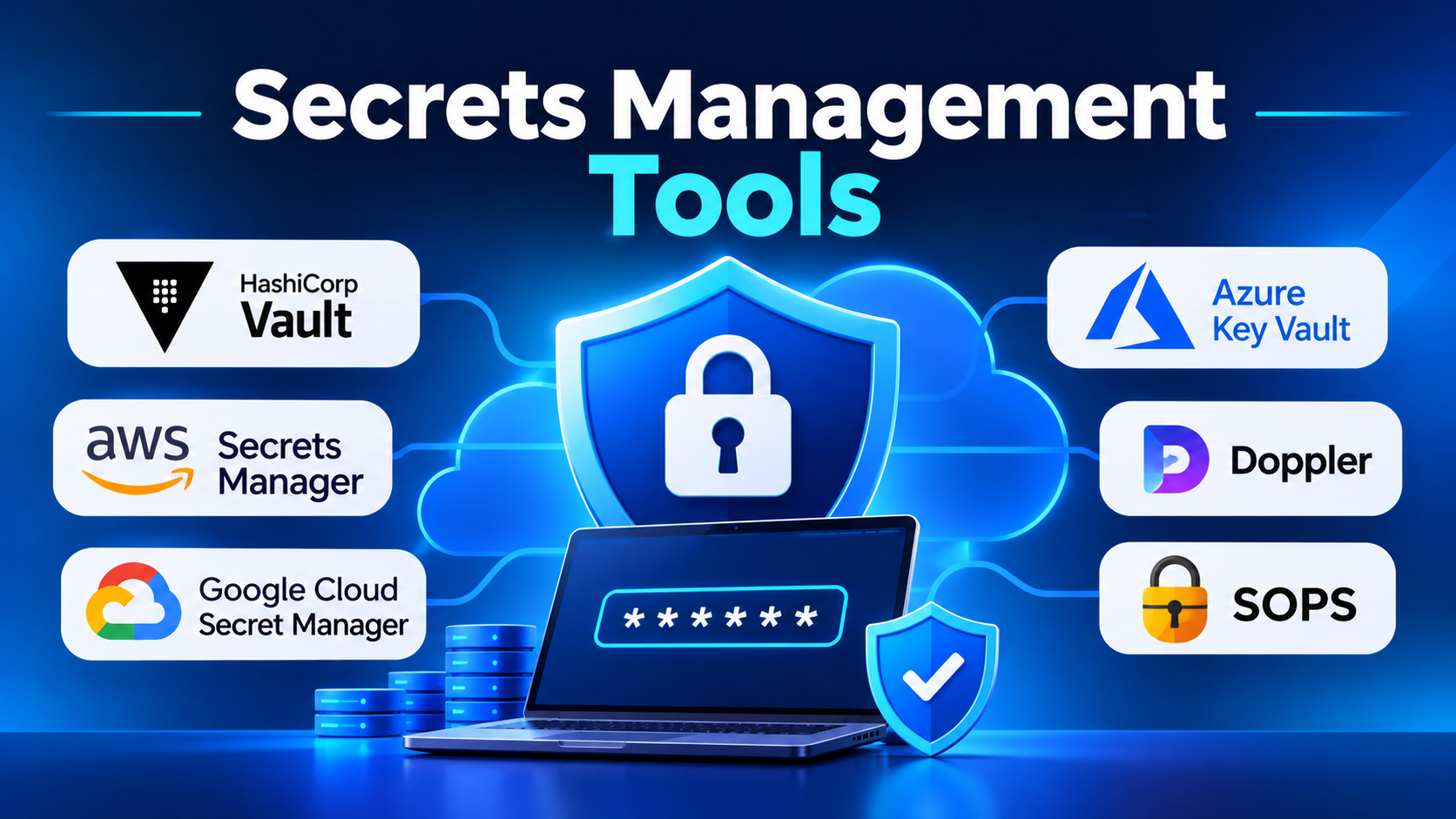
A single committed AWS access key in a public repository or an unencrypted .env file copied across developer laptops can undermine an entire perimeter security investment. Secrets management tools exist to strip static passwords, API tokens, TLS certificates, and database credentials out of source code and configuration files—replacing them with centralized encryption, identity-based access policies, and automated rotation.
Yet the secrets management category spans fundamentally different operational architectures. A self-hosted cryptographic engine that mints short-lived, single-use PostgreSQL credentials on demand solves a very different engineering problem than a cloud-native key-value store tied to IAM roles, or a client-side CLI utility that encrypts secret values directly inside GitOps manifests. Selecting the wrong approach either burdens a lean engineering team with Tier-0 cluster administration or leaves static secrets unrotated across CI/CD pipelines.
Three Competing Models in Secrets Management
Before comparing specific platforms, security and infrastructure teams should determine which storage and delivery architecture fits their operational boundaries.
1. Dynamic Credential Brokers
Platforms such as HashiCorp Vault and OpenBao act as active cryptographic intermediaries. Rather than storing long-lived passwords, they authenticate workloads using platform-attested identities (Kubernetes service accounts, AWS IAM roles, OIDC tokens) and generate ephemeral, lease-bound credentials on demand—automatically revoking database users or cloud tokens when the lease expires.
- Core strength: Eliminates standing credentials and creates granular audit trails of every secret lease issued.
- Primary trade-off: Introduces a critical Tier-0 infrastructure component; if the vault cluster becomes unavailable or unsealed improperly, dependent applications fail to authenticate.
2. Cloud-Provider Managed Secret Stores
Services like AWS Secrets Manager, Google Cloud Secret Manager, and Azure Key Vault operate as fully managed, multi-tenant cloud services integrated directly with each provider’s Identity and Access Management (IAM) layer.
- Core strength: Zero server administration, built-in high availability, KMS envelope encryption, and native rotation hooks for managed cloud databases.
- Primary trade-off: Creates multi-cloud operational fragmentation and introduces per-secret and per-API-call billing that can escalate quickly if high-throughput services query secrets without local caching.
3. Developer-Centric SaaS Sync and Git-Encrypted Workflows
Developer-experience platforms (such as Doppler, Infisical, and 1Password Secrets Automation) centralize environment variables and inject them directly into local processes, CI runners, and cloud runtimes. Meanwhile, cryptographic GitOps tools (such as Mozilla SOPS and Bitnami Sealed Secrets) encrypt secret values asymmetrically so encrypted configuration files can safely reside in Git alongside deployment manifests.
- Core strength: Low friction for developers and clean alignment with declarative GitOps pipelines.
- Primary trade-off: Focuses predominantly on managing static secrets rather than minting ephemeral, on-demand database or infrastructure credentials.
Notable Secrets Management Tools Across Architectures
HashiCorp Vault and OpenBao — Enterprise Dynamic Secrets and Encryption-as-a-Service
HashiCorp Vault remains the reference architecture for enterprise secrets management across hybrid and multi-cloud estates. Beyond versioned key-value storage, Vault’s defining capability is dynamic secrets: connecting directly to PostgreSQL, MySQL, MongoDB, AWS, Google Cloud, Active Directory, and internal PKI authorities to mint unique, time-limited credentials per workload instance. Its Transit Secrets Engine also provides “encryption as a service,” letting applications encrypt and decrypt sensitive payloads without ever handling raw cryptographic keys.
Following HashiCorp’s transition to the Business Source License (BSL), the Linux Foundation launched OpenBao as an open-source (MPL 2.0) community fork maintaining API compatibility with Vault’s open-source core. Both Vault and OpenBao offer unmatched cryptographic breadth, though self-hosting requires dedicated platform engineering capacity to manage Integrated Storage (Raft) clusters, cloud KMS auto-unsealing, and disaster recovery replication.
AWS Secrets Manager — Native IAM Integration and Managed Database Rotation
For organizations standardized on Amazon Web Services, AWS Secrets Manager provides tightly integrated secret storage backed by AWS Key Management Service (KMS). Workloads on EC2, ECS, EKS, and AWS Lambda authenticate directly via IAM roles, avoiding static bootstrap credentials.
Its standout operational capability is automated rotation via AWS Lambda blueprints for Amazon RDS, Redshift, and DocumentDB—capable of rotating credentials without interrupting active database connections through dual-user rotation strategies. Organizations operating heavily across multiple clouds or seeking unified local developer .env synchronization will find AWS Secrets Manager less ergonomic outside AWS environments.
Google Cloud Secret Manager and Azure Key Vault — Cloud-Aligned Governance
Google Cloud Secret Manager and Azure Key Vault fulfill parallel roles within their respective ecosystems:
- Google Cloud Secret Manager emphasizes global replication policies, immutable secret versions, IAM condition expressions, and clean integration with Cloud Run, GKE Workload Identity, and Cloud Build.
- Azure Key Vault unifies application secrets, cryptographic keys, and TLS/SSL certificates under Microsoft Entra ID access policies and Azure RBAC, making it standard across regulated Microsoft enterprise environments.
Both services eliminate cluster administration overhead while metering costs based on active secret versions and API access volume.
Doppler — Developer-First Secret Synchronization Across Runtimes
Doppler targets engineering teams frustrated by passing .env files between developers and maintaining duplicate secret entries across GitHub Actions, Vercel, AWS, and Kubernetes. Through a centralized web console, CLI (doppler run), and native sync connectors, Doppler injects secrets directly into application processes as environment variables without writing plaintext files to disk.
Doppler excels at developer ergonomics, role-based environment inheritance (sharing base configurations across dev, staging, and prod while overriding environment-specific keys), and centralized audit trails. Its focus is managed SaaS synchronization of static secrets rather than acting as an on-premises dynamic credential broker.
Infisical — Open-Source Secrets Platform with Self-Hosted Control
Infisical pairs developer-friendly secret synchronization (CLI injection, SDKs, Kubernetes operator, and CI/CD integrations) with an open-source core that organizations can either consume as a managed cloud platform or self-host via Docker and Kubernetes.
Infisical has expanded beyond static environment syncing to incorporate dynamic secrets for databases, internal PKI certificate issuance, and automated secret scanning across Git repositories to catch leaked credentials early. It appeals strongly to teams wanting Doppler-style developer ergonomics alongside self-hosting control and open-source transparency.
Mozilla SOPS (Secrets OPerationS) — Encrypted Secrets Inside GitOps Repositories
For Kubernetes and infrastructure-as-code teams practicing GitOps with Argo CD or Flux, committing plaintext Kubernetes Secret manifests to Git is unacceptable. SOPS solves this by encrypting only the values inside YAML, JSON, ENV, or INI files while leaving key names readable—preserving clear pull-request diffs during code review.
SOPS delegates master encryption keys to cloud KMS services (AWS KMS, GCP KMS, Azure Key Vault) or age/PGP keys, ensuring that only authorized CI runners or Kubernetes controllers (via Flux’s native SOPS decryption support or External Secrets Operator) can decrypt payloads at deployment time. Because SOPS is a stateless CLI tool rather than a running service, it requires zero server maintenance, though rotating master keys across large repositories requires disciplined CLI automation.
External Secrets Operator (ESO) — The Kubernetes Synchronization Layer
While not a storage vault itself, External Secrets Operator has become an essential architectural bridge in Kubernetes environments. Running inside your cluster, ESO continuously synchronizes secrets from external providers—including HashiCorp Vault, AWS Secrets Manager, Google Secret Manager, Azure Key Vault, Doppler, and Infisical—into native Kubernetes Secret resources. This decouples applications from vendor-specific SDKs while keeping authoritative secret storage outside the cluster.
Comparison of Secrets Management Tools
| Tool / Platform | Core Architecture | Hosting & Deployment | Dynamic Credentials | Standout Strength | Primary Trade-Off |
| HashiCorp Vault / OpenBao | Cryptographic broker & dynamic secret engine | Self-Hosted (OSS / BSL) or HCP Vault Cloud | Yes (DBs, Cloud IAM, SSH, PKI) | Short-lived on-demand credentials, Transit encryption, and deep enterprise policy | High operational complexity when self-hosted |
| AWS Secrets Manager | Cloud-native managed secret store | AWS SaaS (IAM + KMS backed) | Native RDS/DB rotation hooks | Zero-maintenance IAM authentication and built-in RDS credential rotation | AWS-centric; API call costs can grow without client-side caching |
| Azure Key Vault / GCP Secret Manager | Cloud-native managed secret & key store | Azure / Google Cloud SaaS | Cloud-managed rotation workflows | Deep Entra ID / GCP Workload Identity integration and compliance certifications | Tied primarily to respective cloud provider ecosystems |
| Doppler | SaaS secret synchronization & CLI injection | Managed Cloud SaaS | Limited (focused on static secret sync) | Fast developer onboarding, CLI process injection, and multi-platform sync | Commercial SaaS dependency; not designed for self-hosted air-gapped use |
| Infisical | Open-source secrets & dynamic credential platform | Self-Hosted (Docker/K8s) or Cloud SaaS | Yes (selected databases & integrations) | Combines developer-friendly .env/CLI workflows with self-hosting and dynamic secrets | Younger enterprise ecosystem than HashiCorp Vault |
| Mozilla SOPS | Client-side file encryption for GitOps | Stateless CLI tool (Git-stored files) | No (encrypts static config files) | Keeps encrypted secrets inside Git with human-readable YAML keys and zero server ops | Lacks centralized runtime leasing or automated database rotation |
Five Security and Operational Pitfalls to Avoid
1. Solving “Secret Zero” Poorly
Every secrets manager faces the bootstrap problem: how does an application prove its identity to the vault initially? If your deployment script stores a static VAULT_TOKEN or cloud API key in plaintext on disk to authenticate with your secrets manager, you have simply shifted the vulnerability one layer up. Always use platform-attested identities—such as Kubernetes Projected Service Account Tokens, AWS IAM Instance Profiles, GCP Workload Identity, or GitHub Actions OIDC—to authenticate without static bootstrap secrets.
2. Fetching Secrets on Every Request Without Caching
In serverless functions or high-throughput APIs, querying a cloud secrets manager on every incoming HTTP request introduces network latency, risks rate-limiting during traffic spikes, and inflates API billing. Use local sidecar agents (such as Vault Agent), SDK-level memory caching with sensible TTLs, or Kubernetes sync operators so workloads read secrets from memory or local tmpfs mounts.
3. Confusing Base64 Encoding with Encryption in Kubernetes
Native Kubernetes Secret resources are base64-encoded—not encrypted—by default, and anyone with kubectl get secret RBAC access or unencrypted etcd backups can decode them immediately. Enable envelope encryption at rest for etcd, restrict RBAC permissions strictly, and source secrets from an external vault or SOPS-encrypted GitOps pipeline.
4. Ignoring Lease Expiration and Graceful Reloading
Enabling dynamic database rotation fails in production if your application reads credentials once at startup and crashes when the lease expires hours later. Verify that your application connection pools reload rotated credentials gracefully—or use sidecar templates that signal application restarts cleanly upon secret renewal.
5. Leaving Developer Laptops Outside Governance
Production clusters often receive strict IAM controls while developers copy shared .env files over messaging apps for local testing. Choose a secrets workflow that supports scoped, least-privilege development environments and injects secrets ephemerally into local processes (doppler run, infisical run, or sops exec-env) rather than leaving plaintext .env files sitting in working directories.
Choosing the Right Secrets Management Architecture
- For cloud-homogeneous teams building on AWS, GCP, or Azure: Start with your cloud provider’s native secret manager (AWS Secrets Manager, GCP Secret Manager, or Azure Key Vault) paired with workload identity authentication and External Secrets Operator for Kubernetes clusters.
- For engineering teams prioritizing fast developer workflows and multi-cloud sync: Adopt Doppler (for turnkey SaaS management) or Infisical (when self-hosting and open-source control are priorities) to unify local CLI development, CI/CD variables, and production deployments.
- For Kubernetes GitOps teams wanting zero additional server infrastructure: Use Mozilla SOPS backed by cloud KMS keys to store encrypted secrets safely inside your Git repositories alongside Helm and Kustomize manifests.
- For regulated enterprises requiring dynamic database credentials, PKI certificates, and encryption-as-a-service across hybrid infrastructure: Standardize on HashiCorp Vault (managed HCP Vault Dedicated to reduce operational burden, or self-hosted Vault / OpenBao if your platform team has dedicated infrastructure engineering capacity).
