For years, software testing documentation lived in a dangerous place: massive, sprawling Excel spreadsheets shared across email attachments, or siloed inside rigid legacy quality assurance suites that felt completely disconnected from actual code repositories. When a developer refactored a microservice or an automation pipeline ran a hundred regression tests in a CI/CD runner, tracking test coverage, execution history, and bug traceability became a manual administrative chore.
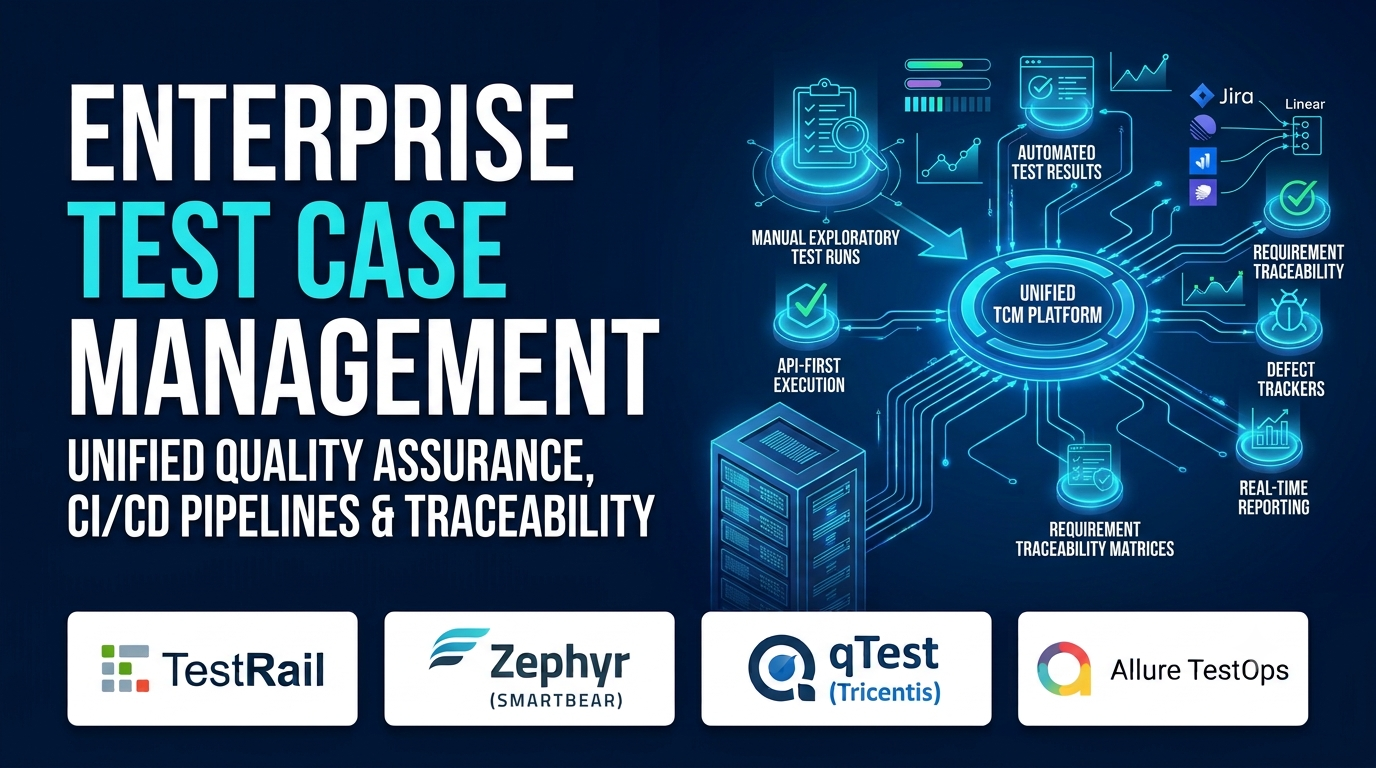
Modern test case management (TCM) tools bridge this gap. They serve as the single source of truth for software quality, connecting manual exploratory test runs, automated test results, requirement traceability matrices, and defect trackers into a unified control plane.
Evaluating test case management tools requires looking past simple folder hierarchies and examining API integrations with test automation runners, requirement coverage tracking, real-time reporting, and collaboration workflows.
The Core Architecture of Modern Test Management
Effective test case management systems do more than store steps and expected results. They sit at the intersection of product planning, automated execution, and defect reporting.
[Requirements & User Stories (Jira / Linear)]
                     │
                     ▼
[Test Case Repository & Version Control]
                     │
                     ├──────────────────► Manual Test Execution Runs
                     │
                     └──────────────────► Automated Test Results (CI/CD Webhooks)
When evaluating TCM platforms for engineering teams, several structural pillars separate outdated documentation vaults from modern quality hubs:
- Bidirectional Traceability: A robust TCM tool links test cases directly to user stories and requirements in issue trackers like Jira. If a requirement changes, teams instantly see which test cases are impacted and need revision.
- Automation Integration (API-First Execution): Automated tests running in GitHub Actions, Jenkins, or GitLab CI need a way to report their status back to the TCM platform. Modern tools provide rich REST APIs and native CLI plugins to ingest test results programmatically.
- Test Case Versioning and Modularity: In agile environments, features evolve rapidly. The TCM platform must support versioning test cases so historical test runs don’t break when a test step is updated for a new software release.
Evaluating Leading Test Case Management Platforms
Different platforms cater to distinct team structures, ranging from agile engineering squads embedded in Jira to enterprise QA teams managing complex regulatory compliance.
1. TestRail
TestRail is one of the most widely adopted test management platforms, known for its clean interface, robust Jira integration, and flexible support for both manual and automated testing.
- Primary Purpose: Comprehensive test case authoring, execution tracking, and milestone management.
- Architectural Strengths: Exceptional flexibility in organizing test suites into folder hierarchies, milestones, and test runs. It offers a powerful REST API that allows automated test frameworks (like Playwright, Selenium, or Cypress) to push results effortlessly via CLI runners.
- Operational Trade-offs: While cloud-hosted plans scale easily, self-hosted (server) deployments require traditional maintenance overhead, and licensing costs scale per user seat.
2. Zephyr Scale / Zephyr Squad (SmartBear)
Zephyr is purpose-built for teams that live and breathe inside Jira, embedding test management directly into the Atlassian ecosystem.
- Primary Purpose: Native Jira-integrated test case management and execution tracking.
- Architectural Strengths: Eliminates context-switching by embedding test creation, execution, and traceability inside Jira issues. Zephyr Scale handles large-scale test repositories with advanced folder structures and re-usable test steps, making it ideal for agile engineering teams.
- Operational Trade-offs: Because it is deeply tied to Jira, teams not using Atlassian products will find little value in its ecosystem.
3. qTest (Tricentis)
qTest is an enterprise-grade test management platform designed for large organizations scaling agile testing, DevOps automation, and multi-project governance.
- Primary Purpose: Scalable enterprise test orchestration, BDD (Behavior-Driven Development) support, and multi-project reporting.
- Architectural Strengths: Outstanding enterprise reporting, cross-project analytics, and robust support for BDD with Cucumber integrations. It connects multiple disparate automation tools into a single central dashboard.
- Operational Trade-offs: The user interface can feel dense and heavily corporate, requiring deliberate onboarding and administrative training for developers.
4. Allure TestOps
Allure TestOps is a modern, developer-centric testops platform designed specifically to bridge the gap between automated test execution and management dashboards.
- Primary Purpose: DevOps-native test management driven entirely by automated test execution data.
- Architectural Strengths: Treats automated tests as first-class citizens. Instead of manually writing test cases in a UI, Allure generates test structures dynamically from code annotations and CI/CD test reports, providing deep insights into flakiness, execution trends, and environment failures.
- Operational Trade-offs: Less optimized for traditional manual QA exploratory testing workflows compared to tools like TestRail.
Comparison of Test Case Management Tools
| Tool | Primary Deployment & Integration | Automation Support | Key Advantage | Notable Limitation |
| TestRail | Cloud / Self-Hosted (Jira, GitHub, APIs) | Excellent via REST API and CLI | Highly intuitive interface and flexible test run organization | Per-user licensing costs can scale quickly for large teams |
| Zephyr Scale | Native Jira Add-on | Strong via API and CI plugins | Seamless integration inside Jira without leaving the Atlassian ecosystem | Strongly coupled to the Jira ecosystem |
| qTest | Enterprise SaaS / On-Premises | Comprehensive enterprise automation integrations | Advanced cross-project analytics and BDD support | Steeper learning curve and corporate UI overhead |
| Allure TestOps | Cloud / On-Premises | Native-first for automated testing pipelines | Dynamic test generation from CI/CD execution results | Less suited for traditional manual-heavy QA workflows |
Implementation Considerations and Common Pitfalls
Deploying a test case management tool fails when organizations treat the tool as a dumping ground for stagnant test documentation.
- Creating Monolithic, Unmaintainable Test Suites: Copy-pasting hundreds of redundant test cases into deep folder structures creates a maintenance nightmare. Adopt modular, reusable test steps and prune obsolete tests regularly.
- Disconnecting Automated Tests from Manual Tracking: Maintaining automated test results in one system while manual QA teams track results in a spreadsheet defeats the purpose of a TCM platform. Unify both workflows into a single dashboard.
- Ignoring User Adoption Friction: If the tool is too cumbersome for developers or manual testers to update after a run, data quickly goes stale. Choose a platform that fits your team’s existing daily workflows (such as Jira or your CI/CD pipeline).
Conclusion
Choosing a test case management tool requires balancing your team’s testing methodology against your existing software stack. Engineering teams heavily embedded in Jira often find native add-ons like Zephyr Scale indispensable. Organizations balancing both manual exploratory testing and automated regression suites gravitate toward TestRail, while DevOps-heavy teams managing massive automated pipelines increasingly adopt Allure TestOps. Audit your team’s automation maturity and workflow habits before committing to a platform.
