Introduction
Businesses, public relations teams, nonprofits, and government organizations need to understand how they are discussed across the media.
News coverage can influence brand reputation, customer confidence, investor perceptions, and public awareness. Social conversations can reveal emerging concerns, while industry publications may highlight competitors and market developments.
Manually tracking these sources is difficult because information appears across news websites, social networks, blogs, forums, and broadcast channels.
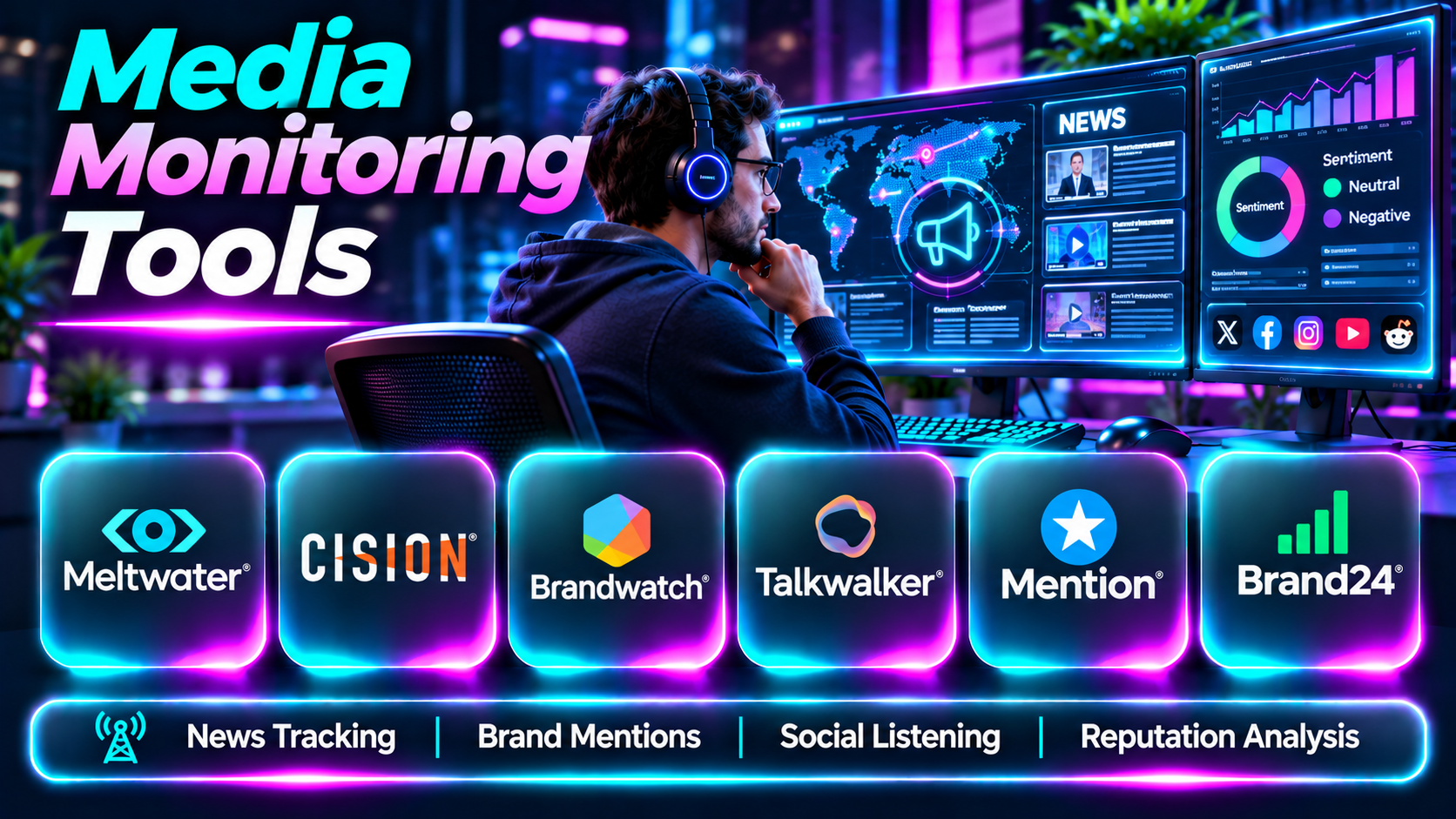
Media monitoring tools help organizations discover relevant mentions, organize coverage, analyze trends, and report on communication performance.
However, not every platform monitors the same sources. Some specialize in traditional media, others emphasize social listening, and others combine monitoring with PR outreach or competitive intelligence.
This guide compares ten media monitoring tools and explains how to choose a solution that supports reliable reputation and communication analysis.
What Are Media Monitoring Tools?
Media monitoring tools are software platforms that track references to brands, organizations, people, products, topics, or keywords across supported information sources.
Typical capabilities include keyword alerts, news tracking, social listening, sentiment analysis, coverage reporting, competitive monitoring, and dashboards.
Enterprise platforms may also provide journalist databases, media contact management, PR campaign workflows, and broadcast monitoring.
Media monitoring differs from media outreach. Monitoring observes coverage and discussion, while outreach involves communicating with journalists and publishers.
Monitoring results should be interpreted carefully. Source coverage may be incomplete, sentiment analysis can misclassify context, and mention volume does not necessarily indicate reputation improvement.
Top 10 Media Monitoring Tools
1. Meltwater
Short Description
Meltwater is a media intelligence platform providing capabilities for monitoring news, online conversations, and brand-related coverage.
It helps communication teams identify relevant mentions, analyze media trends, and prepare reports.
Meltwater is particularly relevant to enterprises managing reputation and communications across multiple markets.
Key Features
- News monitoring: Tracks relevant coverage from supported sources.
- Social listening: Analyzes available social conversations.
- Keyword alerts: Identifies selected mentions.
- Sentiment analysis: Estimates tone in monitored content.
- Competitive intelligence: Compares coverage and discussion patterns.
- Media analytics: Supports trend analysis.
- Reporting dashboards: Organizes communication results.
- Global monitoring capabilities: Supports broader market analysis.
Benefits
Meltwater helps organizations consolidate media intelligence into repeatable workflows.
Pros
- Broad media intelligence focus.
- News and social capabilities.
- Enterprise reporting.
- Competitive analysis.
- Suitable for global communications.
Cons
- Commercial investment.
- Source coverage varies.
- Analytics require interpretation.
- Implementation and training may be needed.
Use Cases
Corporate reputation monitoring, PR measurement, and competitive intelligence.
Best For: Enterprise communications teams.
2. Cision
Short Description
Cision provides public relations and communications technology, including media monitoring and earned media analysis.
Its broader ecosystem also supports media relations workflows.
Cision is especially relevant to PR organizations that need monitoring alongside journalist research, outreach, and campaign measurement.
Key Features
- Media monitoring.
- News coverage tracking.
- Earned media analytics.
- Journalist and media information.
- PR reporting.
- Campaign measurement.
- Coverage alerts.
- Media relations workflows.
Benefits
Cision connects monitoring with broader public relations operations.
Pros
- PR-focused ecosystem.
- Media relations capabilities.
- Coverage reporting.
- Enterprise relevance.
- Campaign measurement.
Cons
- Commercial cost.
- Product packaging varies.
- Setup and training requirements.
- Not every source is covered.
Use Cases
PR monitoring, journalist outreach support, and earned media reporting.
Best For: Corporate PR teams and agencies.
3. Brandwatch
Short Description
Brandwatch is a consumer intelligence and social listening platform focused on understanding online conversations.
It helps organizations analyze discussion trends, audience themes, and brand perception across supported digital sources.
Brandwatch is particularly relevant when social conversation analysis is more important than traditional press clipping.
Key Features
- Social listening.
- Online conversation analysis.
- Topic tracking.
- Sentiment analysis.
- Audience insights.
- Competitive monitoring.
- Trend identification.
- Analytics dashboards.
Benefits
Brandwatch helps teams understand how audiences discuss brands and topics online.
Pros
- Social intelligence focus.
- Deep conversation analysis.
- Useful trend reporting.
- Competitive insights.
- Enterprise suitability.
Cons
- Less focused on traditional PR outreach.
- Commercial investment.
- Platform data restrictions.
- Automated sentiment limitations.
Use Cases
Brand perception research and social conversation monitoring.
Best For: Consumer insights and social intelligence teams.
4. Talkwalker
Short Description
Talkwalker provides social listening and consumer intelligence capabilities for monitoring digital conversations and brand-related trends.
It helps organizations identify relevant discussions and analyze patterns across supported online sources.
Talkwalker is especially relevant to enterprises seeking broad digital conversation intelligence.
Key Features
- Social listening.
- Brand mention monitoring.
- Topic analysis.
- Sentiment estimation.
- Trend detection.
- Competitive benchmarking.
- Visual analytics.
- Reporting dashboards.
Benefits
Talkwalker helps organizations interpret large volumes of digital discussion.
Pros
- Social intelligence capabilities.
- Trend analysis.
- Brand monitoring.
- Enterprise reporting.
- Competitive insights.
Cons
- Commercial pricing.
- Source coverage limitations.
- Analytics require validation.
- Implementation complexity.
Use Cases
Digital reputation monitoring and consumer intelligence.
Best For: Enterprise social listening teams.
5. Mention
Short Description
Mention is a brand monitoring platform that helps organizations track references to selected keywords and brands across supported web and social sources.
It provides alerts and reporting that can help teams respond to relevant discussions.
Mention is particularly useful for smaller businesses and agencies seeking accessible monitoring workflows.
Key Features
- Keyword monitoring.
- Brand mention alerts.
- Web monitoring.
- Social monitoring capabilities.
- Competitive tracking.
- Sentiment-related analysis.
- Reporting.
- Collaboration workflows.
Benefits
Mention helps teams discover brand-related discussions without constant manual searching.
Pros
- Focused monitoring workflows.
- Useful alerts.
- Brand tracking.
- Agency relevance.
- Accessible use cases.
Cons
- Coverage depends on source access.
- Advanced analytics vary by plan.
- False positives require filtering.
- Commercial pricing.
Use Cases
Brand alerts, competitor monitoring, and reputation management.
Best For: SMB marketing and PR teams.
6. Brand24
Short Description
Brand24 provides online brand monitoring and social listening capabilities.
It helps businesses identify mentions, follow discussion trends, and assess online visibility.
Brand24 is particularly relevant to organizations seeking monitoring and reporting without implementing a large enterprise PR platform.
Key Features
- Brand mention tracking.
- Keyword alerts.
- Social listening.
- Sentiment analysis.
- Mention analytics.
- Trend monitoring.
- Competitive tracking.
- Reporting dashboards.
Benefits
Brand24 helps teams monitor online discussion and identify reputation-related signals.
Pros
- Brand monitoring focus.
- Useful reporting.
- Social listening capabilities.
- Suitable for smaller teams.
- Competitive tracking.
Cons
- Source access varies.
- Sentiment is not always accurate.
- Historical coverage depends on plan.
- Not a full PR outreach suite.
Use Cases
Online reputation monitoring and campaign mention analysis.
Best For: Small and midmarket brands.
7. Muck Rack
Short Description
Muck Rack is a public relations platform that combines media database capabilities with monitoring and reporting.
It helps communication professionals research journalists, manage relationships, and understand media coverage.
Muck Rack is especially relevant to PR teams that need monitoring connected to media relations.
Key Features
- Media monitoring.
- Journalist database.
- Media relationship workflows.
- Coverage reporting.
- PR campaign analytics.
- Keyword tracking.
- Media research.
- Collaboration capabilities.
Benefits
Muck Rack connects coverage analysis with journalist relationship management.
Pros
- Strong PR orientation.
- Journalist research.
- Monitoring and reporting.
- Agency suitability.
- Media relations workflows.
Cons
- Commercial investment.
- Less focused on broad consumer social analytics.
- Source coverage varies.
- Requires structured PR processes.
Use Cases
PR campaigns, journalist research, and earned media measurement.
Best For: Public relations agencies and communications teams.
8. Critical Mention
Short Description
Critical Mention provides media monitoring and earned media analysis capabilities, including broadcast-oriented monitoring.
It helps organizations discover relevant coverage across supported media channels.
Critical Mention is particularly useful when television, radio, or other broadcast references are important to the monitoring strategy.
Key Features
- Broadcast monitoring.
- News monitoring.
- Media alerts.
- Coverage search.
- Media clipping workflows.
- Earned media reporting.
- Analytics.
- PR measurement.
Benefits
Critical Mention helps teams track media coverage beyond standard web search.
Pros
- Broadcast monitoring relevance.
- PR reporting.
- Coverage search.
- Media intelligence workflows.
- Useful for communications teams.
Cons
- Commercial pricing.
- Geographic coverage must be checked.
- Source availability varies.
- Specialized requirements may affect cost.
Use Cases
Broadcast coverage tracking and PR reporting.
Best For: Organizations monitoring television and radio.
9. Determ
Short Description
Determ is a media monitoring and social listening platform that helps organizations track brand mentions and relevant topics.
It provides alerting, analysis, and reporting for communication teams.
Determ is particularly relevant to businesses seeking a dedicated monitoring environment for reputation and media coverage.
Key Features
- Media mention tracking.
- Keyword monitoring.
- Real-time alerts.
- Sentiment analysis.
- Competitive monitoring.
- Topic tracking.
- Reporting dashboards.
- Media analytics.
Benefits
Determ helps teams organize relevant media information and respond to important developments.
Pros
- Monitoring specialization.
- Useful alerts.
- Reporting capabilities.
- Reputation tracking.
- Competitive analysis.
Cons
- Source coverage varies.
- Sentiment requires review.
- Commercial pricing.
- Monitoring queries need refinement.
Use Cases
Brand reputation and media campaign monitoring.
Best For: PR and communications teams.
10. Google Alerts
Short Description
Google Alerts is a free web monitoring service that sends notifications when Google discovers new results matching selected search terms.
It provides a simple way to monitor names, topics, competitors, or industry keywords.
Google Alerts is useful as a lightweight starting point, but it does not provide the comprehensive source coverage, analytics, or reporting workflows available in dedicated media intelligence platforms.
Key Features
- Keyword alerts.
- Web result monitoring.
- Email notifications.
- Search term configuration.
- Alert frequency options.
- Basic source filtering.
- Simple setup.
- Free access.
Benefits
Google Alerts provides an accessible way to follow selected web mentions.
Pros
- Free.
- Easy to configure.
- Useful basic monitoring.
- Minimal setup.
- Suitable for individuals.
Cons
- Limited analytics.
- Incomplete coverage.
- No comprehensive social listening.
- Limited collaboration and reporting.
Use Cases
Basic brand alerts and industry topic tracking.
Best For: Individuals and small organizations.
Media Monitoring Tools Comparison Table
| Platform | Primary Strength | Best For |
|---|---|---|
| Meltwater | Broad media intelligence | Enterprises |
| Cision | PR monitoring and outreach | PR teams |
| Brandwatch | Consumer and social intelligence | Insights teams |
| Talkwalker | Digital conversation analysis | Enterprises |
| Mention | Brand mention alerts | SMBs |
| Brand24 | Online reputation tracking | Growing brands |
| Muck Rack | PR media relationships | Agencies |
| Critical Mention | Broadcast monitoring | Communications teams |
| Determ | Media alerts and analytics | PR managers |
| Google Alerts | Basic web alerts | Individuals |
How to Choose the Right Media Monitoring Tool
1. Define Monitoring Objectives
Identify whether the priority is reputation, earned media, social conversation, competitor activity, or crisis detection.
2. Evaluate Source Coverage
Confirm support for relevant news, social, broadcast, blog, and industry sources.
3. Review Geographic and Language Coverage
International organizations should test coverage across their key markets.
4. Assess Alert Quality
Alerts should identify relevant developments without overwhelming teams with irrelevant matches.
5. Examine Sentiment Analysis
Automated sentiment is useful for screening, but sarcasm, context, and complex language can cause errors.
6. Review Competitive Monitoring
Compare similar topics and sources rather than treating raw mention counts as definitive market share.
7. Evaluate Reporting
Choose tools that support useful summaries, coverage trends, and campaign evaluation.
8. Consider Crisis Workflows
Important alerts should reach appropriate staff with clear escalation procedures.
9. Review Data Retention and Licensing
Understand source access, content reuse restrictions, and historical data availability.
10. Compare Total Cost
Include subscriptions, monitored topics, user seats, source coverage, and reporting requirements.
Best Media Monitoring Software by User Type
| User Type | Recommended Platform |
|---|---|
| Enterprise communications leader | Meltwater |
| Corporate PR manager | Cision |
| Consumer insights analyst | Brandwatch |
| Social intelligence team | Talkwalker |
| Small business marketer | Mention |
| Growing brand | Brand24 |
| PR agency | Muck Rack |
| Broadcast monitoring specialist | Critical Mention |
| Reputation manager | Determ |
| Individual professional | Google Alerts |
Practical Example: Monitoring a Product Launch
A technology company is preparing to launch a new cybersecurity product.
Step 1: Define the monitoring goals.
Step 2: Identify the brand, product, competitor, and industry keywords.
Step 3: Select relevant media sources and geographic markets.
Step 4: Configure keyword queries and exclusions.
Step 5: Establish baseline coverage before launch.
Step 6: Create alerts for important product and reputation mentions.
Step 7: Assign monitoring responsibilities to communication team members.
Step 8: Review coverage quality and publication relevance.
Step 9: Validate sentiment classifications.
Step 10: Identify recurring questions and concerns.
Step 11: Share findings with product, marketing, and support teams.
Step 12: Prepare a post-launch report comparing coverage against the baseline.
Step 13: Use insights to improve future communication.
Frequently Asked Questions
1. What is media monitoring?
Tracking relevant references across news, social, and other media sources.
2. What is a media monitoring tool?
Software that discovers and organizes media mentions.
3. What is earned media?
Coverage or attention obtained without directly purchasing the placement.
4. What is social listening?
Analyzing relevant conversations across supported social sources.
5. What is brand monitoring?
Tracking references to a brand or its products.
6. What is reputation monitoring?
Observing information that may influence public perception.
7. What is sentiment analysis?
Estimating the tone of written or spoken content.
8. Is sentiment analysis always accurate?
No. Context and language can affect classification.
9. What is media clipping?
Collecting relevant excerpts or references from media coverage.
10. What is broadcast monitoring?
Tracking relevant television and radio coverage.
11. What is competitive media monitoring?
Tracking media references to competing organizations.
12. What is share of voice?
A measure comparing a brand’s coverage or discussion with a defined competitive set.
13. Does high share of voice mean positive reputation?
No. Coverage can be negative or unrelated to business success.
14. What is a keyword alert?
A notification triggered by matching monitored terms.
15. What is Boolean search?
Using logical operators to refine search queries.
16. Why use exclusions in monitoring queries?
To reduce irrelevant matches.
17. Can media monitoring detect crises?
It may identify early warning signals.
18. Can monitoring tools track competitors?
Many support competitor-related queries.
19. What is media reach?
An estimate of the audience potentially exposed to coverage.
20. Is estimated reach the same as actual readership?
No. It is an estimate, not proof of exposure.
21. What is earned media value?
An attempt to assign value to media coverage using a defined methodology.
22. Are advertising value equivalents reliable?
They have significant limitations and should not be treated as definitive PR value.
23. Can media monitoring support SEO?
It can help identify coverage and relevant mentions, but it is not a complete SEO solution.
24. Can media monitoring tools track influencers?
Some platforms provide relevant social and creator intelligence.
25. What is media intelligence?
Analysis of media information to support business decisions.
26. Are free monitoring tools sufficient?
They may be adequate for simple requirements.
27. Can monitoring platforms cover every website?
No. Source access and indexing vary.
28. What are common monitoring mistakes?
Poor queries, incomplete source coverage, and overreliance on automated sentiment.
29. How should monitoring success be measured?
Use relevant coverage quality, response effectiveness, and communication objectives.
30. Which media monitoring tool is best?
The best choice depends on source requirements, geographic coverage, reporting, and budget.
Final Thoughts
Media monitoring tools help organizations understand how their brands and topics appear across the information landscape.
Meltwater and Cision provide broad media intelligence and PR workflows. Brandwatch and Talkwalker emphasize digital conversation analysis. Mention, Brand24, and Determ support brand monitoring, while Muck Rack and Critical Mention address specialized PR requirements.
Google Alerts remains a useful starting point for basic web monitoring.
The most effective media monitoring program combines relevant source coverage, carefully designed search queries, human interpretation, and actionable reporting. Monitoring should help organizations understand what matters—not simply count mentions.
