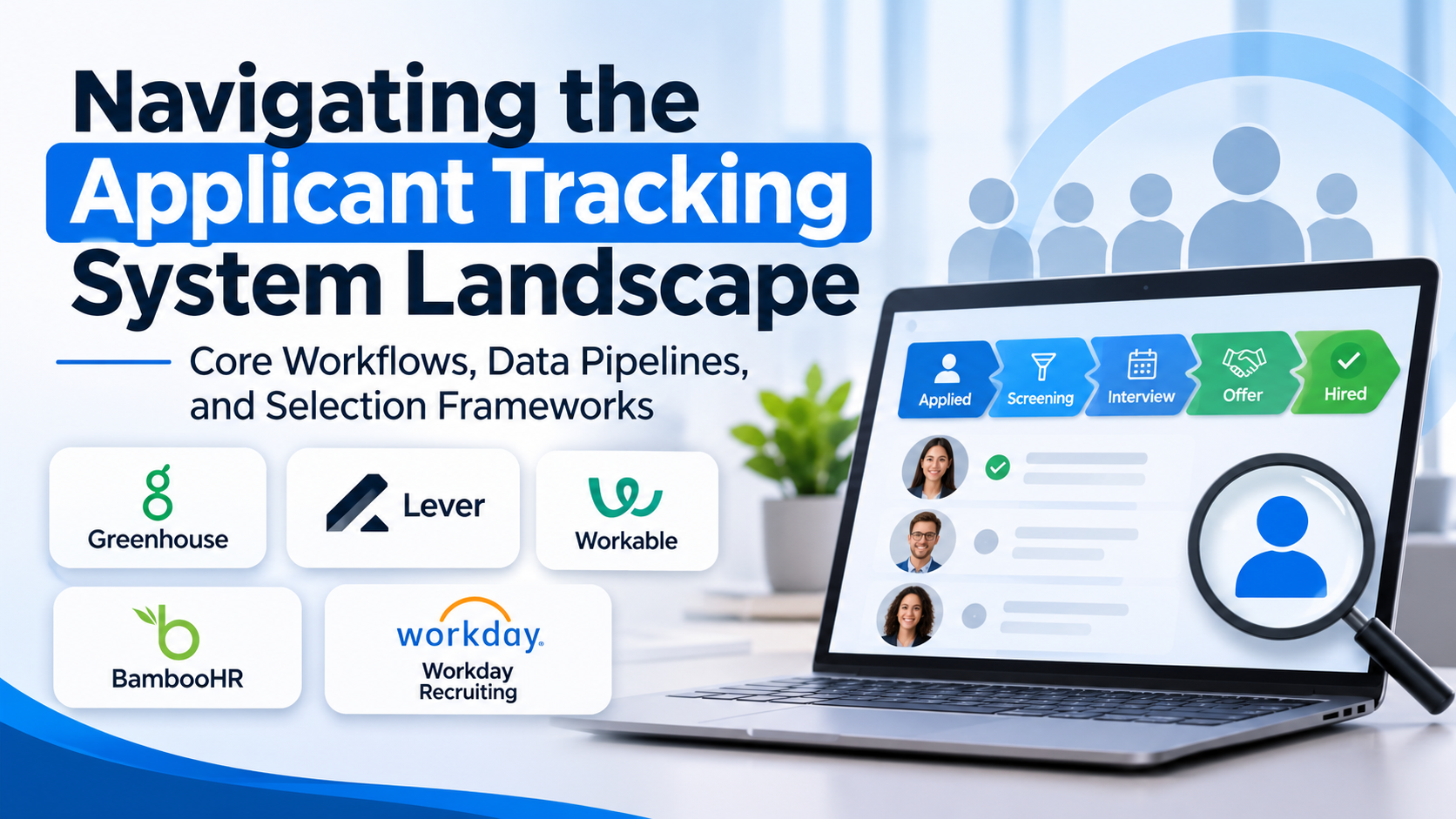
When an organization opens a technical or corporate role, the resulting influx of applications can quickly overwhelm hiring teams. A single job posting across multiple boards can generate hundreds—sometimes thousands—of resumes within days. Managing that volume through email threads, shared folders, and manual spreadsheets inevitably leads to lost candidates, communication bottlenecks, and missed hires.
An Applicant Tracking System (ATS) solves this operational friction by digitizing the recruitment pipeline. However, treating an ATS as a simple digital filing cabinet underestimates its role in modern workforce acquisition. Today’s systems act as centralized governance engines, managing candidate sourcing, resume parsing, automated screening, interview scheduling, and compliance tracking.
Evaluating the ATS market requires looking past vendor marketing claims to understand how different architectures handle data pipelines, recruiter workflows, and candidate experience.
The Anatomy of an ATS Data Pipeline
To understand how applicant tracking systems differ, one must examine how data flows through them. A standard recruitment pipeline moves through several distinct phases:
1. Ingestion and Resume Parsing
Candidates apply via career pages, job boards, or employee referrals. The ATS ingests resumes in various formats (PDF, DOCX) and uses parsing engines to extract structured data—such as employment history, skills, education, and contact details—into candidate profiles.
2. Screening and Filtering Logic
Once parsed, candidates are evaluated against job requirements. Some platforms rely on basic keyword matching and boolean search filters, while others employ automated knockout questions (e.g., verifying required licensures or legal work authorization) and predictive algorithms to rank applicants.
3. Collaborative Review and Interview Workflows
Hiring managers and recruiters collaborate within the platform, leaving feedback, scoring candidate interviews, and moving applicants through customized pipeline stages (e.g., phone screen, technical assessment, onsite, offer).
4. Conversion to HRIS and Onboarding
Upon offer acceptance, the ATS converts the candidate record into an active employee profile, securely piping master data directly into downstream Core HR and payroll systems.
5 Leading Applicant Tracking Systems Compared
| Platform | Primary Focus | Standout Technical Strength | Core Limitation |
| Greenhouse | Structured hiring & collaborative interview workflows | Exceptional tools for defining interview scorecards and reducing hiring bias | Steeper learning curve for occasional hiring managers |
| Lever | Combined CRM and ATS talent pipeline management | Blends passive sourcing CRM capabilities seamlessly with active applicant tracking | Reporting and custom dashboard analytics require careful configuration |
| Workable | Rapid SMB deployment & intuitive mobile recruiting | Clean user interface, built-in AI sourcing assistants, and mobile interview apps | Less optimized for complex enterprise-wide multi-subsidiary workflows |
| BambooHR ATS | Unified core HRIS integration for growing teams | Eliminates data silos by housing applicant data directly within the core HR record database | Lacks advanced programmatic sourcing and enterprise-grade recruiting analytics |
| Workday Recruiting | Enterprise global talent acquisition & internal mobility | Deep native integration with enterprise finance, core HR, and global object data models | High cost, complex configuration overhead, and lengthy deployment timeline |
Critical Evaluation Factors Beyond the Resume Drop
When organizations evaluate applicant tracking systems, they often focus exclusively on resume screening features while ignoring architectural and operational constraints that determine long-term success.
- Candidate Experience and Mobile Portals: If an applicant must navigate a sluggish, multi-page application form that fails to render correctly on mobile devices, top-tier talent will abandon the application process entirely. Evaluate the friction level of your candidate-facing portal.
- API Openness and Ecosystem Integration: An ATS cannot operate in isolation. It must integrate smoothly with background check providers, calendar scheduling tools (like Calendly or Microsoft Bookings), video interviewing platforms, and your core HRIS.
- Compliance and Data Privacy: Regulatory frameworks govern how long candidate data can be retained. Ensure your ATS supports automated data purging policies to comply with regional privacy regulations and equal employment opportunity reporting standards.
- Structured Interview Scorecards: The best ATS platforms enforce consistency by requiring interviewers to submit standardized scorecards against pre-defined job competencies, mitigating unconscious bias during hiring reviews.
Common Implementation Pitfalls to Avoid
Migrating to a new ATS or launching one for the first time involves predictable operational missteps:
- Overcomplicating Pipeline Stages: Creating a rigid workflow with twelve distinct interview and review stages ensures that recruiters and managers will bottleneck the process. Keep pipeline stages as lean as operational reporting requires.
- Neglecting Historical Talent Pools: Shifting to a new ATS without migrating active candidate databases or historical talent pools forces your team to start sourcing from zero. Ensure data migration protocols are thoroughly tested.
- Failing to Train Hiring Managers: An ATS is only as effective as its users. If engineering or sales managers refuse to log interview feedback within the platform, your talent pipeline data becomes incomplete and unreliable.
Making the Final Decision
Selecting an applicant tracking system is an exercise in aligning software architecture with organizational hiring velocity. If your primary goal is implementing rigorous, unbiased structured hiring across growing teams, Greenhouse provides exceptional workflow frameworks. If you operate in an enterprise environment requiring deep integration with core HR and finance, Workday Recruiting offers unmatched scale. For organizations seeking an intuitive, rapid rollout that integrates directly with mid-market HR tools, Workable or BambooHR deliver immediate administrative relief.
Begin by auditing your current hiring bottlenecks—whether that is slow candidate communication, poor interdepartmental collaboration, or messy data tracking—and select the platform designed to eliminate that specific friction point.
