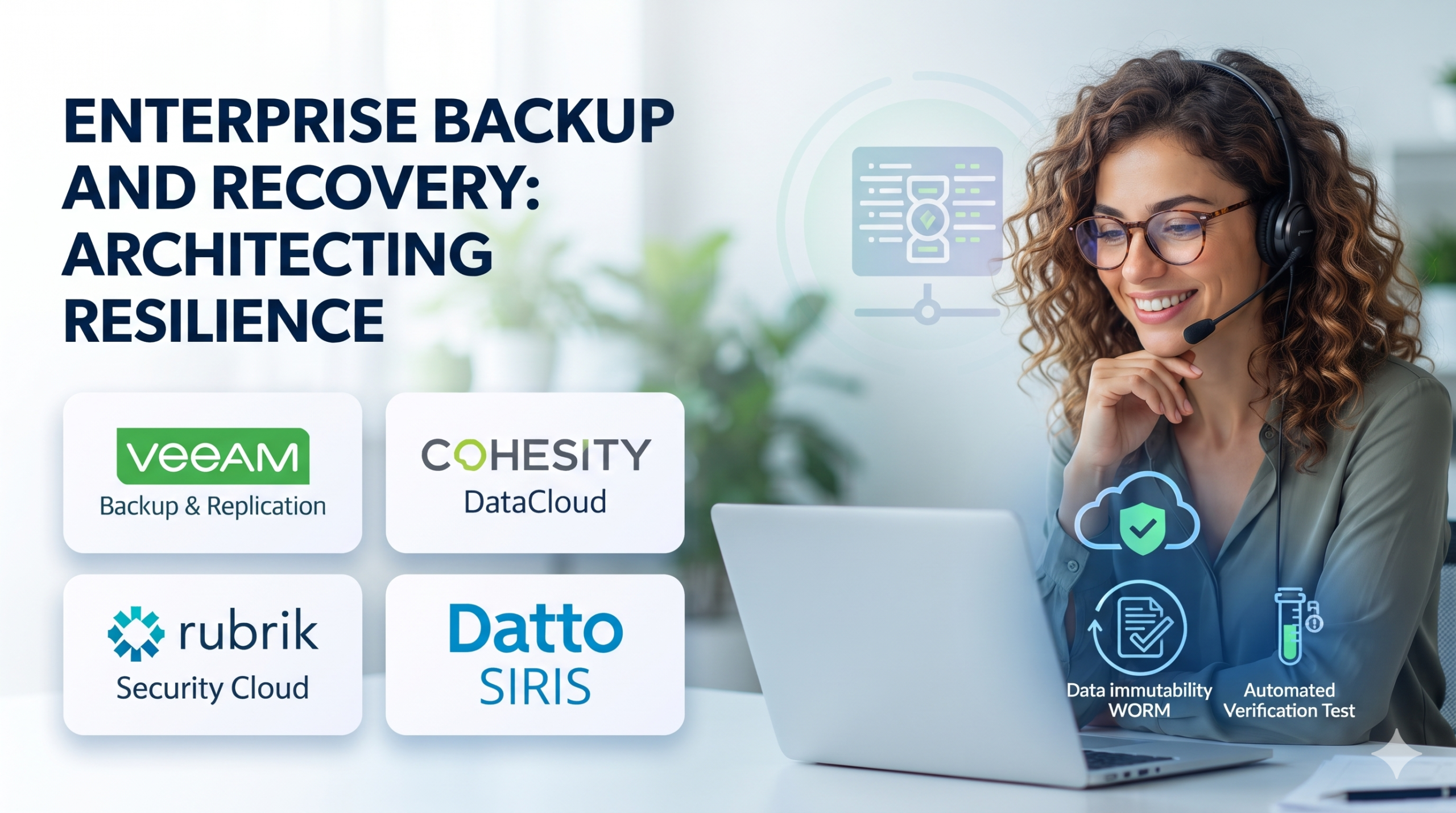
In contemporary IT infrastructure, a backup is no longer merely a static insurance policy against hardware failure or accidental file deletion. With ransomware gangs actively targeting backup repositories to maximize extortion leverage, data recovery has transformed into a high-stakes operational discipline. Organizations can no longer assume their data is safe simply because a nightly snapshot completed successfully; they must verify that recovery workflows can restore business operations within strict Recovery Time Objectives (RTO) and Recovery Point Objectives (RPO).
Designing a resilient backup and disaster recovery (BDR) strategy requires navigating a complex landscape of immutable storage architectures, cloud-native replication models, and virtualized machine recovery points. Evaluating the right tooling means looking past marketing metrics to understand how quickly an organization can recover under catastrophic pressure.
The Paradigm Shift in Data Protection
A decade ago, backup architecture followed a straightforward predictable cadence: full backups on weekends, incremental backups on weeknights, and tapes shipped off-site for long-term archiving. Today, that linear model collapses under the weight of petabyte-scale hybrid cloud environments, containerized microservices, and relentless cyber threats.
Modern backup and recovery solutions must contend with three distinct operational realities:
- Ransomware Immutable Boundaries: Attackers routinely attempt to compromise backup administrator credentials and encrypt backup catalogs before launching primary payloads. Modern tools must enforce immutability (WORM storage) and multi-person authorization (MPA) to prevent deletion or alteration of recovery points.
- SaaS and Multi-Cloud Proliferation: Critical business data no longer resides solely on local server racks. Protecting workloads distributed across Microsoft 365, Google Workspace, AWS, and Azure requires specialized cloud-to-cloud backup architectures.
- Instant Recovery Demands: Waiting hours to rebuild a failed database or hypervisor host is unacceptable. Modern enterprise platforms emphasize instant VM recovery and continuous data protection (CDP) to minimize downtime to mere seconds.
Core Evaluation Pillars for Recovery Solutions
When infrastructure architects evaluate backup and disaster recovery platforms, success depends on examining four foundational capabilities:
- Immutability and Air-Gapping: Protection against insider threats and ransomware requires write-once-read-many (WORM) storage targets, object lock capabilities, and physically or logically isolated air-gapped repositories.
- Granular vs. Bare-Metal Recovery: A platform must offer both rapid bare-metal system restoration for complete site failures and granular file-level or object-level recovery for accidental deletions.
- Automated Recovery Verification: Unverified backups are essentially non-existent backups. Leading platforms feature automated sandbox testing (such as SureBackup) that boots backed-up VMs in an isolated network to validate integrity and test application responsiveness without human intervention.
- Storage Efficiency and Compression: With enterprise data growing exponentially, intelligent deduplication, compression, and tiered archiving (moving cold backups to cost-effective cloud object storage) directly impact operational budgets.
Leading Backup and Recovery Platforms Compared
The enterprise data protection market spans dedicated hypervisor-level backup suites to comprehensive cloud-native SaaS protection platforms.
| Product | Primary Focus | Deployment Model | Supported Platforms | Standout Advantage | Notable Limitation |
| Veeam Backup & Replication | Comprehensive Enterprise Virtual & Hybrid Backup | Software-Defined / Appliance | VMware, Hyper-V, Nutanix, AWS, Azure, Linux, Windows | Industry-leading reliability, instant VM recovery, and robust immutability options. | Requires dedicated planning and hardware provisioning for optimal scale. |
| Cohesity DataCloud | Hyperconverged Secondary Storage & Data Security | Software / Appliance / Cloud | VMware, Kubernetes, Databases, NAS, SaaS | Combines backup, file services, and security analytics into a single data platform. | Complex architecture with a steep learning curve for smaller IT teams. |
| Rubrik Security Cloud | Zero Trust Data Security & Automated Ransomware Recovery | Cloud-Managed SaaS | Enterprise VMs, Cloud Workloads, SaaS, Databases | Exceptional automated anomaly detection, machine learning threat analysis, and rapid recovery orchestration. | Premium enterprise pricing can be prohibitive for smaller organizations. |
| Datto SIRIS | All-in-One Business Continuity for SMBs / MSPs | Physical / Virtual Appliance | Physical Servers, Virtual Machines, Workstations | Tailored specifically for Managed Service Providers with instant local virtualization failover. | Less suited for massive, sprawling multi-cloud enterprise data centers. |
Deep-Dive Platform Analysis
Veeam Backup & Replication: The Enterprise Standard
Veeam has built its reputation on rock-solid reliability across virtualized environments. It provides deep integration with VMware vSphere and Microsoft Hyper-V, allowing administrators to capture application-consistent backups without agent overhead. Its Scale-out Backup Repository (SOBR) architecture seamlessly tiers older backups from high-performance local storage to cost-effective object storage while enforcing strict immutability locks.
- Best Suited For: Mid-sized to large enterprises seeking flexible, hardware-agnostic backup infrastructure with unmatched hypervisor integration.
- Operational Trade-Off: While incredibly powerful, managing complex distributed enterprise deployments requires experienced administrative oversight.
Rubrik Security Cloud: Zero-Trust Data Resilience
Rubrik approaches backup and recovery through an uncompromising security lens. Recognizing that backups are prime targets during cyber attacks, Rubrik enforces zero-trust architecture natively. Its platform continuously scans backup data for malware signatures and file entropy changes, alerting security teams to anomalous behavior before restoration occurs.
- Best Suited For: Large enterprises and regulated industries prioritizing automated ransomware detection and rapid cloud-orchestrated recovery.
- Operational Trade-Off: The SaaS-managed architecture and enterprise licensing model represent a significant financial investment.
Datto SIRIS: Purpose-Built Business Continuity
For small to mid-sized businesses and Managed Service Providers (MSPs), recovering a server in hours is often too slow. Datto SIRIS appliances allow failed physical or virtual servers to spin up locally inside the backup appliance itself in a matter of seconds, acting as a temporary virtual machine while underlying hardware is repaired or replaced.
- Best Suited For: SMBs and MSPs requiring turnkey business continuity and rapid local failover capabilities.
- Operational Trade-Off: Heavily reliant on dedicated Datto hardware appliances, offering less flexibility for highly customized enterprise cloud architectures.
Implementation Pitfalls and Operational Best Practices
Deploying a backup and recovery solution fails instantly if organizations neglect standard operational guardrails:
- Adhere to the 3-2-1-1-0 Rule: Maintain at least 3 copies of your data, across 2 different media types, with 1 copy stored off-site, 1 copy stored on immutable/offline storage, and with 0 errors verified during automated recovery testing.
- Enforce Multi-Factor Authentication Everywhere: Backup consoles are the ultimate keys to the kingdom. Secure all administrative accounts with hardware-token MFA and enforce multi-person authorization for deletion policies.
- Run Regular, Unannounced Recovery Drills: Never assume a backup works until you successfully restore a critical database in an isolated recovery environment and verify application integrity.
Strategic Decision Framework
Selecting the right backup and recovery tool depends heavily on your infrastructure scale, security risk profile, and internal operational capacity:
- If you manage a traditional or hybrid virtualized data center requiring granular control and proven reliability, Veeam offers the most versatile software-defined architecture.
- If your primary concern is advanced ransomware detection, automated threat analysis, and zero-trust security, Rubrik provides industry-leading cloud intelligence.
- If you operate as an MSP or lean IT team needing turnkey business continuity with instant local virtualization, Datto SIRIS delivers unmatched operational simplicity.
Audit your current recovery time objectives, verify your immutable storage boundaries, and conduct a live restoration test before finalizing your data protection architecture.
