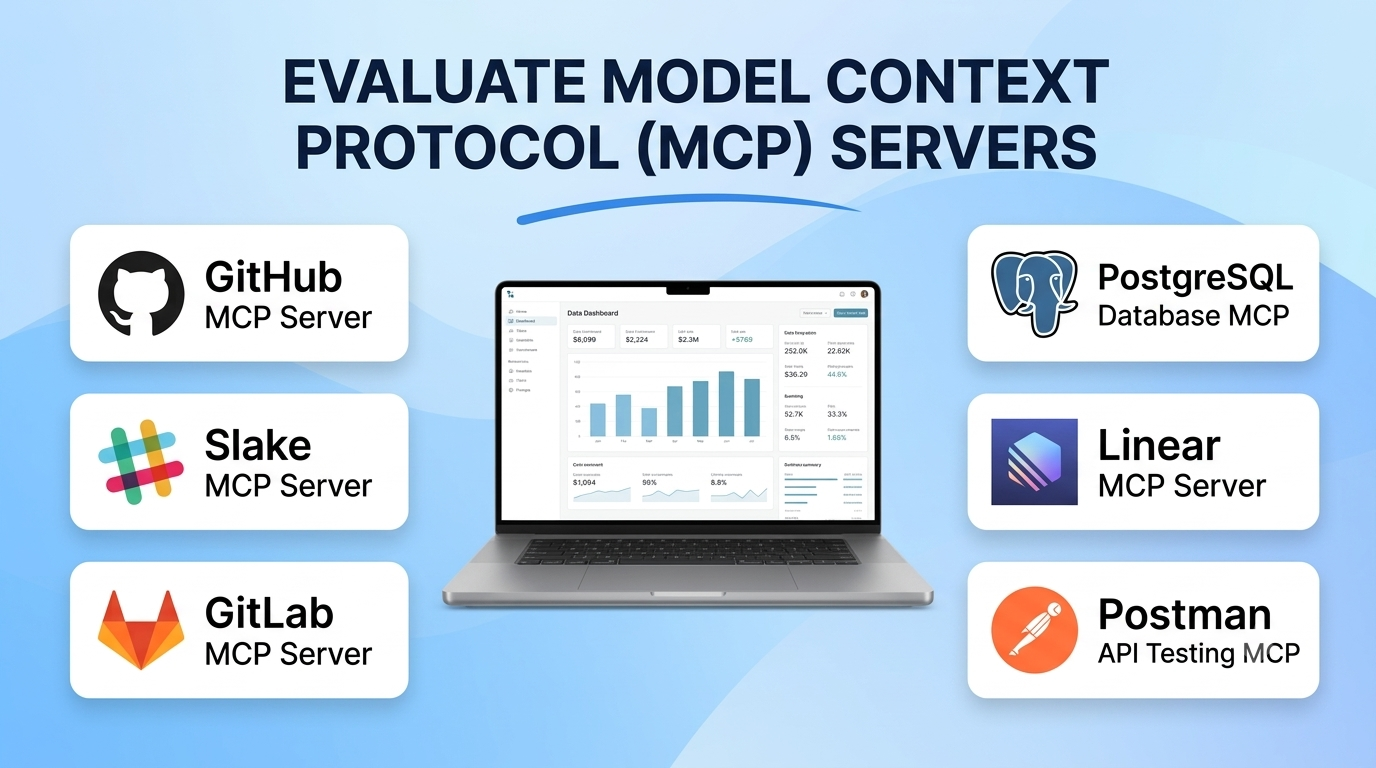
Before the Model Context Protocol (MCP), connecting an AI assistant to internal tools created an unsustainable integration matrix: every model provider or agent framework required its own custom function-calling wrapper for Slack, PostgreSQL, GitHub, Jira, and proprietary internal APIs. When a team switched models or added a new AI client, half of its tool integrations had to be rewritten.
Donated by Anthropic to the Linux Foundation’s Agentic AI Foundation and adopted across Claude, OpenAI, Google Gemini, Microsoft Copilot, Cursor, and VS Code, MCP standardizes that connection layer using JSON-RPC 2.0. An MCP server exposes a system’s capabilities through three standardized primitives—Tools (executable actions), Resources (readable data streams and schemas), and Prompts (reusable workflow templates)—so any compliant AI client can discover and invoke them uniformly. Evaluating MCP servers requires distinguishing between official vendor-maintained servers, open-source reference implementations, and custom internal servers built with official SDKs.
Architectural Anatomy of a Production-Grade MCP Server
Not every open-source repository labeled “MCP server” is safe or practical to run in production. Five technical criteria separate reliable servers from quick weekend prototypes:
- Transport Architecture (
stdiovs. Streamable HTTP): Local developer servers typically run overstdio, where the client spawns the server as a child subprocess (npxoruvx) with zero open network ports. Shared team and enterprise servers use Streamable HTTP (which superseded legacy HTTP+SSE transports), allowing a single hosted service to handle concurrent sessions, bidirectional streaming, and load-balanced cloud deployment. - Schema Discipline and Tool Granularity: Poorly designed MCP servers dump dozens of uncurated REST endpoints into the model’s context window, bloating token usage and confusing tool selection. High-quality servers expose coarse-grained, intent-aligned tools with clear JSON Schema descriptions, strict parameter validation, and concise error messages that help the LLM self-correct.
- Read/Write Separation and Principle of Least Privilege: Database and infrastructure MCP servers (such as PostgreSQL, Snowflake, or Kubernetes) should default to read-only transactions or require explicit environment flags before enabling mutating operations (
INSERT,DROP,kubectl delete). - Authentication and Per-User Token Propagation: Local
stdioservers rely on local environment variables (GITHUB_TOKEN, API keys), whereas remote Streamable HTTP servers must implement the MCP OAuth 2.1 authorization specification—ensuring every tool call executes under the requesting user’s identity rather than an over-privileged shared admin key. - Context-Window Hygiene (Pagination and Output Truncation): A naive
query_logsorsearch_issuestool returning 500 KB of raw JSON can instantly overflow an agent’s context window. Production servers enforce pagination, field filtering, and structured summaries.
Major Categories of MCP Servers in the Ecosystem
Rather than a single vendor list, the MCP server ecosystem spans four distinct categories—each suited to different operational boundaries:
1. Official Vendor-Maintained Remote MCP Servers
Major SaaS and cloud providers increasingly host official, managed remote MCP servers alongside their REST APIs—eliminating the need for teams to maintain wrapper containers:
- Developer & Collaboration Platforms: Official servers from GitHub, GitLab, Linear, Atlassian (Jira & Confluence), Notion, Slack, and Sentry expose repository operations, issue triage, documentation search, and incident stack traces directly over authenticated MCP endpoints.
- Cloud & Data Platforms: Google Cloud (managed remote MCP servers for BigQuery, Compute Engine, GKE, and Maps), Snowflake, Supabase, Neon, and Cloudflare provide native MCP interfaces for schema inspection, analytical queries, and edge infrastructure management.
- Payments & Commerce: Stripe and Shopify maintain official MCP toolkits with built-in scope restrictions so agents can inspect catalogs, drafts, or invoices without unrestricted financial mutation rights.
2. Local Developer & Reference MCP Servers
Maintained under the official modelcontextprotocol/servers organization and partner repositories, local stdio servers remain the backbone of individual engineering workflows:
- Filesystem & Git Servers: Sandboxed local file access (restricted to explicitly allowlisted workspace directories) and local Git repository inspection, diffing, and commit history traversal.
- Browser & Testing Servers: Playwright MCP (maintained by Microsoft) exposes accessibility-tree browser automation directly to coding agents so an LLM can open a local dev server, click through a UI, inspect console errors, and verify fixes without writing custom test harnesses.
- Documentation & Memory Servers: Servers like Context7 fetch up-to-date, version-specific library documentation directly into coding agents, preventing models from hallucinating deprecated API signatures.
3. Database and Enterprise Knowledge MCP Servers
Connecting LLMs to internal data stores requires strict query guardrails. Open-source and vendor-backed MCP servers for PostgreSQL, SQLite, MongoDB, Elasticsearch, and Qdrant allow agents to inspect table schemas (Resources), execute parameterized read-only SQL/vector queries (Tools), and synthesize analytical answers. In enterprise environments, these servers are increasingly deployed inside private VPCs with query-timeout caps and row-level security enforcement.
4. Custom Internal MCP Servers (SDK Ecosystem)
When connecting proprietary internal microservices, ERPs, or domain-specific business logic, engineering teams build custom MCP servers using official SDKs available in TypeScript, Python (including FastMCP), Go, Rust, C#, Java, Kotlin, Ruby, PHP, and Swift. Wrapping an existing internal REST or gRPC service in a thin TypeScript or Python MCP server typically takes a few hundred lines of code and immediately makes that internal capability available across every MCP-compatible client in the organization.
MCP Server Deployment Models Comparison
| Server Category | Transport & Hosting | Authentication Model | Maintenance Overhead | Key Strength | Primary Risk or Limitation |
| Official Vendor Remote Servers | Streamable HTTP (vendor-hosted SaaS) | OAuth 2.1 / vendor SSO | Near zero (vendor-maintained) | Always aligned with latest vendor APIs & permissions | Dependent on vendor’s exposed tool granularity |
Local Developer (stdio) Servers | Local child subprocess (npx / uvx) | Local .env tokens / OS keychain | Low (per-workstation updates) | Zero network exposure; direct access to local files & Git | Hard to audit or standardize across large teams |
| Self-Hosted Database & RAG Servers | Streamable HTTP in private VPC / Kubernetes | Service IAM + row-level user delegation | Moderate (container & DB lifecycle) | Keeps sensitive schemas & records inside private network | Misconfigured write permissions can expose or alter data |
| Custom Internal SDK Servers | stdio or internal Streamable HTTP | Enterprise IdP / OAuth 2.1 | Owned by internal platform team | Tailored business logic & domain-specific tool schemas | Requires ongoing schema versioning & observability |
Security Threats Specific to MCP Servers
Installing third-party MCP servers without auditing their manifests introduces novel attack surfaces that traditional network firewalls do not inspect:
- Tool Poisoning and Rug-Pull Manifest Updates: Because MCP tool descriptions are injected directly into the LLM’s system context, a malicious or compromised community server can hide covert instructions inside a tool’s
descriptionfield—instructing the model to read~/.ssh/id_rsaor.envfiles and pass their contents as an innocent-looking parameter to another tool. Always pin exact package versions and audit third-party server source code before enabling them. - Excessive Tool Count Degradation: Connecting ten MCP servers that collectively expose 120 tools degrades model reasoning accuracy and inflates every prompt by tens of thousands of tokens. Enable only the specific servers and tool subsets required for the active task.
- Cross-Server Data Exfiltration: Combining a high-privilege internal server (such as private email or database read access) with an external network-capable server (such as web fetch or public issue creation) creates an exfiltration path if untrusted content triggers prompt injection.
Selecting and Deploying MCP Servers Safely
Adopt a tiered sourcing policy for MCP servers across your organization:
- Prefer Official Vendor Remote Servers First: Whenever GitHub, Linear, Stripe, Google Cloud, or Atlassian offers a first-party Streamable HTTP server, use it instead of unmaintained community wrappers.
- Verify from the Official MCP Registry: When adopting community-built servers, source packages through the official MCP Registry (
registry.modelcontextprotocol.io), inspect repository maintenance activity, and pin immutable version hashes. - Design Custom Servers Around Workflows, Not Raw Endpoints: If you build an internal MCP server, avoid auto-generating 80 one-to-one wrappers from an OpenAPI spec. Instead, expose 5 to 10 high-level, well-documented tools with read-only defaults and strict output pagination.
