Recording a product defect or audit finding in a spreadsheet is easy; proving to an FDA investigator, ISO 9001 auditor, or Tier-1 customer that you systematically contained the issue, isolated the true root cause rather than blaming “operator error,” implemented permanent system-level changes, and verified months later that the defect never returned is where manual quality tracking collapses.
Corrective and Preventive Action (CAPA) management tools enforce structured, closed-loop problem solving across manufacturing, life sciences, healthcare, and regulated engineering operations. While CAPA engines often live inside broader Enterprise Quality Management Systems (eQMS), organizations also evaluate standalone workflow tools, low-code quality apps, and integrated PLM/QMS modules. Evaluating these platforms requires separating regulated life-sciences CAPA systems, industrial 8D/manufacturing CAPA platforms, and agile low-code quality workflow builders.
Five Core Capabilities That Separate True CAPA Tools From Issue Trackers
Generic project management tools like Jira or Asana can track tasks, but they lack the regulatory state gates and evidence controls required for formal quality compliance:
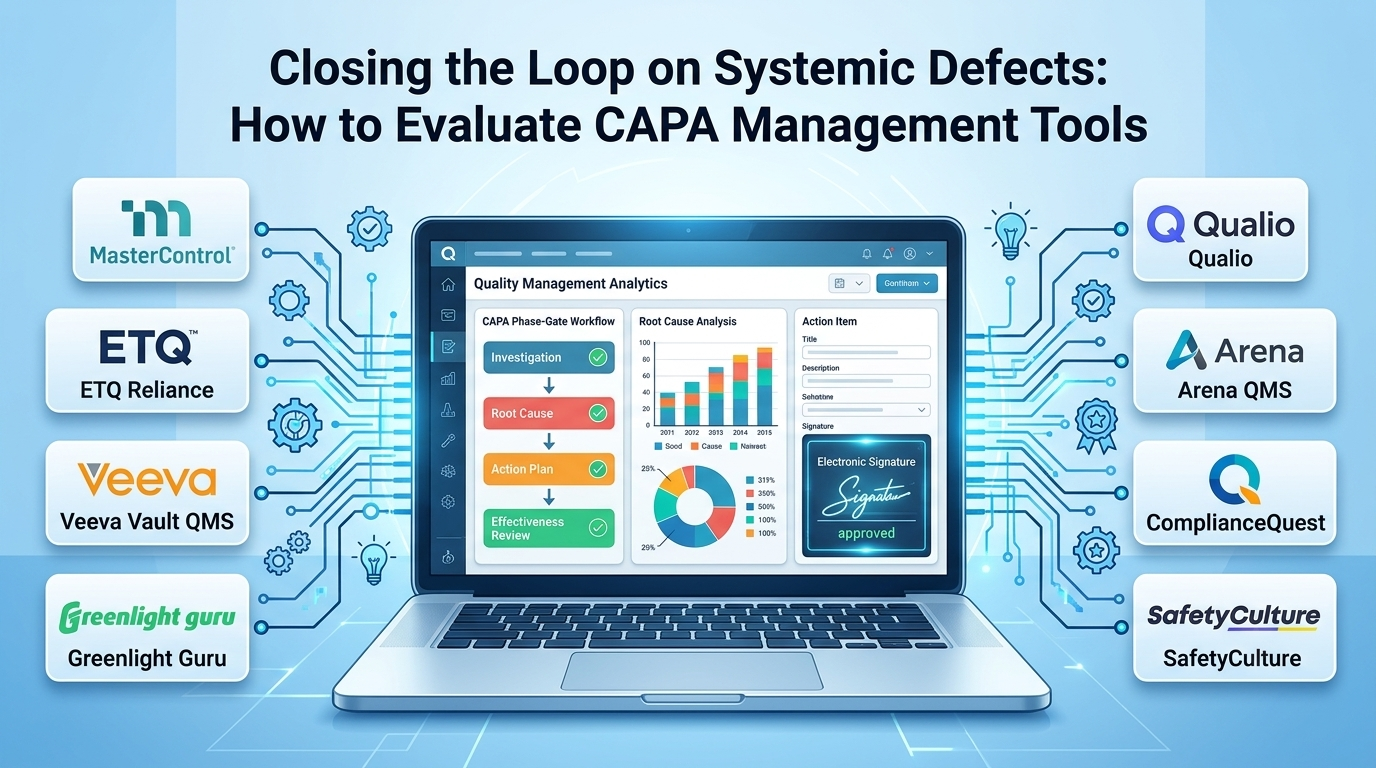
- Enforced Phase-Gate Workflows (Containment → Root Cause → Action → Effectiveness): Preventing teams from prematurely marking a CAPA “Closed” without documented containment verification, approved root-cause investigation, completed action items, and a scheduled post-implementation effectiveness check (such as auditing the next 30 production lots).
- Structured Root-Cause Analysis (RCA) Toolkits: Embedding interactive 5-Whys, Fishbone (Ishikawa) diagrams, Fault Tree Analysis, and 8D problem-solving templates directly inside the CAPA record so investigation logic is auditable rather than buried in attached Word files.
- Risk-Based Triage and Escalation Triggers: Scoring incoming nonconformances, customer complaints, and audit findings by severity, occurrence, and detectability (RPN)—automatically escalating high-risk or recurring trends into formal CAPAs while keeping minor isolated glitches in lightweight triage.
- Closed-Loop Links to Documents, Training, and Engineering Changes: When a CAPA updates a standard operating procedure (SOP) or engineering drawing, the platform must automatically trigger revision control and mandatory operator retraining tasks before the CAPA can close.
- FDA 21 CFR Part 11 / EU Annex 11 Electronic Signatures and Audit Trails: Capturing immutable, time-stamped electronic signatures with reason-for-change logs for every phase approval and due-date extension.
Leading CAPA Management Tools and Platforms
MasterControl CAPA (Quality Excellence)
MasterControl sets the benchmark for regulated pharmaceutical, biologics, and medical device CAPA management. Connecting customer complaints, nonconformances, audit findings, and out-of-specification (OOS) lab results directly into configurable 21 CFR Part 11-compliant CAPA forms, MasterControl automates task routing, links directly to MasterControl Documents and Training for SOP updates, and enforces mandatory effectiveness checks.
Life sciences manufacturers facing strict FDA inspections and complex multi-departmental CAPA approvals rely heavily on MasterControl’s pre-validated workflows. Smaller non-FDA discrete shops may find its validation governance heavier than necessary.
ETQ Reliance CAPA (by Hexagon)
ETQ Reliance delivers a highly configurable, industrial-strength CAPA engine tailored for discrete and process manufacturers across automotive, aerospace, electronics, and chemicals. Supporting structured 8D, 5-Why, and Fishbone investigations alongside automated AI-assisted defect clustering, ETQ links CAPA records directly to Supplier Corrective Action Requests (SCARs), PFMEA risk tables, and production nonconformances across global plant networks.
Multi-site industrial manufacturers needing flexible 8D workflows and tight supplier quality integration favor ETQ Reliance.
Veeva Vault QMS (CAPA Module)
Inside the Veeva Vault ecosystem, CAPA management connects seamlessly with deviations, change controls, QualityDocs, and external Contract Manufacturing Organizations (CMOs). Quality leaders gain real-time dashboards tracking aging CAPAs, overdue action items, and effectiveness-check backlogs across internal sites and external manufacturing partners.
Biopharma and MedTech enterprises collaborating closely with external CMOs or already operating Veeva Vault QualityDocs gain unified cross-organization visibility.
Greenlight Guru and Qualio (Agile MedTech & Life Sciences CAPA)
For growing medical device and life sciences companies outgrowing spreadsheets without wanting multi-year enterprise deployments:
- Greenlight Guru embeds closed-loop CAPA directly into a medical-device-specific quality graph—linking every CAPA to ISO 14971 risk files, Design Controls, complaints, and supplier records out of the box.
- Qualio provides a streamlined, cloud-native CAPA workflow with guided root-cause templates, automated training triggers, and rapid audit readiness for scaling biotech and MedTech teams.
Arena QMS and ComplianceQuest (PLM- and CRM-Connected CAPA)
- PTC Arena QMS connects CAPA workflows directly to Product Lifecycle Management (PLM) Bills of Materials and Engineering Change Orders (ECOs)—ideal for electronics and hardware manufacturers where resolving a systemic defect requires modifying component specs or CAD assemblies.
- ComplianceQuest (built natively on Salesforce) links customer service complaints directly to 8D/5-Why CAPA investigations and supplier corrective actions inside one cloud data model.
SafetyCulture (iAuditor) and Tulip (Frontline Rapid Containment & Corrective Actions)
For operational safety, hospitality, retail, and agile shop-floor environments needing fast mobile defect capture and corrective action assignment rather than heavyweight FDA validation, SafetyCulture (for mobile inspections and instant action assignment) and Tulip (for frontline shop-floor containment apps) provide high-adoption, lightweight execution.
CAPA Management Tools Comparison
| Platform | Primary Problem-Solving Methodology | Cross-Module Closed-Loop Links | Regulatory & Audit Alignment | Deployment & Complexity | Best Fit |
| MasterControl CAPA | Regulated multi-phase CAPA + 5-Why / Fishbone | Documents, Training, Complaints, Audits, Deviations | FDA 21 CFR Part 11, ISO 13485, cGMP | Enterprise Cloud SaaS (pre-validated) | Pharma, biologics & regulated medical manufacturers |
| ETQ Reliance (Hexagon) | 8D, 5-Why, Fishbone & risk-scored CAPA | Nonconformance, SCAR, PFMEA, EHS, Audits | ISO 9001, IATF 16949, AS9100, ISO 14001 | Enterprise Cloud / Hybrid (highly configurable) | Global automotive, aerospace & industrial manufacturers |
| Veeva Vault QMS | GxP deviation-to-CAPA & effectiveness workflows | QualityDocs, Change Control, RIM, CMO portals | FDA 21 CFR Part 11, EU Annex 11, ISO 13485 | Veeva Vault Cloud | Biopharma & MedTech enterprises working with external CMOs |
| Greenlight Guru / Qualio | Guided CAPA with built-in RCA & effectiveness checks | ISO 14971 Risk, Design History Files, Training | ISO 13485, FDA 21 CFR Part 820 / Part 11 | Agile Cloud SaaS | Emerging & mid-market medical device / biotech firms |
| Arena QMS / ComplianceQuest | Hardware ECO-linked CAPA (Arena) / 8D CRM-linked (CQ) | PLM BOMs/ECOs (Arena); CRM Complaints/SCARs (CQ) | ISO 9001, ISO 13485, IATF 16949 | Cloud SaaS (Propel/CQ on Salesforce) | Hardware OEMs (Arena) or Salesforce-centric enterprises (CQ) |
| SafetyCulture / Tulip | Rapid mobile issue capture & corrective task routing | Mobile checklists, IoT sensors & frontline work instructions | General operational & ISO 9001 internal audits | Lightweight Cloud SaaS / Mobile | Frontline operations needing fast adoption over heavy GxP |
Common CAPA Implementation Pitfalls to Avoid
- Treating “Retrain the Operator” as a Valid Root Cause: Auditors immediately flag CAPAs that repeatedly close with “retrained operator on SOP” without addressing ambiguous work instructions, missing poka-yoke fixtures, or poor ergonomic design. Configure root-cause fields to require systemic verification.
- Overloading the CAPA Pipeline With Minor Issues: Routing every trivial scratch or one-off paperwork typo into a full 60-day CAPA creates massive overdue backlogs—which is itself a top FDA audit citation. Use strict risk-scoring criteria so only systemic, recurring, or high-severity events trigger formal CAPAs.
- Closing CAPAs Before Effectiveness Verification: Implementing a fix is not proof that it worked. Enforce a mandatory waiting period (e.g., 30 to 90 days or three consecutive production runs) with documented statistical evidence before final quality sign-off.
Selecting the Right CAPA Management Tool
Choose your CAPA platform based on where defects originate and which regulatory standard governs your audits:
- For FDA-Regulated Life Sciences and Medical Devices: Select MasterControl or Veeva Vault QMS at enterprise scale, or Greenlight Guru / Qualio for agile MedTech teams.
- For Multi-Plant Industrial, Automotive, or Aerospace Manufacturing: Standardize on ETQ Reliance for configurable 8D workflows and supplier corrective actions.
- For Hardware and Electronics Manufacturers: Choose PTC Arena QMS so CAPA actions drive Engineering Change Orders directly on the Bill of Materials.
